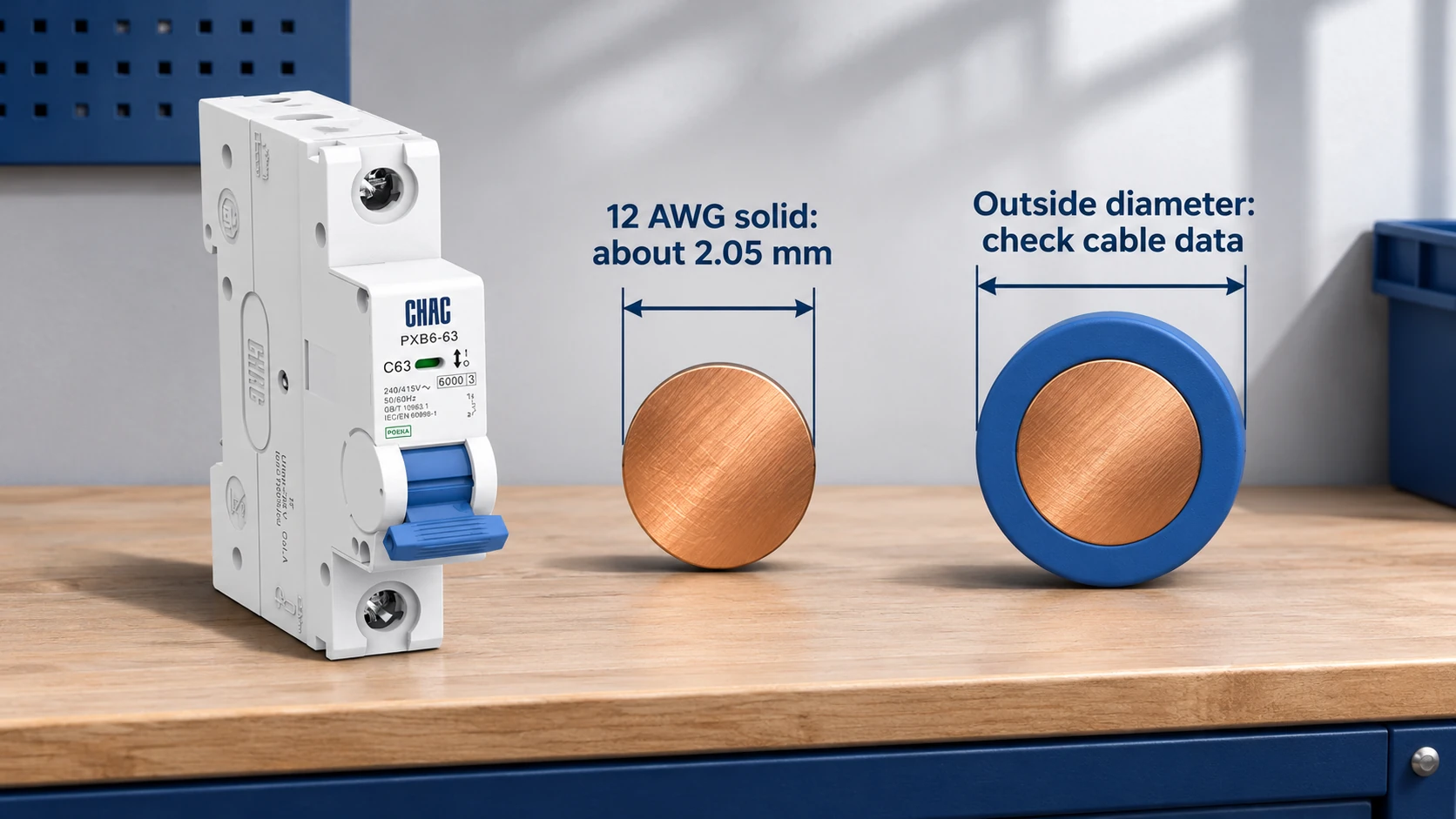
A buyer specifies a cable entry using the 2.05 mm dimension found beside 12 AWG in a conversion chart. The delivered insulated wire is thicker and does not fit the planned opening. In this illustrative example, the chart was not wrong: the buyer used bare-conductor diameter where overall wire diameter was needed.
Zusammenfassung: Der Nominal 12 gauge wire diameter is approximately 2.052 mm, or 0.0808 inch, for a solid bare AWG conductor. Its metallic cross-sectional area is approximately 3.31 mm². Neither number gives the outside diameter of insulated wire or a complete cable; those dimensions come from the selected manufacturer’s data.
What does the 2.052 mm diameter of 12 AWG wire actually measure?
American Wire Gauge describes conductor size. In the familiar solid-wire form, each gauge corresponds to a nominal bare diameter. The AWG sequence runs in the opposite direction from an intuitive size ranking: 10 AWG is larger than 12 AWG, and 14 AWG is smaller.
When someone asks how thick 12 gauge wire is, clarify what will be measured. They may mean the bare metal, the insulated single conductor or a jacketed cable containing several conductors. These are different dimensions, even when the label 12 AWG appears on all three products.
For a solid circular conductor, area is calculated as A = πd²/4. Using approximately 2.052 mm gives about 3.31 mm². Diameter is a length; area is a surface measure. A statement such as 12 AWG equals 3.31 mm is therefore incomplete and can lead to an incorrect terminal or entry specification.
| AWG size | Nominal solid bare diameter | Approximate diameter in inches | Metallic area |
|---|---|---|---|
| 10 AWG | 2.588 mm | 0.1019 inch | 5.26 mm² |
| 12 AWG | 2.052 mm | 0.0808 inch | 3.31 mm² |
| 14 AWG | 1.628 mm | 0.0641 inch | 2.08 mm² |
These rounded reference values are consistent with published AWG tables such as PowerStream’s wire-size reference. They are useful for comparison, but are not a finished cable’s manufacturing tolerance. A procurement drawing should state the applicable wire construction and its approved dimensional limits.
Do not automatically substitute a nominal metric conductor size for 12 AWG. A 2.5 mm² conductor has less metallic area, while a 4 mm² conductor has more. Whether either is acceptable depends on electrical sizing, terminal approval and the project specification, not simply which number looks closest.
Why stranded 12 AWG wire needs a separate terminal-fit check
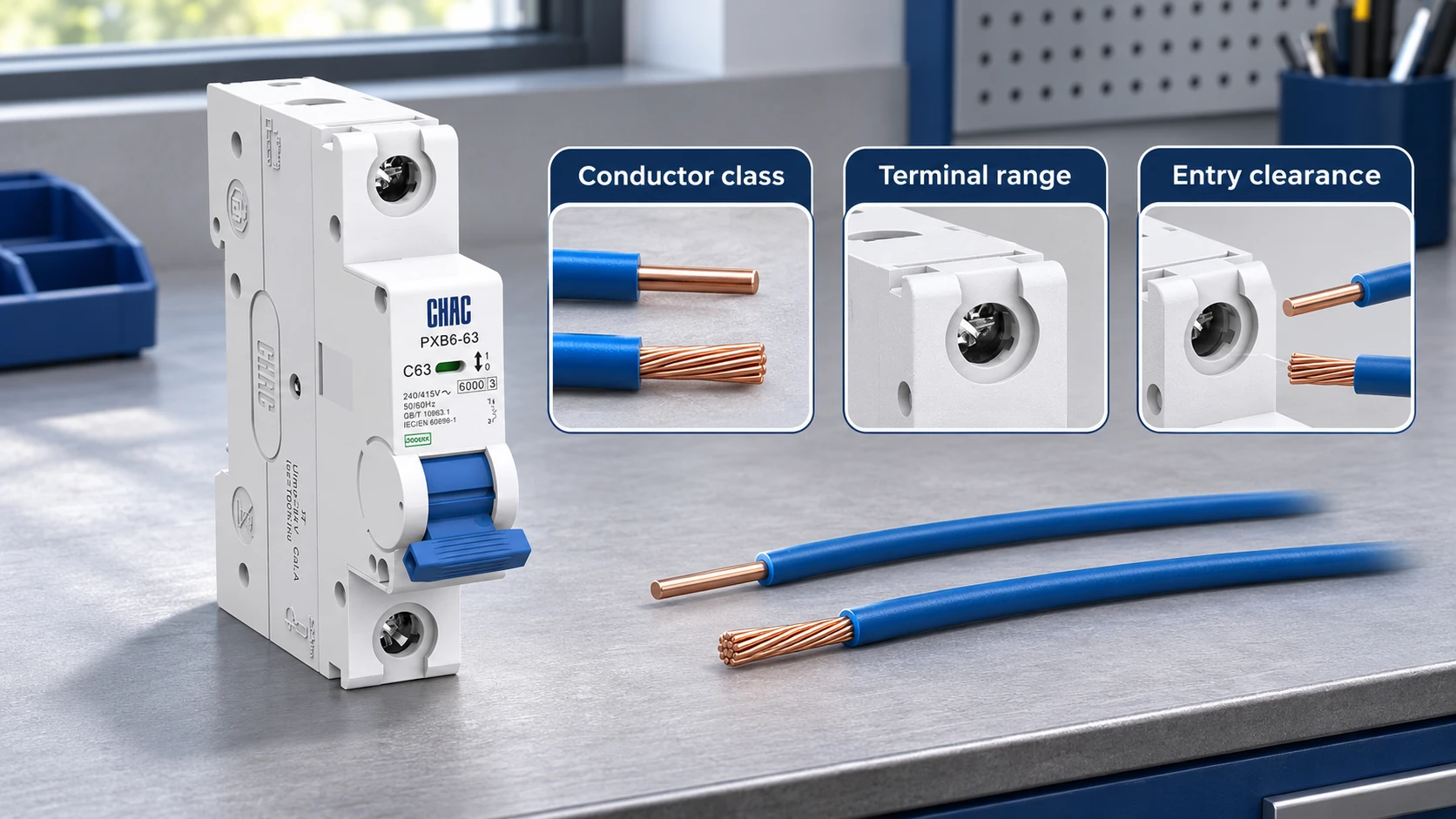
Stranded conductor diameter depends on the strand arrangement and construction. The strands occupy an envelope that includes spaces between them unless compacted. Two 12 AWG conductors can therefore have comparable metallic area but different bare outside diameters, flexibility and termination requirements.
Do not measure one small strand and treat its diameter as that of the complete conductor. Conversely, measuring the outside of a stranded bundle does not directly establish metallic area using the solid-circle formula. Strand count, individual strand dimensions and compaction must be considered.
For terminal selection, use the device’s declared conductor range and permitted conductor types. A terminal that accepts a particular AWG range may have different instructions for solid, stranded and fine-stranded wire. Ferrules, if permitted or required, change the termination arrangement and must be selected accordingly.
Check strip length and tightening instructions separately. A conductor that physically enters the opening can still be incorrectly terminated if insulation sits in the clamping area or exposed copper extends too far. The connection should follow the exact device instructions rather than a general wire-diameter chart.
Why 12 AWG THHN outside diameter depends on the selected product
THHN identifies a wire insulation and application designation; it does not prescribe one universal outside diameter for every 12 AWG product. Insulation construction, the outer covering and conductor construction affect the finished dimension. Solid and stranded versions should be checked independently.
A typical-data column on a manufacturer’s sheet may provide nominal outside diameter. If the design has limited clearance, also obtain the applicable tolerance or maximum dimension. A nominal value without tolerance may be adequate for identification but insufficient for a close-fitting gland or molded passage.
This guide intentionally does not assign a universal THHN outside diameter. Use the current data sheet for the exact manufacturer, catalog number and construction being ordered. That avoids treating one brand’s dimension as a standard that all other brands must follow.
| Dimension oder Eigenschaft | Where to obtain it | What it helps determine |
|---|---|---|
| Nominal AWG bare size | Recognized wire-size reference | Basic conductor-size comparison |
| Stranded bundle diameter | Selected wire construction data | Termination and processing considerations |
| Insulated wire outside diameter | Manufacturer’s exact product data sheet | Routing and physical clearance |
| Complete cable outside diameter | Cable assembly data sheet | Gland selection and entry sizing |
| Terminal acceptance range | Device instructions and markings | Permitted conductor and termination arrangement |
| Allowable current | Applicable installation rules and conditions | Electrical sizing, independently of simple physical fit |
A multi-core 12 AWG cable adds insulated cores, possible fillers and an overall jacket. Its diameter cannot be calculated by adding bare diameters in a straight line. The cable layout, jacket thickness and construction determine the finished envelope, including whether it is round or another shape.
Measure wire diameter and verify electrical suitability separately
A caliper can help identify a sample’s dimensions, but measurement does not prove its gauge, material or certification. For bare solid wire, measure without deforming the conductor. For insulation or flexible cable, avoid excessive pressure that compresses the material and produces a misleadingly small result.
Record what was measured: bare metal, insulated wire or overall cable. Include the instrument resolution and several readings where dimensional variation matters. Compare those measurements with the ordered construction and supplier data rather than with a photograph of another cable.
Electrical sizing remains a separate task. Installation method, conductor material, temperature limits, grouping and termination ratings influence permissible current. A statement that 12 AWG is commonly used on a particular circuit rating is not enough to approve every installation using that gauge.
ASTM B258 is a relevant reference for standard nominal diameters and areas of AWG solid round wire. Installation rules such as the adopted NEC address different questions, including circuit application and allowable current. Neither a dimensional reference nor an online conversion table is a substitute for the project’s applicable installation requirements.
Specify conductor construction and terminal requirements before ordering
Specify conductor material, AWG size, solid or stranded construction, insulation designation, required approvals and color identification. Add outside-diameter limits where routing or sealing depends on them. For a multi-core cable, identify the number of cores and overall construction rather than writing only 12 gauge cable.
CHACs PXB6-63 Miniatur-Leistungsschalter is a relevant example of equipment whose terminal requirements must be checked against the selected wire. This article does not establish that every 12 AWG construction or ferrule arrangement is accepted by every variant.
Verwenden Sie die cable sizing calculator for a preliminary electrical calculation where its assumptions match the application. Then verify the result against installation rules and actual terminal data. Keep the physical fit check and the current-carrying check as separate sign-off items.
For repeat purchasing, retain an approved sample and the corresponding data-sheet revision. A supplier change that preserves gauge but changes strand construction or insulated diameter may affect assembly tooling. Reviewing that change before the next production batch is easier than reworking finished panels.
Common questions about 12 AWG wire and cable dimensions
What is the diameter of 12 AWG wire in millimeters and inches?
A nominal solid bare 12 AWG conductor is approximately 2.052 mm or 0.0808 inch in diameter. These figures exclude insulation. Stranded and insulated outside diameters require the selected product’s data.
Are 12 gauge wire and 12 AWG wire the same size?
They mean the same nominal size when gauge explicitly refers to American Wire Gauge. Other gauge systems exist, so confirm AWG in an international purchase specification. The phrase 12 gauge alone can be ambiguous.
What is the cross-sectional area of 12 AWG wire in mm²?
It is approximately 3.31 mm² of conductor area. That is not a diameter or the area of an entire insulated cable. Keep the square-millimeter unit when converting the specification.
Does the 12 AWG diameter include the insulation?
No. The standard solid-wire diameter describes bare conductor size. Insulation and outer coverings add to the finished outside diameter.
What is the outside diameter of 12 AWG THHN wire?
It depends on the exact manufacturer and construction, including whether the conductor is solid or stranded. Use the current catalog dimension and tolerance for the ordered product. There is no single outside diameter that should be assigned to every 12 AWG THHN wire.
Do solid and stranded 12 AWG wires have the same outside diameter?
Not necessarily. Stranding and compaction affect the bare bundle envelope, and insulation construction affects the finished wire. Confirm terminal suitability for the specific conductor type.
How does 12 AWG diameter compare with 10 AWG and 14 AWG?
For solid bare conductors, 10 AWG is about 2.588 mm, 12 AWG about 2.052 mm and 14 AWG about 1.628 mm. Lower AWG numbers indicate larger conductors within this range. These values do not describe insulated cable diameters.
Verweise
- PowerStream: AWG diameter and area reference
- Engineering ToolBox: American Wire Gauge dimensions
- NFPA 70: Installationsvorschriften-Ausgabe-Informationen
A clear size specification names the metal, insulation and termination separately. Contact CHAC about breaker terminal requirements with the exact conductor construction and intended application.