

Two circuit breakers can carry the same ampere rating and still be unsuitable substitutes. The difference may lie in their fault-interruption duty, trip settings, terminals or approval for the distribution assembly. Understanding what MCCB and MCB mean is useful only if it leads to those checks.
MCB means miniature circuit breaker; MCCB means molded-case circuit breaker. Both provide overcurrent protection, but their available constructions, ratings and trip options differ. MCBs commonly serve final circuits, while MCCBs commonly serve feeders and larger distribution loads. The current ranges overlap. Select from the circuit’s voltage, prospective fault current, conductor requirements and coordination needs rather than applying a universal ampere cutoff.
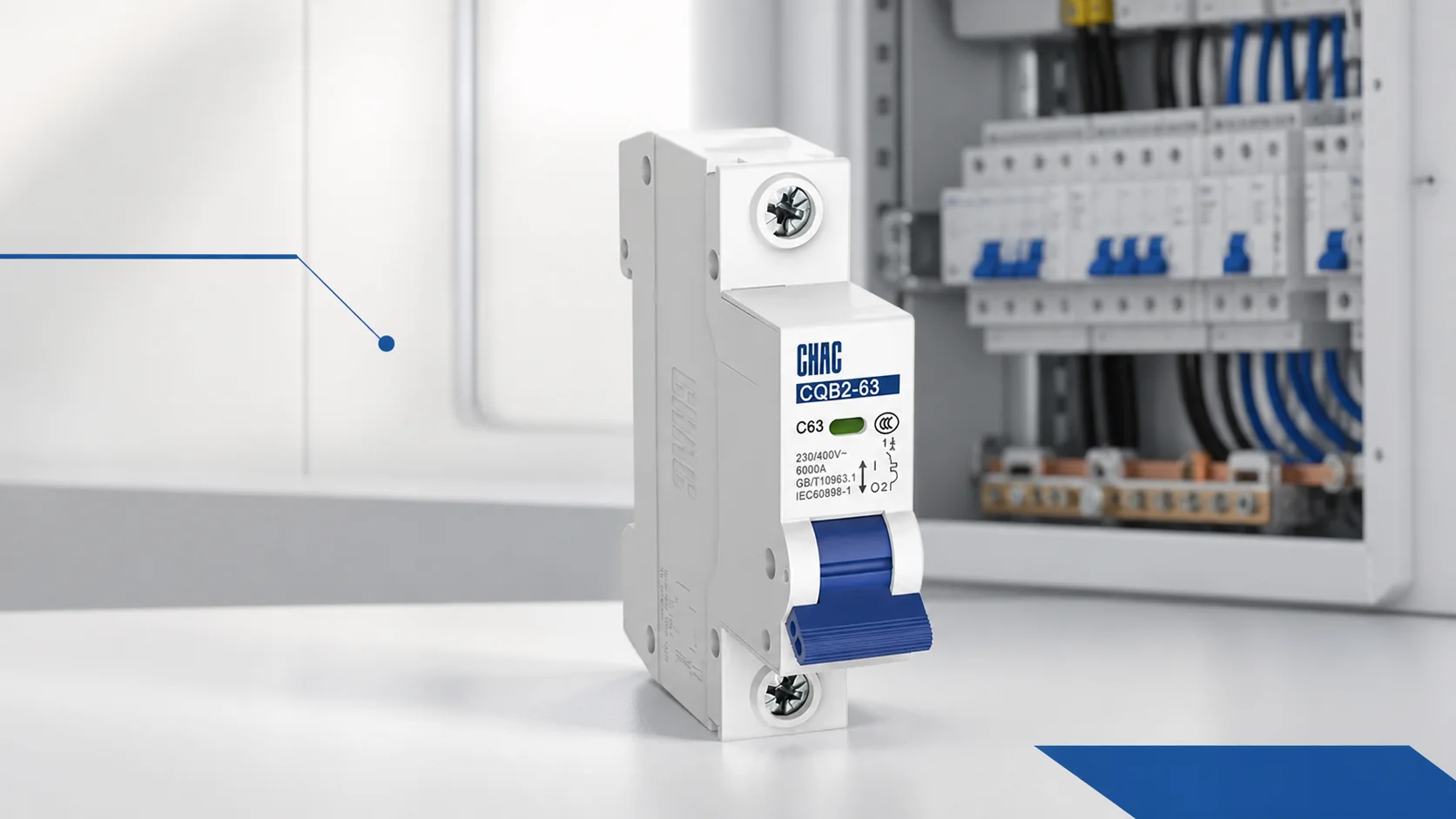
What does an MCB do?
A Leitungsschutzschalter interrupts a circuit under specified overload and short-circuit conditions. Common thermal-magnetic models have a fixed trip characteristic and a compact mounting format. The device must carry normal load and permissible starting current while protecting the circuit within its declared performance limits.
Der offizielle IEC 60898-1:2015+A1:2019 abstract covers AC breakers for household and similar installations within stated limits: up to 440 V between phases, 125 A rated current and 25,000 A rated short-circuit capacity. These are the standard’s scope limits, not ratings that every MCB possesses. Some compact breakers also carry declarations under IEC 60947-2, so appearance alone cannot identify the applicable rating basis.
What does an MCCB add?
A molded-case circuit breaker houses its switching mechanism and trip system in an insulating case. Depending on the model, it may offer fixed thermal-magnetic protection, adjustable settings or an electronic trip unit. Accessories can include status contacts, remote-trip releases and operators, but none should be assumed from the family name.
IEC 60947-2:2024 covers low-voltage circuit breakers intended for installation and operation by instructed or skilled persons. The official scope is broader than a simple “large breaker” definition. Product documentation must establish which functions and ratings apply to the exact frame and trip unit.
How do MCBs and MCCBs compare in a selection review?
| Question | MCB selection | MCCB selection |
|---|---|---|
| What circuit is being protected? | Often final circuits and compact distribution ways. | Often feeders, incomers and larger equipment circuits. |
| Can the trip characteristic be changed? | Commonly fixed; select the documented curve. | Fixed or adjustable, depending on the trip unit. |
| What short-circuit rating applies? | Read the stated standard, voltage and Icn or other declared rating. | Read the voltage-specific Icu/Ics or applicable market rating. |
| Will it fit the assembly? | Check busbar, rail, terminals, enclosure and approved device types. | Check frame, mounting, lugs, barriers and accessory space. |
| Will the downstream device trip first? | Use coordination evidence for the exact pair. | Settings may help, but selectivity still needs verification. |
This is a comparison of selection considerations, reviewed on 16 October 2026, rather than a ranking of manufacturers. Product families have exceptions; no universal performance or price advantage follows from the acronym.
Why are Icn, Icu and Ics not interchangeable?
Icn is the rated short-circuit capacity used under IEC 60898-1. IEC 60947-2 uses Icu for rated ultimate short-circuit breaking capacity and Ics for rated service short-circuit breaking capacity. These ratings refer to defined test duties. A larger number printed under one standard should not be substituted for the rating required under another.
A useful comparison records the number, voltage, AC or DC duty and standard together. For example, a product’s rating at one operational voltage does not establish the same capacity at a higher voltage. A dual-rated breaker may legitimately display different values under different standards. The designer must use the value relevant to the project requirement.
Fault interruption is also separate from normal load current. A 63 A breaker can still be unsuitable at an installation point with a fault level beyond its declared capacity. The 6 kA versus 10 kA breaking-capacity guide develops that distinction.
Does an adjustable MCCB automatically improve selectivity?
No. Adjustable long-time, short-time or instantaneous settings can provide more design flexibility, but the actual functions depend on the trip unit. Raising an instantaneous setting to ride through inrush can also affect fault-clearing performance. Settings have to be checked against conductor protection, equipment withstand and the coordination study.
Two breakers with different ampere ratings are not automatically selective throughout the fault-current range. Manufacturer tables may state selectivity only up to a specific current. Likewise, an approved backup or cascading combination does not necessarily provide selectivity: an upstream breaker may also open while helping the downstream device interrupt the fault.
Der thermal-magnetic versus electronic MCCB comparison helps separate trip-unit capabilities from the frame’s current and short-circuit ratings.
Can an MCB replace an MCCB with the same ampere rating?
Only after a full substitution review. Compare operational voltage, fault rating, trip curve or settings, pole and neutral arrangement, conductor termination, environmental limits, mounting and the assembly’s approved configurations. For motor or transformer circuits, starting behavior also matters.
Another often-missed distinction is component versus assembly rating. The UL Solutions marking and application guide explains that a breaker with a higher interrupting rating does not raise an end-use assembly’s lower marked short-circuit rating. Physical fit and an impressive component rating cannot approve a panel substitution.
Which product details should be confirmed before purchase?
- Record the actual system voltage, frequency, earthing arrangement and AC/DC duty.
- Establish design load, conductor capacity and prospective short-circuit current.
- Choose the required trip behavior, poles and accessory functions.
- Verify the installation drawing, terminal data and assembly compatibility.
- Retain the model-specific ratings, applicable certificates and coordination evidence.
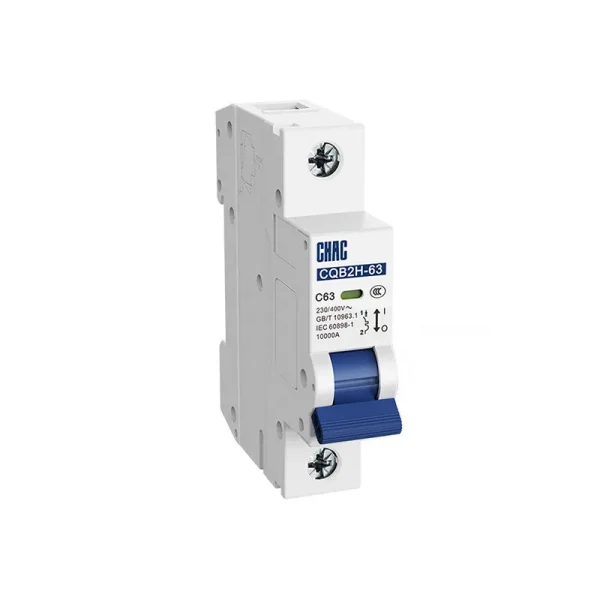
For CHAC product comparisons, the CQB2H-63 MCB page und MCCB-Programm are separate starting points. The exact configured model, rather than a general family description, should appear on the approved schedule.
What else should buyers know about MCBs and MCCBs?
What are the full forms of MCB and MCCB?
MCB means miniature circuit breaker. MCCB means molded-case circuit breaker. Both names describe device families, not a complete set of ratings or approvals.
Is an MCCB always adjustable?
No. MCCBs may have fixed thermal-magnetic trips or adjustable thermal-magnetic or electronic trips. Check the exact trip-unit model and available settings.
Is there a universal current rating where an MCB becomes an MCCB?
No. Commercial ranges overlap. The product construction, declared standard, ratings and application determine suitability rather than a single ampere boundary.
Can an MCB or MCCB provide leakage protection?
Only when the required residual-current function is explicitly included or provided through an approved arrangement. Ordinary overcurrent protection is not automatically personnel leakage protection.
Can an AC-rated breaker be used on DC?
Only if the exact device has an appropriate declared DC rating and the specified pole, polarity and wiring arrangement is followed. AC ratings must not be transferred to a DC application.
Does a higher breaking capacity prevent overload trips?
No. Breaking capacity concerns fault interruption. Overload behavior depends on the trip characteristic or setting, load current and operating conditions.
Verweise
- IEC 60898-1:2015+AMD1:2019 CSV: AC circuit breakers for household and similar installations — official consolidated publication and scope.
- IEC 60947-2:2024: low-voltage circuit breakers — official sixth-edition publication and scope.
- UL Solutions: Molded Case Circuit Breaker – Marking and Application Guide — voltage, interruption, terminals and assembly-rating limitations.
How should the final breaker family be selected?
The useful difference between MCB and MCCB is the set of documented options each can offer for the circuit. Begin with the load, conductors and available fault current, then establish the trip behavior and installation constraints. Compare voltage-specific short-circuit ratings under the correct standard, and verify the complete assembly before approving a replacement. Neither extra ampere capacity nor additional trip settings can make up for missing compatibility or coordination evidence. CHAC can support the product-document review for the selected family, but the project’s protection study remains the basis for circuit breaker selection. An approved model and recorded settings are more valuable than choosing a device simply because its acronym sounds more suitable.


