Interruptor automático magnetotérmico modular con protección contra sobreintensidad y corriente de fuga a tierra and RCCB selection is a protection-boundary decision. An RCBO combines residual-current and overcurrent protection in one documented device arrangement. An RCCB provides residual-current protection, while suitable overcurrent protection must be provided elsewhere. The right choice depends on how the single-line diagram divides circuits and neutral returns.
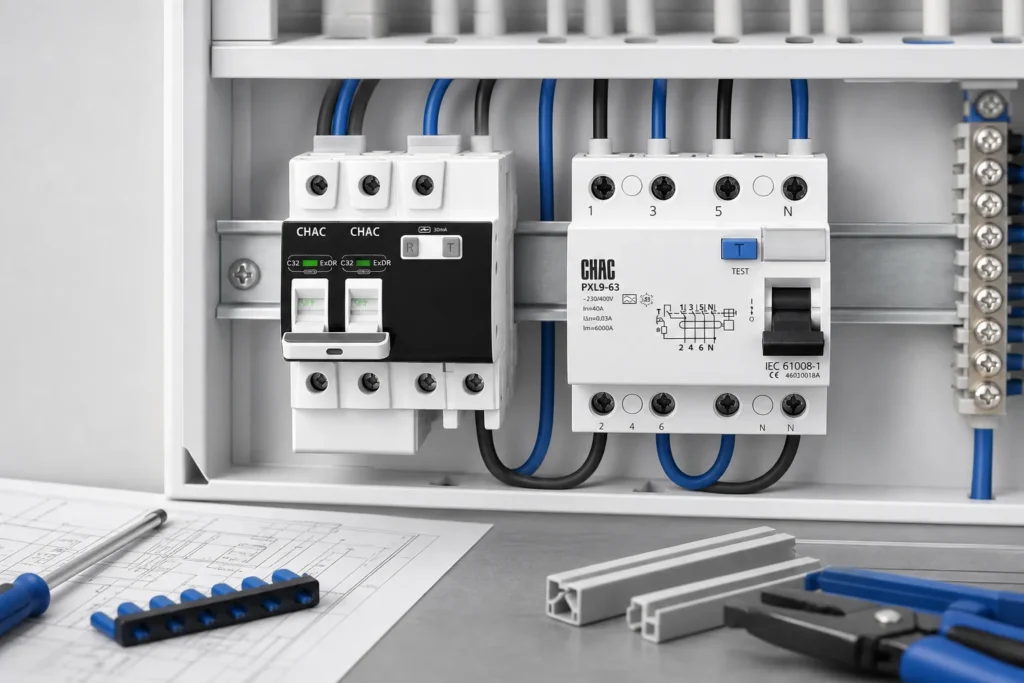
Map the two protection functions before comparing devices
Mark where overload and short-protección de circuitos are provided, which circuits share residual-current protection, and how each neutral returns. The RCBO product route and an RCCB route should be compared only after those functions are visible on the drawing.
What is the functional difference between an RCBO and an RCCB?
An RCBO can isolate a single outgoing circuit for both residual-current and overcurrent events when the model is designed for that duty. An RCCB can protect a group against residual current, but downstream MCBs or another verified overcurrent arrangement are still required.
Which circuit inputs expose the real duty split?
Record load type, rated current, neutral arrangement, residual-current type, prospective fault current, selectivity needs and the consequence of one device disconnecting several circuits. Electronic loads and variable-speed equipment may change the required residual-current waveform type.
How should the drawing keep the functions separate?
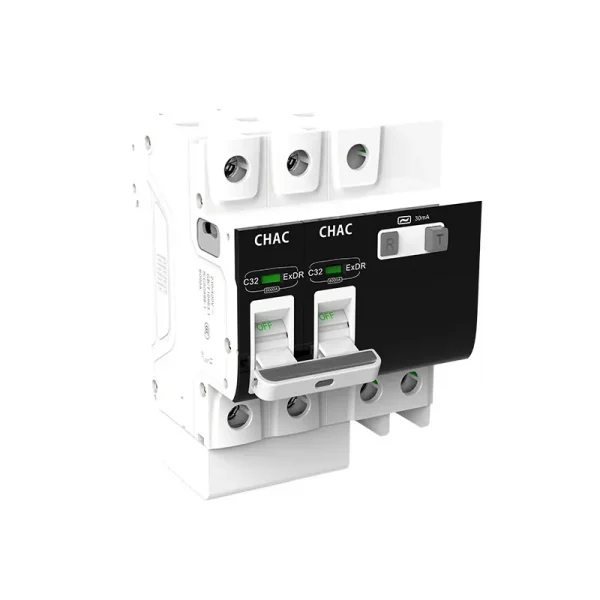
Show the overcurrent device, residual-current device, neutral bar and downstream circuit boundaries explicitly. Do not mix neutrals between independently protected RCBO circuits, and do not assume that an RCCB adds overcurrent protection.

When can individual RCBOs improve circuit subdivision?
Individual RCBOs may be useful when the design wants one circuit’s residual-current event to avoid interrupting unrelated circuits. A grouped RCCB-plus-MCB arrangement may still be suitable when the project accepts group interruption and the coordination is documented.
What should a comparison request contain?
List the device function, rated current, poles and neutral treatment, residual-current type and sensitivity, breaking capacity, installation format, selectivity requirements and the evidence required for the target market. Keep sensitivity selection separate from the basic RCBO-versus-RCCB boundary.
Which CHAC pages can support the shortlist?
Compare the CQB3LE-63 electronic RCBO with the PXL9-63 leakage breaker only after confirming each model’s documented function and configuration.
¿Quién es el propietario del límite de protección final?
The responsible project designer owns the final choice. Use IEC 61008-1 y IEC 61009-1 as standards references, then verify the exact model, neutral routing, type and local installation requirements.
The schedule should name the required Protección contra corrientes residuales function and its neutral arrangement so that a supplier cannot replace an RCBO with an RCCB without exposing the missing overcurrent duty.
Preguntas frecuentes
¿Es un RCBO simplemente un interruptor diferencial con un nombre diferente?
No. Un IDMC se revisa cuando las funciones de corriente residual y de sobrecorriente están previstas en una disposición de dispositivo documentada.
¿Puede un ID (interruptor diferencial) reemplazar a un PIA/ID (interruptor magnetotérmico con diferencial) sin rediseñar el circuito?
Solo si el diseño aprobado aún proporciona la capacidad de sobrecorriente faltante en otra parte y los modelos seleccionados admiten esa disposición.
¿Qué campos de dibujo importan más en la comparación?
Capacidad de corriente residual, capacidad de sobrecorriente, disposición de polos/neutro y circuitos secundarios compartidos.
¿Qué deben confirmar los proveedores por escrito?
Identificación exacta del modelo más los documentos que respaldan únicamente las obligaciones solicitadas en la solicitud de cotización (RFQ).
¿En qué se diferencia esto de una guía de selección de sensibilidad?
La sensibilidad es una cuestión de configuración de corriente residual separada; este artículo se centra en las funciones de los dispositivos combinados frente a los separados.
¿Quién es el propietario del límite de protección final?
El diseñador eléctrico responsable del proyecto es el propietario del mismo utilizando los planos aprobados y la evidencia del modelo seleccionado.