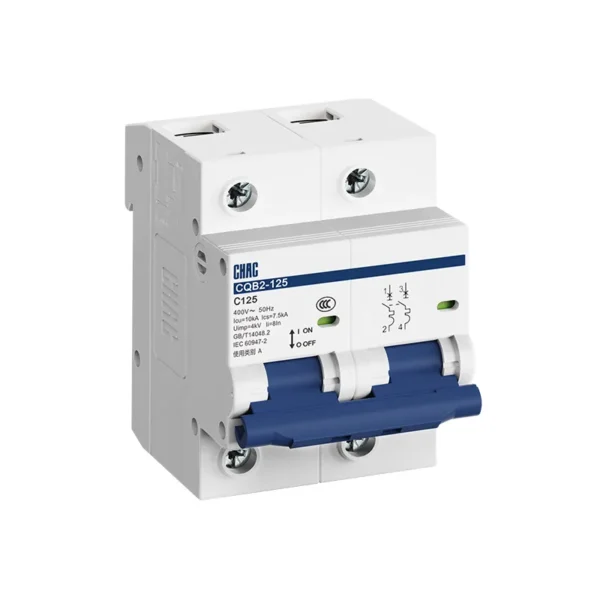
CQB2-125 Miniature Circuit Breaker
The CQB2-125 miniature circuit breaker is designed for overload and short-circuit protection in higher-current AC distribution circuits. It is available in 63A, 80A, 100A and 125A ratings, with C or D tripping curves and 1P, 2P, 3P or 4P configurations. The series has a 10kA ultimate short-circuit breaking capacity and is specified to IEC 60947-2. Select the configuration according to the circuit design, prospective fault current, conductor requirements and destination market.
Product Overview
The CQB2-125 is a high-current AC miniature circuit breaker for commercial, light-industrial and infrastructure distribution circuits that require overload and short-circuit protection. It is available in 63A, 80A, 100A and 125A ratings, with C or D tripping curves and 1P, 2P, 3P or 4P configurations. The series provides 10kA Icu and 7.5kA Ics short-circuit ratings and is designed to IEC 60947-2 and GB/T 14048.2.
Selection should be based on design current, conductor capacity, pole arrangement, load inrush, prospective short-circuit current and the requirements of the destination market. The CQB2-125 is an AC product and should not be treated as a substitute for a DC-rated breaker, an RCBO with residual-current protection or an MCCB required for adjustable protection and higher fault duties.
Key Features
Typical Applications
The CQB2-125 can be evaluated for feeder and higher-current branch protection in commercial switchboards, high-rise building distribution, light-industrial panels and infrastructure equipment. It is suitable only when the selected current, curve, pole configuration and short-circuit ratings match the circuit study. For circuits at 63A and below, compare the CQB2-63; where adjustable settings or a higher interruption duty are required, review the MCCB range.
Applications and Selection Guide
| Selection item | How to evaluate it | CQB2-125 options |
|---|---|---|
| Rated current | Confirm design current, conductor capacity, installation method, ambient temperature, grouping and coordination. Do not select 125A simply because it is the highest available rating. | 63A, 80A, 100A, 125A |
| Tripping curve | Compare normal operating current, starting or inrush current and the fault-current level needed for timely magnetic operation. | C or D |
| Number of poles | Match the supply system and determine which live conductors must be switched and protected together under the project rules. | 1P, 2P, 3P, 4P |
| Short-circuit duty | Verify that the prospective short-circuit current and protection coordination are within the device ratings at the installation point. | Icu 10kA; Ics 7.5kA |
| Standard and documents | Check the product standard, destination-market rules and the exact documents required by the customer or approval body. | IEC 60947-2; GB/T 14048.2; CCC confirmed |
Compare current range, breaking capacity, tripping curves, pole configurations and protection functions before selecting a CQB2-125 miniature circuit breaker.
6kA vs 10kA MCB
Select breaking capacity according to the prospective short-circuit current at the installation point, not only the rated current of the circuit.
C Curve vs D Curve
Select the tripping curve according to the load’s inrush characteristics and the available fault current, not by current rating alone.
1P vs 2P vs 3P vs 4P
Choose the pole configuration from the supply arrangement and required common switching or isolation—not from panel space alone.
MCB vs RCBO
An MCB protects against overload and short circuit, while an RCBO also provides residual-current protection.
Need Help Selecting a CQB2-125 Configuration?
Share the rated current, pole configuration, tripping curve, system voltage, available fault-current information and quantity. CHAC will review the requested configuration and applicable documents.
CQB2-125 Ordering Guide
| Required information | Buyer selection |
|---|---|
| Product series | CQB2-125 |
| Rated current | 63A / 80A / 100A / 125A |
| Number of poles | 1P / 2P / 3P / 4P |
| Tripping curve | C / D |
| Project details | System voltage, application and available fault-current information |
| Commercial details | Quantity, destination market, marking, packaging and required documents |
Installation Details to Confirm
How to Choose Between C and D Curves
C and D curves respond differently to short-duration inrush current. C curve is commonly evaluated for general distribution loads with moderate inrush, while D curve may be considered for equipment with higher starting current. These are selection tendencies, not universal assignments. Confirm that the chosen curve tolerates normal starting current while still providing the required fault protection and disconnection time.
How to Choose the Pole Configuration
Select 1P, 2P, 3P or 4P from the actual supply and isolation requirements. The design must identify which conductors require protection and common switching. Neutral treatment, earthing arrangement and local rules vary, so the pole configuration should be confirmed against the project drawings rather than selected from enclosure space alone.
When a 10kA MCB Is Required
The 10kA Icu value describes the rated ultimate short-circuit breaking capacity, not the normal load current. Use CQB2-125 only when the prospective short-circuit current, Ics requirement and protection coordination are within its published ratings. Where the required duty exceeds these values, select a suitably rated protective device or a verified coordinated solution.
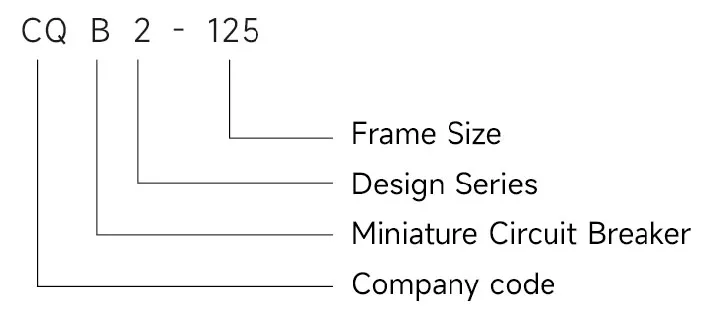
CQB2-125 Type Designation
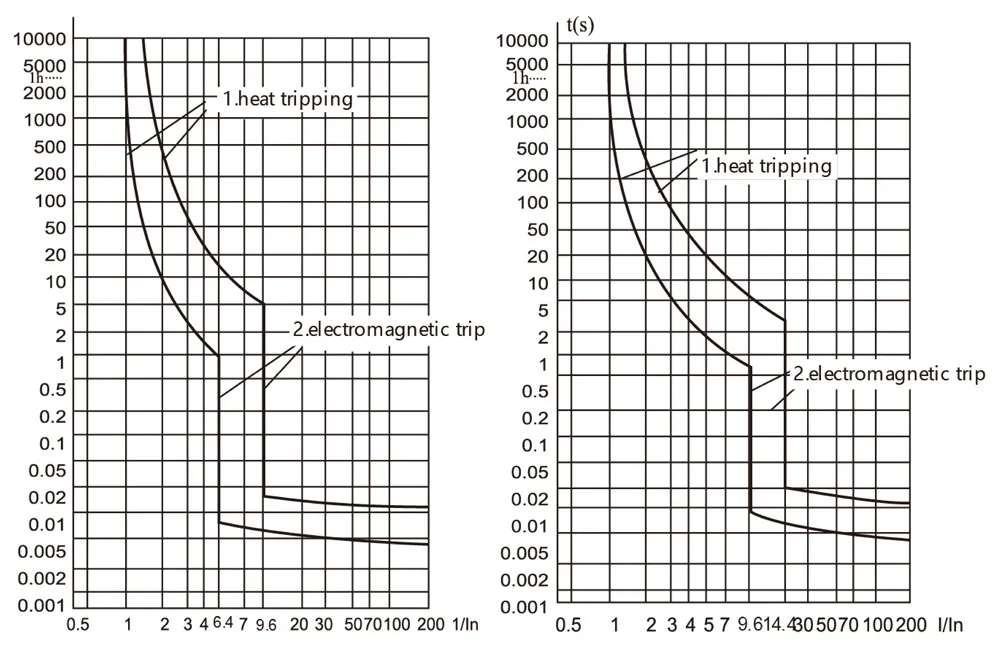
CQB2-125 C and D Tripping Curves
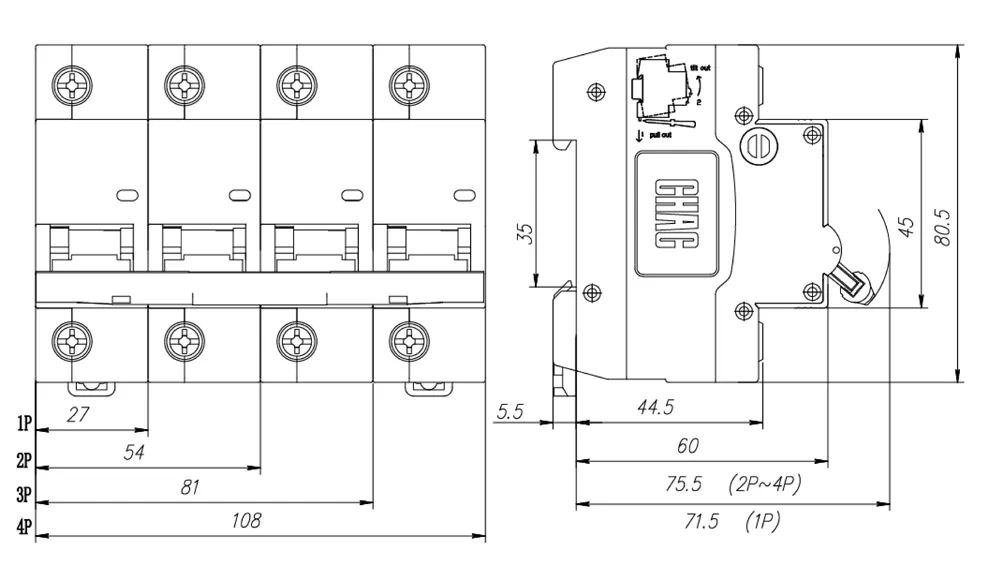
CQB2-125 Dimensions (mm)
Technical Specifications
Use the table below to confirm voltage, rated current, poles, tripping curve, short-circuit duty, service life, protection degree, standard and certification for the CQB2-125 series. Final selection must be checked against the complete circuit design.
| Parameter | CQB2-125 |
| Rated voltage (V) | AC230V, AC400V |
| Rated current (A) | 63A, 80A, 100A, 125A |
| Number of poles | 1P, 2P, 3P, 4P |
| Tripping curves | C, D |
| Rated short-circuit breaking capacity Icu (A) | 10000 A |
| Rated service short-circuit breaking capacity Ics (A) | 7500 A |
| Rated impulse withstand voltage Uimp (V) | 4000 V |
| Mechanical life | ≥ 8500 operations |
| Electrical life | ≥ 1500 operations |
| Degree of protection | IP20 |
| Standards | IEC 60947-2, GB/T 14048.2 |
| Certification | CCC |
CQB2-125 Tripping Characteristics at 30°C Reference Temperature
| Item | Tripping Curve | Test current ln(A) | Initial Status | Time limit for tripping or non-tripping | Expected result | Remarks |
| a | C、D | 1.05ln | Cold | 1h(In≤63A) | Non-tripping | Current smoothly rises to specified value within 5s |
| b | C、D | 1.3ln | Following item a test | 2h(ln>63A) | Tripping | |
| c | C、D | 2ln | Cold | 1h(ln≤63A) | Tripping | |
| d | C | 8ln×80% | Cold | 2h(In>63A) | Non-tripping | Switch on the power supply by closing the auxiliary switch |
| D | 12ln×80% | 1s<t<300s | ||||
| e | C | 8In×120% | Cold | t≤0.2s | Tripping | Switch on the power supply by closing the auxiliary switch |
| D | 12ln×120% | t<0.2s |
Test note: “Cold” means the test is carried out at the reference calibration temperature without load before the test.
Reference Copper Conductor Cross-Sections
| Copper cross-section(mm²) | Rated current In(A) |
| 16 | 63A |
| 25 | 80A |
| 35 | 100A |
| 50 | 125A |
Conductor note: These cross-sections are CQB2-125 product references. Final conductor sizing must follow the project design, installation method, ambient temperature, grouping, voltage-drop requirements and applicable local rules.
Why Choose CHAC
CQB2-125 production is supported by CHAC’s low-voltage manufacturing, assembly and quality-control system. Incoming components, assembly processes, operating checks and final inspection are managed against the approved product specification. The company-scale figures below describe CHAC’s overall manufacturing capability rather than a separate performance claim for this model.

30+
YEARS EXPERIENCE
Low-voltage product engineering and manufacturing experience

1100+
EMPLOYEES
Production, engineering and quality teams support project execution

100M+
POLES ANNUAL CAPACITY
Company-wide annual pole capacity across supported product ranges

90%
AUTOMATED PRODUCTION
Automated processes support repeatable assembly and inspection

Automated Assembly Line

Testing Laboratory
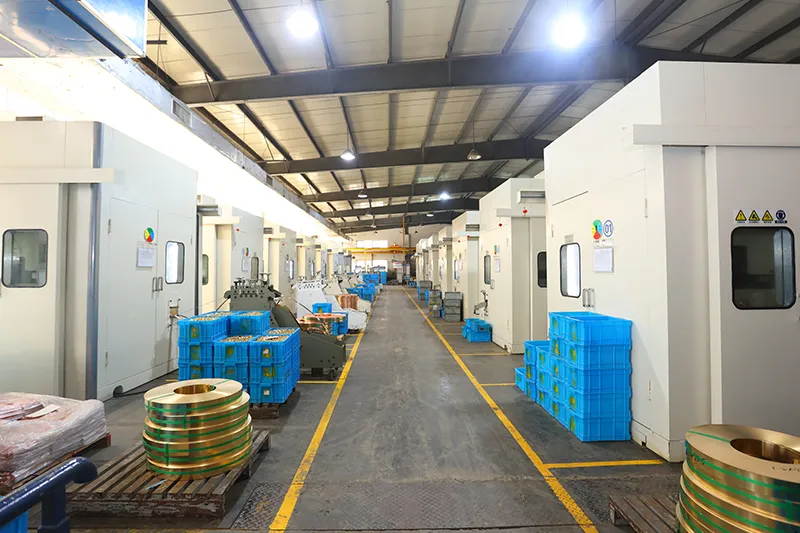
Injection & Stamping

Quality Inspection



Quality records and applicable product documents can be supplied for the confirmed CQB2-125 configuration. Certification and market-approval availability must be verified for the selected model.
What Can We Customize?
For CQB2-125 projects, CHAC can assess private-label marking, packaging, appearance, existing electrical configurations and technical-document requirements. Requests outside the published product range, including new electrical ratings or market approvals, are subject to engineering evaluation, testing and project feasibility.

Logo & Branding
Private-label marking and nameplate options are available subject to artwork review and sample approval.


Packaging
Customization
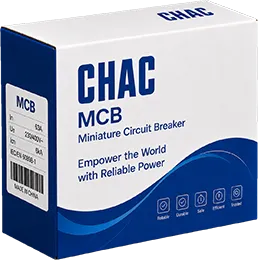
Color boxes, cartons, labels and manuals can be prepared for the destination market and approved order specification.

Electrical
Customization
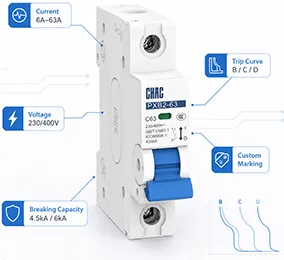
Select from the published 63–125A, 1P–4P and C/D options; requests outside this range require technical evaluation.

Product
Appearance
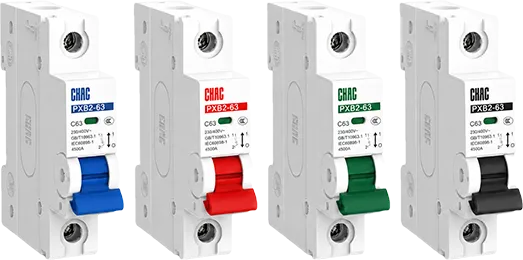
Housing, handle and appearance options can be reviewed subject to tooling, MOQ and technical feasibility.

Certification
Support
Datasheets, drawings and verified certificate information are supplied for the applicable approved configuration.


Engineering
Development
Project support can include drawing review, sample evaluation, testing and production planning, subject to technical approval.

Download
CQB2 Series Miniature Circuit Breaker
Download the CQB2 series overview for product selection reference. Confirm that each specification and document applies to the CQB2-125 configuration requested for your project.
Need CQB2-125 Technical Documents?
Request the applicable datasheet, drawings, verified certificate information, selection support or OEM/ODM project review.
CQB2-125 Miniature Circuit Breaker FAQ
Q1. What does 10kA mean on the CQB2-125 miniature circuit breaker?
The CQB2-125 has a rated ultimate short-circuit breaking capacity (Icu) of 10,000A and a rated service short-circuit breaking capacity (Ics) of 7,500A. The 10kA marking does not make the breaker suitable for every installation. The prospective short-circuit current at the installation point and the complete protection design must be checked before selection.
Q2. How do I choose between a C curve and D curve MCB?
Choose the curve according to the load’s inrush characteristics and the required protection coordination. C curve is commonly evaluated for general distribution loads with moderate inrush, while D curve may be considered for loads with higher starting current. The correct choice depends on the actual load and system study, not on rated current alone.
Q3. What is the difference between Icu and Ics?
Icu is the rated ultimate short-circuit breaking capacity. Ics is the rated service short-circuit breaking capacity and indicates the short-circuit duty after which the breaker is expected to remain suitable for continued service under the applicable test conditions. For CQB2-125, the listed values are 10kA Icu and 7.5kA Ics.
Q4. Can the CQB2-125 be used as a 125A DC circuit breaker?
No. The specifications on this page describe an AC 230/400V product. AC and DC interruption duties are not interchangeable. Use a breaker that is specifically rated and verified for the intended DC system when DC protection is required.
Q5. What cable size is required for a 125 amp circuit breaker?
The CQB2-125 product reference table pairs 125A with a 50mm² copper conductor; it also lists 16mm² for 63A, 25mm² for 80A and 35mm² for 100A. These are product references, not universal wiring rules. Final conductor sizing must account for installation method, temperature, grouping, voltage drop, conductor material and local electrical requirements.
Q6. When should I choose a 125A MCB instead of a 63A MCB or MCCB?
Consider CQB2-125 when the circuit design requires a 63A to 125A modular AC breaker and its fixed C or D curve, 10kA Icu and other listed characteristics meet the project. For lower-current circuits, a 63A-range MCB may be more appropriate. If adjustable protection, higher fault duty or more advanced coordination is required, evaluate an MCCB. The final decision should be made from the complete system study.
Build the Right CQB2-125 Configuration for Your Project
Send the required current rating, C or D curve, pole configuration, system voltage, destination market and estimated quantity. CHAC will review the specification and provide the applicable technical documents and commercial proposal.