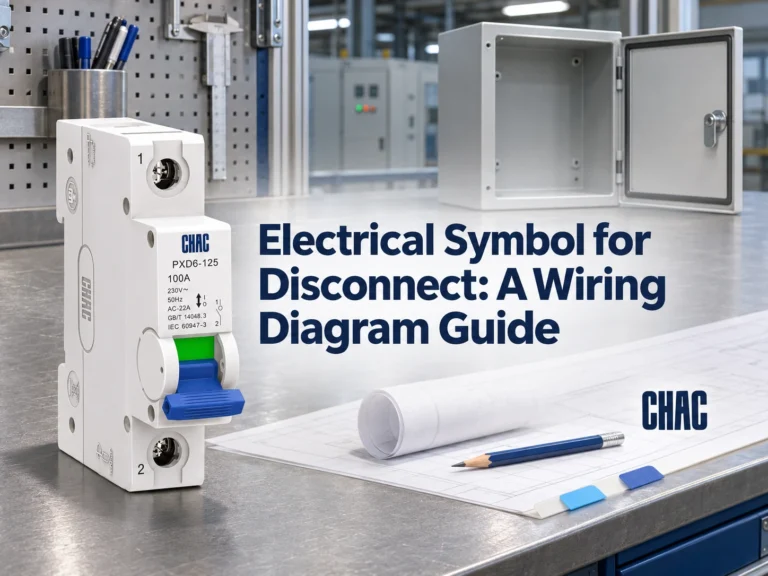
Le meilleur disjoncteur de phase 50 et 3 est celui qui est approuvé pour le circuit et l’assemblage concernés. Une description du type “ 50 A, 3P ” omet la tension du système, le courant de défaut disponible, le comportement au déclenchement et les caractéristiques de démarrage de la charge. Sans ces informations, toute recommandation de marque serait prématurée.
Un 50 Un disjoncteur triphasé utilise généralement trois circuits de phase protégés actionnés par un mécanisme commun approprié. Le courant nominal s’applique à chaque pôle dans les conditions indiquées ; il ne crée pas un 150 Un calibre pour circuit unique. Choisissez l’appareil en tenant compte des calculs de charge et de conducteur, de la capacité de coupure spécifique à la tension, du comportement de déclenchement requis et de la compatibilité avec le tableau.
Quel type de disjoncteur 50 devrait être comparé en premier ?
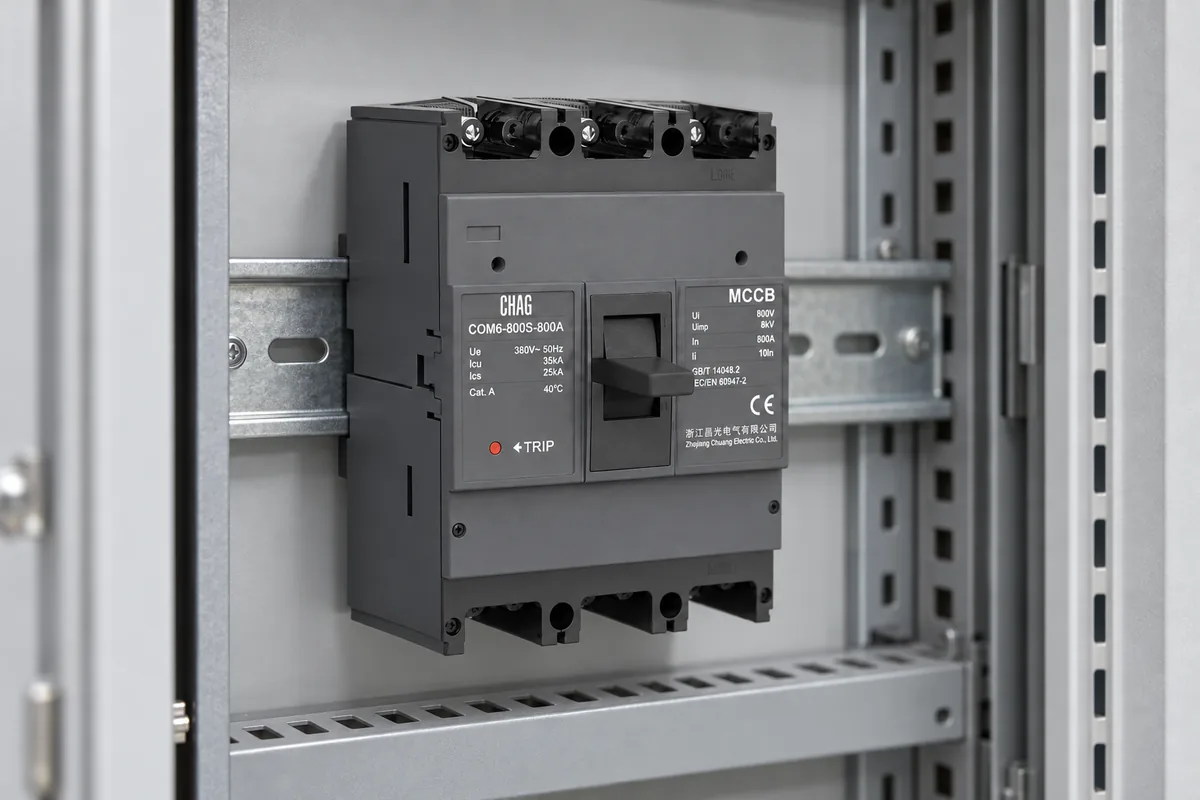
Un disjoncteur miniature compact peut convenir à un circuit de distribution lorsque ses caractéristiques nominales et sa courbe fixe répondent aux exigences de la conception. Un disjoncteur motorisé modulaire peut être approprié lorsque le projet requiert une capacité de coupure différente, une protection réglable, un mode de montage ou un ensemble d’accessoires spécifique. Aucune des deux familles ne l’emporte uniquement parce que le courant nominal est de 50 A.
| Approche des candidats | Pourquoi cela pourrait convenir | Ce qui doit être établi |
|---|---|---|
| Disjoncteur miniature tripolaire à caractéristique fixe | Disposition compacte de distribution avec une courbe adaptée | Tension, pouvoir de coupure, comportement au démarrage et installation approuvée |
| Disjoncteur modulaire tripolaire avec le déclencheur requis | Différentes exigences en matière de cadre, de paramètres ou d’accessoires | Valeur ou réglage réel de 50, coordination et montage |
| Dispositif de protection motorisée coordonné | Surcharge du moteur et exigences de démarrage | Données du moteur, démarreur, combinaison de protection contre les surcharges et les courts-circuits |
Cette comparaison a été examinée le 16 octobre 2026. Elle compare les voies d’application plutôt que de classer les fournisseurs en l’absence de données de produit équivalentes. Les liens vers les produits CHAC ci-dessous sont des références fabricant, et non des attestations de tests indépendants.
Why does the supply voltage matter as much as 50 A?
A breaker must be rated for the actual system and connection. Three-phase supplies are not all the same voltage, and a rating for a grounded wye system cannot be transferred automatically to every delta arrangement. Read both line-to-line and line-to-ground limitations where they apply.
Le UL Solutions breaker guide explains the difference between straight-voltage and slash-voltage ratings. It also distinguishes common-trip devices from independent-trip devices. Three single-pole breakers with a handle arrangement should not be assumed to provide the same protection as an approved common-trip three-pole device.
How much power can a 50 A three-phase circuit supply?
Current alone does not determine power. For a balanced three-phase AC load, apparent power is S = √3 × VLL × I. Real input power also depends on power factor. Motor shaft output additionally depends on efficiency.
As an arithmetic illustration, 400 V line-to-line and 50 A give approximately 34.6 kVA. With a power factor of 0.85, the corresponding real input is about 29.4 kW. These are calculated examples, not a permitted continuous-load limit, motor output rating or CHAC product claim. Supply conditions, loading rules and equipment duty still have to be checked.
For an unbalanced system, do not assume the balanced formula establishes every conductor’s loading. Check phase currents and any neutral requirements separately.
Can a 50 A breaker carry 50 A continuously?
It depends on the applicable rules and the device’s declared installation conditions. The UL guide explains the usual 80% application for continuous loads lasting three hours or more unless the breaker is marked for 100% continuous use under specified conditions. Under that ordinary 80% basis, 50 A corresponds to 40 A continuous load. This is not a universal limit for every IEC installation or every specially rated assembly.
Ambient temperature, enclosure arrangement and grouping can add constraints. Use the actual product documentation and project calculation rather than applying “50 A means 50 A all day” or a universal derating shortcut.
Why does a motor need more than a matching breaker rating?
A motor’s starting current differs from its normal running current. The 50 amp three-phase breaker must be assessed with the starting method, acceleration conditions and protective combination. A device that carries the running load may still trip during starting, while a larger device may fail to provide the required protection if selected without the applicable motor-circuit rules.
Motor overload protection is a separate requirement unless the selected arrangement explicitly provides it. Check the coordinated breaker, contactor and overload device, as well as any drive or starter instructions. The MPCB versus MCCB motor-protection guide explains why a distribution breaker alone is not always the complete answer.
What breaking capacity and wire size are required?
Capacité de rupture must be adequate for the prospective short-circuit current at the installation point, at the specified voltage and under the applicable standard. It is independent of the 50 A load rating. A location close to a transformer can have a different fault level from a distant branch circuit.
Wire size also cannot be selected from “50 A three-phase” alone. Conductor material, insulation, terminal temperature rating, installation method, grouping, ambient conditions, voltage drop and load-specific rules all matter. The UL guide explicitly addresses conductor material and temperature markings at breaker terminals. A generic wire-gauge answer can miss those constraints.
For the difference between headline fault-current numbers, see the 6 kA versus 10 kA MCB guide. Any backup-protection arrangement needs evidence for the exact combination.
What should a supplier receive before recommending a model?
- Supply voltage, frequency, phase arrangement and any neutral-switching requirement.
- Design load, operating duration, motor or transformer data and starting method where relevant.
- Conductor design and prospective short-circuit current at the breaker position.
- Required product standard, approval route, trip curve or settings and accessories.
- Panel reference, mounting arrangement, terminals, enclosure conditions and coordination requirements.
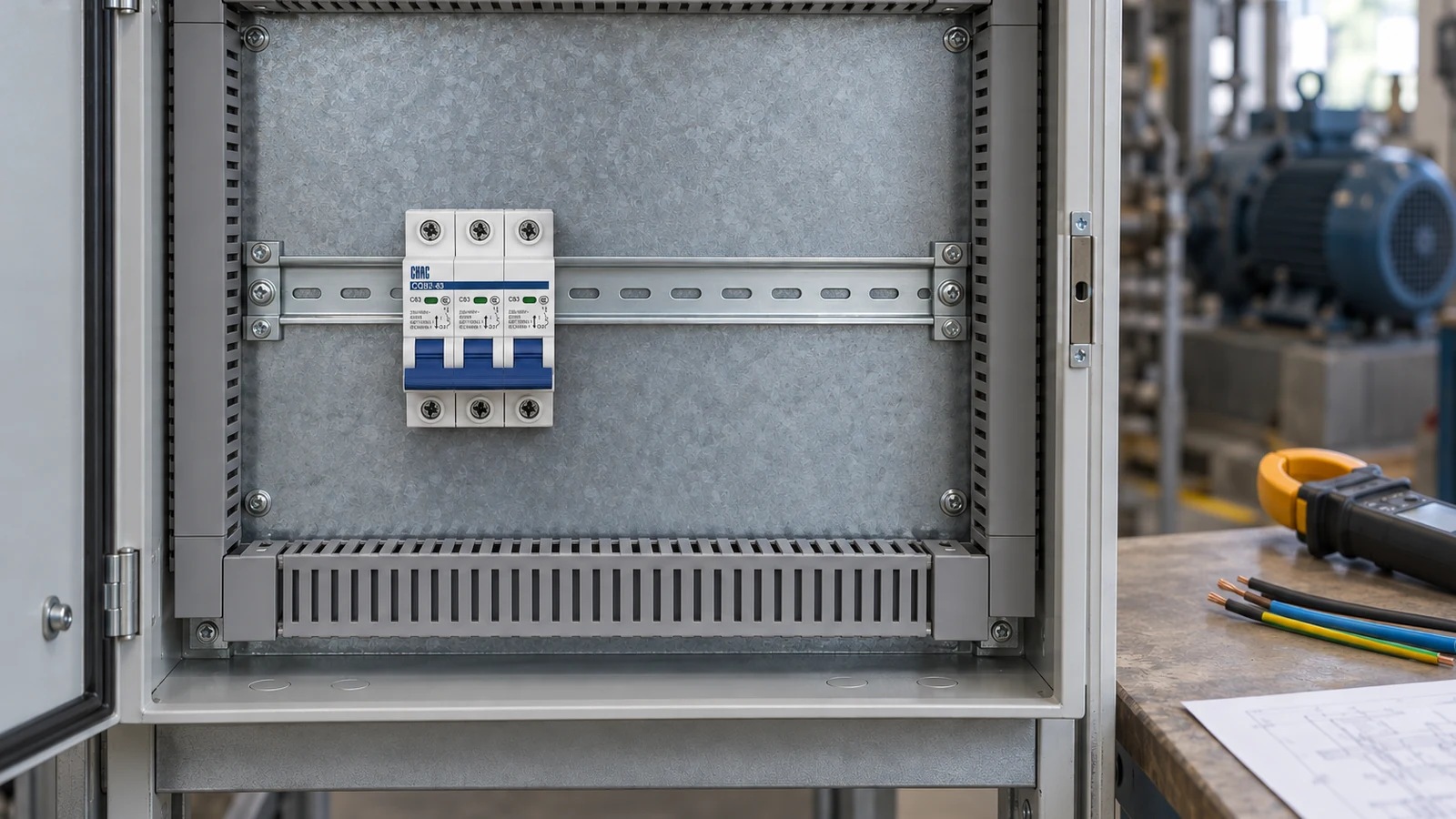
For a compact product review, use the CQB2-63 miniature circuit breaker page to confirm the exact available configuration. For a different frame or trip-unit requirement, review the CHAC MCCB range. Neither reference replaces confirmation of the selected 50 A arrangement and its market approval.
What else should buyers ask about 50 A three-phase breakers?
Does a three-pole 50 A breaker provide 150 A?
No. Each phase path has the stated current rating under its specified conditions. Adding the three pole ratings is not the way to describe circuit capacity.
Does a three-phase circuit always need a neutral pole?
No. Neutral requirements depend on the load, supply system and installation rules. A three-phase motor may not use a neutral, while other circuits can require a neutral and a defined switching arrangement.
What size wire is needed for a 50 A three-phase circuit?
Use the applicable conductor calculation and terminal markings. Material, insulation, installation, ambient conditions, grouping and motor-specific rules can change the answer.
Can a 50 A three-phase breaker run a 50 A motor?
Not automatically. Assess starting current, overload protection, conductor design and the manufacturer’s coordinated protective arrangement.
Is a 10 kA breaker always better than a 6 kA breaker?
It has a higher declared interruption figure only when compared on the same voltage and standard basis. The required rating comes from the fault-current assessment; other compatibility and protection checks still apply.
Can three single-pole breakers replace a three-pole breaker?
Do not assume equivalence. Common trip, simultaneous operation, voltage rating and the assembly’s approval must meet the circuit requirements.
Références
- UL Solutions : Disjoncteur à boîtier moulé – Guide de marquage et d’application — voltage ratings, common trip, continuous loading and terminals.
- IEC 60947-2:2024: low-voltage circuit breakers — official scope.
- IEC 60947-4-1:2023: electromechanical contactors and motor-starters — relevant motor-control product framework.
- OSHA 1910.303: interrupting ratings and equipment suitability.
How should the best option be selected for the project?
The best choice follows the circuit requirements rather than a generic supplier ranking. Establish voltage, duty and conductor capacity first, then verify fault interruption, trip behavior and panel compatibility. Treat continuous loading and motor starting as separate checks, and keep illustrative power calculations separate from permitted operating limits. A three-pole circuit breaker with the right current label can still be wrong for the supply or installation. Once those constraints are documented, the supplier can identify a suitable configured model and provide the supporting documents. CHAC’s technical enquiry team can review that information before a product is included in the final purchasing schedule.