Deux disjoncteurs peuvent avoir la même intensité nominale et ne pas pour autant être des substituts adéquats. La différence peut résider dans leur capacité d’interruption en cas de défaut, leurs réglages de déclenchement, leurs borniers ou leur homologation pour l’ensemble de distribution. Comprendre ce que signifient les MCCB et les MCB n’est utile que si cela conduit à effectuer ces vérifications.
MCB signifie disjoncteur miniature ; MCCB signifie disjoncteur à boîtier moulé. Tous deux assurent une protection contre les surintensités, mais leurs conceptions, leurs calibres et leurs options de déclenchement diffèrent. Les MCB sont généralement utilisés pour les circuits terminaux, tandis que les MCCB sont couramment employés pour les circuits d’alimentation et les charges de distribution plus importantes. Les plages de courant se chevauchent. Le choix doit tenir compte de la tension du circuit, du courant de court-circuit prévisible, des exigences relatives aux conducteurs et des besoins de coordination, plutôt que d’appliquer un seuil de coupure uniforme en ampères.
À quoi sert un disjoncteur miniature ?
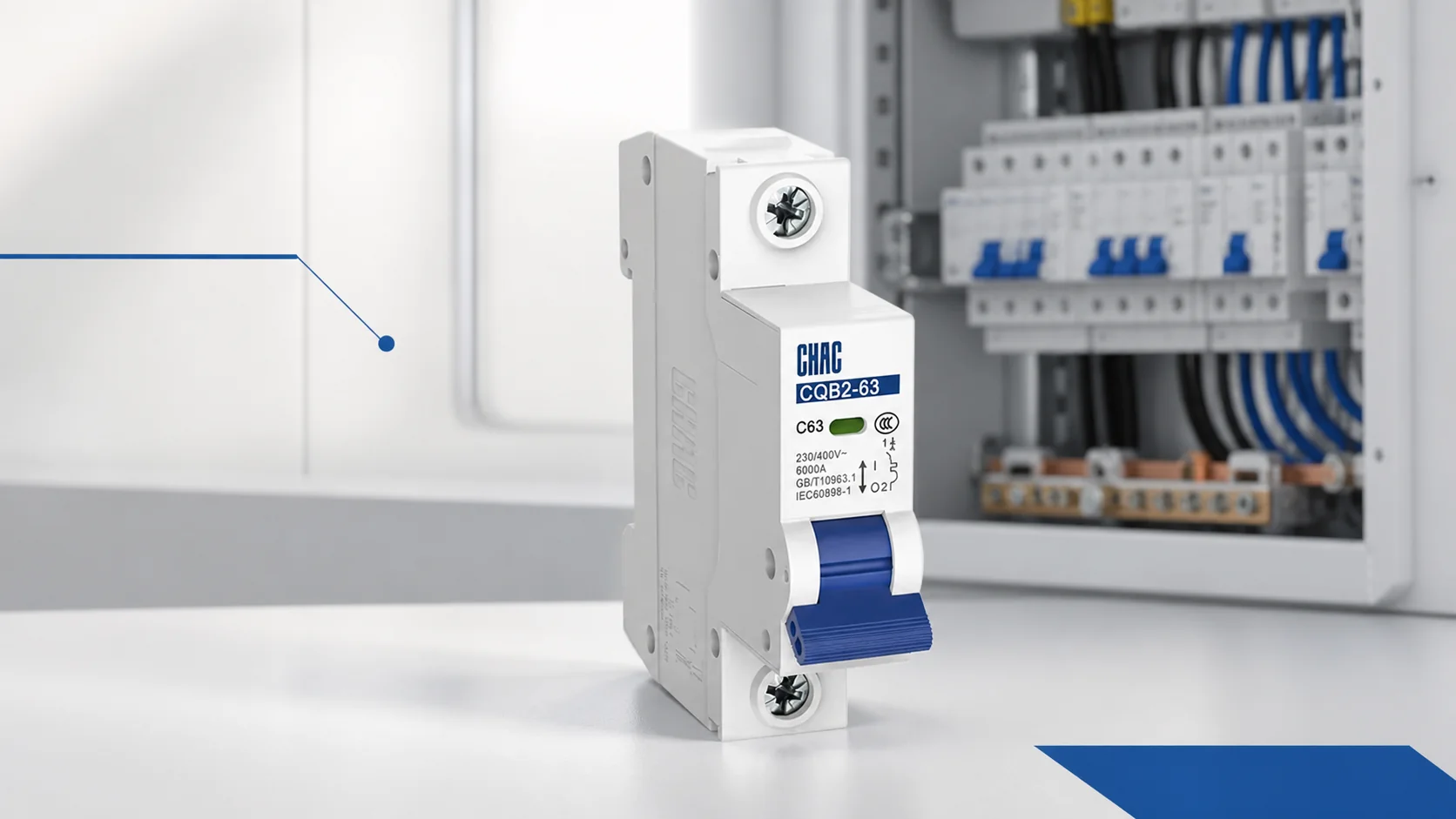
A disjoncteur miniature Il interrompt un circuit sous des conditions spécifiées de surcharge et de court-circuit. Les modèles thermomagnétiques courants présentent une caractéristique de déclenchement fixe et un format de montage compact. L’appareil doit supporter la charge nominale ainsi que le courant de démarrage admissible, tout en protégeant le circuit dans les limites de performance qui lui sont assignées.
Le responsable IEC 60898-1:2015+A1:2019 résumé couvre les disjoncteurs AC pour installations domestiques et similaires dans les limites indiquées : jusqu’à 440 V entre phases, 125 A de courant assigné et 25,000 A de capacité de court-circuit assignée. Ce sont les limites de portée de la norme, et non des caractéristiques que chaque MCB possède. Certains disjoncteurs compacts comportent également des déclarations selon IEC 60947-2, de sorte que l’aspect extérieur seul ne permet pas d’identifier la base de classement applicable.
Quels avantages apporte un disjoncteur modulaire ?
A disjoncteur à boîtier moulé Il abrite son mécanisme de commutation et son système de déclenchement dans un boîtier isolant. Selon le modèle, il peut offrir une protection thermomagnétique fixe, des réglages ajustables ou un déclencheur électronique. Les accessoires peuvent inclure des contacts de signalisation, des déclencheurs à distance et des dispositifs de manœuvre, mais aucun ne doit être supposé uniquement sur la base de la dénomination de la gamme.
CEI 60947-2:2024 Ces normes couvrent les disjoncteurs basse tension destinés à être installés et exploités par des personnes formées ou qualifiées. Le champ d’application officiel est plus large qu’une simple définition de “ grand disjoncteur ”. La documentation du produit doit préciser quelles fonctions et quelles caractéristiques s’appliquent au modèle précis ainsi qu’à l’unité de déclenchement correspondante.
Comment les disjoncteurs miniatures (MCB) et les disjoncteurs modulaires à boîtier moulé (MCCB) se comparent-ils lors d’une analyse comparative ?
| Question | Sélection du disjoncteur miniature | Sélection du disjoncteur modulaire à boîtier moulé |
|---|---|---|
| Quel circuit est protégé ? | Souvent des circuits terminaux et des chemins de distribution compacts. | Souvent les circuits d’alimentation, les circuits d’arrivée et les équipements de plus grande puissance. |
| Can the trip characteristic be changed? | Commonly fixed; select the documented curve. | Fixed or adjustable, depending on the trip unit. |
| What short-circuit rating applies? | Read the stated standard, voltage and Icn or other declared rating. | Read the voltage-specific Icu/Ics or applicable market rating. |
| Will it fit the assembly? | Check busbar, rail, terminals, enclosure and approved device types. | Check frame, mounting, lugs, barriers and accessory space. |
| Will the downstream device trip first? | Use coordination evidence for the exact pair. | Settings may help, but selectivity still needs verification. |
This is a comparison of selection considerations, reviewed on 16 October 2026, rather than a ranking of manufacturers. Product families have exceptions; no universal performance or price advantage follows from the acronym.
Why are Icn, Icu and Ics not interchangeable?
Icn is the rated short-circuit capacity used under IEC 60898-1. IEC 60947-2 uses Icu for rated ultimate short-circuit breaking capacity and Ics for rated service short-circuit breaking capacity. These ratings refer to defined test duties. A larger number printed under one standard should not be substituted for the rating required under another.
A useful comparison records the number, voltage, AC or DC duty and standard together. For example, a product’s rating at one operational voltage does not establish the same capacity at a higher voltage. A dual-rated breaker may legitimately display different values under different standards. The designer must use the value relevant to the project requirement.
Fault interruption is also separate from normal load current. A 63 A breaker can still be unsuitable at an installation point with a fault level beyond its declared capacity. The 6 kA versus 10 kA breaking-capacity guide develops that distinction.
Does an adjustable MCCB automatically improve selectivity?
No. Adjustable long-time, short-time or instantaneous settings can provide more design flexibility, but the actual functions depend on the trip unit. Raising an instantaneous setting to ride through inrush can also affect fault-clearing performance. Settings have to be checked against conductor protection, equipment withstand and the coordination study.
Two breakers with different ampere ratings are not automatically selective throughout the fault-current range. Manufacturer tables may state selectivity only up to a specific current. Likewise, an approved backup or cascading combination does not necessarily provide selectivity: an upstream breaker may also open while helping the downstream device interrupt the fault.
Le thermal-magnetic versus electronic MCCB comparison helps separate trip-unit capabilities from the frame’s current and short-circuit ratings.
Can an MCB replace an MCCB with the same ampere rating?
Only after a full substitution review. Compare operational voltage, fault rating, trip curve or settings, pole and neutral arrangement, conductor termination, environmental limits, mounting and the assembly’s approved configurations. For motor or transformer circuits, starting behavior also matters.
Another often-missed distinction is component versus assembly rating. The UL Solutions marking and application guide explains that a breaker with a higher interrupting rating does not raise an end-use assembly’s lower marked short-circuit rating. Physical fit and an impressive component rating cannot approve a panel substitution.
What should an IEC 60947-2 reference tell a breaker buyer?
CEI 60947-2 is a low-voltage circuit-breaker product standard. Its 2024 edition’s official scope concerns circuit breakers intended for installation and operation by instructed or skilled persons. A reference to the standard is not a certification of an unnamed product, and the MCB or MCCB label alone does not establish the applicable test basis.
When a specification uses IEC/EN 60947-2, request the exact designation and edition claimed for the offered model, with the relevant declaration or test evidence. Check voltage, pole arrangement and rating definitions before comparing its kA value with a device documented under IEC 60898-1. Do not assume that an EN adoption and an IEC publication are interchangeable in every procurement document.
Keep the standard reference and the rating evidence in the same comparison row. The breaking-capacity selection guide connects those ratings to the installation fault level, while the MCCB buying guide addresses trip-unit and configuration details that a standard number does not settle.
Which product details should be confirmed before purchase?
- Record the actual system voltage, frequency, earthing arrangement and AC/DC duty.
- Establish design load, conductor capacity and prospective short-circuit current.
- Choose the required trip behavior, poles and accessory functions.
- Verify the installation drawing, terminal data and assembly compatibility.
- Retain the model-specific ratings, applicable certificates and coordination evidence.
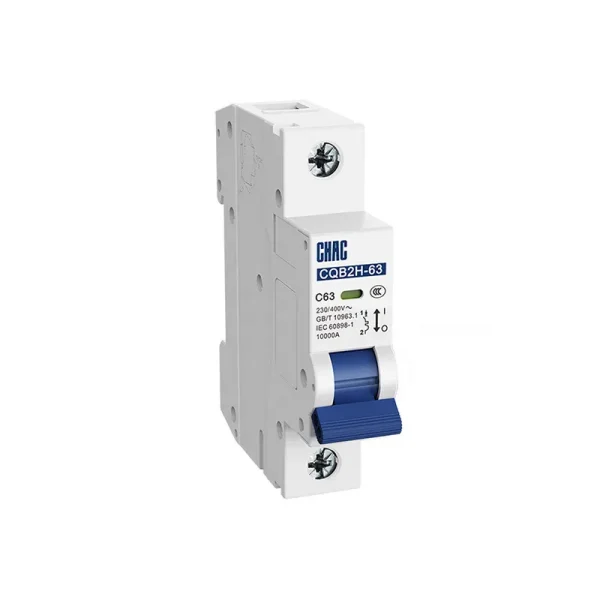
For CHAC product comparisons, the CQB2H-63 MCB page et Gamma de MCCB are separate starting points. The exact configured model, rather than a general family description, should appear on the approved schedule.
What else should buyers know about MCBs and MCCBs?
What are the full forms of MCB and MCCB?
MCB means miniature circuit breaker. MCCB means molded-case circuit breaker. Both names describe device families, not a complete set of ratings or approvals.
Is an MCCB always adjustable?
No. MCCBs may have fixed thermal-magnetic trips or adjustable thermal-magnetic or electronic trips. Check the exact trip-unit model and available settings.
Is there a universal current rating where an MCB becomes an MCCB?
No. Commercial ranges overlap. The product construction, declared standard, ratings and application determine suitability rather than a single ampere boundary.
Can an MCB or MCCB provide leakage protection?
Only when the required residual-current function is explicitly included or provided through an approved arrangement. Ordinary overcurrent protection is not automatically personnel leakage protection.
Can an AC-rated breaker be used on DC?
Only if the exact device has an appropriate declared DC rating and the specified pole, polarity and wiring arrangement is followed. AC ratings must not be transferred to a DC application.
Does a higher breaking capacity prevent overload trips?
No. Breaking capacity concerns fault interruption. Overload behavior depends on the trip characteristic or setting, load current and operating conditions.
Références
- IEC 60898-1:2015+AMD1:2019 CSV: AC circuit breakers for household and similar installations — official consolidated publication and scope.
- IEC 60947-2:2024: low-voltage circuit breakers — official sixth-edition publication and scope.
- UL Solutions : Disjoncteur à boîtier moulé – Guide de marquage et d’application — voltage, interruption, terminals and assembly-rating limitations.
How should the final breaker family be selected?
The useful difference between MCB and MCCB is the set of documented options each can offer for the circuit. Begin with the load, conductors and available fault current, then establish the trip behavior and installation constraints. Compare voltage-specific short-circuit ratings under the correct standard, and verify the complete assembly before approving a replacement. Neither extra ampere capacity nor additional trip settings can make up for missing compatibility or coordination evidence. CHAC can support the product-document review for the selected family, but the project’s protection study remains the basis for Sélection du disjoncteur. An approved model and recorded settings are more valuable than choosing a device simply because its acronym sounds more suitable.