Scatola di derivazione per esterni La scelta del prodotto fallisce più spesso quando la classe di protezione dell’enclosure viene considerata come l’intera specifica. Le aperture per i cavi, la condensa, l’esposizione ai raggi UV, l’orientamento di montaggio, il drenaggio, il sostegno dei conduttori e l’accesso per la manutenzione possono influenzare il risultato, anche quando due contenitori hanno le stesse dimensioni nominali. Questa revisione integra tali condizioni di campo e distingue la terminologia relativa all’ingresso dall’insieme delle decisioni necessarie per un’installazione completa.
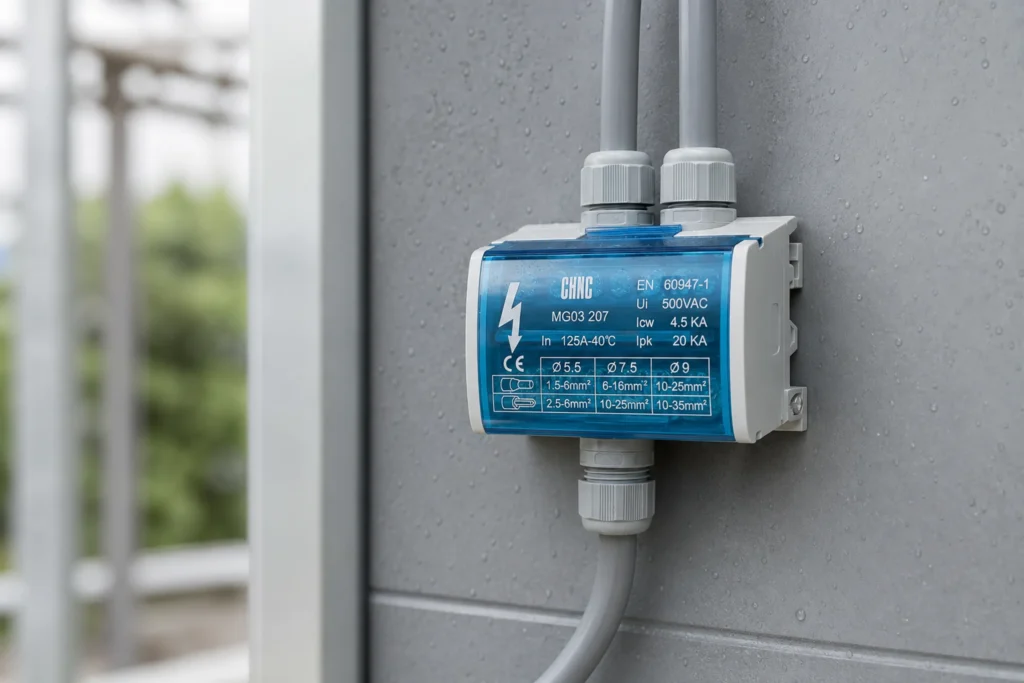
Parte 1. Cosa comprende effettivamente la scelta della scatola di derivazione per esterni?
An outdoor junction box selection starts with the installation exposure, the required connection function, the cable-entry plan, and the product evidence for the chosen enclosure. It is an enclosure-selection exercise, not a comparison between a distribution box and a junction box or a claim that any box is weatherproof in every installation.
IEC 60670-22:2024 addresses connecting boxes and enclosures for household and similar fixed electrical installations, including indoor or outdoor use within its stated scope. The selected product and project requirements still control the final decision.
Parte 2. Quali condizioni del sito devono essere registrate per prime?
Record where the enclosure will be mounted, the expected exposure to dust, moisture, sunlight, corrosion risk, mechanical impact, and temperature conditions, plus the access needed for inspection and maintenance. These are project inputs, not characteristics that can be inferred from a catalogue image. Replace broad requests for an all weather junction box or waterproof junction box with the actual exposure. If the specification calls for an IP65 junction box or IP67 junction box, retain that exact requirement and its test scope; the higher numeral is not a substitute for checking the installation conditions.
Where an ingress-protection level is required, write the exact project requirement and ask for product evidence for the complete assembly. An enclosure rating does not automatically prove the installed condition after entries, glands, plugs, and mounting are changed.
| Project input | Perché è importante | Documenti da richiedere |
|---|---|---|
| Exposure description | Sets the environmental review | Project specification and installation location |
| Cable-entry layout | Defines fittings and internal routing | Cable or conduit schedule and drawing |
| Enclosure route | Connects request to a product review | Selected-model instructions and datasheet |
Parte 3. Come devono essere pianificate le entrate dei cavi?
List each cable or conduit, its outside diameter or relevant entry requirement, the entry direction, termination space, and any need for strain relief or sealing. The enclosure and every entry component must be reviewed together because unused openings, mismatched fittings, or unsuitable cable routing can change the installed result.
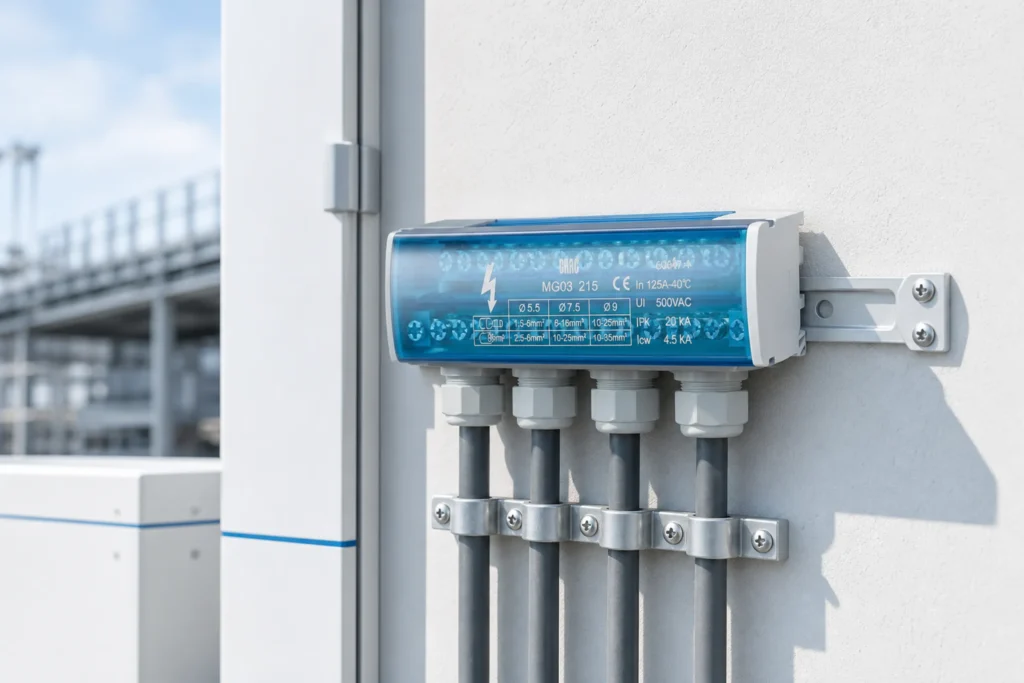
Plan the entry layout before cutting or ordering. For an industrial electrical junction box with knockouts, identify which openings will be used and how unused openings will remain sealed under the manufacturer’s instructions. The cable junction box, glands, plugs and cover should be reviewed as the installed combination. A practical layout keeps connections accessible and avoids forcing bends, crowding terminations, or putting a connection method outside the product documentation.
How should NEMA enclosure ratings be used for an outdoor box?
A NEMA ratings chart is useful only when its environmental duties match the site. NEMA’s Panoramica sui tipi di involucro, published in November 2005, distinguishes rain exposure from windblown dust, hose-directed water and additional corrosion resistance. It is background guidance, not a current certificate for a box offered for sale.
- Type 3R addresses specified outdoor weather exposure; it does not carry all the dust and water duties of Type 4.
- A NEMA 4 enclosure rating includes hose-directed water and dust protection under its defined tests.
- The NEMA 4X enclosure rating adds corrosion-resistance requirements; it does not mean immunity to every chemical.
When reviewing NEMA ratings for electrical enclosures or junction boxes, require documentation for the exact box and its entry configuration. Glands, plugs, cutouts and mounting changes belong in that review. A material description or a claim that a box is “outdoor” cannot establish its enclosure type.
Can an IP65 rating be converted into a NEMA rating?
No automatic IP65 NEMA equivalent should be used to approve a purchase. NEMA vs IP ratings compare different test scopes. NEMA’s overview explicitly warns that its comparison cannot be reversed to assign a NEMA type from an IP designation. An IP rating does not by itself establish the additional corrosion or other requirements of a NEMA type. Use an IP/NEMA chart to identify questions, then request separate evidence for the specified rating.
What should buyers check when comparing IP67 and IP68?
In an IP67 vs IP68 review, ask for the actual immersion conditions and permitted installation configuration. IP67 testing and the IP68 test method must be tied to the applicable IEC 60529 requirements and the manufacturer’s declared conditions. Do not buy on the word “waterproof.” Record test depth and duration from the report, whether cable entries were installed, and any restrictions on service use.
For IP65 vs IP67 vs IP68, distinguish water-jet exposure from immersion. The same distinction matters for IP66 vs IP68: an immersion designation alone does not establish water-jet performance. Check whether both duties are documented when both occur on site. The IEC explanation of IP ratings provides the classification context; the plastic-versus-metal junction-box guide addresses the separate material decision.
Part 4. What should the enclosure evidence include?
Request the selected product’s datasheet, installation instructions, dimensions, material information where relevant, entry options, and any test or rating documentation required by the project. Do not turn a generic IP-code explanation into a claim that a CHAC enclosure has a particular rating.
IEC 60529 defines the IP code system, while the product documentation identifies what has been tested or declared for a specific enclosure and configuration. Those are complementary, not interchangeable, records.
Part 5. Which installation details affect the final assembly?
The mounting surface, fastening method, cable approach, drainage considerations, access clearance, grounding or bonding requirements where applicable, and maintenance access should be shown on the installation drawing. A box that fits a cable count on paper can still be unsuitable if the installation leaves no safe termination or service space.
Follow the selected product’s instructions and the applicable local project rules for installation. This guide does not replace electrical installation design or site acceptance.
| Buyer should provide | Perché è importante | Errore comune |
|---|---|---|
| Application and circuit role | Defines the function to review | Naming a device without a drawing |
| Control and installation data | Defines interfaces and assembly context | Assuming a family variant is interchangeable |
| Required documentation | Makes the request auditable | Treating a catalogue page as approval evidence |
Part 6. Which CHAC route should buyers use for a product review?
CHAC Electric’s published junction-box route is a useful starting point after the project team has defined the enclosure and entry data. Provide the planned installation details with the purchase specification so the supplier can respond against a specific product route piuttosto che an unspecified outdoor-use claim.
Do not recommend a distribution-box product simply because it is an enclosure, and do not recommend a junction box solely from appearance. The connection function, internal space, entry arrangement, and documented installation evidence must match the application.
CHAC Junction Box Recommended:
Junction Box – CHAC Electric
Quali prove del prodotto dovrebbero richiedere gli acquirenti?
Utilizza il pubblicato product route only as a starting point for a documented product review. For branding, packaging, or panel-program discussion, use CHAC Electric’s relevant customization route after the engineering inputs are complete.
Parte 7. Dove si trova il limite di adattamento per questa guida?
Fit Boundary: this guide supports early planning for an outdoor junction-box purchase specification. It is not a substitute for a hazardous-location assessment, a final installation design, a site-specific environmental evaluation, or a declaration of enclosure rating, certification, or compatibility.
Before procurement, confirm the selected model, complete entry system, installation method, applicable project rules, and any required testing or approvals.
Which site conditions belong in an outdoor junction-box review?
Record the installation location, exposure to rain or washdown, sunlight, temperature range, condensation risk, mounting orientation, cable-entry direction, gland system, conductor bend radius and service access. Then match the enclosure material, sealing method, entry accessories and declared ingress rating to the installed configuration. An IP marking describes a defined test condition; it does not by itself prove UV life, corrosion resistance or cable-entry performance.
| Site condition | Documenti da richiedere |
|---|---|
| Water and dust exposure | Declared IP rating and the installed cover, gasket and entry arrangement. |
| Sun, heat and condensation | Material and temperature information, ventilation or drainage provisions where applicable. |
| Cable entries and service | Gland compatibility, bend radius, strain relief, mounting and safe maintenance clearance. |
Google results for outdoor junction-box selection emphasize cable entry and enclosure protection, but those are not interchangeable claims. Review the CQMG03 junction-box reference against the actual installed entry and environmental conditions.
FAQ
Come scelgo una scatola di derivazione per esterni?
Iniziare dal circuito o dalla funzione di collegamento documentati, dalle condizioni del sito e dal disegno o dalla tabella di progetto.
Quali informazioni sono necessarie per la scelta di un involucro per esterni?
No. Una pagina di categoria può identificare una famiglia di prodotti, ma la documentazione del modello selezionato è quella che determina la revisione finale.
Come devono essere progettate le aperture per i cavi in una scatola di derivazione?
Fornire l’applicazione, il disegno, la configurazione dei comandi o delle interfacce di ingresso, le condizioni di installazione, la documentazione richiesta e i requisiti di progetto.
In che modo i pressacavi influiscono sulla protezione degli involucri?
La funzione richiesta deve essere indicata nel progetto di controllo o di installazione prima di scegliere l’accessorio o il percorso dell’alloggiamento.
Cosa bisogna controllare prima di installare un involucro per esterni?
Richiedi le prove specifiche relative al modello selezionato, anziché dedurre valutazioni, approvazioni o compatibilità da una famiglia di prodotti generica.
Quali dettagli devono essere inclusi nella specifica d’acquisto di una scatola di derivazione per esterni?
È necessaria la revisione finale prima di prendere una decisione d’acquisto o di approvare l’installazione, una volta disponibili gli input del progetto e i dati del modello selezionato.
Una classificazione IP dimostra che una scatola di derivazione per esterni è resistente ai raggi UV?
No. Le classificazioni IP si riferiscono a prove di protezione specifiche contro l’ingresso di corpi estranei e acqua. L’esposizione ai raggi UV, l’invecchiamento dei materiali, le prestazioni in termini di temperatura e la tenuta dei cavi richiedono prove separate.
Perché il pressacavo può influire sul grado di protezione dell’alloggiamento?
La pressacavo, la guarnizione, il diametro del cavo, il serraggio e l’orientamento dell’ingresso installati costituiscono parte integrante dell’armadio completo. La classe di protezione dell’armadio non può essere attribuita a un sistema di ingresso non verificato.
Referenze
- IEC 60670-22:2024 connecting boxes and enclosures
- IEC 60529 IP code overview
- Outdoor junction-box cable-entry discussion
- IEC: Panoramica sulle classificazioni IP Use for the meaning and limits of ingress-protection terminology.
- IEC Webstore search: IEC 60670-1 Confirm the applicable enclosure standard and edition for the product.