When Marcus, a maintenance supervisor in Birmingham, unplugged every visible appliance on a warehouse office circuit, the breaker still snapped open within seconds of being reset. It looked like a worn breaker, but tracing the branch changed the diagnosis: a hardwired control transformer, a damp exterior box, and an incorrectly shared return path meant the circuit had never been idle.
Summary: If a breaker keeps tripping with nothing plugged in, treat the circuit as energized by an unseen load or fault until testing proves otherwise. Thermal-magnetic protection responds to overcurrent, AFCI protection evaluates qualifying arc signatures, and RCD, RCCB, RCBO, or GFCI protection responds to current imbalance; each mechanism points to a different first check. Leave repeated or immediate trips de-energized and have a qualified electrician map fixed loads, isolate branch sections, inspect neutrals and damp locations, and select the appropriate current, continuity, leakage, or insulation-resistance test.
“Nothing plugged in” describes only the receptacles someone can see. It says nothing about ceiling equipment, controls, concealed junctions, outdoor spurs, or the condition of the cable. The trip pattern – immediate, delayed, weather-related, or linked to another circuit – usually provides a better starting point than the empty outlets.
Start with what the branch still supplies
A hidden electrical load may be completely normal. Hardwired alarms, fans, controls, transformers, emergency-light chargers, signage, photocells, surge devices, and smart relays can remain connected after portable appliances are removed. “Phantom load” can describe standby consumption, but anything wired to the branch can draw current or develop a fault.
Compare the panel schedule with what is actually energized; altered buildings often contain undocumented extensions. A qualified electrician can use a clamp meter to reveal current while outlets are empty, then stage isolation to tie that current to a fixed load. A low reading does not clear the circuit because damage or moisture may cause intermittent leakage or arcing.
Map both ends of every cable before disconnecting anything. Ceiling lights, ventilation controls, door equipment, exterior lighting, alarm panels, and equipment fed through a junction box are easy to miss. A circuit directory is useful evidence, not proof that the labeling is current.
A shared neutral needs careful interpretation. A correctly designed multi-wire branch circuit is not automatically defective. Trips can arise when return conductors are misidentified, separate neutrals are mixed, or an AFCI or residual-current device is wired contrary to its instructions. Switching a neighboring circuit may then change what the device senses.
| Observed pattern | Likely hidden cause | Best confirming check |
|---|---|---|
| Trips immediately after reset | Short circuit, neutral-ground fault, severe leakage, damaged fixed load, or active arc condition | Keep de-energized; isolate branch sections and test before another reset |
| Trips after minutes or hours | Hardwired load cycling, overload, heat at a loose termination, or aging breaker mechanism | Load logging, termination inspection, and breaker evaluation after the branch is cleared |
| Trips after rain or overnight | Moisture ingress, condensation, outdoor lighting control, or temperature-dependent insulation breakdown | Trip-time log, enclosure inspection, and suitable insulation-resistance testing |
| Trips when another circuit operates | Mixed or shared neutral, cross-connection, or AFCI/RCD wiring interaction | Circuit tracing and neutral segregation check |
| Trips while fixed controls remain live | Hardwired transformer, relay, sign, alarm, fan, or other concealed load | Clamp-current measurement and staged load isolation |
Let the protective device narrow the diagnosis
A thermal-magnetic breaker opens for sustained overcurrent or high fault current. A hardwired load may still overload the branch, while damaged insulation can create a line-to-neutral or line-to-ground fault. A loose termination may add heat, but the handle position alone cannot identify it.
An AFCI evaluates current waveforms for hazardous arcing characteristics. A loose terminal, broken conductor, carbonized path, damaged cable, or failing fixed device may trip it. Shared-neutral arrangements complicate application: conductors, disconnecting means, and device wiring must follow the applicable rules and the device instructions. UL 1699 is an AFCI product standard, not a field certificate for the completed branch.
Residual-current protection compares current leaving on the live conductors with current returning through the intended path. A neutral-ground fault, mixed neutral, moisture, or insulation leakage can divert return current and trip an RCD, RCCB, RCBO, or GFCI below the overcurrent rating. NEC Articles 210.8 and 210.12 cover US GFCI and AFCI applications; IEC 60364-6 addresses installation verification, while IEC 61008-1 and IEC 61009-1 cover residual-current device classes. Applicability depends on the market and adopted edition.
| Protective function | What it is primarily detecting | Useful diagnostic direction | What not to assume |
|---|---|---|---|
| Thermal-magnetic MCB | Overload or high fault current | Measure connected load; inspect fixed equipment, conductors, and terminations | An empty outlet means zero branch current |
| AFCI | Qualifying arc signatures | Inspect loose connections and damaged cable; review shared-neutral compatibility | Every trip is harmless “nuisance” operation |
| RCD or RCCB | Residual-current imbalance | Check moisture, insulation leakage, mixed neutrals, and neutral-ground faults | The circuit must be overloaded |
| Interruttore magnetotermico differenziale | Overcurrent plus residual current | Identify which fault path is present through systematic isolation and testing | Handle position alone identifies the cause |
Use timing and weather as diagnostic evidence
Trips after rain, washdown, or a cold night implicate the environment. Water can enter cracked receptacle covers, exterior lights, rooftop disconnects, underground joints, or poorly sealed conduit. Condensation needs no standing water; contamination inside a cooling box may become conductive only at high humidity.
Insulation breakdown can also be time-dependent. Cable pinched, chewed, heat-damaged, or rubbed by vibration may fail as temperature and moisture change. Insulation-resistance testing can help only after safe isolation and removal or protection of sensitive equipment; indiscriminate test voltage can damage electronics.
Log rainfall, humidity, time, equipment schedules, and adjacent-circuit activity. A pattern that follows a photocell, defrost cycle, or fixed control turns a “random” event into a repeatable lead. The log should record which protective device operated and how quickly it reopened, not just that the lights went out.
Isolate the branch in a controlled sequence
Before any inspection, record the device type, its circuit identification, the reset attempt, and the trip timing. Burning odor, discoloration, buzzing, water, heat, or an immediate repeat trip calls for de-energization and professional investigation. Read when repeated breaker trips become dangerous for practical escalation signs.
With the supply safely off and verified by a competent person, identify every endpoint and isolate downstream sections. Check terminations, conductors, seals, and required neutral-ground separation. Then match tests to the circuit: clamp-current measurement for unseen load, continuity checks on isolated conductors, circuit tracing for shared returns, leakage-current assessment for residual-current trips, and insulation-resistance testing where equipment permits.
Reconnect one verified section or fixed load at a time and see whether the trip follows. Test buttons check only the prescribed device function, not all downstream wiring. Do not bypass protection, substitute a larger-rated device, remove a neutral, or work inside an energized panel as a homeowner diagnostic.
Know when the breaker itself is the suspect
An aging or heat-damaged breaker can become unreliable, but check the load and wiring first. Evidence includes mechanism damage, overheating at the device or bus connection, failure to reset with a verified isolated branch, or results outside manufacturer criteria. See how to tell whether a circuit breaker is bad for device-specific checks.
If replacement is justified, match more than the ampere marking. Poles, voltage, interrupting capacity, trip characteristic, terminals, mounting, panel compatibility, ambient conditions, and protective functions matter. A interruttore magnetotermico miniaturizzato provides overcurrent protection; an RCBO or other residual-current device adds a different protective function, so categories are not interchangeable without confirming the application and wiring.
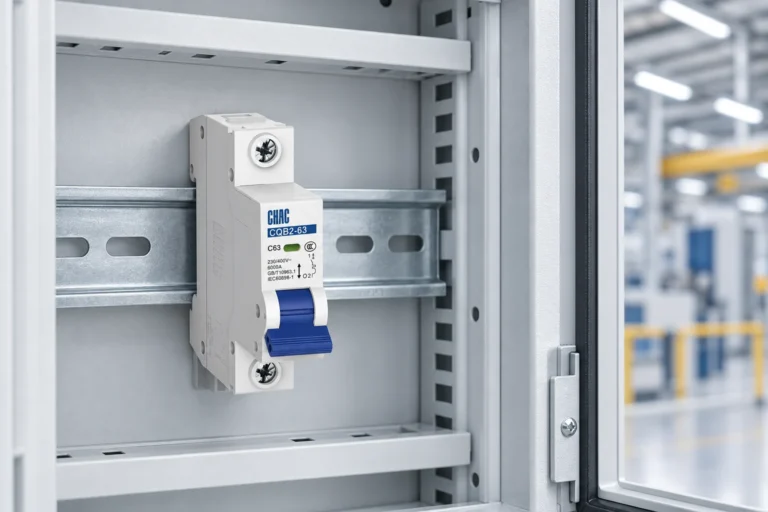
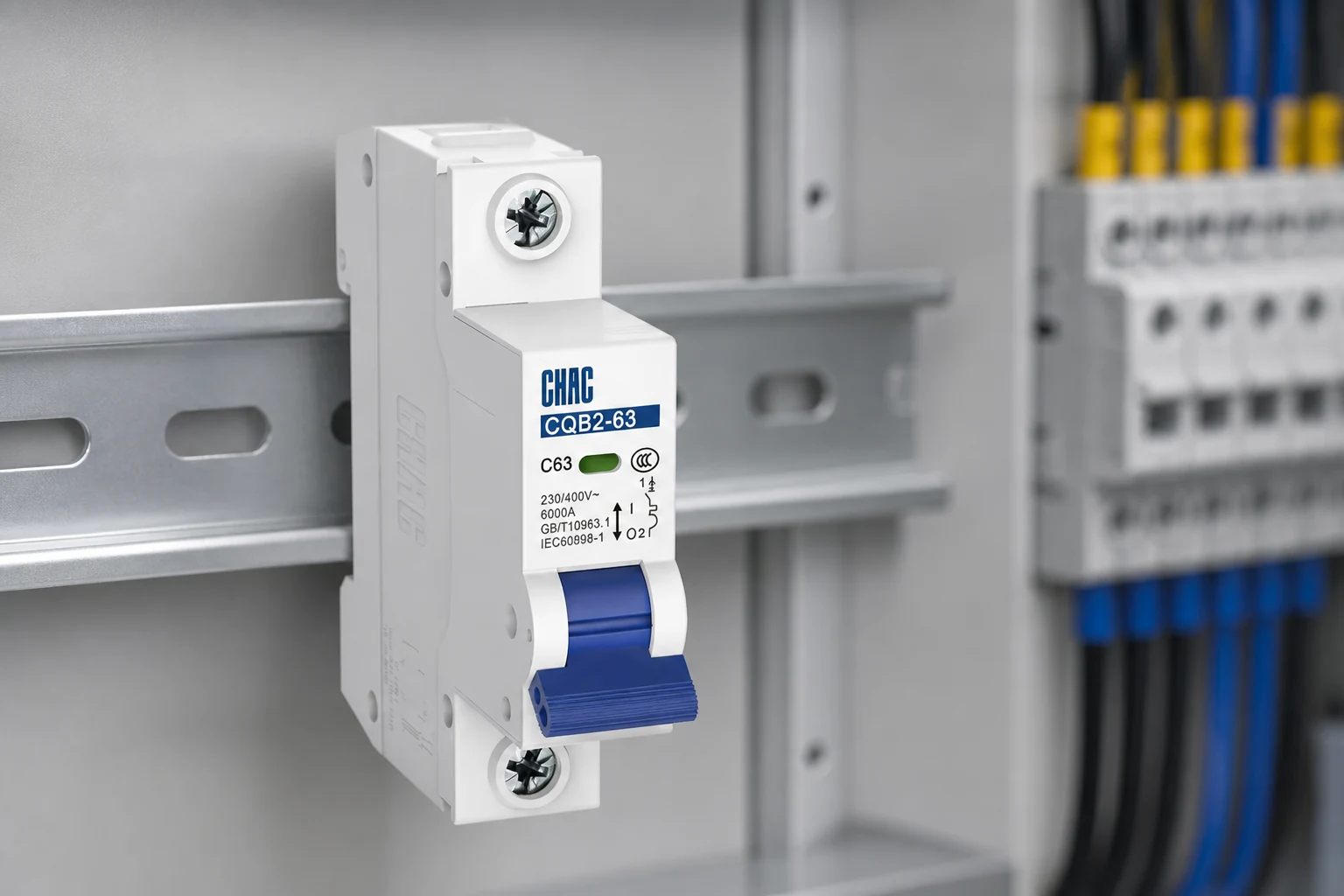
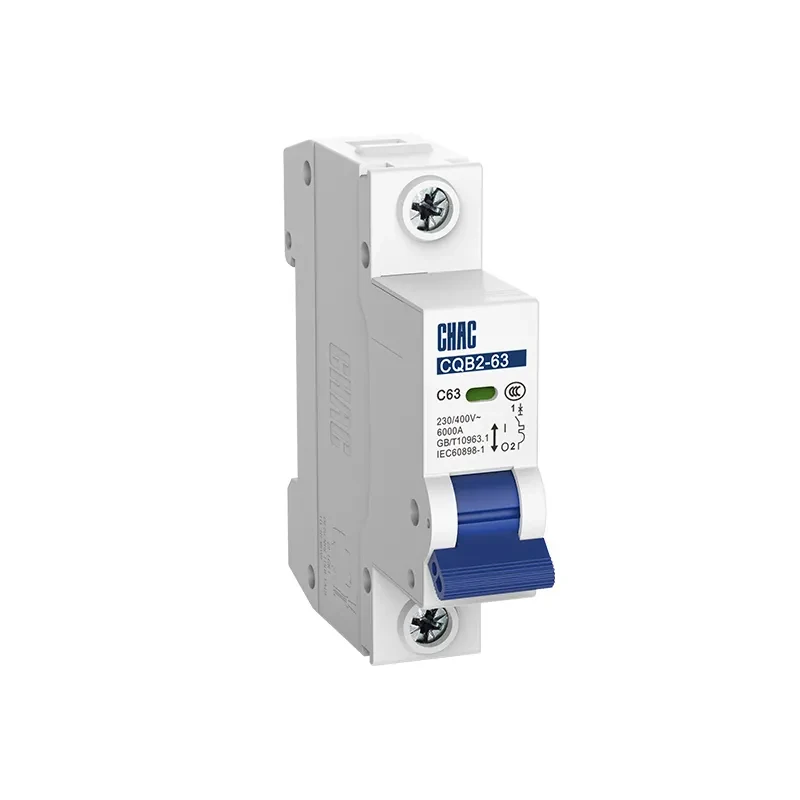
For documentation, CHAC Electric can review circuit rating, poles, fault level, protective function, trip history, and destination requirements. Use the CQB2-63 product information only after identifying the hidden load or fault path and confirming panel compatibility.
Questions about a breaker tripping with nothing plugged in
Can a breaker trip even if every appliance is unplugged?
Yes. The branch may still supply lights, alarms, controls, transformers, signs, fans, outdoor equipment, or other hardwired loads. It may also contain damaged wiring, moisture, or an unintended return path that operates AFCI or residual-current protection.
Does this always mean the breaker itself is bad?
No. Aging or heat damage can affect a breaker, but downstream faults and fixed loads must be ruled out first. Replacing the device without finding the cause can leave the hazard in place and produce the same trip again.
Why would the trip happen only during rain or overnight?
Rain can enter exterior fittings, while overnight cooling can create condensation in boxes and equipment. Both can lower insulation resistance or increase leakage, so weather and time records should guide inspection of outdoor and damp locations.
Can a shared neutral make one circuit trip when another circuit is used?
Yes, if neutrals are mixed, the return path is misidentified, or the protective device is not suitable or wired correctly for that branch arrangement. A properly designed multi-wire branch circuit is not inherently faulty, so circuit tracing and manufacturer instructions are essential.
What should a qualified electrician test first?
First identify the protection type and map every fixed load and branch section. Then use the trip pattern to choose among current measurement, termination inspection, neutral segregation, leakage-current assessment, continuity checks, and carefully prepared insulation-resistance testing.
When should I stop resetting the breaker?
Stop after an immediate repeat trip or whenever there is heat, odor, discoloration, buzzing, water, or visible damage. Keep the circuit isolated and arrange a qualified electrician; repeated resets can stress equipment and obscure evidence of the original fault.
References
- NFPA, NFPA 70, National Electrical Code, especially Articles 210.8 and 210.12 in the adopted edition.
- IEC, IEC 60364-6, Low-voltage electrical installations – Verification.
- IEC, IEC 61008-1 e IEC 61009-1 for residual-current protective devices and RCBOs.
- UL Standards, UL 1699, Arc-Fault Circuit-Interrupters.
The durable rule is simple: “nothing plugged in” is an observation, not a diagnosis; the answer lies in the entire branch, its environment, and the protective function that operated. When the evidence points to a replacement device, CHAC Electric can help you compare the required protective function and product documentation – contact the team before specifying a substitute.