Cenowa oferta na wyłącznik może odpowiadać klasie prądowej podanej na rysunku, a mimo to nie uzyskać akceptacji. Brak danych dotyczących prądu zrywania dla określonego napięcia, niezgodny typ rozdzielnicy lub niezatwierdzona jednostka odłączająca mogą opóźnić montaż nawet po dostarczeniu sprzętu. Wykonawcy ograniczają to ryzyko poprzez powiązanie każdego proponowanego elementu z dokumentacją projektową.
Wykonawcy instalacji elektrycznych wybierają wyłączniki niskiego napięcia, sprawdzając obciążalność obwodu, przewody, dostępny prąd zwarciowy, wymagania dotyczące zabezpieczeń oraz kompatybilność montażową. W zatwierdzonej dokumentacji technicznej powinno być dokładnie wskazane型号 wyłącznika, jednostka odłączająca oraz akcesoria. Zdjęcie z katalogu, ogólny certyfikat ani alternatywa o tej samej wartości prądu nie mogą zastąpić tych kontroli.
Jakie informacje powinny być dostępne przed wyborem wyłącznika?
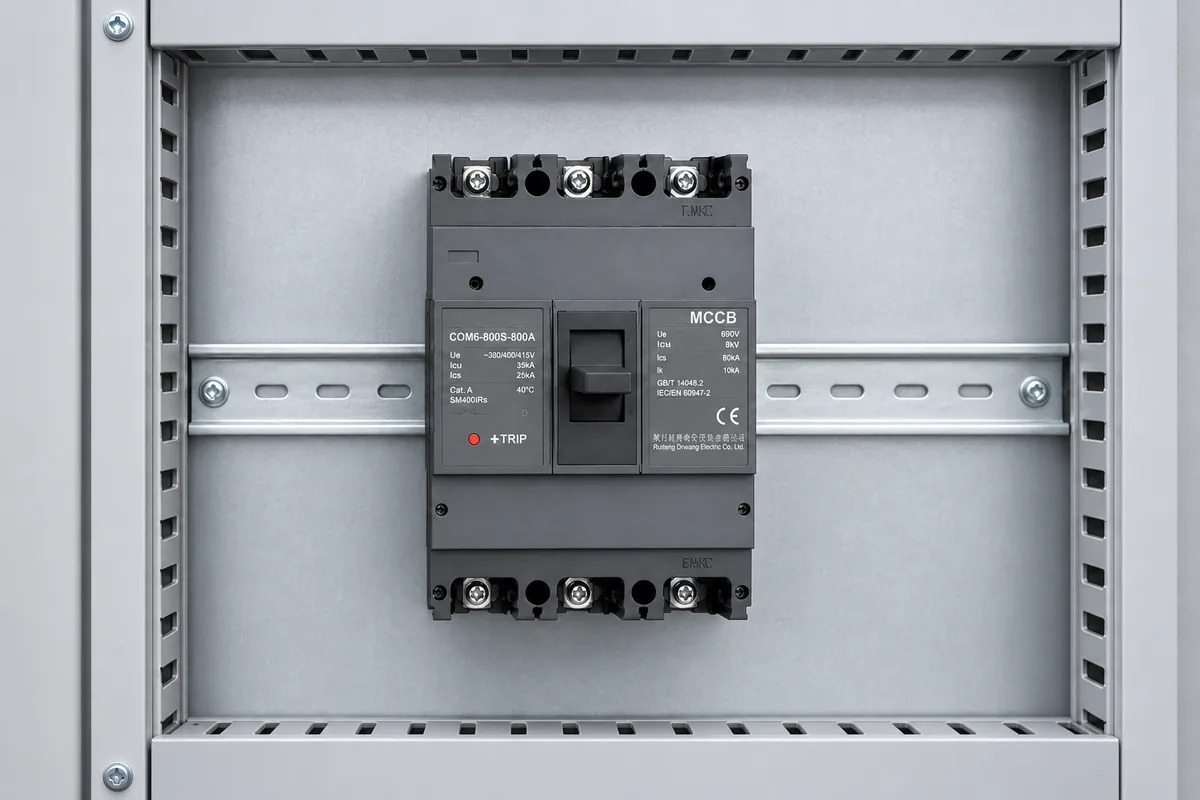
Rozpocznij od schematu jednoliniowego, harmonogramu obciążeń, projektu przewodów oraz odpowiednich specyfikacji projektowych. Określ napięcie, częstotliwość, liczbę faz i układ uziemienia. Następnie wyznacz potencjalny prąd zwarciowy w miejscu instalacji wyłącznika, zamiast przyjmować, że jest on taki sam we wszystkich częściach budynku.
Źródło zasilania ma znaczenie. Transformator sieciowy, generator lub inne źródło zasilania mogą generować różne warunki awaryjne i rozruchowe. Projekt uwzględniający tylko jeden tryb pracy może pomijać ograniczenia związane z zabezpieczeniami w innych trybach. Odpowiedzialny projektant powinien wyjaśnić te założenia przed zatwierdzeniem zakupu alternatywnych rozwiązań.
W jaki sposób rodzina wyłączników jest dopasowywana do obciążalności obwodu?
Low-voltage circuit breaker selection starts with function. A compact fixed-characteristic MCB may suit a final circuit, while an MCCB may provide the frame, terminals or adjustable trip needed for a feeder. Those are typical patterns, not automatic application rules. Motor, transformer and power-electronic loads may require additional consideration of starting, overload and coordination.
Product standard and installation code answer different questions. IEC 60898-1 and IEC 60947-2 have different scopes; a compact device can carry ratings under more than one standard. For North American work, the required listing and the assembly’s approved breaker types must also be established. See the MCB versus MCCB comparison for the device-family boundary.
Which ratings should be compared together?
| Submittal item | Evidence to review | Typical acceptance problem |
|---|---|---|
| Operating voltage and supply system | Exact nameplate and datasheet rating | Using a slash-voltage rating on an unsuitable system |
| Continuous current and trip setting | Load calculation, derating and selected trip unit | Confusing maximum frame size with the approved setting |
| Interrupting performance | Voltage-specific rating against calculated fault current | Comparing headline kA values without voltage or standard |
| Protection coordination | Curves and applicable selectivity or backup tables | Assuming different ampere ratings guarantee selectivity |
| Assembly compatibility | Panel instructions and approved mounting/connection arrangement | Accepting physical fit as approval |
| Accessories and terminals | Exact accessory references, coil supply and conductor data | Approving a base breaker while omitting the required interface |
The UL Solutions marking guide explains several of these distinctions, including slash-voltage applications, terminal requirements and the relationship between breaker interrupting ratings and the end-use assembly rating. These details can change whether two apparently similar offers are technically comparable.
Why is the panel’s short-circuit rating a separate check?
A component’s interrupting rating does not automatically become the rating of the assembled panel. Busbars, contactors, terminal systems and other components can constrain the permitted arrangement. Where a series rating or backup combination is used, the evidence must identify the applicable devices and conditions.
Short-circuit current rating should therefore be recorded at the appropriate assembly level, with the protective-device rating assessed separately. The OSHA 1910.303 requirements address interrupting capability and coordination of circuit characteristics for US workplaces. A component substitution that changes the approved combination needs review even when its individual kA number is higher.
What makes a breaker substitution technically reviewable?
Compare the proposed and specified devices in a short deviation schedule. Include the exact model, voltage, current or setting, fault rating, curve, poles, accessories, mounting and terminal data. Identify what changes in the drawing, enclosure layout or protection study if the substitute is accepted.
Availability should be reported separately from equivalence. An earlier delivery date is useful, but it does not close a technical deviation. The contractor, designer and supplier should know which assumptions have been accepted and which evidence is still outstanding.
Keep an approved reference after the substitution review. This prevents the field team receiving a third “equivalent” part that was never included in the approval.
What should the field team receive before installation?
Installation instructions should cover conductor materials and sizes, permitted terminal arrangements, tightening torque, clearances and accessory wiring. Do not infer a permission to double up conductors from the terminal’s apparent size. Use the manufacturer’s declared termination arrangement.
The handover package should also identify approved settings, circuit labels, required tests and the person authorized to approve changes. A current setting on an electronic trip unit is a design parameter; it should not be adjusted casually to eliminate a commissioning trip.
How can suppliers make the approval package more useful?
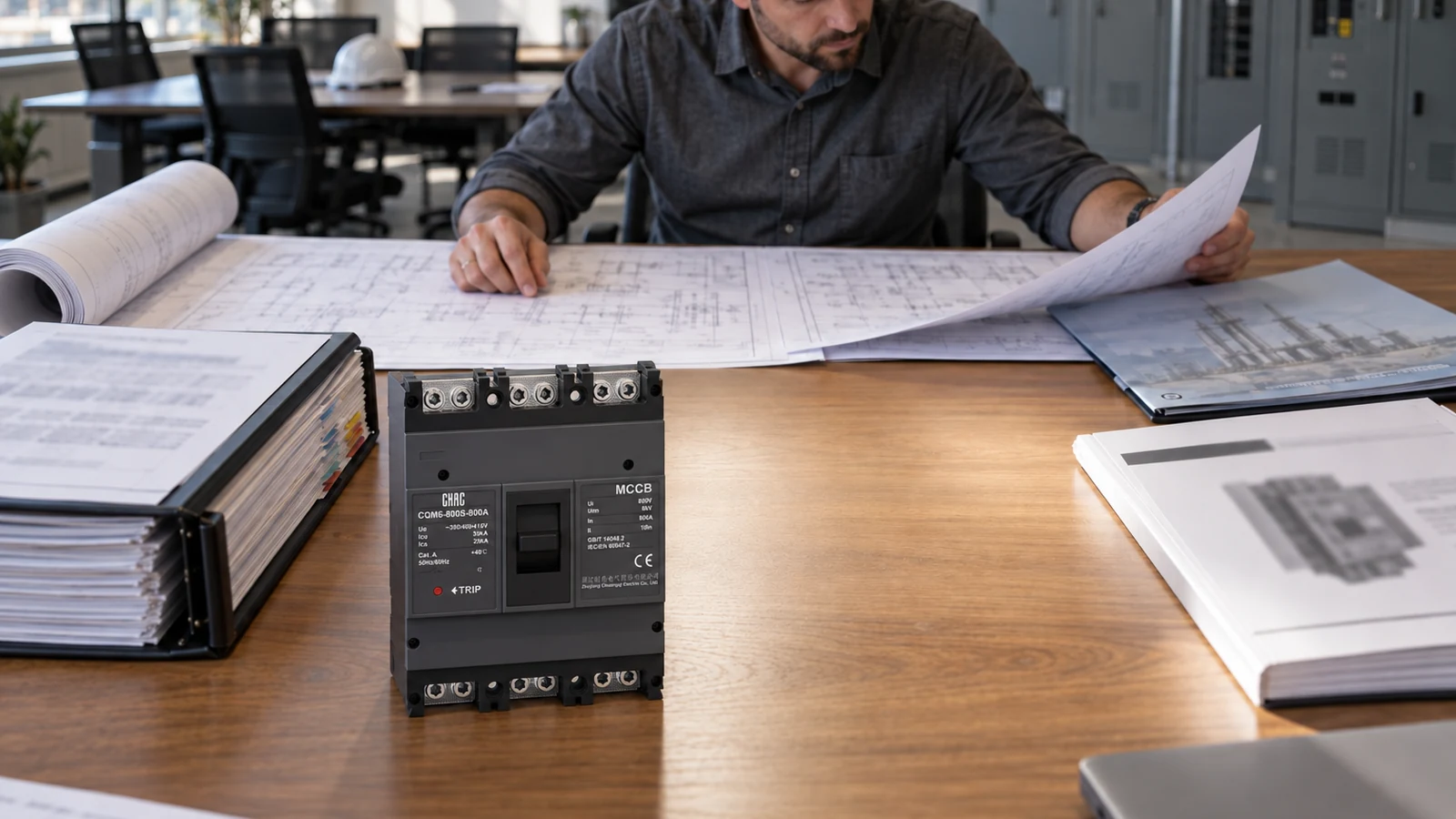
A supplier can provide a model-specific document set with the selected ratings, dimensional drawing, accessory schedule, installation instructions and applicable certificates. Any coordination claim should identify the exact combination and its limit. General brand claims should not be used as evidence for an unlisted configuration.
For a CHAC quotation, identify whether the project needs miniaturowe wyłączniki, molded-case circuit breakers or a documented distribution package. This lets the product review begin with the appropriate family while leaving project approval with the responsible reviewer.
What else should contractors clarify during approval?
Can the breaker be chosen from its ampere rating alone?
No. Voltage, fault current, trip behavior, poles, terminals and assembly compatibility are also required. Additional protection functions must be specified explicitly.
Does a larger frame mean a higher operating-current setting?
Not necessarily. Frame capability, trip-unit rating and selected protection setting are separate values. Record the exact configured device and approved setting.
Does a higher kA breaker improve the whole panel’s rating?
Not automatically. The assembly rating depends on the approved arrangement and other components. A higher component rating does not remove a lower assembly limit.
Are two breakers from the same brand automatically selective?
No. Selectivity depends on the exact devices, settings and fault-current range. Use the applicable coordination evidence.
What should a contractor’s breaker quotation include?
State the exact part references, ratings, accessories, supplied documents, delivery basis and exclusions. Identify proposed substitutions and any design assumptions requiring approval.
Which records should be retained after commissioning?
Keep the approved submittal, updated drawings, installed model references, settings, torque and test records, and the manufacturer’s maintenance instructions.
Przypisy
- UL Solutions: Złącze obwodowe w obudowie formowanej – przewodnik po znakowaniu i zastosowaniach — ratings, terminals, accessories and application limits.
- IEC 60947-2:2024: low-voltage circuit breakers — official product-standard scope.
- IEC 60898-1:2015+AMD1:2019: AC breakers for household and similar installations.
- OSHA 1910.303: electrical equipment suitability and rating requirements.
What makes the final breaker choice defensible?
The final choice is defensible when the installed part can be traced back to the circuit design and the approved assembly. Establish the operating conditions, verify current and fault duty, then check protection coordination and physical interfaces. Resolve substitutions before installation, and pass the approved settings and instructions to the field team. Do not let a catalogue screenshot or general certification claim stand in for model-specific evidence. A complete circuit breaker submittal also makes future replacements more straightforward because the original acceptance basis remains available. Where enclosure and distribution integration are involved, CHAC’s indywidualizacja dystrybucji energii elektrycznej provides a route for reviewing the documented package requirements.