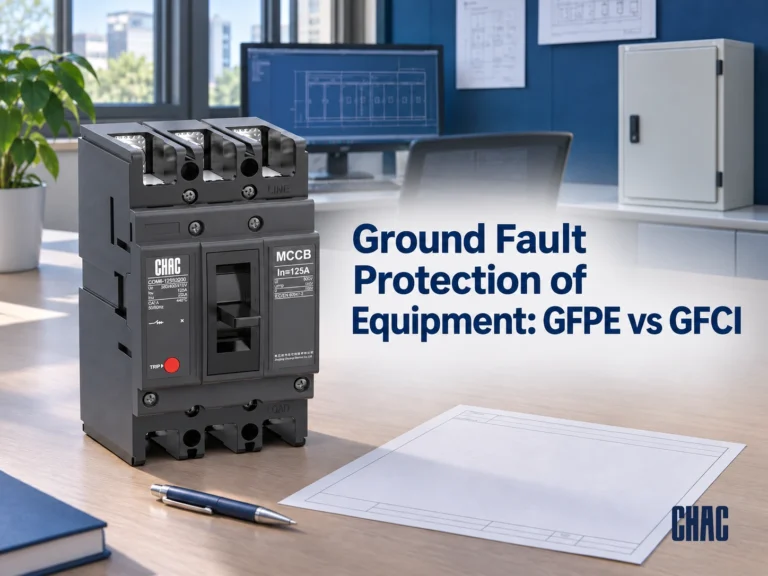
Obwód może przewodzić całkowicie normalne obciążenie, a mimo to nadal wystąpić problem związany z zwarciem na ziemię. Dlatego też urządzenie GFCI może się wyzwolić, podczas gdy zwyczajny wyłącznik nadprądowy pozostaje włączone, a zwiększenie jego klasy zabezpieczającej nie rozwiązuje tego problemu. Oba urządzenia reagują na różne warunki. Dla projektantów praktycznym wyzwaniem jest określenie, która funkcja ochronna jest wymagana, w jakim miejscu ma działać oraz czy wybrane urządzenie posiada odpowiednie atesty. Niniejszy przewodnik omawia zasadę równowagi prądowej na przykładzie typowych pytań dotyczących instalacji i usuwania awarii, ze szczególnym uwzględnieniem amerykańskich wymagań dotyczących urządzeń GFCI klasy A oraz różnorodnej terminologii stosowanej w odniesieniu do urządzeń różnicowo-prądowych IEC.
A Wyłącznik różnicowoprądowy klasy A Monitoruje bilans prądu w przewodnikach obwodu. Jeśli wystarczająca ilość prądu powraca nieprzewidzianą drogą, urządzenie otwiera zabezpieczony obwód zgodnie z kryteriami działania. Opublikowane wytyczne Leviton określają próg UL 943 klasy A na poziomie 4–6 mA. Nie jest to nominalny prąd obciążeniowy obwodu rozdzielczego i nie oznacza, że urządzenie chroni przed każdym możliwym porażeniem. Wybierz zatwierdzony typ GFCI, zweryfikuj zabezpieczony obwód i przeprowadź test zgodnie z instrukcjami producenta. Nie należy mylić klasy UL A z klasyfikacją kształtu fali IEC typu A.
Jak niewielka nierównowaga prądów powoduje wyzbycie?
W zaprojektowanym obwodzie prądy przepływające przez układ pomiarowy są zrównoważone. Czynnik wycieku, który powraca poza ten układ, powoduje wystąpienie prądu różnicowego. Urządzenie reaguje, gdy to zaburzenie równowagi spełnia jego warunki działania. Jego funkcje pomiarowe i odłączające są odrębne od mechanizmu przeciążeniowego zwykłego wyłącznika.
To wyjaśnia przeznaczenie wyłączników różnicowoprądowych: ochrona personelu przed określonymi stanami zwarć doziemnych, a nie ochrona przewodów przed każdym nadmiernym obciążeniem. W obwodzie 20 może wystąpić kilka miliamperów prądu wycieku bez wywołania przeciążenia. Z drugiej strony, zrównoważone przeciążenie może wymagać działania zwykłego urządzenia przeciwprądowego bez spowodowania uruchomienia GFCI. Publikacja Wytyczne Leviton klasy A Zapewnia próg i kontekst aplikacji.
| Stan | Co ocenia ochrona | Kluczowa różnica |
|---|---|---|
| Nadmierne obciążenie | Prąd i czas trwania w stosunku do urządzenia przeciwprzepięciowego | Może wystąpić przy zrównoważonych prądach wychodzących i powrotnych. |
| Wyciek prądu zwarcia na ziemię | Pozostałe niezrównoważenie w monitorowanym obwodzie | Może wystąpić znacznie poniżej klasy obciążeniowej gałęzi. |
| Krótkie spięcie | Prąd zwarciowy i charakterystyki urządzenia przeciążeniowego | Wymaga odpowiedniej zdolności przerwania obciążenia |
| Łuk elektryczny | Funkcja wykrywania określona dla AFCI | Not automatically provided by a GFCI |
What does the 4–6 mA Class A range mean?
It describes personnel-protection sensitivity in the relevant US product standard, not an adjustable target for an installer. Do not replace a required Class A GFCI with a higher-threshold equipment-protection device to avoid trips. Nor should a single universal trip time be inferred from the current band: operating-time requirements depend on the applicable test conditions and standard.
An IEC Type A RCD designation concerns the residual-current waveforms the device is intended to detect. A common 30 mA IEC application is therefore not evidence of a UL 943 Class A device. Buyers should request the exact standard, residual-current rating, approval and operating instructions instead of matching the letter A on two unrelated data sheets.
How can a small imbalance exist on an otherwise normal load?
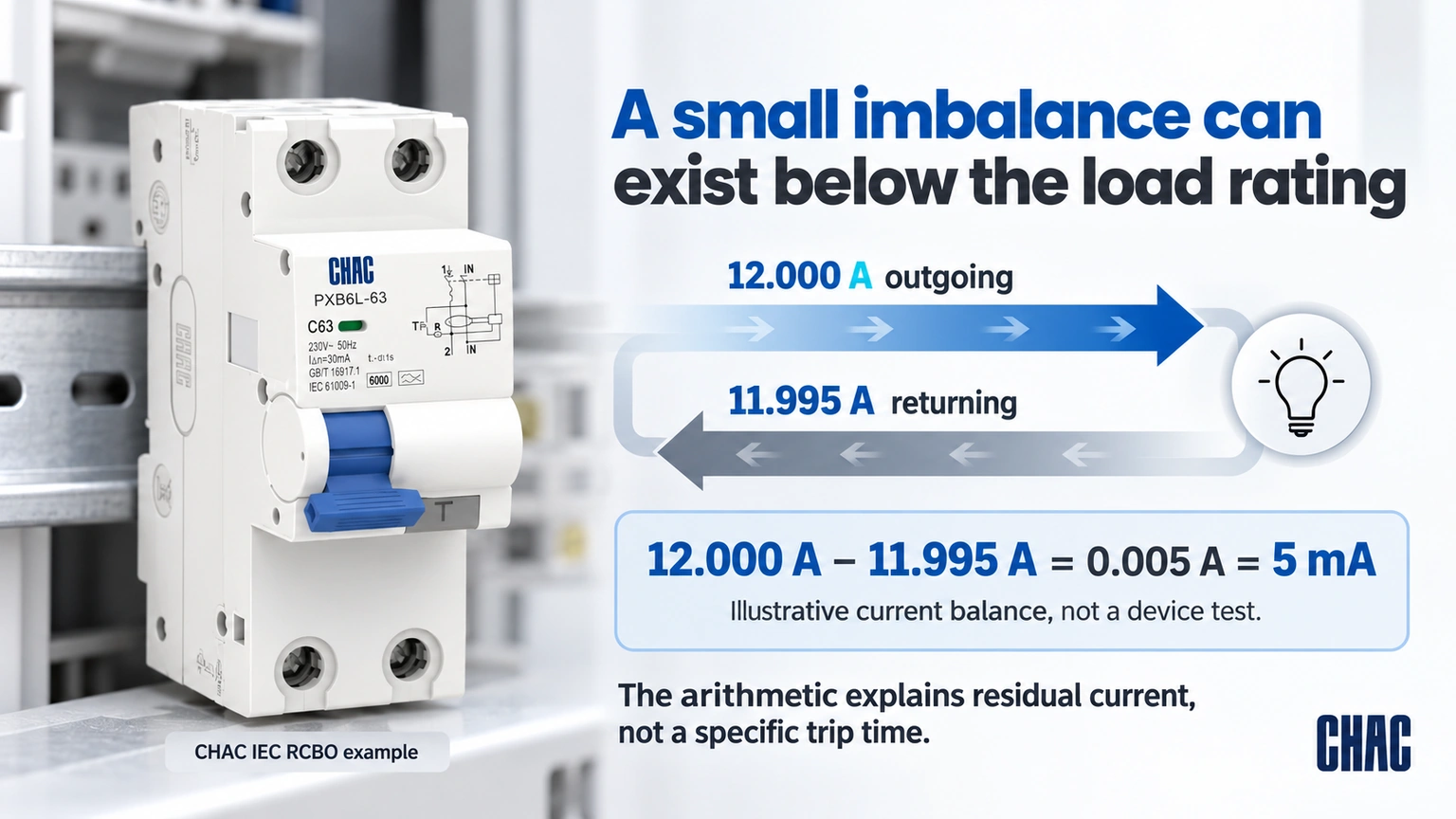
Consider an illustrative current-balance calculation, not a field test: assume 12.000 A flows out through the monitored path and 11.995 A returns through that path under the same reference conditions. The difference is 0.005 A, or 5 mA, despite the total load being below 15 A. This explains why an ordinary overcurrent device may remain closed while Class A ground-fault protection operates.
Do not turn that arithmetic into a test procedure or a universal trip-time prediction. Real residual current can have different waveforms and frequency components, and a casual comparison of two ordinary meter readings may not resolve milliamperes accurately. Qualified personnel need a suitable measurement method and the exact device criteria. UL’s high-frequency guidance is especially relevant when power-conversion equipment is involved; a nominal current calculation does not establish the behavior of every waveform.
Why can shared neutrals and downstream faults complicate troubleshooting?
A neutral connected outside the intended sensing arrangement can prevent the device from seeing a balanced circuit. Shared-neutral circuits need a specifically suitable protective arrangement and correct installation. The answer is not to disconnect required grounding, join neutral and ground downstream or bypass the sensing function.
Na rzecz GFCI circuit breakers, panel compatibility and neutral routing are important parts of selection. Some models use different connection arrangements. Use the exact instructions and have qualified personnel trace the circuit before replacing components. A generic online diagram should not override the product’s permitted wiring method.
| Objaw | Potential investigation | What not to conclude |
|---|---|---|
| Przerywanie obwodu w wyniku działania innego obwodu | Shared or misrouted neutral | The trip threshold should be increased |
| Trips during cleaning or wet weather | Moisture and insulation condition | A reset alone removes the cause |
| Trips with modern electronic equipment | Actual leakage and device suitability | All such trips are nuisance trips |
| Will not reset after installation | Power, LINE/LOAD arrangement and protection status | The reset button proves the device is defective |
How should testing and reset checks be handled?
Modern electronic loads deserve a more specific question than whether the device is “too sensitive.” UL’s guidance on high-frequency GFCIs explains that the August 2025 revision of UL 943 introduced an optional HF rating under Supplement SB. It addresses evaluation of devices exposed to high-frequency leakage associated with inverter-driven equipment. Check whether the selected product actually carries the relevant HF marking and suits the application. This is not a property of every Class A GFCI, and it is not permission to bypass required protection or dismiss an unexplained trip. Local adoption of the 2026 NEC must also be checked separately.
Follow the model’s instructions for its TEST button, reset procedure and test interval. Auto-monitoring does not eliminate every user or maintenance test specified by the manufacturer. Leviton’s GFCI support guidance explains self-test functions and why a device may lock out resetting when protection cannot be provided.
After an unexplained trip, establish whether the fault is associated with an appliance, fixed wiring, moisture or the protective device. Repeated operation should prompt investigation. Pool circuits and other specialized locations need the applicable installation rules and equipment requirements; the presence of any GFCI is not a complete pool-safety design.
What information makes an intermittent GFCI trip easier to investigate?
Record the operating stage rather than writing only “trips sometimes.” Note whether the event occurs at startup, during a heating or washing cycle, after cleaning, or when another connected load operates. Include the device model, indicated trip condition, affected outlets and recent wiring or appliance changes. Do not reproduce a suspected fault by repeatedly resetting the device or deliberately exposing equipment to moisture.
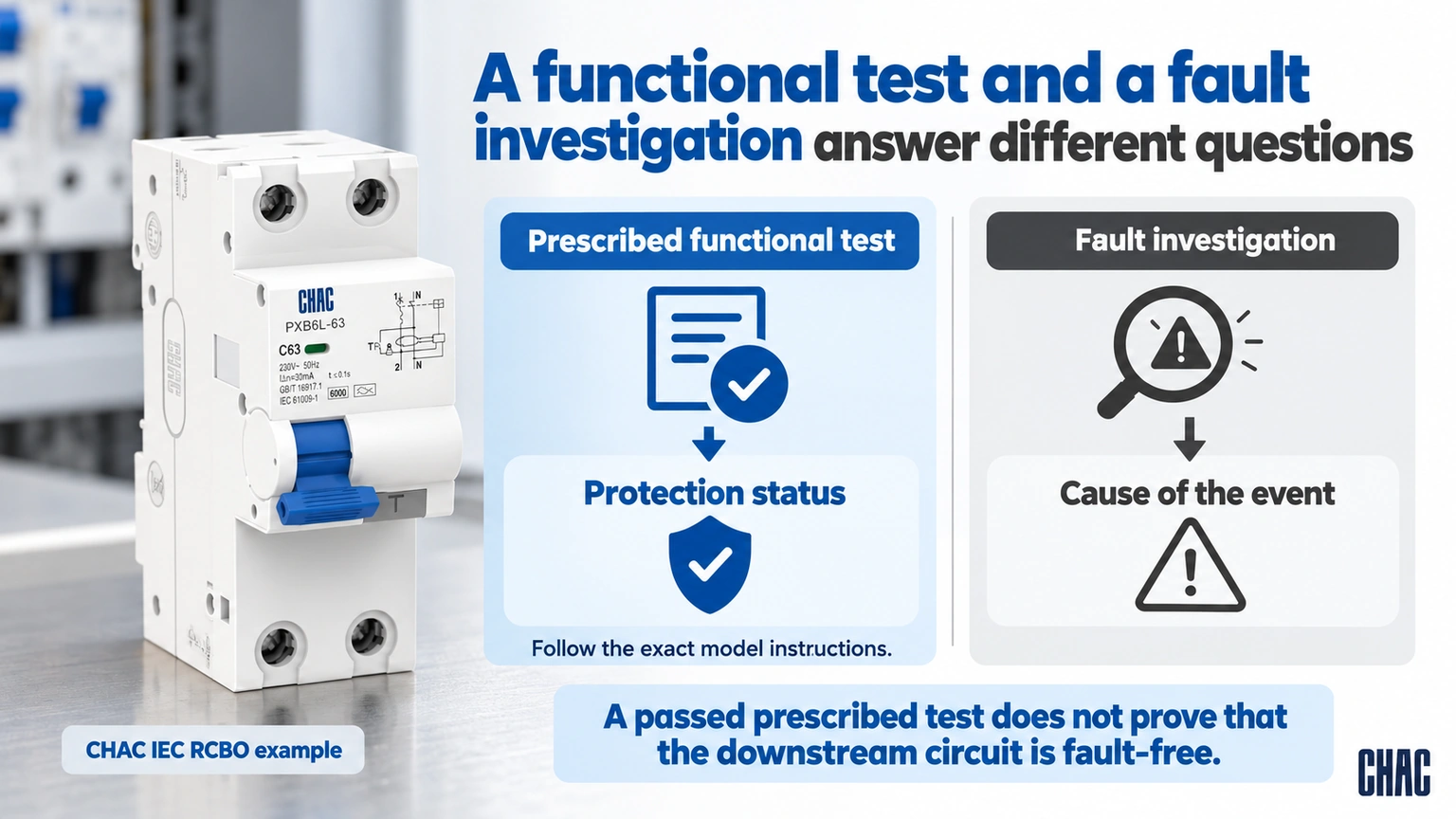
Keep the manufacturer’s functional test result separate from the fault investigation. A device that passes its prescribed TEST/RESET sequence can still disconnect because a real downstream problem exists. Conversely, a failed prescribed test or reset lockout needs the action specified by that manufacturer. Comparing these two records helps the investigator distinguish protection status from the conditions that triggered operation, without declaring an intermittent event harmless or assigning a diagnosis from its timing alone.
Which documents should an international buyer compare?
Compare the requested market approval, supply voltage, load rating, protected poles and residual-current characteristics. CHAC’s electronic RCBO i electromagnetic residual-current breaker pages are useful model records for IEC product evaluation. Neither link should be treated as a claim of UL Class A approval. Confirm the exact device documents for the destination installation.
What are the common Class A GFCI questions?
How much does an electrician charge to install a GFCI breaker?
There is no defensible universal price. Panel compatibility, circuit tracing, access, permits, local labor and any wiring correction affect the quotation; request an itemized site-specific estimate.
Is a GFCI a class a device?
US personnel-protection GFCIs are commonly specified as Class A under UL 943. Verify the actual marking and approval; equipment ground-fault protection and IEC Type A terminology describe different requirements.
What does a class a GFCI trip at?
Leviton identifies the UL 943 Class A threshold as 4–6 mA. This residual-current sensitivity is separate from the amperage rating of the circuit.
Is there a difference between a GFI and a GFCI?
GFI is often used as an informal shortening of GFCI. For an order or design, specify the exact device type, standard and protective function rather than relying on the abbreviation.
What is a Class A ground fault circuit interrupter and how does it work?
It is a personnel-protection device that detects a qualifying imbalance in the monitored circuit currents and interrupts the circuit. It still requires correct installation and suitable accompanying overcurrent protection.
Where is a Class A ground fault circuit interrupter required?
The adopted installation code, occupancy, equipment and local amendments define the requirement. Wet-location and other specified circuits are common applications, but there is no single location list valid for every jurisdiction.
Przypisy
- Leviton GFCIs for Personnel Safety, including dated code examples; accessed October 19, 2026
- Leviton GFCI Outlets and Receptacles, self-test and troubleshooting guidance; accessed October 19, 2026
- Leviton commercial GFCI receptacles; accessed October 19, 2026
- UL Solutions: High-Frequency Ground-Fault Circuit Interrupters; accessed October 19, 2026
Wniosek
Evaluate GFCI protection by the fault it is intended to detect, not by whether its current rating resembles the ordinary breaker beside it. Confirm the required personnel-protection class, the device approval and the complete protected circuit before installation. If it trips, investigate the current imbalance and circuit arrangement rather than raising a threshold or bypassing protection. Keep US Class A terminology separate from IEC waveform types, and follow the actual model instructions for testing and reset. CHAC provides model-specific residual-current and overcurrent product information for IEC distribution projects. Comparing those documents with the destination requirements helps buyers identify the correct product category without implying an approval that has not been demonstrated.
W przypadku odpowiednich rysunków modelowych i dokumentacji projektowej, Skontaktuj się z CHAC w sprawie wymagań dotyczących obwodu..