

A breaker can remain on while a dangerous leakage current flows. That is why choosing between a circuit breaker and a ground-fault circuit interrupter starts with the hazard being addressed, rather than the current number printed on the handle.
An ordinary circuit breaker provides overload and short-circuit protection. A GFCI detects an imbalance between outgoing and returning current to reduce electric-shock risk. Some breakers combine both functions, but a receptacle GFCI does not replace the branch circuit’s overcurrent protection. For an actual specification, identify the required functions, destination standard, panel compatibility and installation rules separately.

Why might an ordinary circuit breaker fail to interrupt a shock current?
A thermal-magnetic breaker responds to current through its protected poles. Its thermal element responds to sustained overload, while its magnetic mechanism responds to sufficiently high short-circuit current. A leakage path can expose a person to a hazardous current that is still far below the breaker’s normal operating current. Overcurrent protection alone therefore cannot be treated as GFCI protection.
A ground-fault circuit interrupter compares current flowing out with current returning through the intended circuit conductors. An imbalance can indicate an unintended path through equipment, earth or a person. Its operating threshold and time characteristics belong to the particular product standard and device class.
O UL Solutions circuit-breaker marking guide identifies Class A circuit-breaker/GFCI devices and states a maximum ground-fault trip threshold of 6 mA. It also warns that protection does not extend to contact with more than one circuit conductor. A GFCI is an additional protective function, not permission to work on energized equipment.
How do a standard breaker, GFCI breaker and RCBO differ?
| Dispositivo | Function to verify | Important limitation |
|---|---|---|
| Ordinary overcurrent breaker | Overload and short-circuit protection | No GFCI function unless specifically provided and marked. |
| Receptacle GFCI | Ground-fault protection at the receptacle and correctly connected protected downstream points | The circuit still needs suitable overcurrent protection. |
| GFCI circuit breaker | Combined overcurrent and ground-fault functions | Must be suitable for the panel, circuit and required device class. |
| Disjuntor Diferencial Residual | Residual-current protection without integral overcurrent protection | Needs coordinated overcurrent protection. |
| Disjuntor Diferencial Residual | Residual-current and overcurrent protection in one device | IEC terminology does not establish equivalence to a US-listed GFCI breaker. |
| AFCI or dual-function device | Arc-fault protection and any separately declared GFCI function | “Combination AFCI” alone does not mean AFCI plus GFCI. |
That last distinction matters when reading a purchasing schedule. In UL terminology, a combination-type AFCI designation concerns its arc-fault protection. A device providing both AFCI and GFCI protection must explicitly identify both functions. The appearance of a TEST button is not enough to determine what the device detects.
Is a 30 mA RCD interchangeable with a US Class A GFCI?
No. “RCD” is a broad residual-current device term used in IEC-based practice. A 30 mA residual-current rating and a US Class A GFCI designation describe different requirements. The rated residual operating current, operating time, waveform response, voltage and product approval all need to match the installation.
O IEC 61008-1:2024 official abstract explicitly describes RCCBs as devices without integral overcurrent protection. That distinction remains important even when the RCCB has a substantial ampere rating: its load-current rating does not turn it into an overload-protective breaker. The related RCBO versus RCCB comparison explains how combined and separate protection arrangements differ.
Does a GFCI need a ground wire to detect leakage?
Residual-current sensing compares the circuit’s current-carrying conductors; it does not use the equipment-grounding conductor as the normal return path. This explains why a GFCI can detect an imbalance without that conductor. It does not mean that the device creates an equipment ground or removes grounding, bonding and labeling requirements.
Existing ungrounded installations require a code-specific assessment. A permitted receptacle replacement arrangement is not the same as upgrading the wiring to provide an equipment-grounding conductor. For the fault-path distinction, see the ground fault versus short circuit guide.
Why can a GFCI trip when the ordinary breaker stays on?
It may be detecting exactly the hazard that the ordinary breaker is not designed to detect. Moisture, damaged insulation, an appliance fault or an incorrect neutral arrangement can create residual current while the overall load current remains normal. Several electronic loads can also contribute standing leakage, making a circuit-level assessment more useful than repeatedly replacing the protective device.
A qualified electrician should identify the device that operated and use any manufacturer-provided trip indication. Shared neutrals, downstream neutral-to-ground connections and incorrect line/load connections require investigation against the approved wiring diagram. Calling an unexplained event a “nuisance trip” before finding the cause can conceal a real fault.
What should be checked when specifying combined protection?
- State whether the circuit needs overcurrent, personnel ground-fault, equipment ground-fault and/or arc-fault protection.
- Confirm the adopted installation code and the required product certification for that market.
- Match voltage, poles, neutral arrangement and interrupting rating to the actual circuit.
- Verify the panel’s approved devices and the exact accessory or combined-function configuration.
- Include the manufacturer’s testing instructions and a commissioning record.
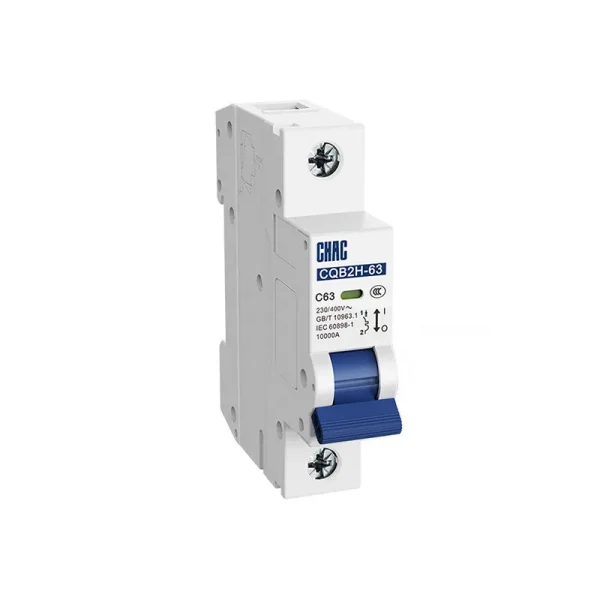
Um overcurrent circuit breaker remains a distinct component when leakage protection is provided separately. CHAC’s Disjuntor em miniatura CQB2H-63 is a product reference for that discussion; this article does not establish GFCI functionality or US listing for that model.
What else do buyers ask about GFCI protection?
Is a GFCI the same as a breaker?
No. A receptacle GFCI detects ground-fault imbalance. A GFCI circuit breaker combines that function with overcurrent protection. Check the exact device marking.
Can a GFCI be used as the only circuit breaker?
A receptacle GFCI cannot replace the required overcurrent breaker. A suitably approved GFCI breaker can provide both functions when its ratings and panel compatibility meet the installation requirements.
What does GFCI stand for?
GFCI stands for ground-fault circuit interrupter. It is different from an AFCI, which detects specified arcing conditions.
Does “combination AFCI” mean that GFCI protection is included?
No. Combination-type AFCI is an arc-fault designation. Confirm explicit GFCI or dual-function markings before assuming that ground-fault personnel protection is included.
Why does a GFCI trip with no appliance plugged in?
The protected circuit may include fixed equipment, downstream wiring or additional outlets. Moisture, wiring damage or an incorrect neutral connection can also cause an imbalance. A no-load appearance does not prove that the circuit is fault-free.
Does pressing TEST check the entire grounding system?
No. Follow the manufacturer’s instructions for the internal test function. A successful button test does not establish that every downstream connection, grounding path or required installation test is satisfactory.
Referências
- UL Solutions: Molded Case Circuit Breaker – Marking and Application Guide — combined GFCI/AFCI functions, markings and application limits.
- IEC 61008-1:2024: RCCBs without integral overcurrent protection — official scope and edition information.
- NFPA 70, National Electrical Code: official standard information — check locally adopted GFCI requirements.
How should the protection arrangement be chosen?
The decisive question is which fault each device can detect. Establish the required protection functions first, then check the circuit voltage, neutral arrangement, available fault current and panel approval. A larger ampere rating cannot compensate for a missing leakage function, and an IEC residual-current rating cannot be substituted for a US GFCI requirement without the required product evidence. Keep the testing and maintenance instructions with the circuit records so that future replacements preserve the same protection. For IEC-based projects, CHAC’s RCBO options offer a relevant starting point for reviewing combined residual-current and overcurrent protection; suitability still depends on the exact model and installation.


