A buyer uses a transformer’s 1 MVA nameplate and calculates about 52 A for the incoming circuit. That result is then copied into the low-voltage switchboard schedule, where the expected full-load current is actually about 1,443 A. This illustrative error comes from using the high-voltage winding value on the low-voltage side.
Resumo: For a balanced three-phase system, the MVA formula is S(MVA) = √3 × VLL(kV) × I(A) ÷ 1,000. Use line-to-line voltage and line current. One MVA equals 1,000 kVA; the same apparent power produces very different current at different voltages.
What MVA measures and how it converts to kVA
MVA means megavolt-amperes, a unit of apparent power. Apparent power represents the voltage-current loading of electrical equipment. It is different from active power, expressed in watts, and from energy, expressed in units such as kilowatt-hours.
When a specification uses MVA in an electrical rating, identify the equipment and operating conditions attached to that rating. A transformer nameplate rating, a calculated load and a short-circuit level expressed in MVA are not interchangeable quantities simply because they share a unit.
| Quantity | Conversion or relationship | O que descreve |
|---|---|---|
| 1 kVA | 1,000 VA | Apparent power |
| 1 MVA | 1,000 kVA = 1,000,000 VA | Apparent power at a larger scale |
| 1 MW | 1,000 kW = 1,000,000 W | Potência ativa |
| Fator de potência | Active power ÷ apparent power | Relationship between useful active power and voltage-current loading |
| 1 MWh | 1 MW sustained for one hour | Energy, not instantaneous power |
The conversion between MVA and kVA is purely a unit conversion. No power factor is needed. Converting MVA to MW is different because active power depends on power factor. Keeping those two operations separate prevents a common error in load schedules.
For a single-phase circuit, apparent power is S(VA) = V × I using the appropriate RMS voltage and current. The balanced three-phase expression includes √3 because it combines the three phases while using line quantities. Do not add that factor to a single-phase calculation.
Calculate three-phase MVA using line-to-line voltage and line current
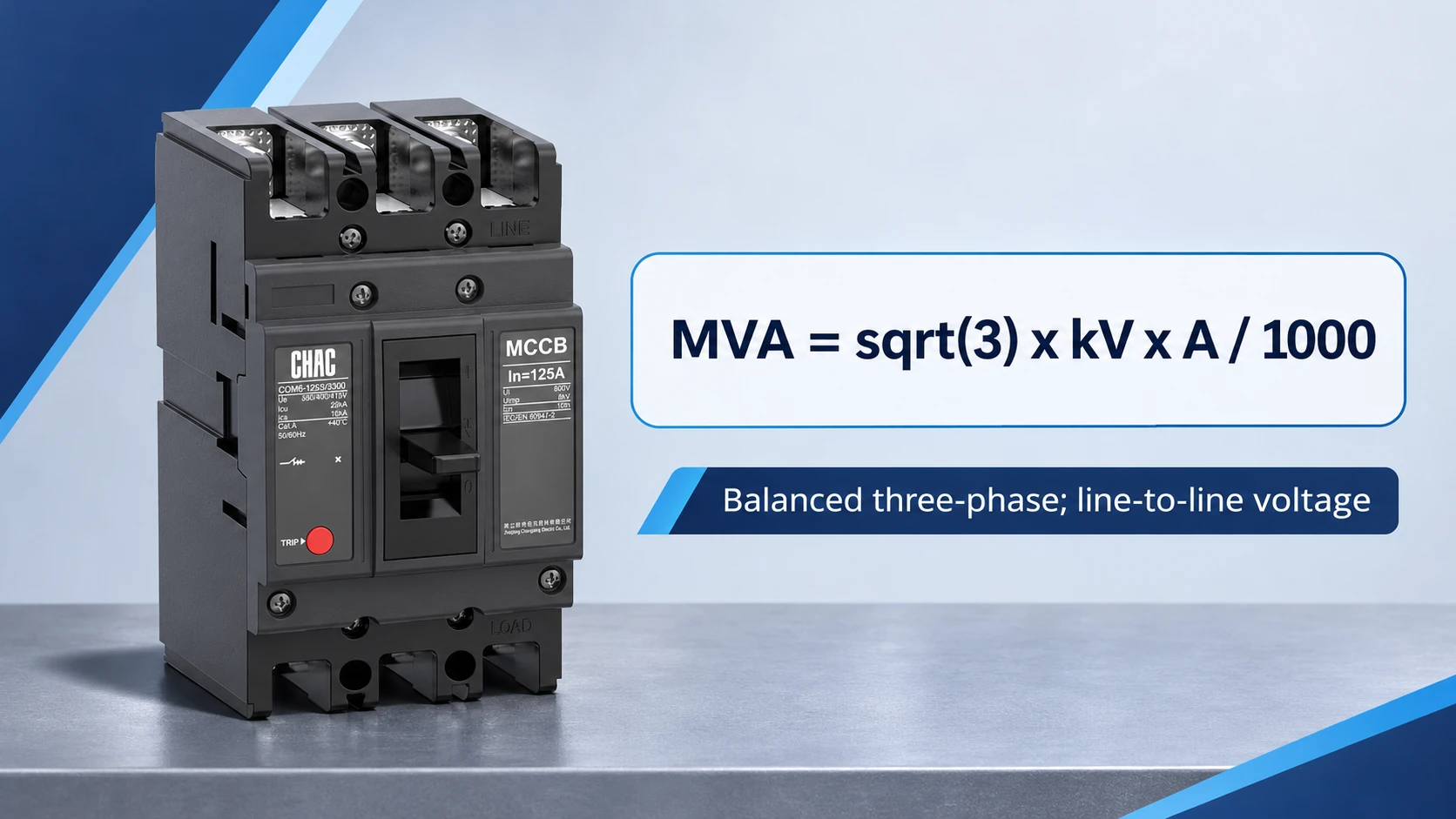
With voltage in volts and current in amperes, balanced three-phase apparent power is S(VA) = √3 × VLL × IL. Divide by 1,000,000 for MVA. If voltage is already in kilovolts, divide the product by 1,000 instead.
The subscript LL means line-to-line voltage. For a balanced wye supply, line-to-neutral voltage is lower by a factor of √3. Using line-to-neutral voltage in a formula that expects line-to-line voltage produces a result that is too small.
There is an equivalent phase-based expression: S = 3 × Vphase × Iphase for a balanced system. However, phase and line currents differ in a delta connection. Use one consistent set of quantities rather than mixing a phase voltage with a line current and hoping the connection factors cancel.
For a worked example, take a hypothetical balanced load at 400 V line to line and 100 A line current. S = √3 × 400 × 100 = approximately 69,282 VA, or 69.28 kVA, or 0.06928 MVA. The same calculation using 0.4 kV gives √3 × 0.4 × 100 ÷ 1,000 = 0.06928 MVA.
That calculation describes the stated operating point. It does not establish conductor ampacity, protection settings or permissible continuous loading. Those depend on equipment ratings, installation conditions and applicable design rules.
How to calculate current on each transformer winding from its MVA rating
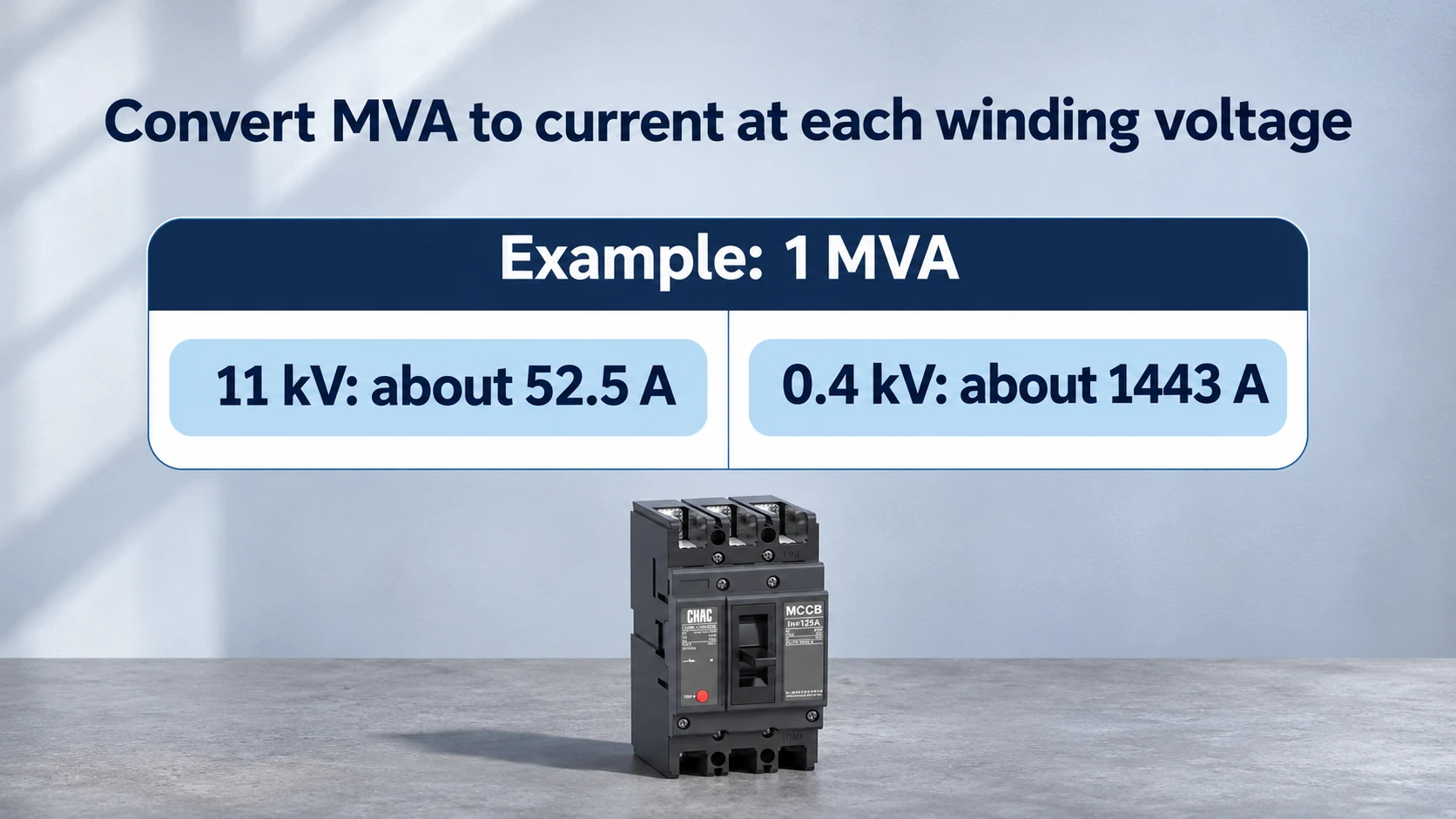
Rearrange the formula to I(A) = S(MVA) × 1,000 ÷ [√3 × VLL(kV)]. For an idealized 1 MVA three-phase transformer, use the voltage of the winding whose current you want. The power rating remains the reference, but the current changes inversely with voltage.
| Illustrative rating | Tensão de linha a linha | Cálculo | Approximate full-load line current |
|---|---|---|---|
| 1 MVA | 11 kV | 1,000 ÷ (√3 × 11) | 52.49 A |
| 1 MVA | 0.4 kV | 1,000 ÷ (√3 × 0.4) | 1,443.38 A |
| 0.5 MVA | 0.4 kV | 500 ÷ (√3 × 0.4) | 721.69 A |
| 2 MVA | 11 kV | 2,000 ÷ (√3 × 11) | 104.97 A |
These are balanced, idealized nameplate-current calculations. Transformer losses, actual loading, tap position and operating voltage affect real measurements. For purchasing and commissioning, compare the calculation with the manufacturer’s nameplate and approved design documents.
Full-load current is not short-circuit current. Fault-current assessment requires source and transformer impedance, network configuration and other relevant data. Selecting an interrupting rating from the full-load current alone is an entirely different and unsafe interpretation of the formula.
Likewise, a 1,443 A calculated load does not automatically select one breaker frame or trip setting. Continuous loading, cable or busbar ratings, temperature, protection coordination and the required fault duty must be reviewed. The arithmetic is an input to equipment selection, not the completed selection.
How power factor relates MVA to MW and Mvar
Active power is P(MW) = S(MVA) × power factor. A hypothetical 1 MVA load at 0.8 power factor therefore uses 0.8 MW of active power. At 0.95 power factor, the same 1 MVA apparent power corresponds to 0.95 MW.
For sinusoidal conditions described by the conventional power triangle, reactive power is Q(Mvar) = √[S(MVA)² − P(MW)²]. At 1 MVA and 0.8 MW, this gives 0.6 Mvar. The sign or direction of reactive power requires the relevant leading or lagging convention.
Where harmonics or unbalance are significant, the simple triangle and balanced formula need more careful treatment. Total power factor is not always the same as the cosine of a single phase angle. Use suitable measurements and the relevant engineering method rather than forcing a distorted waveform into an ideal sinusoidal example.
Power factor is also not efficiency. A motor can have one value for electrical power factor and another for conversion efficiency. If calculating electrical input from mechanical output, account for efficiency at the correct step; do not replace it with power factor.
Check voltage and current units before specifying electrical equipment
Three checks catch most spreadsheet mistakes. First, write the voltage unit beside the value. Second, distinguish amperes from kiloamperes. Third, label the output as VA, kVA or MVA. With voltage in kV and current in kA, √3 × kV × kA directly gives MVA; no extra division by 1,000 is needed.
O power-to-current calculator can help with a preliminary result when the phase, voltage and power-factor assumptions are correct. Keep those inputs with the calculation so a reviewer can reproduce it.
When discussing CHAC’s Opções de MCCB, provide the calculated load current together with system voltage, available fault current, conductor or busbar details and protection requirements. An MVA figure by itself is not a complete breaker inquiry.
For transformer-related procurement, identify primary and secondary winding voltages separately and attach the one-line diagram. That small discipline prevents the correct current for one side from being copied into the specification for the other side.
Common questions about MVA calculations
What does MVA mean in electricity?
MVA means megavolt-amperes, a unit of apparent power equal to one million VA. It describes voltage-current loading. It is not the same as MW of active power or MWh of energy.
How do you calculate MVA from three-phase voltage and current?
For a balanced system, multiply line-to-line voltage in kV by line current in A and by √3, then divide by 1,000. Use consistent RMS quantities. Unbalanced or distorted systems may require a more detailed method.
How many kVA are equal to 1 MVA?
One MVA equals 1,000 kVA. This is a unit conversion and does not require power factor. Divide kVA by 1,000 to obtain MVA.
How do you convert MVA to MW using power factor?
Multiply MVA by power factor. For example, 1 MVA at 0.8 power factor corresponds to 0.8 MW. Use the power factor for the actual load condition.
How do you calculate full-load current from an MVA rating?
For balanced three-phase equipment, I(A) = MVA × 1,000 ÷ (√3 × line-to-line kV). Use the relevant winding or circuit voltage. Compare the result with the equipment nameplate and design conditions.
Why are transformers rated in MVA instead of MW?
Transformer loading and heating depend strongly on voltage and current, while the connected load determines power factor. An apparent-power rating expresses capacity without assuming one load power factor. The detailed rating still includes specified operating and thermal conditions.
What is the difference between MVA and MW and Mvar?
MVA is apparent power, MW is active power and Mvar is reactive power. Under sinusoidal conditions, they can be related using the power triangle. Do not add their numerical values as though they were the same quantity.
Referências
- Engineering ToolBox: electrical power and power-factor concepts
- IEC 60947-2: escopo padrão do disjuntor
- NFPA 70: informações sobre a edição do código de instalação
Keep the units visible and the circuit side explicit. Send CHAC your breaker inquiry with the load calculation, system voltage and required protection data.