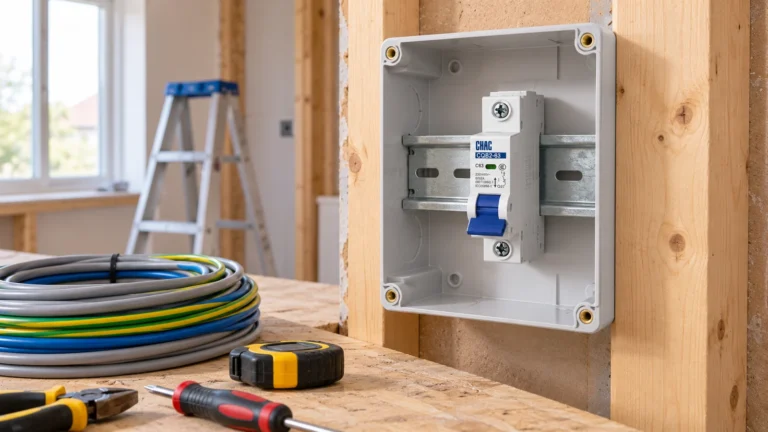
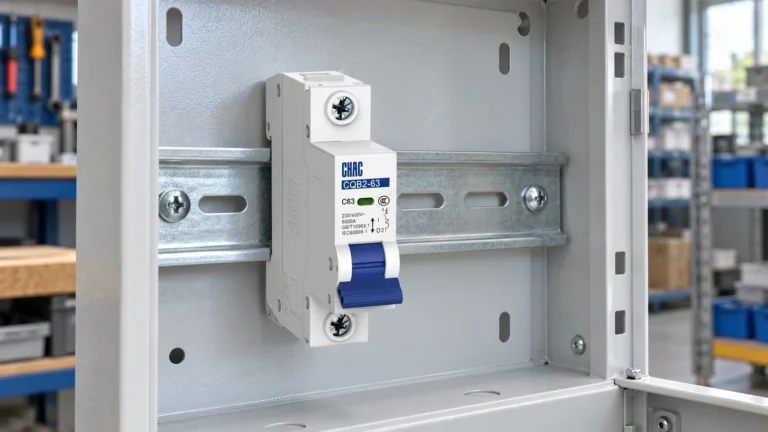
The main Tipos de disjuntores de corrente alternada used in low-voltage projects include miniature and molded-case breakers with declared DC ratings, alongside specialist designs for particular applications. The useful classification is not just the enclosure size. Identify the energy source, maximum voltage, current direction, prospective fault current and approved pole arrangement first. A device suited to one PV string is not automatically suitable for a battery bus at the same nominal voltage.
Separate breaker construction from application approval
DC MCBs are often considered for compact branch circuits; DC-rated MCCBs may offer different frame sizes, trip units and accessory options. Those are family tendencies, not guaranteed current or breaking-capacity boundaries. Read the offered model’s ratings. Some devices have fixed settings and others have adjustable protection, so the letters alone do not tell you what can be configured.
An isolating switch is a different product function. It may provide a means of disconnection without automatic overcurrent protection. Likewise, a remote-opening accessory does not turn an unsuitable protective device into an approved DC breaker. Write the required interruption and isolation duties separately in the equipment schedule.
Treat PV and battery fault sources differently
For a PV circuit, establish the maximum system voltage under the project’s temperature assumptions, string arrangement and possible reverse-current paths. For a battery circuit, establish the battery configuration, prospective fault contribution and the conditions declared for the protective device. An inverter’s normal operating current does not establish the fault duty supplied by a battery.
O battery circuit protection review should include charging, discharging, isolation and fault states. A device that interrupts the normal discharge direction may not be suitable for reverse energy flow or every fault location. Obtain application-specific manufacturer evidence rather than treating a solar-labelled breaker as a universal DC component.
Distinguish polarity from line and load direction
A polarity marking, a line/load instruction and a declaration of bidirectional suitability are related but different pieces of information. Schneider Electric’s C60H-DC FAQ states that the marked polarity must be respected and that the range should not be used where momentary current reversal can occur. That is a model-specific restriction; it should not be generalized to every DC breaker.
Ask the supplier to identify permitted current direction for normal operation and interruption. If a storage system can charge and discharge through the same device, that operating mode must be covered explicitly. Do not infer bidirectional fault interruption from a non-polarized product label alone.
Read voltage and pole arrangement as one rating
Some DC devices use a manufacturer-specified series pole connection to meet a declared voltage. That connection must follow the exact diagram. Do not create a higher voltage rating by multiplying poles, improvise links or parallel poles to increase the current rating. Earthing arrangements and the fault path can affect how voltage is distributed across the interrupting poles.
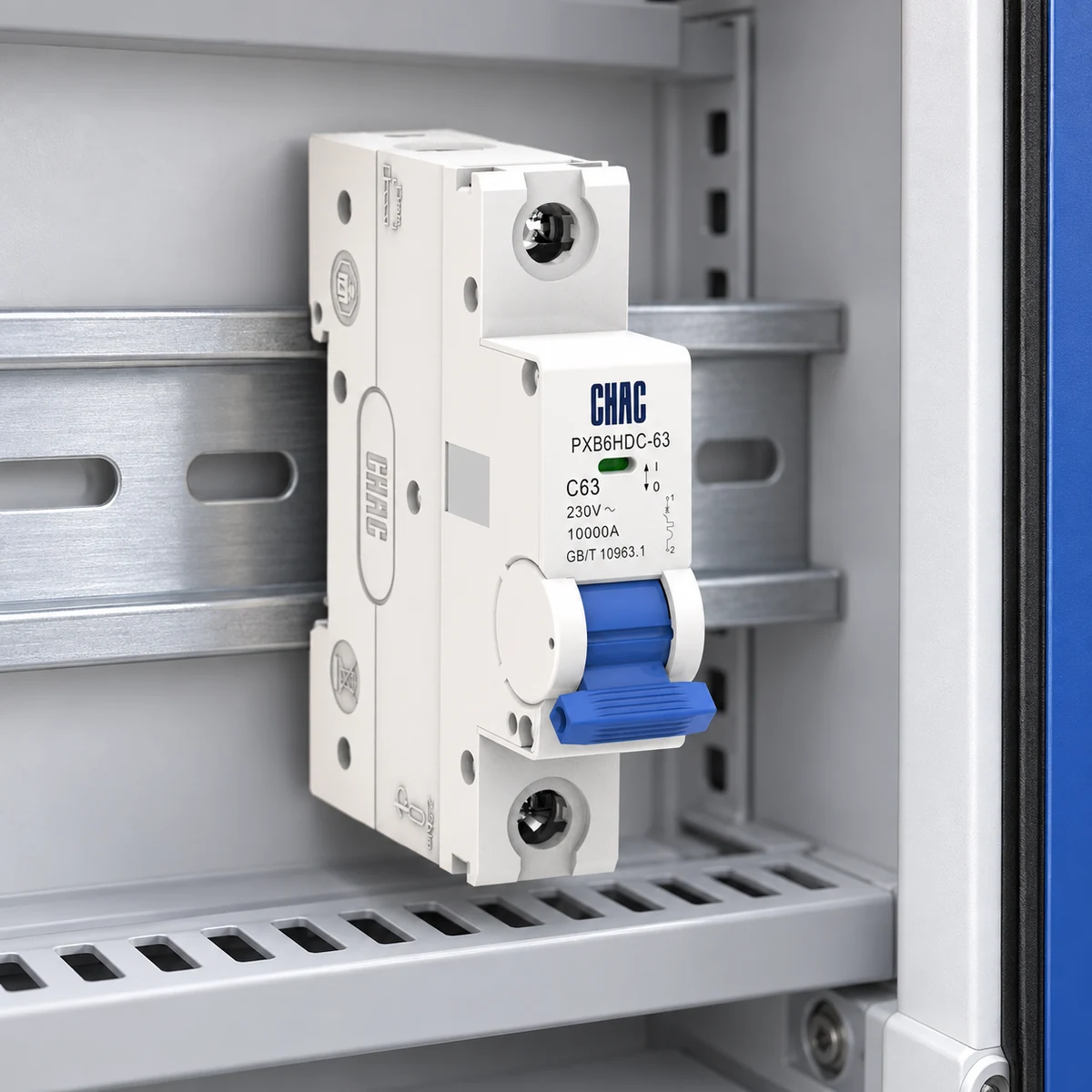
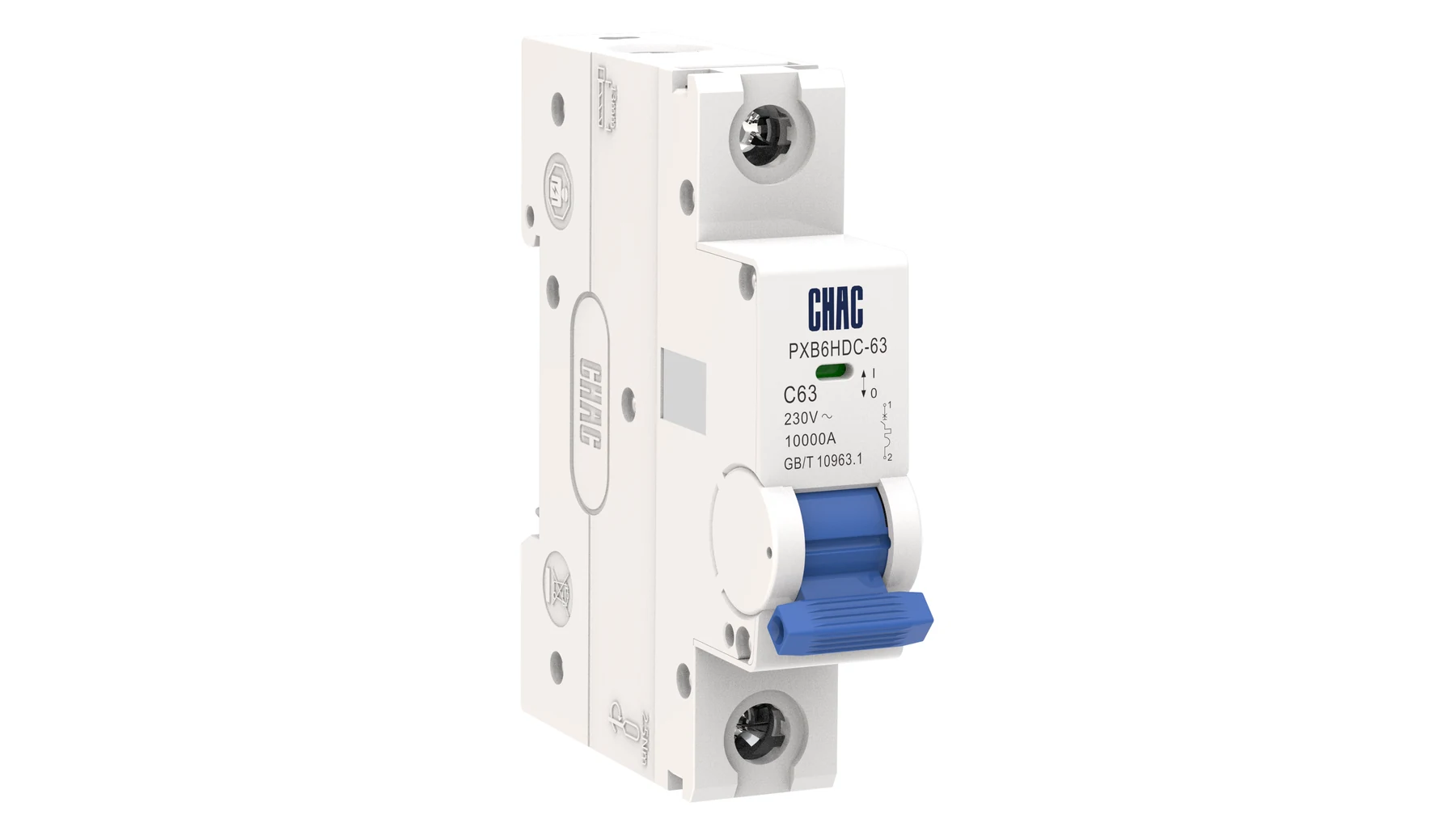
CHAC’s PXB6DC-63 DC miniature circuit breaker e MCCB product range provide starting points for a model enquiry. Confirm which offered device is documented for the actual DC application; a general MCCB family listing does not prove a DC rating.
Keep the selection record useful for future replacement
Record the DC voltage range, pole wiring, polarity, current-direction limits, fault-current assumptions, terminal requirements and approved accessories. Include the exact catalogue number and drawing revision. This prevents a later replacement from being selected only because it fits the rail or has the same ampere marking.
For the physical reason behind the different ratings, see the AC MCB versus DC MCB comparison. Keep DC breaking capacity tied to the specified voltage and test conditions rather than importing an AC kA figure into a DC schedule.
Which DC selection question changes with the source?
| Source or operating condition | Evidence to obtain | Unsafe shortcut |
|---|---|---|
| PV strings | Maximum voltage and reverse-current conditions | Using nominal voltage alone |
| Battery bus | Fault contribution and interruption capability | Sizing from normal inverter current |
| Bidirectional storage | Declared current-direction suitability | Assuming non-polarized means every duty |
| Series-connected poles | Exact manufacturer connection diagram | Multiplying an individual pole voltage |
Perguntas frequentes
É possível usar um disjuntor de CA em DC?
Só quando o fabricante indicar explicitamente uma classificação para a tensão, corrente e disposição dos polos necessários. Uma classificação apenas para o funcionamento em corrente alternada não é suficiente, pois a extinção do arco no caso de corrente alternada é diferente.
Does polarity matter on a DC circuit breaker?
It matters whenever the model has polarity or current-direction restrictions. Follow its markings and approved diagram. For a bidirectional battery circuit, obtain explicit confirmation that charging, discharging and relevant fault conditions are covered.
O que um projetista de combinador de fotovoltaica deve verificar?
Verifique a tensão máxima no circuito aberto à temperatura mínima, a corrente de curto-circuito, os caminhos de corrente reversa, a agrupamento de cabos e a classificação de interrupção de corrente direta do disjuntor.
Os disjuntores de corrente alternada (MCB) da DC são adequados para baterias?
Alguns sim, mas a energia gerada por falhas na bateria pode exceder as capacidades dos disjuntores de baixa potência. Confirme o valor de corrente prevista, o comportamento de limitação da corrente e os dados de aplicação do fabricante.
Should a DC switch be on the positive or negative conductor?
The grounding arrangement, required isolation function and manufacturer diagram decide which conductors must be switched. There is no universal positive-only or negative-only answer. A protective breaker and a disconnect must each satisfy their declared function.
Referências
- Schneider Electric: polarity and reversal limits for C60H-DC
- c3controls: AC and DC MCB interruption principles
- Schneider Electric Electrical Installation Guide: fault-current protection
For a model-specific review, contactar CHAC Electric with the circuit diagram, supply voltage, load details and destination-market requirements.