When a facilities engineer in Phoenix replaced a 30 A breaker in a commercial laundry room, the dryer stopped as soon as it restarted. The device was not simply defective: a single pole breaker had been selected for a load designed around two line conductors, so the team reopened the panel schedule and corrected the circuit specification.
Резюме: A double pole breaker controls two ungrounded voltage paths, while a single pole breaker controls one. In a typical North American 120/240 V split-phase panel, that often means 240 V line to line versus 120 V line to neutral. Specify from the load diagram and panel label, then confirm common-trip duty, neutral arrangement, interrupting rating, and approved panel fit. Never infer suitability from amperage or handle shape alone.

How pole count follows the voltage path
A pole is one switching and overcurrent-protection path through a breaker. In a common North American split-phase service, a one-pole device connects to one bus leg and normally supplies a 120 V line-to-neutral circuit. A two-pole device occupies positions connected to opposite bus legs and normally supplies a 240 V line-to-line circuit. The circuit drawing remains decisive because system arrangements differ by country and installation.
Current rating does not determine pole count. A 20 A lighting circuit can use one pole, while a 20 A heater can use two. Typical one-pole loads include lighting, receptacles, controls, and small motors. Water heaters, condensers, ranges, dryers, and workshop equipment commonly use two poles when their nameplates call for 208 or 240 V.
Some appliances use both voltages. A North American dryer may use 240 V for heating and 120 V for controls, adding a neutral while the breaker still opens both ungrounded conductors. A practical dryer branch-circuit guide can frame the load check, but the appliance instructions and adopted code control the design.
| Decision point | Single pole breaker | Double pole breaker |
|---|---|---|
| Protected voltage paths | One ungrounded conductor | Two ungrounded conductors |
| Typical split-phase use | 120 V line to neutral | 240 V line to line or mixed 120/240 V load |
| Common load examples | Lighting, receptacles, controls, small motors | Water heaters, HVAC units, dryers, ranges |
| Trip relationship | Independent one-pole operation | Factory mechanism intended for coordinated operation |
| Panel position | One approved pole space | Two approved positions on the required bus connections |
| Main evidence | Load diagram and panel schedule | Load diagram, panel label, and two-pole device data |
Why linked handles do not always mean common trip
Simultaneous manual disconnection and automatic common trip answer different questions. A listed handle tie lets a person switch both poles off together, but it does not necessarily make two independent mechanisms respond as one. A true common-trip breaker has an internal design evaluated to trip all associated poles under its listed conditions.
This distinction matters for line-to-line loads because equipment must not remain connected through one conductor when common trip is required. NEC 240.15 addresses overcurrent protection for ungrounded conductors, while device instructions and the panel listing determine acceptable arrangements. Buyers should request the catalog designation and trip description.
A multiwire branch circuit is a related case. Two 120 V circuits can share one neutral when arranged correctly; NEC 210.4(B) requires simultaneous disconnection at the branch circuit origin. A listed two-pole breaker can provide it. A permitted handle-tied arrangement should not be called common trip unless the manufacturer identifies it that way.
A tandem usually provides two independent one-pole circuits within a panel position designed for it. It generally does not create the opposite-leg connection or common-trip action needed by a 240 V load. Similar front profiles do not make tandem and two-pole devices interchangeable.
How neutral treatment changes device selection
A neutral is a grounded circuit conductor, not a second protected line. Many 240 V circuits use two ungrounded conductors and an equipment grounding conductor. A mixed 120/240 V appliance adds a neutral, while branch-circuit overcurrent protection normally remains on the ungrounded conductors.
IEC labels such as 1P, 1P+N, 2P, 3P, and 4P require functional detail. A 1P+N unit may protect the phase while only switching the neutral. Procurement documents should state which conductors are switched, which poles are protected, and whether a required neutral sequence applies.
Isolation also differs from overcurrent protection. A breaker provides isolation only when its standard, markings, and instructions support that function; an isolator is not automatically a protective breaker. Reviewing the required pole configuration for an isolating switch helps separate neutral switching and isolation duties from overload and short-circuit protection.

How to verify panel compatibility
Start with the nameplate and wiring diagram. Record voltage, frequency, current, conductor arrangement, and neutral use. Then identify whether the installation needs simultaneous manual disconnection, automatic common trip, or both. Do not assume an apparently similar replacement is approved.
Next, read the panel label and manufacturer instructions. Compatibility includes the bus interface, permitted positions, conductor range, torque values, enclosure constraints, and approved breaker family. System voltage and interrupting capacity must also suit the fault-current study; correct pole count cannot compensate for an inadequate rating.
Product standards describe different scopes. UL 489 covers molded-case circuit breakers and related equipment for North American applications. IEC 60898-1 addresses circuit breakers for household and similar installations, while IEC 60947-2 addresses circuit breakers within low-voltage switchgear and controlgear. These standards are not interchangeable marketing badges; buyers should verify the exact product marking, report scope, destination market, and conditions of use.
For a new specification, a documented double pole breaker review should align the circuit diagram with the intended product data. CHAC Electric can support product-family and documentation checks, but the panel manufacturer, project designer, and authority having jurisdiction determine acceptance in the final assembly. The related 50 amp pole-selection comparison illustrates why amperage alone is insufficient.
| Buyer checkpoint | Question to resolve | Свидетельства для сохранения |
|---|---|---|
| Voltage path | Is the load line to neutral, line to line, or mixed voltage? | Nameplate and wiring diagram |
| Trip behavior | Is simultaneous switching enough or is common trip required? | Catalog data and installation instructions |
| Shared neutral | Is this a multiwire branch circuit with simultaneous-disconnect duties? | Branch schedule and conductor plan |
| Neutral switching | Must the neutral be switched and is that pole protected? | System diagram and pole-function data |
| Panel fit | Is this exact family accepted for the panel and position? | Panel label and approved-device list |
| Ответственность за нарушение правил | Does the interrupting rating meet the available fault current? | Fault-current study and product marking |
What Should the Purchase Request State?
A useful purchase request does more than say “two-pole, 30 A.” State the system voltage and frequency, whether the load is line-to-line or mixed 120/240 V, the available fault current, the panel family, the required protective function, and whether the device must provide automatic common trip. This prevents a visually similar single pole breaker from being substituted for a device intended to open two ungrounded conductors together.
| Information to provide | Why it changes selection | Record to retain |
|---|---|---|
| System and load voltage | Two poles do not create a voltage that the supply does not provide | Nameplate and single-line diagram |
| Conductor arrangement | Neutral switching and protection depend on the circuit topology | Wiring diagram and panel schedule |
| Trip relationship | Manual handle tie and internal common trip are different functions | Catalog designation and instructions |
| Panel and bus position | Mechanical fit, approved spaces and bus connections are model-specific | Panel label and approved-device list |
| Fault duty and terminals | Interrupting rating, conductor range and torque must suit the installation | Fault study, data sheet and installation record |
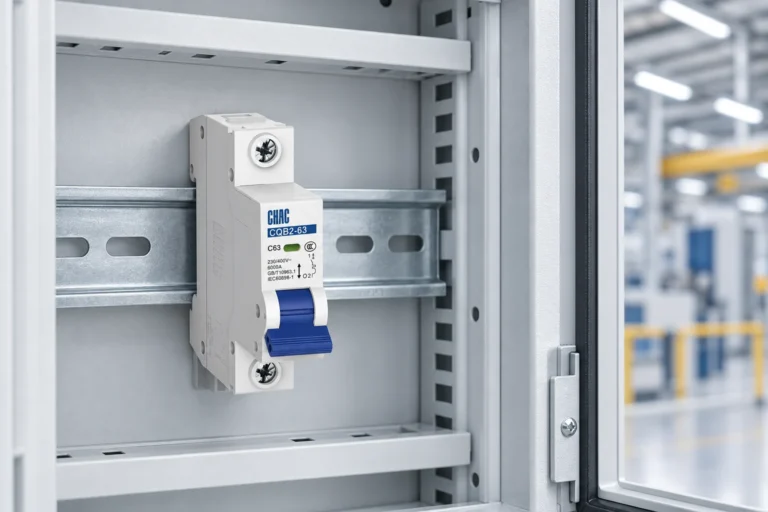
For OEM or distributor inquiries, send a photograph of the panel label and breaker marking together with the load schedule. A catalog family such as the Автоматический выключатель миниатюрный CQB2-63 can be reviewed for available poles and curves, but the final fit still depends on the circuit, enclosure, destination standard and approved assembly. Use the single-pole versus double-pole MCB comparison when the project uses IEC-style 1P, 1P+N or 2P terminology.
Double pole breaker vs single pole questions
Is a double-pole breaker safer than a single-pole breaker?
Neither is inherently safer. Each is appropriate only when its poles, ratings, trip behavior, and panel approval match the circuit. A two-pole device is necessary when the application requires two ungrounded conductors to open together.
Can two single-pole breakers replace one double-pole breaker?
Not by default. A listed handle tie can provide simultaneous manual disconnection in permitted applications, but it does not automatically create internal common-trip performance. Confirm the load requirement, panel instructions, device listing, and adopted code.
What appliances usually need a double-pole breaker?
Many North American electric dryers, water heaters, ranges, condensers, and 240 V workshop loads use two poles. The appliance nameplate and installation instructions determine the actual voltage, current, neutral, and disconnect requirements.
Does a double-pole breaker always mean 240 V?
No. It commonly serves 240 V in a 120/240 V split-phase panel, but other systems and IEC configurations use two poles for different conductor functions. Read the system diagram and product data instead of relying on the label alone.
Is a tandem breaker the same as a double-pole breaker?
No. A tandem commonly supplies two independent one-pole circuits in an approved panel position. A two-pole breaker engages the required bus connections and coordinates operation for one multi-conductor circuit.
What should a buyer verify before ordering a replacement?
Verify voltage path, load current, pole count, trip arrangement, neutral use, panel approval, conductor terminals, interrupting rating, and destination standard. Submit the load diagram and panel label with the inquiry so the comparison is based on the installed system.
Double pole breaker vs single pole references
- NFPA, NFPA 70, Национальный электротехнический кодекс, especially Articles 210 and 240 subject to the adopted edition.
- UL Standards, UL 489, Molded-Case Circuit Breakers, Molded-Case Switches, and Circuit-Breaker Enclosures.
- IEC, IEC 60898-1, Circuit-breakers for overcurrent protection for household and similar installations.
- IEC, IEC 60947-2, Low-voltage switchgear and controlgear – Circuit-breakers.
The reliable rule is simple: choose the pole count from the circuit architecture, not from the handle shape.
For a documented product comparison, review the Автоматический выключатель миниатюрный CQB2-63 and send CHAC Electric the panel family, load diagram, voltage, current, fault-duty requirement, and destination market for a configuration review.