
Руководство по выбору RCD & RCBO
Проведите проверку типа и чувствительности остаточного тока, а затем сравните ток цепи, пропускную способность кабеля, напряжение и рабочую нагрузку приведенных значений номинала RCD или RCBO.
Перед проверкой дифференциального автоматического выключателя CHAC необходимо выполнить проверки на наличие остаточного тока, срабатывание по чувствительности и по току/короткому замыканию. Требуемая степень чувствительности определяется требованиями к электроустановке.
Результат
Residual-current requirement
Type A / 30 mAEntered numeric checks met; verify complete installationIb ≤ In ≤ Iz; declared breaking capability ≥ prospective fault current; required waveform and IΔn from projectThe result records a required type, not proof that an entered device provides it. CHAC PXB6L-63 publicly lists Type AC/A; this tool does not assign it to Type F/B duties. An RCCB needs separate overcurrent protection. Verify actual waveform, earthing, neutral arrangement and disconnection rules.
Почему этот результат?
Формула и метод
Проведите проверку типа и чувствительности остаточного тока, а затем сравните ток цепи, пропускную способность кабеля, напряжение и рабочую нагрузку приведенных значений номинала RCD или RCBO.
Как использовать этот калькулятор
- Enter the actual operating current and candidate device/cable ratings.
- Use the equipment instructions to identify the residual waveform. Enter sensitivity required for this circuit.
- Review the displayed checks, then confirm device type, poles, neutral handling and protection coordination.
Границы расчёта
No universal residual-current type or sensitivity is selected from the building name. This does not calculate earth-loop impedance, disconnection time or a pass/fail certificate. Type F/B availability is not inferred from the CHAC Type AC/A range.
RCD and RCBO selection: type, sensitivity and current
Residual-current waveform type, sensitivity and overcurrent rating describe separate functions. The output records the waveform requirement you entered and checks current, cable, voltage and fault bounds. It does not infer every requirement from a room or building category.
Ввод записей
| Ввод | Что нужно проверить |
|---|---|
| Required waveform | Use the equipment instructions. A Type A requirement is different from the smooth-DC or drive-related duties that can require other types. |
| Sensitivity and leakage | Enter the residual sensitivity required by the circuit design. Standing leakage is shown as a proportion of that value; it does not predict exact trip time. |
| Candidate ratings | Compare Ib, In, corrected Iz, operational voltage and the applicable declared short-circuit capability. Keep Icn, Icu and Ics identified correctly. |
Пример работы · начальные значения форм
Single-phase circuit requiring Type A, 30 mA
230 V · load 16 A · device In 20 A · cable Iz 25 A · fault 4.5 kA · entered breaking capability 6 kA
16 A ≤ 20 A ≤ 25 A; 4.5 kA ≤ 6 kA; 230 V ≤ 230 V
Standing leakage ratio = 5 / 30 × 100 = 16.67%. Required waveform remains Type A.
Type A / 30 mA
The numeric entries meet these bounds. Confirm that the actual device provides the required type and sensitivity at the stated voltage and pole arrangement.
RCD vs RCBO: what protection is included?
RCD is the general term for a residual-current protective device. An RCCB detects residual current but does not provide overload and short-circuit protection. An RCBO combines residual-current and overcurrent protection in one device.
This distinction matters when reviewing an outgoing circuit. An RCCB arrangement needs a coordinated overcurrent device. For an RCBO circuit breaker, check both sets of characteristics: residual-current waveform and sensitivity, then rated current, trip curve and short-circuit capability.
A 30 mA RCBO and a 20 A RCBO rating describe different things
Rated current In is expressed in amperes and belongs to the circuit’s load and overcurrent assessment. Rated residual operating current IΔn is commonly expressed in milliamperes and belongs to residual-current protection. A device can therefore be rated 20 A and 30 mA at the same time.
For the example circuit, 16 A load current, a 20 A device and 25 A corrected cable capacity satisfy Ib ≤ In ≤ Iz. The 30 mA entry is checked separately against standing leakage. Neither number replaces the other, and the leakage ratio does not predict an exact tripping time.
Type A RCD response is different from a breaker trip curve
Type AC and Type A describe residual-current waveform response. Type A covers sinusoidal AC and pulsating DC residual currents within its specified conditions. Letters used for an overcurrent trip curve describe another characteristic; a Type A residual-current requirement does not select an overcurrent curve.
Read the connected equipment’s instructions before choosing the waveform type. CHAC PXB6L-63 lists Type AC and Type A variants. If the application requires Type F or Type B, obtain a device explicitly rated for it; selecting that requirement in the form does not identify an available PXB6L-63 model.
Type and installation still need confirmation
- CHAC PXB6L-63 publicly lists Type AC and Type A variants. Displaying a Type F or Type B requirement does not assert that this family offers that function.
- An RCCB needs coordinated overcurrent protection. Earth-loop conditions, disconnection time, neutral switching, selectivity and the applicable installation rules remain separate checks.
Часто задаваемые вопросы
Does this tool always recommend 30 mA?
No. Sensitivity is entered from the circuit requirements. The default is an example and does not establish the rule for every circuit.
Can a Type AC device be assumed suitable for pulsating DC leakage?
No. Establish the required waveform response from the load documentation and use a device explicitly specified for that duty.
Is an RCCB the same as an RCBO?
No. An RCBO includes overcurrent protection; an RCCB relies on separate, appropriately coordinated overcurrent protection.
Does a numerical pass confirm the model is suitable?
No. The candidate entries are user-supplied. Actual waveform response, sensitivity, standard-specific breaking duty, poles and installation conditions must match the exact device.
Can a 30 mA RCBO have a 32 A current rating?
Yes. The 30 mA value is residual-current sensitivity; 32 A is rated circuit current. The circuit must satisfy the conditions for both ratings, including cable protection and the required residual-current response.
Does a Type A RCD requirement specify the breaker trip curve?
No. Residual-current type and overcurrent trip curve describe different functions. Check the load’s waveform requirement and the device’s overcurrent characteristic separately.
Необходима помощь при выборе продукта CHAC?
При отправке запроса укажите напряжение системы, ток нагрузки и условия установки.
Пример применения · Иллюстративные материалы
Reviewing a single-phase branch with PXB6L-63 data
For a 230 V branch with an assumed 18 A load and 25 A corrected cable capacity, compare a 20 A device against Ib ≤ In ≤ Iz. If the equipment requirements call for Type A and 30 mA, the CHAC PXB6L-63 page lists those options, together with 230 V for 1P+N/2P and 6 kA Ics. Entering a 4.5 kA fault level clears the guide’s numeric fault comparison, subject to the applicable rating and standard. Confirm the exact variant, leakage conditions and neutral arrangement; the calculator records the required type rather than determining it from load current.
Данные о продукте: PXB6L-63 Электромагнитный выключатель дифференциального тока
Связанные продукты CHAC
Review RCBO residual-current and overcurrent data. An MCB alone does not provide residual-current protection.
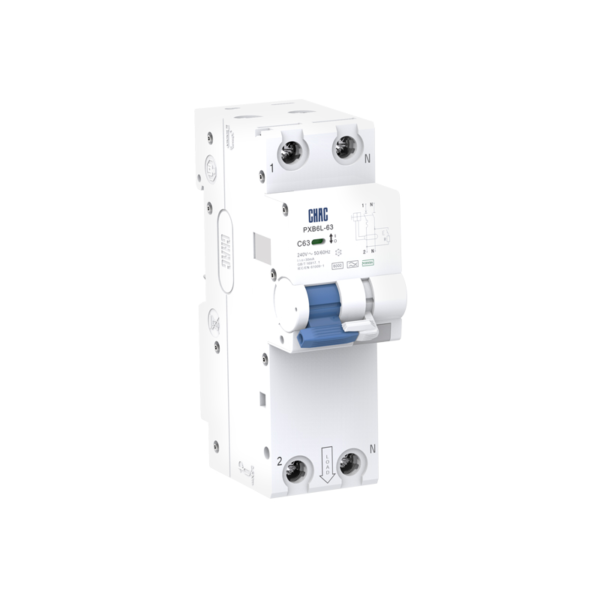
PXB6L-63
Выключатель дифференциального тока с защитой от сверхтоков
Проверьте тип устройства защитного отключения, его чувствительность и номинальный ток срабатывания при перегрузке.
Просмотреть товар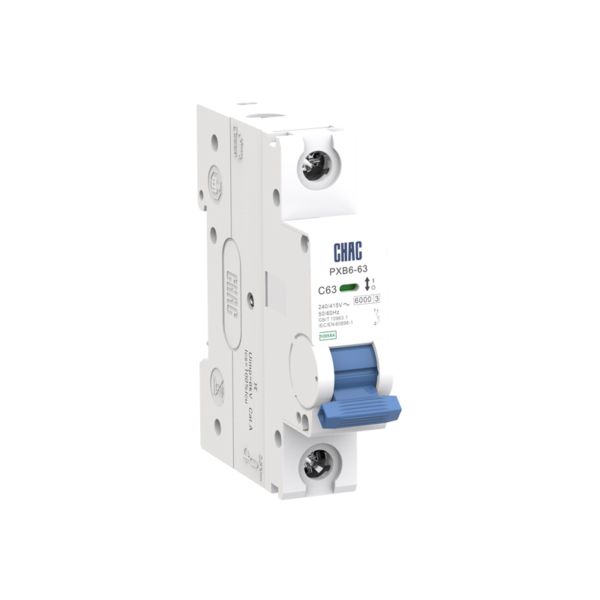
PXB6-63
Миниатюрный автоматический выключатель
Проверьте номинальный ток, количество полюсов и кривую срабатывания.
Просмотреть товар