A purchase description that asks only for a “600V MCB” leaves several different products in the same quotation basket. One supplier may quote an AC breaker; another may quote a DC device whose voltage rating depends on a prescribed multi-pole connection. A catalogue may also show a high insulation voltage beside a lower operational voltage. These differences matter before an order is released: a physically interchangeable device can still have the wrong interruption rating, connection arrangement or approval for the panel. The useful question is therefore not whether a breaker carries the number 600, but what that number describes. This guide explains how to read the ratings and turn a voltage request into a checkable specification.
The short answer is that a Миниатюрный выключатель 600 В is suitable only when its declared operational voltage, AC or DC duty, pole arrangement and breaking capacity match the actual circuit. Rated insulation voltage is a separate characteristic; it does not establish a 600V operating rating. Record line-to-line and line-to-earth voltage, earthing arrangement, maximum DC voltage where applicable, and available fault current. Then obtain the exact model’s rating table and connection instructions. A 230/400V AC MCB is not a substitute for a 600V device merely because the current rating and mounting dimensions are similar.
Which voltage rating actually permits operation at 600V?
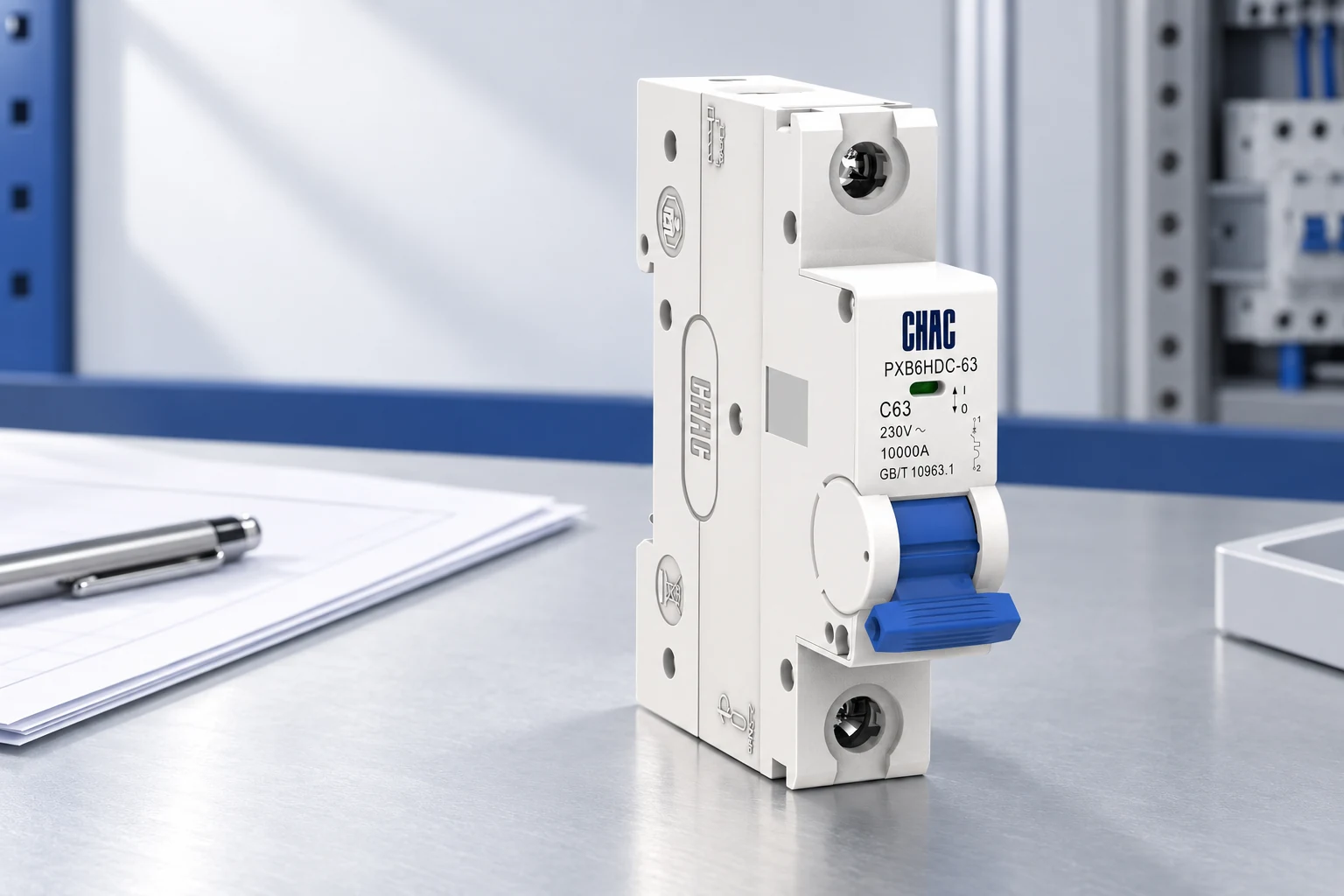
Start with rated operational voltage, usually written Ue in IEC documentation. Schneider Electric’s Electrical Installation Guide [1] describes Ue as the voltage at which the breaker is designed to operate in normal conditions. Read the corresponding current-interruption data at that voltage. A breaking-capacity value published for a lower voltage cannot be carried over to 600V without supporting manufacturer data.
| Published field | What it establishes | What it does not establish |
|---|---|---|
| Operational voltage, Ue | Declared operating voltage under the specified conditions | Suitability for every AC/DC circuit or earthing system |
| Insulation voltage, Ui | A reference for dielectric tests and creepage requirements | Permission to interrupt current at that voltage |
| Impulse withstand voltage, Uimp | Withstand capability for a specified impulse test | A continuous working-voltage rating |
| AC/DC and pole-connection table | The duty and configuration associated with each declared rating | Permission to improvise a different series connection |
The guide’s explanation of Ui and Uimp [2] makes the distinction explicit: Ue must not exceed Ui, but knowing Ui alone does not tell the buyer which operating duties are approved. For example, a hypothetical specification showing Ui = 690V and Ue = 400V AC provides no evidence for 600V operation. These numbers illustrate how to read a record; they are not ratings for a product offered here.
Can a 600V AC breaker be used on a 600V DC circuit?
Only when the manufacturer separately declares the required DC application. AC and DC are different interruption duties. A multi-pole DC arrangement may use more than one contact gap in a prescribed current path, but the permissible voltage cannot be calculated by multiplying an individual pole’s rating. The approved drawing must define the connections, polarity if relevant, line/load restrictions and system conditions.
The circuit description must also distinguish an AC line-to-line voltage from voltage to earth. Where a device has a restricted voltage marking or requires a particular grounded system, the supply arrangement forms part of its suitability. Ask for confirmation for the actual system rather than treating every marking containing “600” as equivalent.
For DC, specify the highest voltage expected in the intended operating range. A photovoltaic application requires the design maximum string voltage, including the project’s temperature assumptions. A battery application requires the maximum charged voltage and fault contribution. A nominal bus value alone is not a complete equipment specification. These are application-review inputs, not evidence that a solar-rated breaker can protect a battery circuit.
How should breaking capacity be checked at 600V?
Пропускная способность describes the fault-current interruption duty, not the continuous load current. A breaker selected for a 20A load still needs an adequate fault rating at its installation point. The voltage and fault-current values must belong to the same declared rating and test conditions.
As an illustrative acceptance check, a standalone breaker rated 6kA at the required voltage does not cover an 8kA available fault current. An upstream device does not automatically repair the mismatch. A backup or series-rated arrangement needs evidence for the specific combination and its permitted conditions; the assembled equipment also needs review. The distinction follows the interruption and coordination requirements in OSHA 1910.303(b)(4)–(5) [4] for covered US workplaces.
In IEC records, Icn, Icu and Ics identify different declared characteristics and test frameworks. The guide distinguishes ultimate breaking capacity from service breaking capacity [1–2]. For a process where restart after a fault matters, request the service-duty information and the manufacturer’s inspection or replacement instructions. Neither a high headline kA value nor a successful opening proves that the whole panel is ready to return to service.
What evidence changes with the application?
| Circuit | Required design inputs | Release condition |
|---|---|---|
| Industrial AC distribution | Frequency, phase/earth voltages, earthing system and available fault current | Matching AC voltage and fault rating, with required market approval |
| PV DC string | Maximum string voltage, current, reverse-current exposure and polarity | Declared suitability for the PV circuit and approved pole wiring |
| Battery-fed DC circuit | Charged voltage, fault current, charge/discharge paths and isolation requirements | Documented battery-duty suitability and permitted current directions |
| Replacement in an existing panel | Original approved device, busbar/terminal arrangement and assembly documentation | Electrical and mechanical compatibility, not rail fit alone |
Altitude, ambient temperature, contamination, terminal spacing and enclosure conditions belong in this review. They may affect insulation or thermal performance, but there is no universal clearance or derating number for every 600V MCB. Use the exact installation instructions. Allowing space for required connections, access and approved accessories can change the panel cost more than the difference between two unit prices.
Which documents should accompany the purchase?
The standards overview [3] distinguishes industrial circuit-breakers under IEC 60947-2 from household and similar circuit-breakers under the IEC 60898 family. A standard number identifies a framework; it does not establish a particular model’s voltage or satisfy every destination-market requirement. Request the applicable edition, exact model coverage and required approval documents. Do not infer certification from a supplier’s company-wide certificate or another product in the range.
- Freeze the supply description and load profile, including maximum voltage and prospective fault current.
- Obtain the model-specific operational-voltage, interruption and pole-connection tables.
- Confirm terminals, conductor types, torque, enclosure conditions and assembly compatibility.
- Approve the document revision and record the accepted configuration before allowing substitutions.
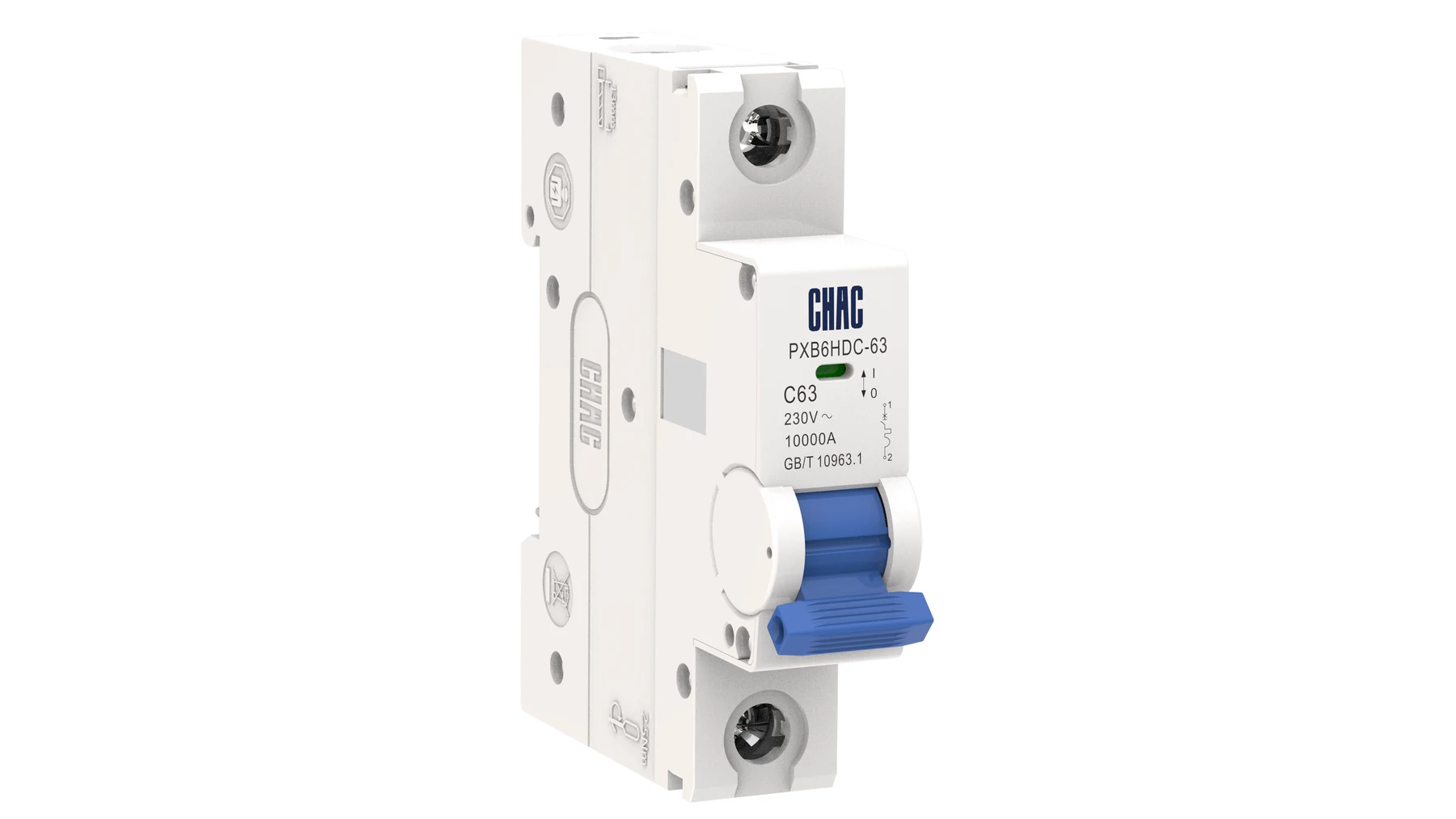
For CHAC sourcing, the MCB category и DC circuit-breaker category provide separate starting points. A concrete boundary is the published CQB2-63 record: it states 230/400V AC operational voltage and 500V insulation voltage. Those values do not support a 600V claim. If the required configuration is not documented, request another verified model or protective architecture rather than raising the stated rating.
Часто задаваемые вопросы
Можно ли использовать любой МКБ с маркировкой 600 В при напряжении 600 В?
No. Check what the marking refers to, the AC/DC duty, the permitted supply system and the exact pole connection. Accept it only when the corresponding operating and interruption data cover the application.
Подходит ли МКБ с напряжением 600 В для фотоэлектрических цепей?
Only when its declared DC/PV application covers the design maximum string voltage and relevant current conditions. A 600V AC rating alone is insufficient. Follow the manufacturer’s prescribed connections and polarity.
Какие проверки на изоляцию необходимы?
Review Ui, Uimp and the installation conditions that affect insulation coordination. Obtain the required spacing and environmental limits from the actual device and panel documentation; do not derive them from an exterior photograph.
Изменяет ли напряжение 600 В номинал ампеража выключателя?
Voltage and current are separate selection constraints. The permitted current can also depend on temperature and installation conditions, while the fault-interruption value must be checked at the required voltage.
Can two lower-voltage poles be connected in series to obtain 600V?
Only if the manufacturer publishes that arrangement for the exact device and application. Dividing or multiplying voltage ratings does not establish equal voltage sharing, approved interruption performance or permitted fault behavior.
Ссылки
Technical sources checked 20 October 2026; the Electrical Installation Guide pages below show revisions dated 5 August 2026. Manufacturer guidance explains the ratings; it does not replace the applicable standard or project approval.
- Schneider Electric, Electrical Installation Guide: Fundamental characteristics of a circuit-breaker.
- Schneider Electric, Electrical Installation Guide: Other characteristics of a circuit-breaker.
- Schneider Electric, Electrical Installation Guide: Standards and description of circuit-breakers.
- US OSHA, 29 CFR 1910.303: installation, interrupting rating and circuit coordination.
Conclusion
The decisive distinction is between a voltage printed somewhere in the product record and a declared operating duty for the actual circuit. Begin with the supply and fault study, then match operational voltage, AC/DC duty, connection arrangement and interruption performance before comparing price or module width. Keep insulation ratings and assembly compatibility in the same review, because neither a higher Ui nor an upstream protective device automatically makes an unsuitable breaker acceptable. The lowest purchase price can become expensive when undocumented substitutions force drawings, panel layouts or approvals to be repeated. CHAC’s published product data provides a starting point for that review; a missing 600V rating should remain an unresolved requirement until the exact model evidence is supplied. For a documented selection, send CHAC the circuit conditions and required approval scope.