The key difference between an Bộ ngắt mạch nhỏ AC and a DC MCB is the interruption duty for which the exact device is rated and tested. AC current has periodic zero crossings; steady DC does not provide the same natural opportunity for arc extinction. Similar dimensions and ampere markings therefore do not establish interchangeability. Check voltage, breaking capacity, polarity and the approved connection arrangement before considering a substitution.
Understand why interrupting DC is a different task
When breaker contacts separate under current, an arc can form. In AC circuits, periodic current zero crossings assist interruption. In DC circuits, the breaker must extinguish the arc under its declared DC conditions without relying on that periodic current zero. Arc-control construction and permitted application can therefore differ even when the outside cases look similar.
Do not use appearance as evidence of internal design. A product photo cannot confirm contact separation, arc-chamber behavior or a permitted DC voltage. For a dual-rated device, use the manufacturer’s separate AC and DC information rather than assuming one set of ratings applies to both.
Read the voltage and breaking-capacity entries together
Phần DC MCB rating must identify the conditions under which the device can interrupt the available fault. Check the maximum circuit voltage, current rating, breaking capacity and pole arrangement together. A kA figure stated for AC is not automatically a DC rating, and a nominal battery voltage is not necessarily its highest operating voltage.
Some approved arrangements place poles in series for a particular DC voltage. Follow the manufacturer diagram exactly. Do not invent series links, parallel poles to increase current capacity or infer a new rating by multiplication. The supply’s grounding and the possible fault paths also belong in the application review.
Distinguish a polarity marking from bidirectional suitability
Certain DC breakers use directional arc-control arrangements. Schneider Electric’s C60H-DC FAQ requires the marked polarity to be followed and says the range should not be used where momentary current reversal can occur. That statement describes the cited range, not every DC breaker on the market.
For a battery that charges and discharges through one protective device, obtain explicit evidence for the current directions and fault conditions involved. A “non-polarized” description does not, on its own, document every interruption scenario. Ask for the application instructions and record any restrictions in the circuit schedule.

Keep AC and DC product enquiries separate
Specify the energy source and duty in the enquiry: AC distribution, PV string, battery branch or another DC circuit. Include maximum voltage, calculated current, prospective fault current and permitted mounting. This prevents an offered device from being accepted solely because its current and pole count resemble the original.
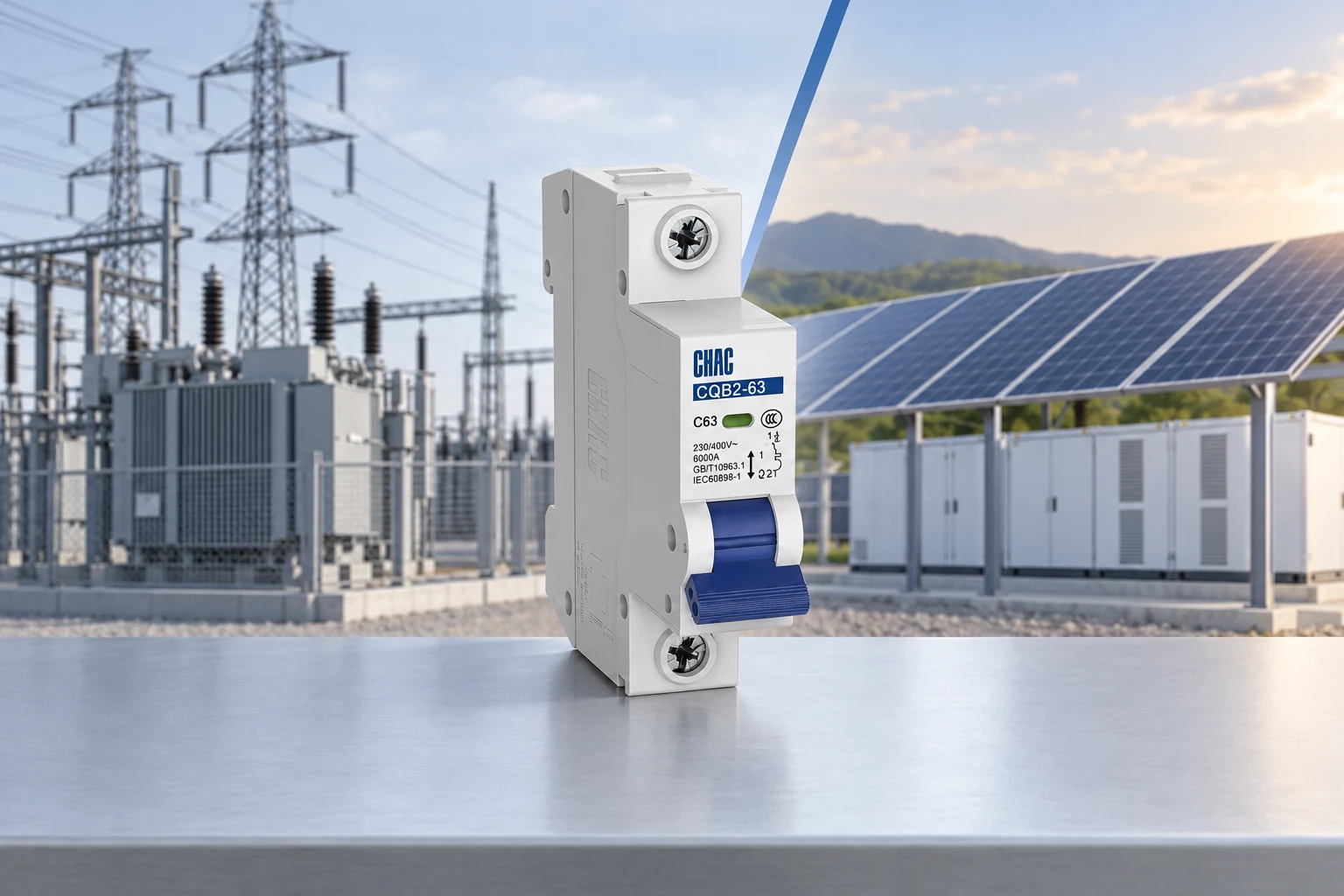
CHAC CQB2-63 AC MCB information and PXB6DC-63 MCB DC page provide separate model-review starting points. Confirm the exact variant’s declared application; these links do not establish cross-compatibility between the families.
Review stored energy and reverse feeds during isolation
Phần AC/DC breaker compatibility decision is also a system review. Inverters, PV arrays and batteries can create more than one source or a reverse-feed condition. Opening the familiar mains breaker does not establish that every DC conductor is de-energized. The installation documents should identify the relevant isolation points and verification procedure.
For the broader device-family choice, see DC circuit breaker types for PV and battery applications. If the manufacturer does not publish the required DC rating or connection arrangement, do not substitute the AC-only device. Obtain a documented suitable alternative instead.
Which AC and DC data must be checked separately?
| Feature | AC application | DC application |
|---|---|---|
| Interruption context | Periodic current zero crossings | No periodic current zero in steady DC |
| Voltage entry | Declared AC system conditions | Declared DC voltage and pole arrangement |
| Current direction | Follow line/load restrictions where specified | Check polarity and bidirectional limits |
| Fault rating | Use the stated AC breaking capacity | Use the stated DC breaking capacity |
| Substitution | Check exact device application evidence | An AC-only marking is insufficient |
Các câu hỏi thường gặp
Có thể sử dụng cầu nối MCB AC trên mạch DC không?
Chỉ khi bảng dữ liệu của thiết bị này cung cấp rõ ràng thông số định mức DC và cấu hình cực phù hợp thì mới được sử dụng. Nếu không, hãy sử dụng MCB hoặc MCCB DC được thiết kế và thử nghiệm cho chức năng đó.
Tại sao chỉ số DC lại thấp hơn hoặc khác nhau?
Nếu không có dòng điện tự nhiên, bộ ngắt phải kéo giãn và dập tắt tia lửa bằng cách sử dụng buồng và thiết kế từ của mình. Điện áp và cấu hình cực ảnh hưởng trực tiếp đến nhiệm vụ này.
Tôi nên đấu dây như thế nào cho một bộ công tắc DC có độ nhạy về cực?
Hãy tuân thủ đường dây/dấu hiệu tải và dấu hiệu tích cực/tiêu cực một cách chính xác. Đọc tài liệu về bố trí và xác nhận sự cách ly trước khi khởi động.
Liệu một ổ cắm MCB DC có cần công suất cắt cao hơn không?
Nó cần công suất phù hợp với dòng điện lỗi DC có sẵn. Hệ thống pin có thể cung cấp năng lượng lỗi rất cao ngay cả ở điện áp danh định khiêm tốn.
Is there any difference between an AC MCB and a DC MCB?
Yes. The interruption duty, ratings, arc-control arrangement and connection restrictions may differ. Compare the exact datasheet entries for voltage, breaking capacity, poles and current direction. Similar front labels do not prove the devices are interchangeable.
Can a DC MCB be used on an AC circuit?
Only when the manufacturer declares suitable AC ratings and the proposed installation follows its instructions. A DC label alone does not establish AC suitability, just as an AC-only label does not establish DC suitability.
Tham khảo
- Schneider Electric: model-specific DC polarity and current-reversal restriction
- c3controls: AC versus DC MCB principles
Đối với một đánh giá cụ thể về mô hình, liên hệ Điện lực CHAC cùng với sơ đồ mạch, điện áp cung cấp, thông tin về tải và yêu cầu của thị trường đích.