A box sold as “4 inch” can still need a different wall opening, cover or mounting allowance than another nominally similar box. The outside envelope, usable internal volume and mounting arrangement answer different questions. Procurement becomes especially risky when a drawing shows only width and height while the installer needs room for connectors, conductor bends and the finished cover. This guide explains which dimensions to request, how box-fill requirements differ from physical fit, and why a device box, enclosure and distribution-terminal box should not be grouped together just because suppliers call all three a junction box.
There is no single set of standard junction box sizes suitable for every installation. Select the actual product drawing, verify the usable or marked volume, and check the required wiring, mounting and environmental conditions. Nominal names such as 4 inch or single-gang describe a family or configuration, not the complete installation envelope. For example, RACO’s 299 ceiling-box record lists a nominal 4 inch size alongside 4.25 inch width and height and 22.4 cubic inches of capacity. Those values are product-specific, not universal dimensions for every round or ceiling box.
Which electrical box dimensions should be recorded separately?
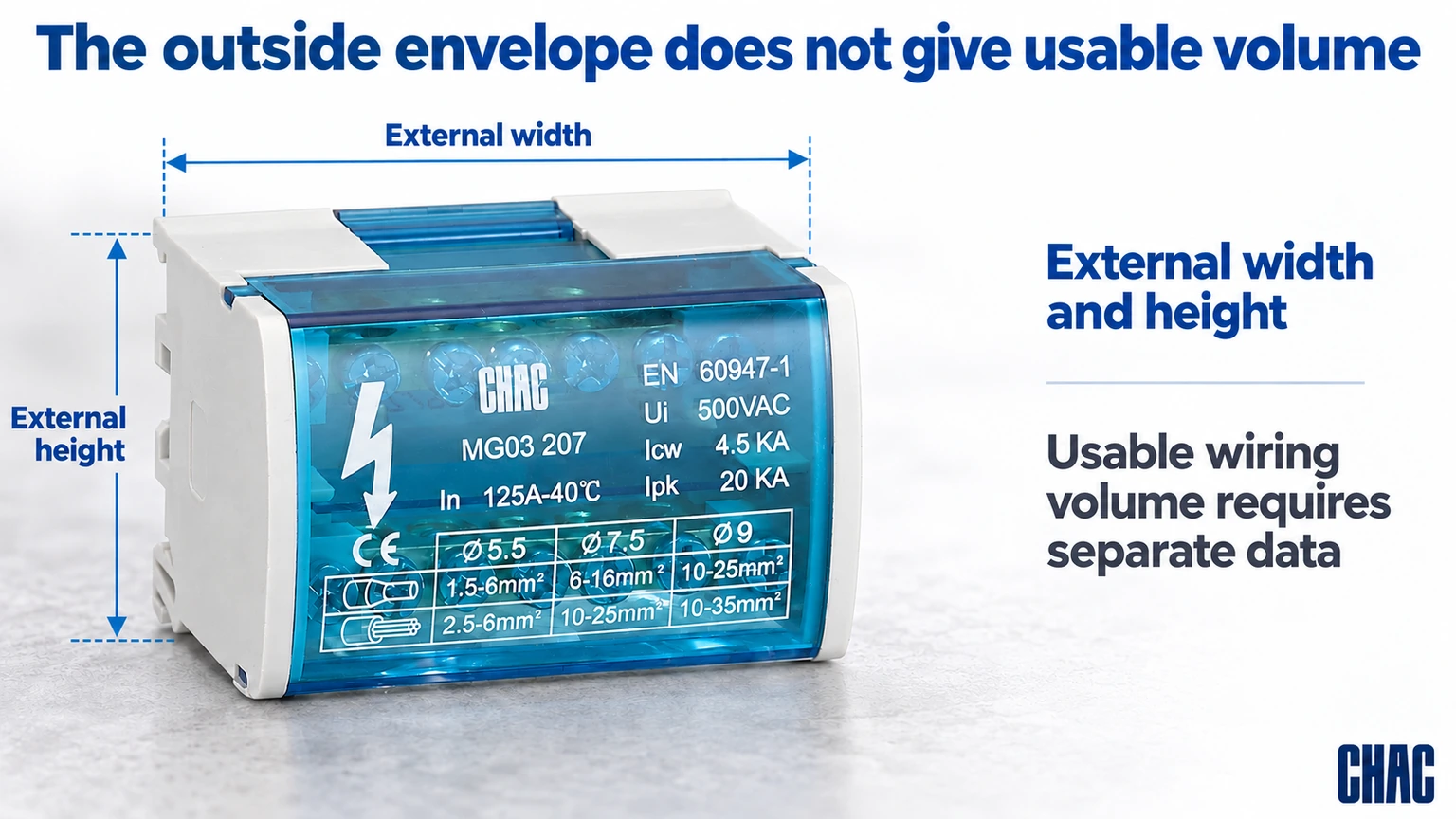
Record external width, height and depth, the mounting-hole arrangement, cover size and wall-opening requirements. Then record internal or marked volume separately. Wall thickness, brackets, lugs and projecting fasteners can change the installation envelope without adding usable wiring space. A drawing should make its reference surfaces clear.
Phần electrical box dimensions on a supplier’s headline may refer to the box body, a nominal family size or the largest overall projection. RACO’s 299 product record, for instance, labels depth as 2.125 inches and also lists “Actual Depth” as 2.56 inches. Do not choose one number without consulting the drawing and confirming which envelope the installation requires.
| Dimension or property | Useful for | Insufficient on its own for |
|---|---|---|
| External width and height | Space and mounting review | Usable wiring volume |
| Body and overall depth | Cavity and projection checks | Device or connector bend space |
| Marked capacity | Applicable box-fill calculation | Fit of every bulky device |
| Entry positions and sizes | Cable fitting and route planning | Environmental suitability of the finished assembly |
| Cover and fixing pattern | Access and finished installation | Approval for fixture or fan support |
How does box fill differ from physical clearance?
Box fill is a code-based volume calculation, not a count of how many wires can be forced inside. The applicable rules account for conductors and specified allowances for items such as devices, clamps and grounding arrangements. Use the adopted edition because details and exceptions can change. Conduit fill is a different calculation and should not be substituted for box fill.
Even after a volume calculation passes, the actual arrangement needs enough space for connectors, device bodies and conductor bends. A deep electronic control may require a deeper box than a simple switch with the same faceplate. Request a sample or dimensioned assembly drawing when bulky fittings or repeated production layouts make fit uncertain.
What can change when the cable-entry fitting is added?
Review the box with its entries fitted, not as an empty shell. Identify the cable or raceway, each permitted entry fitting, any internal projection and the space needed to install it. A connector can clear the enclosure wall yet conflict with a device or another conductor route inside. Outside the box, the fitting and installation tool may need space that is missing from a body-only drawing.
Keep the box, cover, entry fittings and any required sealing parts in one controlled bill of materials. If an installer proposes another fitting, repeat the affected clearance and suitability checks rather than approving it by thread size alone. Where an environmental rating is required, obtain the instructions for the complete permitted arrangement. An appropriate box material does not establish that every field-cut opening or substitute gland preserves the intended protection.
When should a metal junction box be chosen instead of a nonmetallic one?
A metal junction box may suit a particular wiring method, mechanical environment or bonding arrangement, but metal is not automatically better for every application. Nonmetallic boxes have their own permitted uses and installation requirements. Select the listed product and fittings for the actual environment and circuit, then follow the relevant grounding or bonding requirements.
For damp, wet, dusty or corrosive locations, evaluate the enclosure and its complete entry system. A nominal material name does not prove an ingress rating or resistance to the actual exposure. Covers, gaskets, cable glands and installation orientation can all affect the final result. Do not turn a catalogue photograph into an unsupported weatherproof claim.
| Ứng dụng | Primary selection check | Common procurement omission |
|---|---|---|
| Wall switch or receptacle | Device mounting, depth and box fill | Using faceplate size as the cutout |
| Ceiling outlet | Connection space and permitted support duty | Assuming every box supports a fan |
| Surface junction enclosure | Entry system, cover and environment | Ignoring fitting projections |
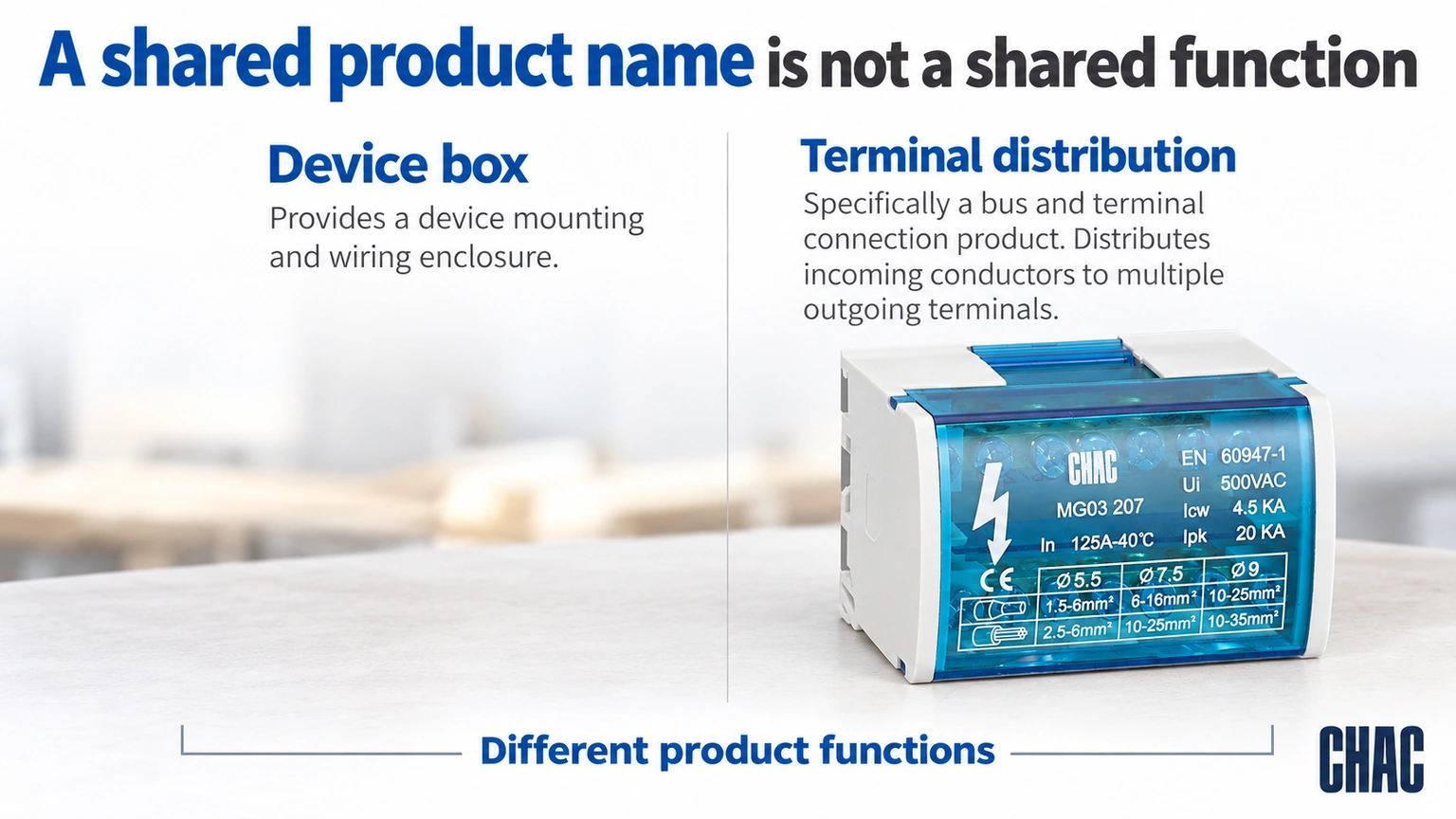
| Distribution-terminal assembly | Terminal layout, ratings and cabinet space | Treating it as an empty outlet box |
How do you avoid a dimensional error when drawings use different units?
Convert an identified dimension, not a nominal family name. Using the cited RACO 299 example, 4.25 in converts to 107.95 mm at 25.4 mm per inch. Converting its nominal “4 in” description instead gives 101.6 mm, a difference of 6.35 mm. These calculations explain the naming issue; neither result is an approved wall-opening dimension.
On the first sample, compare the requested drawing revision with the received model, mounting features and matching cover. Record which dimensions are nominal, which are actual and which require a manufacturer-defined tolerance. Do not invent a tolerance from the number of decimal places in a catalogue. Resolve inconsistent units or reference planes before repeating the order, and keep the accepted sample configuration attached to the procurement record.
What should a procurement checklist include?
Specify the exact model, drawing revision, material, external envelope, marked capacity, entry layout, mounting method, cover and required documentation. State the destination market and any required support or environmental rating. RACO’s box families separate switch boxes, multi-gang boxes and ceiling-support products because the installation tasks differ. Its multi-gang range is a useful reminder that gang count is not a complete dimensional specification.
CHAC’s distribution junction box is specifically a bus and terminal connection product. Its published model widths include 65, 100, 132 and 167 mm variants, with configurations depending on the ordered model. It is not evidence that CHAC supplies the round or single-gang outlet boxes described above. For a complete cabinet project, review the electrical distribution product range by function and request the appropriate enclosure and component drawings.
What do buyers ask about metal junction boxes?
What are metal junction boxes used for?
They house the connections or devices permitted by their design and approval. The exact use depends on the wiring method, environment, mounting and any specified support duty.
Is it better to use metal or plastic junction boxes?
Neither material is universally better. Compare the permitted wiring method, mechanical exposure, bonding requirements, environment and product approval for the actual installation.
Does every metal junction box need to be grounded?
Exposed conductive enclosures generally need the grounding or bonding arrangement required by the applicable installation rules. The permitted method depends on the wiring system and fittings; do not assume an isolated screw or nearby conduit is sufficient.
Are metal electrical boxes up to code?
A particular listed box can be suitable when installed according to its instructions and the adopted rules. Metal construction alone does not establish compliance.
What are the standard sizes for metal junction boxes?
Manufacturers offer several nominal families, depths and mounting arrangements. Select a specific model drawing instead of treating a family name as a universal external dimension.
How deep should a metal junction box be for the wiring inside?
It must provide the required calculated volume and practical room for the actual conductors, connectors and devices. The installation cavity, cover and entry fittings also affect the usable arrangement.
Tham khảo
- Hubbell RACO 299 round ceiling-rated box, product dimensions and capacity; accessed October 19, 2026
- Hubbell RACO box families; accessed October 19, 2026
- Hubbell RACO multi-gang boxes and covers; accessed October 19, 2026
Conclusion
Select a junction box by the job it must perform and the dimensions that control that job. Separate nominal size from the external envelope, and separate marked volume from the practical clearance needed for devices and connectors. Confirm the mounting, entry system, cover, bonding and environmental requirements before using a familiar box family as a specification. A ceiling support box, wall device box and distribution-terminal product are not automatic substitutes. CHAC publishes model-specific information for its bus and terminal connection products and broader distribution range. Use those records where the function matches, and obtain the exact enclosure drawing and approval for the installation rather than relying on a generic product name.
For the relevant model drawings and project documentation, contact CHAC with the circuit requirements.