Tình huống thực tế minh họa: Khi Maya, một quản lý cơ sở vật chất tại Houston, khởi động một cụm điều hòa không khí đặt trên mái nhà sau một cơn bão mùa hè, bộ điều nhiệt bị reset, tiếp điểm của dàn ngưng tụ ngắt, và tòa nhà mất khả năng làm mát chỉ trong vài giây. Quá trình kiểm tra sau đó không phát hiện đầu nối lỏng lẻo hay máy nén bị hỏng; nguyên nhân sâu xa nằm ở sơ đồ bảo vệ quá độ được thiết kế không đầy đủ và đường dây nhánh mạch điện kéo dài. Bài học thực tiễn rút ra là: một thiết bị chỉ được ghi nhãn “Bộ chống sét lan truyền” không phải lúc nào cũng là biện pháp bảo vệ phù hợp cho một hệ thống điều hòa hoặc lò sưởi.
Tóm tắt: Hiệu quả hệ thống HVAC Bộ chống sét lan truyền cài đặt bắt đầu từ hệ thống cấp nguồn, bố trí nối đất, mức độ tiếp xúc và các hướng dẫn của nhà sản xuất thiết bị—chứ không phải từ một nhãn ghi dòng điện thông thường. Điều 285 của NEC đề cập đến các thiết bị chống sét lan truyền trên các mạch có điện áp lên đến 1,000 V, trong khi IEC 61643-11 quy định các yêu cầu và phương pháp thử nghiệm đối với SPD được kết nối với hệ thống điện hạ thế. Hãy để một thợ điện có chứng chỉ phối hợp vị trí lắp đặt SPD, dây dẫn, bảo vệ quá dòng và hồ sơ vận hành với cầu dao HVAC hoặc tủ phân phối trước khi đưa thiết bị vào vận hành.
Các thiết bị điện tử HVAC phải chịu các quá độ chuyển mạch phát sinh từ động cơ, contactor, bộ biến tần và hoạt động sét gần đó. Máy nén, bảng điều khiển, mô-đun đánh lửa, thermostat và hệ thống dây nối truyền thông không cùng trải qua một đường dẫn hoặc mức năng lượng như nhau. Do đó, biện pháp bảo vệ cần được triển khai như một hệ thống phối hợp: giảm bớt quá độ tại điểm cấp nguồn hoặc điểm phân phối, sau đó hạn chế điện áp dư ở gần các thiết bị nhạy cảm, tùy theo điều kiện lắp đặt cho phép.
Thực chất một thiết bị chống sét lan truyền cho hệ thống HVAC làm gì?
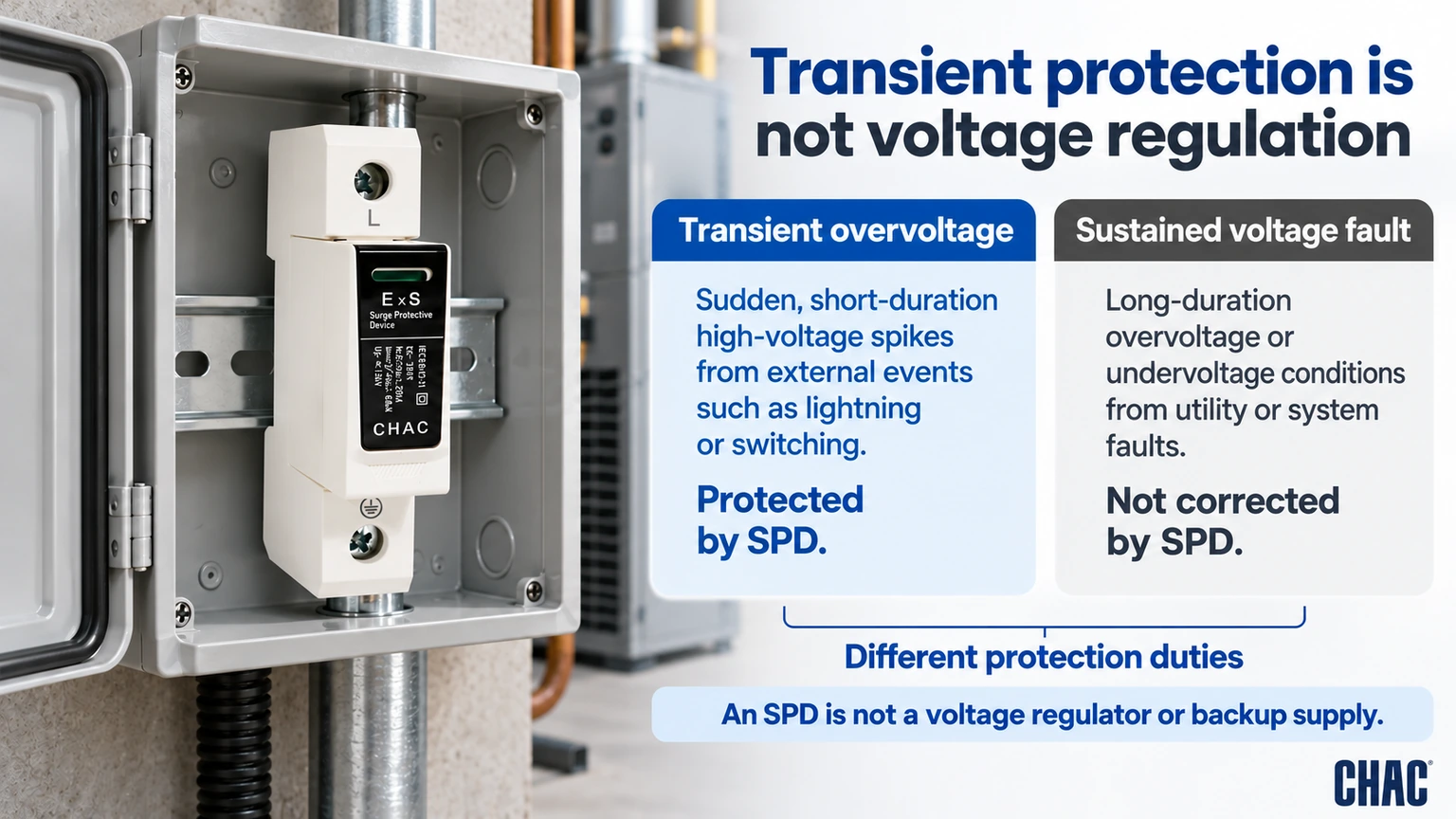
Thiết bị chống sét lan truyền (SPD) cung cấp một đường dẫn được kiểm soát cho quá áp trong thời gian ngắn, nhờ đó mạch điện được bảo vệ sẽ chịu mức quá độ thấp hơn so với khi không có thiết bị. Nó không phải là bộ điều chỉnh điện áp, nguồn dự phòng, cũng không thể thay thế cho hệ thống bảo vệ quá dòng đúng cách. Ngoài ra, thiết bị này cũng không thể đảm bảo rằng các linh kiện của hệ thống HVAC sẽ vượt qua mọi sự cố; hiệu suất của nó phụ thuộc vào điện áp hệ thống, hệ thống nối đất và liên kết đẳng thế, chiều dài dây dẫn, sự phối hợp giữa các thiết bị, cũng như biên độ và dạng sóng của xung sét.
Đối với một Thiết bị chống sét cho hệ thống HVAC, nhà lắp đặt cần xác định xem thiết bị được cấp nguồn từ một thiết bị cắt điện chuyên dụng, một tủ điện gần đó hay từ một đường dây cấp dài hơn. Một kết nối ngắn, thẳng với tiết diện dây dẫn theo quy định của nhà sản xuất thường giúp giảm độ tự cảm của dây dẫn; cách bố trí đường dây, bán kính uốn cong và mô-men siết tại đầu nối đều rất quan trọng, vì SPD chỉ có thể hạn dòng hiệu quả khi đường đi kết nối của nó được thiết kế hợp lý như một phần của mạch điện.
Thiết bị nên được lắp đặt ở đâu?
Không có một giải pháp chung duy nhất là “đặt một hộp tại bộ ngưng tụ”. Vị trí tối ưu là điểm làm hạn chế quá áp trên các dây dẫn cấp nguồn cho thiết bị được bảo vệ, đồng thời vẫn đảm bảo dễ dàng tiếp cận để kiểm tra. Tùy theo thiết kế, đó có thể là SPD đặt tại tủ phân phối chính hoặc tủ phân phối nhánh, SPD lắp tại cầu dao HVAC, hoặc hệ thống bảo vệ phối hợp tại nhiều điểm khác nhau. Việc lắp đặt phải tuân thủ các tiêu chuẩn ghi trên nhãn của SPD, sơ đồ nối dây, cấp độ bảo vệ của vỏ tủ và quy định của mã điện địa phương.
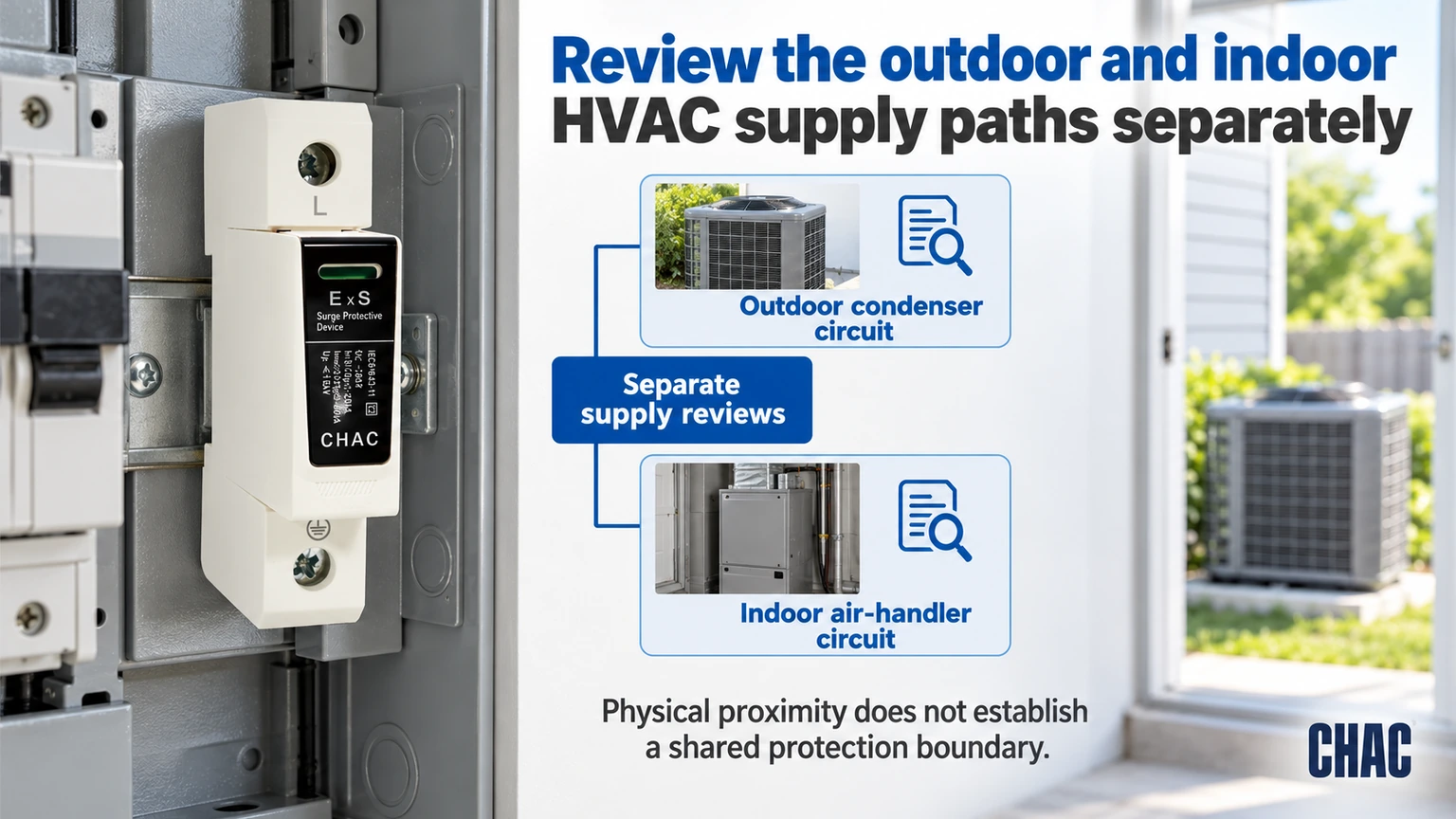
Đối với hệ thống phân tách, hãy xem xét riêng mạch của dàn nóng đặt ngoài trời và mạch của dàn lạnh hoặc lò sưởi trong nhà; nguồn cấp cho chúng có thể xuất phát từ các tủ điện khác nhau. Đối với thiết bị gói đặt trên mái, tủ ngắt kết nối và tủ điều khiển có thể ở gần nhau về mặt vật lý, nhưng vẫn phải được kết nối theo đúng quy định của tiêu chuẩn. Đặt thiết bị ở vị trí sao cho có thể kiểm tra các chỉ báo trạng thái mà không làm nhân viên tiếp xúc với các bộ phận mang điện, đồng thời đảm bảo khoảng cách an toàn cần thiết cho việc vận hành và bảo trì thiết bị điện.
Danh mục kiểm tra dưới đây là danh mục kiểm tra cho công tác mua sắm và lắp đặt, không thay thế được bản thiết kế của kỹ sư điện có chứng chỉ hành nghề:
- Ghi lại điện áp danh định, pha, tần số, hệ thống nối đất, dòng ngắn mạch khả dụng và các hướng dẫn bảo vệ của nhà sản xuất hệ thống HVAC.
- Lập sơ đồ bố trí dây cấp nguồn, dây ngắt kết nối, dây tủ điện và dây điều khiển; ghi chú các đoạn dây dài, vị trí tiếp xúc ngoài trời cũng như các phụ tải cảm kháng lớn khác.
- Hãy chọn loại SPD và các thông số kỹ thuật phù hợp với hệ thống, vị trí lắp đặt tủ điện và điểm đấu nối dự kiến.
- Lắp đặt với các dây dẫn và thiết bị bảo vệ quá dòng đã được chỉ định; đảm bảo đường dây kết nối ngắn và được bảo vệ cơ học.
- Kiểm tra mô-men xoắn, mối nối, tín hiệu trạng thái, nhãn mác và tài liệu; ghi lại ngày lắp đặt và tên người lắp đặt để phục vụ công tác bảo trì trong tương lai.
Cách so sánh các tùy chọn bảo vệ
Type designations describe installation location and application context, not a universal ranking. The following comparison helps a project team discuss the trade-offs without assuming that one option is sufficient for every building.
| Option | Typical position | Useful when | Hạn chế quan trọng |
|---|---|---|---|
| Loại 1 SPD | Service entrance or line side of the main overcurrent device, where permitted | The design needs an upstream first stage for service-level exposure | It does not remove the need to assess branch circuits and sensitive controls |
| Loại 2 SPD | Load side of the service equipment, such as a distribution or HVAC panel | A branch or panel-level protection point is practical and accessible | Coordination and lead length still determine the voltage seen by equipment |
| Type 3 SPD | Close to a particular load or at a point of use, where the product is intended for it | Residual protection is needed near sensitive controls after upstream protection | It is not a replacement for properly selected upstream protection |
| Các giai đoạn được phối hợp | More than one location, selected as a system | Large facilities, long feeders, or mixed indoor/outdoor equipment make coordination valuable | Requires a documented design rather than simply adding devices |
Đối với một surge protector for hvac system, ask the supplier to show the intended connection point, nominal system voltage, maximum continuous operating voltage (Uc or MCOV as applicable), nominal discharge current (In), voltage protection level (Up), short-circuit or backup-protection conditions, and enclosure/environment constraints. These fields support comparison; they do not by themselves prove suitability for a particular installation.
The same discipline applies to furnace surge protector installation: identify the furnace feeder and ignition/control circuits, then verify that the selected device and its location match the manufacturer’s instructions and the adopted code.
Selection by project condition
Use the matrix below during design review. It deliberately avoids a universal rating recommendation because the correct choice changes with the supply and the installation environment.
| Khu vực quyết định | Questions to document | Tác động của việc mua sắm |
|---|---|---|
| Exposure | Is the building in a high-lightning area, industrial site, or location with frequent switching? | Confirm the protection strategy and whether staged SPDs are warranted. |
| Electrical system | What are nominal voltage, phase, frequency, grounding system, and fault-current conditions? | Reject devices whose Uc, configuration, or backup protection does not match the system. |
| Equipment layout | Are the condenser, furnace, air handler, and controls on separate feeders or panels? | Plan each relevant circuit and avoid assuming one device covers every cable path. |
| Môi trường | Will the SPD be outdoors, in a wet location, or in a hot mechanical room? | Verify enclosure, temperature, ingress, and inspection requirements from the product documentation. |
| Serviceability | Can an electrician see the status indicator and replace the device safely? | Prioritize accessible mounting and a clear maintenance record over hidden placement. |
Standards, testing, and commercial risk
In the United States, the National Electrical Code is adopted and amended by jurisdictions; the adopted edition and local amendments control the installation. NEC Article 285 covers surge-protective devices on circuits rated 1,000 V or less. The article is a code framework, not a statement that every SPD or HVAC installation is automatically compliant.
IEC 61643-11 covers low-voltage SPDs connected to low-voltage power systems and specifies requirements and test methods. A test method or product standard is not, by itself, proof of certification for a destination market. Procurement teams should request the applicable declaration, listing, or third-party evidence from the manufacturer and verify that it matches the exact model and configuration being supplied.
Unsupported claims create practical exposure: an inspector may reject the installation, a distributor may face returns, and a building owner may discover that a warranty condition was not met. Keep the submittal package with the wiring diagram, data sheet, installation instructions, inspection record, and any market-specific conformity evidence.
Buying and installing with fewer surprises
- Start with the one-line diagram. Do not choose from a photograph or a nominal current alone; verify the exact system and connection point.
- Check the complete data sheet. Compare Uc/MCOV, In, Up, configuration, enclosure, backup protection, and replacement indication against the project requirements.
- Coordinate with the HVAC OEM. Confirm whether the manufacturer specifies an SPD, a disconnect arrangement, control-circuit protection, or a particular installation distance.
- Specify evidence, not slogans. Request the applicable test standard, instructions, drawings, and market documentation; do not convert a standard reference into an unverified certification claim.
- Plan maintenance. Record status checks and replacement criteria, especially where the device is exposed to repeated switching or lightning events.
CHAC Electric supplies configurable low-voltage protection equipment for OEM, panel-builder, and distribution programs. Review the available surge protection device category against the project’s electrical data, then ask for model-specific documentation before approval. The Bộ bảo vệ sụt áp EXS T1/T2 AC is one product reference for a technical review; final suitability still depends on the system and installation conditions.
Các câu hỏi thường gặp
How much does it cost to install an HVAC surge protector?
There is no responsible single price: labor access, panel space, permits, conductor routing, enclosure requirements, and the selected device all change the quote. Ask for a line-item estimate that identifies the SPD model, installation point, testing, labeling, and any required panel or disconnect work. A low device price can be misleading if the installation requires additional coordination or rework.
Does an HVAC system need a surge protector?
Many HVAC systems benefit from evaluated surge protection because they combine motors with electronic controls, but the need and arrangement depend on the building’s electrical design, exposure, and local requirements. Have an electrician assess the service, branch circuits, controls, and manufacturer guidance rather than treating a generic device as universal insurance.
Where Do You Install an Hvac Surge Protector | Thor Thor?
Install it at a code-permitted service, distribution, branch, or point-of-use location selected to limit transient voltage on the relevant conductors. For an HVAC project, that may mean the panel feeding the disconnect or a coordinated device near the equipment; the electrician must follow the product wiring diagram and local working-clearance rules.
What is hvac surge protector installation and what does it protect?
HVAC surge protector installation is the selection, mounting, wiring, and verification of an SPD for the electrical circuits serving air-conditioning, heat-pump, air-handler, or furnace equipment. It is intended to reduce transient overvoltage stress on power and, where separately addressed, control circuits; it does not regulate normal voltage or replace grounding, bonding, breakers, or maintenance.
Thiết bị nên được lắp đặt ở đâu?
Choose the nearest practical, accessible connection point that protects the intended circuit and keeps the SPD leads short, subject to the manufacturer’s instructions and the adopted electrical code. If the outdoor unit and indoor furnace are on different feeders, assess each path; one device cannot be assumed to protect every conductor.
Tại sao thiết bị chống tăng áp lại liên tục ngắt mạch?
An SPD may disconnect or indicate end-of-life after a surge, or a repeated trip may point to incorrect voltage selection, a wiring fault, excessive transient exposure, or an upstream protection issue. Do not reset or bypass it repeatedly: isolate the circuit safely and have a qualified electrician inspect the device status, connections, system voltage, and manufacturer replacement procedure.
Tham khảo
- NFPA National Electrical Code (NEC) information — code framework and adoption context for electrical installations.
- IEC 61643-11 publication — requirements and test methods for low-voltage surge protective devices.
- NEMA surge protective device resources — industry guidance and terminology for SPD application.
- U.S. Consumer Product Safety Commission lightning safety guidance — general context for lightning exposure and safety planning.
The durable principle is simple: protect the circuit you have documented, not the product label you remember. When the one-line diagram, SPD data sheet, installation method, and inspection record agree, HVAC surge protection becomes a repeatable engineering decision rather than a last-minute add-on.
For model selection, wiring documentation, or OEM sourcing support, contact the CHAC technical team with the system voltage, phase, grounding arrangement, installation point, and destination-market requirements.