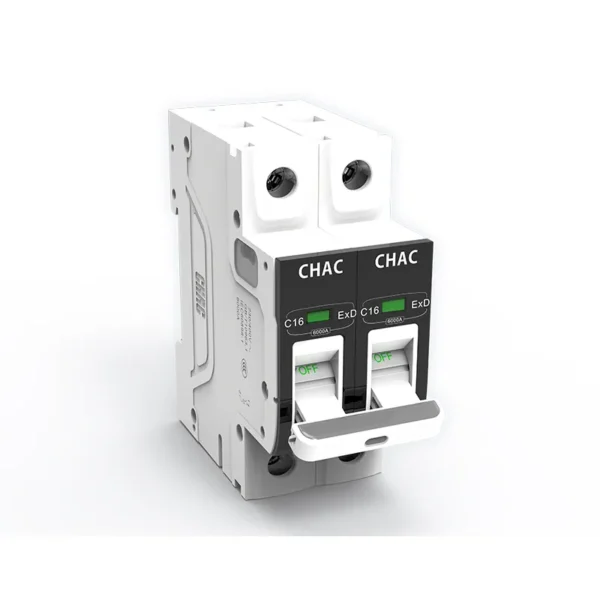




Bộ ngắt mạch đồng trục cỡ nhỏ dòng CQB3-63 50Hz/60Hz AC
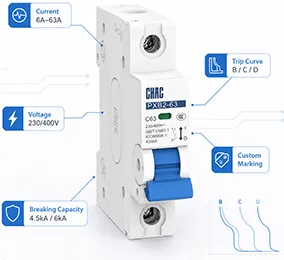
Phần CQB3-63 miniature circuit breaker provides overload and short-circuit protection within the published 6A–63A range. Its verified product data lists 6kA Icn, 1P / 1P+N / 2P / 3P / 3P+N / 4P and B / C / D. Final selection must match the conductor, load, prospective fault current, installation system and applicable local rules.
Product Overview
CQB3-63 is a 6kA Icn miniature circuit breaker covering 6A–63A. It is available with 1P / 1P+N / 2P / 3P / 3P+N / 4P and B / C / D trip options as stated in the product data.
The model data references IEC 60898-1; GB/T 10963.1 and lists CCC certification. Standards, certification scope and technical documents must be confirmed for the ordered configuration and destination market.
Key Features
Typical Applications
It is intended for AC distribution circuits where the selected current rating, curve, pole arrangement and breaking capacity match the conductor and system study. Typical project contexts include residential, commercial and light-industrial final distribution; suitability depends on the actual circuit rather than the application label alone.
Applications and Selection Guide
Use the product-specific values below as a shortlist, then validate the complete circuit design. Product ratings do not replace a fault-current study, conductor calculation, coordination review or applicable installation rules.
| Selection point | CQB3-63 option | What the project must confirm |
|---|---|---|
| Rated current | 6A–63A | Coordinate with design current, conductor ampacity, ambient temperature and grouping |
| Trip curve | B/C/D | Choose for load inrush and required fault-clearing performance, not by current alone |
| Breaking capacity | 6kA Icn | Confirm against the prospective short-circuit current at the installation point |
| Pole arrangement | 1P / 1P+N / 2P / 3P / 3P+N / 4P | Match supply system and local switching or isolation rules |
| Installation interface | 45mm mounting rail reference | Check enclosure, rail/base, terminal and conductor compatibility |
Breaking Capacity
6kA Icn is the published product value. Confirm the prospective short-circuit current at the installation point.
Trip and Load Behaviour
B / C / D is the available trip/protection option. Match it to load inrush and required disconnection performance.
Pole Configuration
Available arrangement: 1P / 1P+N / 2P / 3P / 3P+N / 4P. Confirm which conductors must be switched and protected under local rules.
MCB or RCBO
An MCB does not replace residual-current protection where an RCD or RCBO is required.
Ordering Guide
- Specify the exact model: CQB3-63.
- State the required current rating within 6A–63A.
- Confirm pole arrangement: 1P / 1P+N / 2P / 3P / 3P+N / 4P.
- Confirm trip or protection option: B / C / D.
- Provide system voltage, expected fault level, destination market, quantity and any document requirements.
Installation and Coordination Checks
- Verify conductor material and cross-section against the circuit calculation and the published terminal range.
- Confirm the prospective short-circuit current does not exceed the applicable breaking rating.
- Check upstream/downstream coordination, enclosure temperature, grouping, altitude and required clearances.
- Installation, isolation, testing and maintenance must be carried out by qualified personnel under applicable rules.
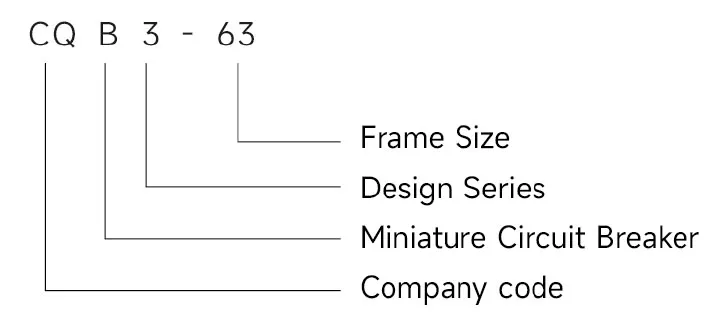
Type designation
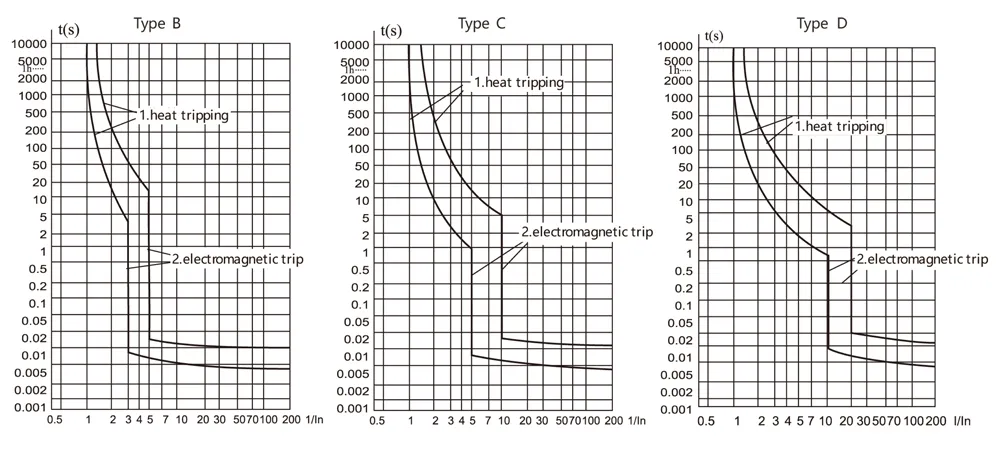
Tripping curves
Dimensions (unit:mm)

Technical Specifications
| Parameter | |
| Rated Insulation Voltage (Ui) | 500V |
| Rated Impulse Withstand Voltage (Uimp) | 4000V |
| Rated Current (In) | 6, 10, 16, 20, 25, 32, 40, 50, 63 |
| Rated Frequency | 50Hz / 60Hz |
| Number of Poles | 1P, 1P+N, 2P, 3P, 3P+N, 4P |
| Rated Breaking Capacity (Icn) | 6000A |
| Mechanical Life & Electrical Life | Mechanical ≥10000, Electrical ≥6000 |
| Tripping Curves | B, C, D |
| Mounting Rail | 45mm |
| Degree of Protection (IP Code) | IP20 |
| Applicable Standards | IEC60898-1, GB/T10963.1 |
| Chứng nhận | CCC |
Table1 Tripping characteristics (Reference temp.30°C)
| Item | Type | Test current In(A) |
Initial Status | Time limit for tripping or non-tripping |
Expected result | Remarks |
| a | B、C、D | 1.13ln | Cold | t≤1h | Non-tripping | Current smoothly rises to specified value in 5s |
| b | B、C、D | 1.45ln | Following previous test |
1h | Tripping | |
| c | B、C、D | 2.55ln | Cold | 1s<t<60s(In≤32A) 1s<t<120s(In>32A) |
Tripping | |
| d | B | 3ln | Cold | t≤0.1s | Non-tripping | Switch on the power supply by closing the auxiliary switch |
| C | 5In | |||||
| D | 10In | |||||
| e | B | 5In | Cold | t<0.1s | Tripping | Switch on the power supply by closing the auxiliary switch |
| C | 10ln | |||||
| D | 20ln |
Note: The term “cold” means that the test is carried out at a reference calibration temperature without load before the test.
Conductor requirements and cross section
| Copper cross-section(mm²) | Rated current In(A) |
| 1 | In≤6 |
| 1.5 | 6<In≤13 |
| 2.5 | 13<In≤20 |
| 4 | 20<In≤25 |
| 6 | 25<In≤32 |
| 10 | 32<In≤50 |
| 16 | 50<In≤63 |
Tại sao nên chọn CHAC
With 30+ years of manufacturing experience, 1100+ employees, 100M+ poles
annual capacity and 90% automated production, CHAC provides stable production capacity and strict
quality control for global OEM/ODM customers. Our in-house manufacturing system supports long-term
cooperation for electrical brands, importers and distributors.

30+
NĂM KINH NGHIỆM
Chuyên sản xuất thiết bị điện hạ thế

1100+
CÔNG NHÂN
Đội ngũ chuyên nghiệp đảm bảo chất lượng và giao hàng ổn định

100 triệu người
Sức chứa hàng năm của các cột
Năng lực sản xuất quy mô lớn để đáp ứng nhu cầu toàn cầu

90%
SẢN XUẤT TỰ ĐỘNG
Tự động hóa nâng cao cho hiệu quả cao và tính nhất quán

Dây chuyền lắp ráp tự động

Phòng thí nghiệm kiểm nghiệm
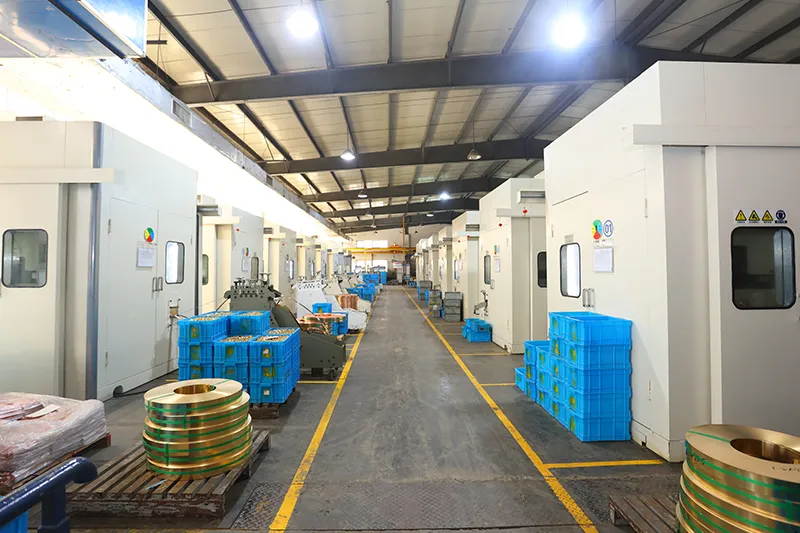
Xay và dập

Kiểm tra chất lượng



Strict quality control system ensures every product meets global standards.
Chúng tôi có thể tùy chỉnh những gì?
For CQB3-63 projects, CHAC can review private-label marking, packaging, appearance, available electrical configurations and technical-document requirements. Requests outside the published range are subject to engineering evaluation, testing, MOQ and project feasibility.

Logo & Thương hiệu
Private-label marking and nameplate options are subject to artwork review and sample approval.


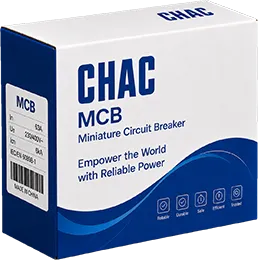
Gói bao bì
Tùy chỉnh
Cartons, labels and manuals can be prepared for the approved order specification and destination market.

Điện
Tùy chỉnh
Select from the published 6A–63A, 1P / 1P+N / 2P / 3P / 3P+N / 4P and B / C / D options; non-standard requests require technical evaluation.

Sản phẩm
Vẻ ngoài
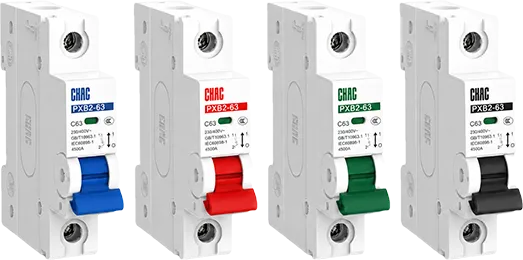
Appearance options can be reviewed subject to tooling, MOQ, marking requirements and technical feasibility.

Chứng nhận
Hỗ trợ
Datasheets, drawings and verified certificate information are supplied for the applicable approved configuration.


Kỹ thuật
Phát triển
Project support may include drawing review, sample evaluation, testing and production planning, subject to technical approval.

Tải xuống
Bộ ngắt mạch cỡ nhỏ dòng CQB3
Complete product overview for low-voltage electrical components and product selection reference.
Need Technical Documents?
Contact us for datasheets, certificates, drawings, selection guidance or OEM/ODM project support.
CQB3-63 Product FAQ
What is the trip curve of an MCB?
The trip curve describes how quickly an MCB responds at different multiples of rated current. CQB3-63 offers B, C and D options, which must be selected from load inrush and required fault-disconnection performance.
Which MCB curve is best for CQB3-63?
There is no universally best curve. B is generally evaluated for lower inrush, C for moderate inrush and D for higher inrush, but the final choice depends on the actual load and available fault current.
When is a C curve appropriate for the CQB3-63?
A C curve is commonly considered for general circuits with moderate starting current. Confirm that normal inrush will not cause nuisance tripping and that the available fault current can still operate the breaker within the required time.
Will a 20A MCB trip exactly at 20A?
Not instantaneously. Thermal operation follows a time-current characteristic, so trip time depends on the magnitude and duration of overcurrent, reference conditions and the applicable product curve.
Does the 80% rule apply to every MCB installation?
No universal 80% rule should be transferred across all markets and applications. Continuous-load treatment, conductor sizing and protective-device selection must follow the applicable installation rules and project design.
What does the 125% rule mean when selecting a breaker?
The phrase commonly refers to market-specific continuous-load or conductor-sizing provisions. It is not a substitute for checking CQB3-63 ratings, derating, cable calculations and the electrical rules that govern the project.
Confirm the Right CQB3-63 Configuration
Send your current rating, pole arrangement, trip option, system voltage, prospective fault level, destination market and quantity. CHAC will review the request against the published product range.