When Elena, a commissioning engineer in Monterrey, closed a new main-incomer breaker, the switchboard tripped before the first production motor started. Her team initially suspected a defective unit; the review showed that the trip thresholds, short-circuit study and bus-coupler operating mode had never been reconciled. The root cause was specification and commissioning process, not simply a bad product.
ملخص: An air circuit breaker (ACB) interrupts current in air and is normally used for main incoming, bus-coupler and high-capacity feeder duties. Under IEC 60947-2, the selection review must distinguish rated current from short-circuit duties such as ultimate breaking capacity (Icu) and service breaking capacity (Ics). Confirm the system voltage, prospective fault current, coordination study, trip-unit functions and installation clearances before approving an ACB. This article explains the air circuit breaker meaning, its mechanism, industrial uses, comparison with vacuum circuit breakers, and practical procurement checks.
What Is an Air Circuit Breaker?
ال air circuit breaker definition is a low-voltage circuit breaker that opens and interrupts a circuit in atmospheric air. Unlike a molded-case breaker, an ACB typically has a larger frame, accessible primary connections and a configurable electronic trip unit for high-current distribution. Unlike a vacuum circuit breaker, it does not use a sealed vacuum interrupter.
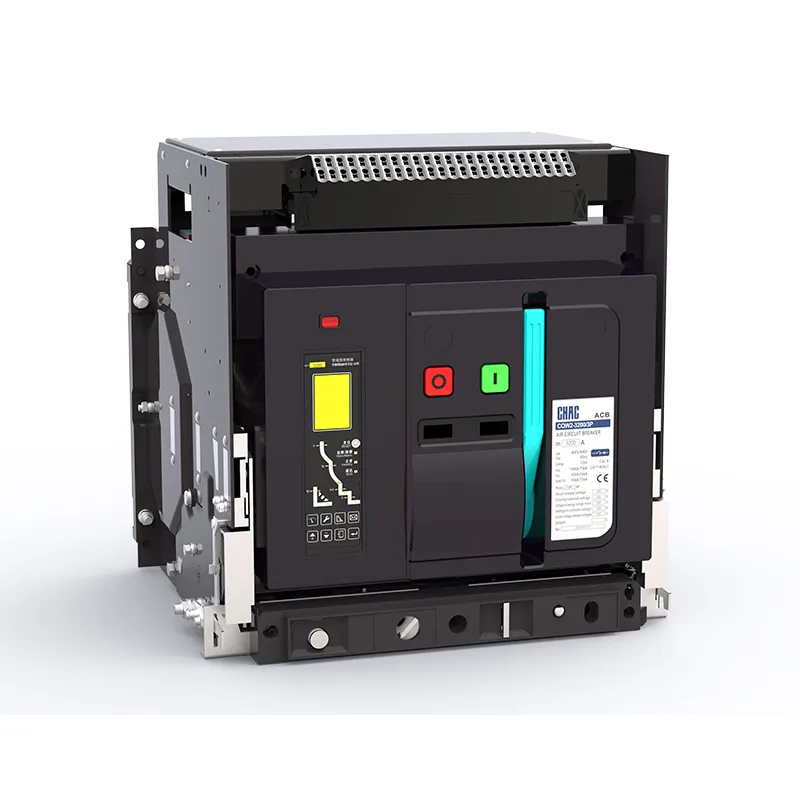
In practical terms, an ACB is a switching and protection assembly. Its main contacts carry normal load current; an operating mechanism opens them when commanded or when the trip unit detects an unacceptable condition; arc-control components divide, cool and extinguish the arc. An ACB may be fixed or drawout, and may include shunt trip, undervoltage release, auxiliary contacts, position indication or interlocking. Those features are model-specific, so the bill of materials should be checked against the manufacturer’s technical documentation.
How Does an Air Circuit Breaker Work?
ال air circuit breaker working principle can be understood as a sequence from sensing to interruption:
- Current sensing: Current transformers or sensors feed the trip unit. The unit compares measured current and time against programmed long-time, short-time, instantaneous and, where provided, ground-fault functions.
- Trip decision: A fault or remote command releases the mechanism. Settings must be coordinated with upstream and downstream devices; a lower threshold is not automatically safer if it creates nuisance trips or poor selectivity.
- Contact separation: Stored energy in a spring-operated mechanism separates the main contacts rapidly. The speed and contact geometry are designed to limit damage while maintaining the required interrupting duty.
- Arc control: An arc forms as contacts separate. Arc runners and arc chutes stretch, split and cool the arc in air until the current can no longer be sustained at the next current zero for the applicable AC duty.
- Isolation and indication: The breaker reaches an open or tripped position. A drawout design may then be moved between connected, test and disconnected positions only in accordance with its interlock and operating instructions.
For AC systems, interruption depends on the source, power factor, prospective short-circuit current and the breaker’s tested duty. The relevant product standard is IEC 60947-2; its test terminology and ratings should not be mixed with ratings from a different standard without checking the test basis.
Which ACB Functions Matter in a Real Switchboard?
Trip-unit settings and coordination
ACB protection settings should be derived from the load study and short-circuit coordination study, not copied from a previous panel. Long-time pickup should protect conductors and equipment under the project’s loading assumptions; short-time and instantaneous functions should coordinate with downstream breakers where selective operation is required. Ground-fault protection, if included, needs a defined sensing arrangement and a review of neutral and bonding paths.
Fixed, drawout and interlocked arrangements
A fixed ACB can be suitable where the equipment is not routinely exchanged, while a drawout ACB can support testing and maintenance workflows when the switchboard is designed for that purpose. Drawout position indicators, shutters, racking mechanisms and key or electrical interlocks are part of the safety case; they are not cosmetic accessories. Verify that the enclosure, busbar joints, cable terminations and clearances match the selected frame.
Short-circuit and endurance evidence
Review the manufacturer’s Icu, Ics, short-time withstand and utilization-category data for the actual voltage and pole arrangement. IEC 60947-2 testing is not a blanket certification for every installation: the product, accessories, settings and assembly still need to meet the project’s design and verification requirements. Keep the test reports, coordination curves and final settings with the panel records.
Where Are Air Circuit Breakers Used?
ال air circuit breaker applications that most often justify an ACB are high-current low-voltage assemblies where protection, switching and continuity must be engineered together:
| تطبيق | Why an ACB may fit | Checks before approval |
|---|---|---|
| Main incoming breaker | Central isolation and adjustable protection for a large low-voltage board | Service entrance rules, fault level, neutral arrangement, metering and selectivity |
| Bus-coupler or tie | Controlled transfer or sectionalizing of switchboard sections | Interlocks, source paralleling logic, phase sequence and short-circuit contribution |
| Generator or utility interface | Switching and protection at a source boundary | Generator subtransient contribution, synchronizing scheme and operating modes |
| Large industrial feeder | Adjustable trip functions for transformers, motors or process distribution | Starting current, conductor ampacity, coordination and maintenance access |
| Data centre or infrastructure board | Documented switching and continuity strategy in a critical distribution path | Redundancy, bypass arrangements, remote operation and testing procedures |
These are application patterns, not automatic recommendations. A molded-case circuit breaker may be more practical for a smaller feeder, while a medium-voltage vacuum circuit breaker may be required on a different voltage class. The honest answer depends on the one-line diagram, available fault current, load profile, enclosure and maintenance strategy.
ACB Versus Vacuum Circuit Breaker
Both devices interrupt fault current, but they operate in different voltage and equipment contexts. An ACB uses air as the interrupting medium and is common in low-voltage main distribution. A vacuum circuit breaker uses a sealed vacuum interrupter and is typically associated with medium-voltage switchgear. Compare the complete system—not just the breaker label—because insulation level, clearances, protection relays, service procedures and switchgear construction also change.
| بعدة أبعاد القرار | Air circuit breaker | Vacuum circuit breaker |
|---|---|---|
| Interrupting medium | Atmospheric air with arc chutes | Sealed vacuum interrupter |
| Typical equipment context | Low-voltage main and high-capacity distribution | Medium-voltage switchgear and feeders |
| Protection approach | Often integrated electronic trip unit | Often relay-based protection with separate switching mechanism |
| Maintenance focus | Contacts, arc chutes, mechanism, accessories and drawout interfaces | Vacuum interrupter condition, mechanism, relay and switchgear insulation |
| Selection risk | Ignoring Icu/Ics, settings or board coordination | Applying a voltage-class or insulation assumption without a switchgear study |
Standards, Testing and Compliance Boundaries
IEC 60947-2 is the key product-standard reference for low-voltage circuit breakers and defines terms, ratings and verification tests relevant to ACB selection. It is not, by itself, proof that a particular installed assembly is compliant. The panel builder must still verify the assembly design, conductor termination, temperature rise, clearances, protection settings and destination-market rules.
NFPA 70 (the National Electrical Code) provides installation rules for covered electrical work in the United States; the adopted edition and local amendments control. Requirements for available fault current, equipment ratings, working space and marking should be checked with the authority having jurisdiction. A standard’s scope is not the same as a product certificate, and marketing language should never imply a certification that the product documentation does not confirm.
How Should Buyers Select an ACB?
- Define the system: nominal voltage, frequency, phases, neutral arrangement, earthing method and maximum continuous load.
- Document the fault duty: prospective short-circuit current at the installation point, source contributions, required Icu/Ics and any short-time withstand requirement.
- Run coordination: compare trip curves and settings with downstream and upstream devices, including generator, transformer and bus-tie operating modes.
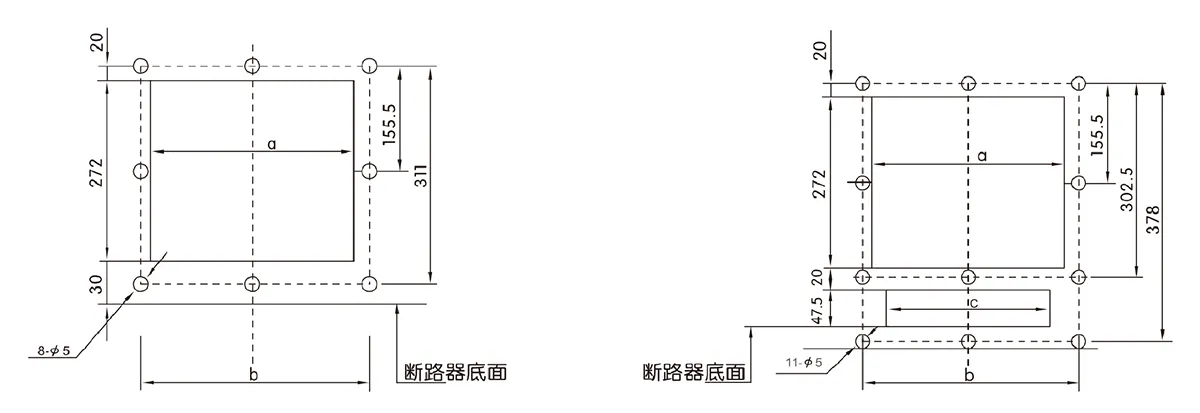
- Specify the physical build: fixed or drawout, frame size, poles, terminals, compartment dimensions, interlocks, auxiliaries and maintenance access.
- Compare lifecycle cost: purchase price, commissioning time, test documentation, spare parts, planned maintenance, downtime exposure and the cost of a future board change.
CHAC Electric positions its ACB range for main incoming and high-capacity distribution circuits in commercial, industrial and infrastructure systems. Review the air circuit breaker category for the available range, then check the model-specific documentation for the CQW2 air circuit breaker before finalizing ratings, accessories or coordination claims.
أسئلة متكررة
How does an ACB breaker work?
An ACB senses abnormal current through its trip unit, releases a stored-energy operating mechanism, separates the main contacts and extinguishes the resulting arc in air using arc-control components. The exact sensing functions, settings and interruption ratings depend on the model and system voltage.
How does ACB work?
During normal operation, the closed contacts carry the load. On an overload, short circuit or trip command, the mechanism opens the contacts and the arc chute cools and divides the arc until current is interrupted; the breaker then indicates open or tripped status.
What is the difference between an air circuit breaker and a vacuum circuit breaker?
An air circuit breaker interrupts in atmospheric air and is commonly used for low-voltage main distribution. A vacuum circuit breaker interrupts in a sealed vacuum interrupter and is generally associated with medium-voltage switchgear; select by voltage class, switchgear design, protection scheme and applicable standards.
How do I reset an air circuit breaker?
First isolate the cause of the trip and follow the manufacturer’s safe isolation procedure; do not repeatedly reclose a breaker into a suspected fault. After the fault is cleared and the mechanism is in the reset-ready position, reset the handle or operating mechanism as instructed, verify interlocks and close only when an authorized person has confirmed the circuit is safe.
What is air circuit breaker used for?
It is used for main incomers, bus couplers, generator interfaces and high-capacity feeders in low-voltage commercial, industrial and infrastructure switchboards. The correct choice depends on current, voltage, fault duty, coordination, physical construction and the project’s maintenance requirements.
How does air circuit breaker work in a drawout switchboard?
The breaker connects to the bus and outgoing circuit in its connected position, can be placed in a test position for functional checks, and can be withdrawn to a disconnected position when the interlock permits. Follow the exact racking, shutter and position-indication instructions for the selected switchboard; a drawout mechanism is not a substitute for isolation and verification.
المراجع
- International Electrotechnical Commission, IEC 60947-2: Low-voltage switchgear and controlgear—Circuit-breakers.
- International Electrotechnical Commission, IEC 60364-4-43: Low-voltage electrical installations—Protection against overcurrent.
- National Fire Protection Association, NFPA 70: National Electrical Code.
The dependable ACB is not the one with the longest feature list; it is the one whose interruption duty, settings, assembly and operating procedure remain correct when the real system is energized.
For a project review, send the one-line diagram, voltage, fault-current study, load profile, required poles, fixed or drawout preference and destination-market documentation needs. Contact CHAC Electric for ACB application support before the panel design is frozen.