Wenn ein Schaltschrankbauer in Rotterdam nach einem Ausfall eines Steuerschranks mit der Ersetzung eines defekten Überspannungsschutzes beauftragt wird, fällt die scheinbar schnellste Entscheidung häufig auf eine bekannte Markenbezeichnung. Die schwierigere Frage ist jedoch, ob das Ersatzgerät den Versorgungsspannungswerten, der Erdungsanordnung, dem Einbaupunkt, der Ableitkapazität und dem vorgesehenen Nachschutz entspricht. Ein Gerät kann zwar qualitativ hochwertig gefertigt sein, dennoch die falsche Wahl darstellen, wenn seine Nennwerte oder die Verdrahtung nicht zum System passen. Dieser Leitfaden erläutert, wie Auftragnehmer, Beschaffungsteams von Originalgeräteherstellern (OEM) und Distributoren vergleichen können. Strombegrenzer Marken, ohne sich auf eine erfundene Rangliste, unbegründete “Top-Bewertung”-Behauptungen oder eine aus dem Zusammenhang gerissene aktuelle Kennzahl zu stützen.
Zusammenfassung: Der beste Überspannungsschutz ist derjenige, dessen geprüfter Anwendungsbereich und Nennwerte mit dem elektrischen System und den geschützten Geräten übereinstimmen. Beginnen Sie mit dem Installationsort und der geltenden Niederspannungs-SPD-Norm, und überprüfen Sie anschließend die maximale dauerhafte Betriebsspannung (Uc), den Nenn- und den maximalen Ableitstrom (In und Imax, sofern angegeben), das Spannungsschutzniveau (Up), die Schutzmodi, die Anforderungen an Kurzschluss-/Rücksicherungseinrichtungen sowie die Statusanzeige. IEC 61643-11 legt Anforderungen und Prüfverfahren für Niederspannungs-Wechselstrom-Überspannungsschutzgeräte fest; sie erstellt keine universelle Markenrangliste. Vergleichen Sie zunächst die Dokumentation und die Eignung für den jeweiligen Anwendungsfall, und beantragen Sie vor dem Kauf eine produktspezifische Bestätigung.
{{FEATURED_IMAGE}}
Was bedeutet “beste Marke für Überspannungsschutz” beim Kauf eines B2B?
Bei einer Steckdosenleiste für den Privatgebrauch kann der Käufer Komfortfunktionen und Garantiebedingungen miteinander vergleichen. Bei einem Verteiler- oder Schaltschrank ist die Frage nach dem “Besten” eine engere technische Frage: Kann der Lieferant für das vorgesehene Spannungssystem, die transienten Bedingungen, die Anschlusstopologie und die Installationsschutzklasse ein entsprechendes Gerät dokumentieren? A beste Marke für Überspannungsschutz Eine Entscheidung ist nur dann sinnvoll, wenn jeder Bewerber anhand derselben Bewerbungsunterlagen und desselben Prüfungsrahmens beurteilt wird.
IEC 61643-11 ist die maßgebliche Referenz für Niederspannungs-Wechselstrom-Schutzgeräte. Die IEC-Publikation beschreibt eine Produktnorm mit festgelegten Anforderungen und Prüfungen; sie ist keine Aussage darüber, dass jedes Produkt mit einem Marketingetikett zertifiziert ist. In nordamerikanischen Projekten können Käufer auch auf ULs Serviceinformationen zu Überspannungsschutzgeräten sowie auf die Anforderungen des lokal übernommenen Elektrocodes stoßen. Bestätigen Sie die Ausgabe und die Marktzulässigkeit beim verantwortlichen Planer oder der zuständigen Behörde.
Welche Bewertungen sollten Käufer zwischen den Marken vergleichen?
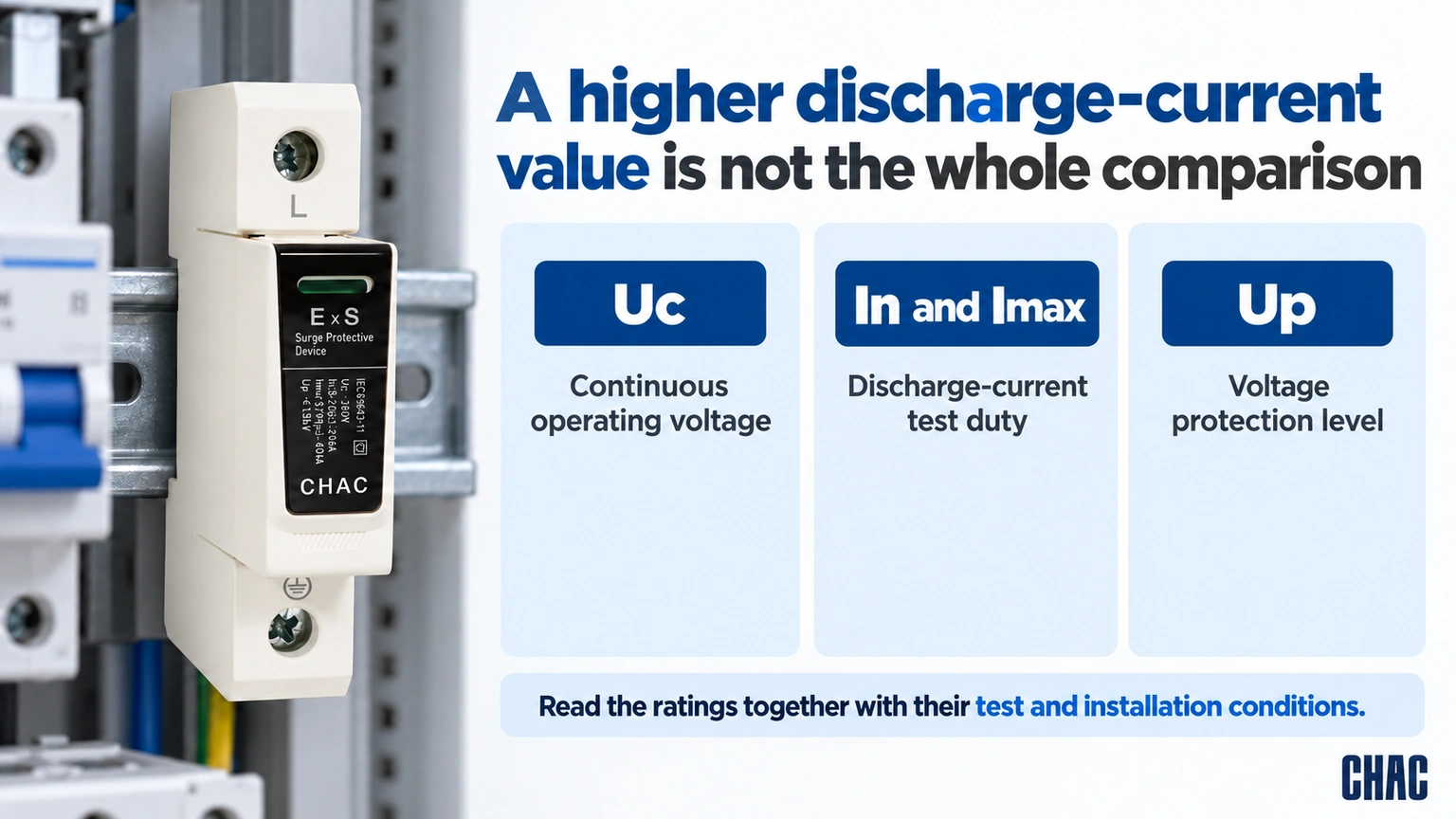
Die Nennwerte sind als Gesamtheit zu betrachten. Uc muss den normalen Systemspannungen und den Bedingungen bei vorübergehenden Überspannungen entsprechen. In und Imax kennzeichnen die Prüfbedingungen für den Ableitestrom, während Up das angegebene Spannungsschutzniveau unter den jeweiligen Prüfbedingungen angibt. Schutzarten, Polzahl, Leiteranordnung sowie die vorgesehene Absicherung oder Schutzschalter are equally important because they determine how the SPD is connected and isolated during an abnormal event. This is why best surge protector brands should be compared by complete data sheets, not popularity alone.
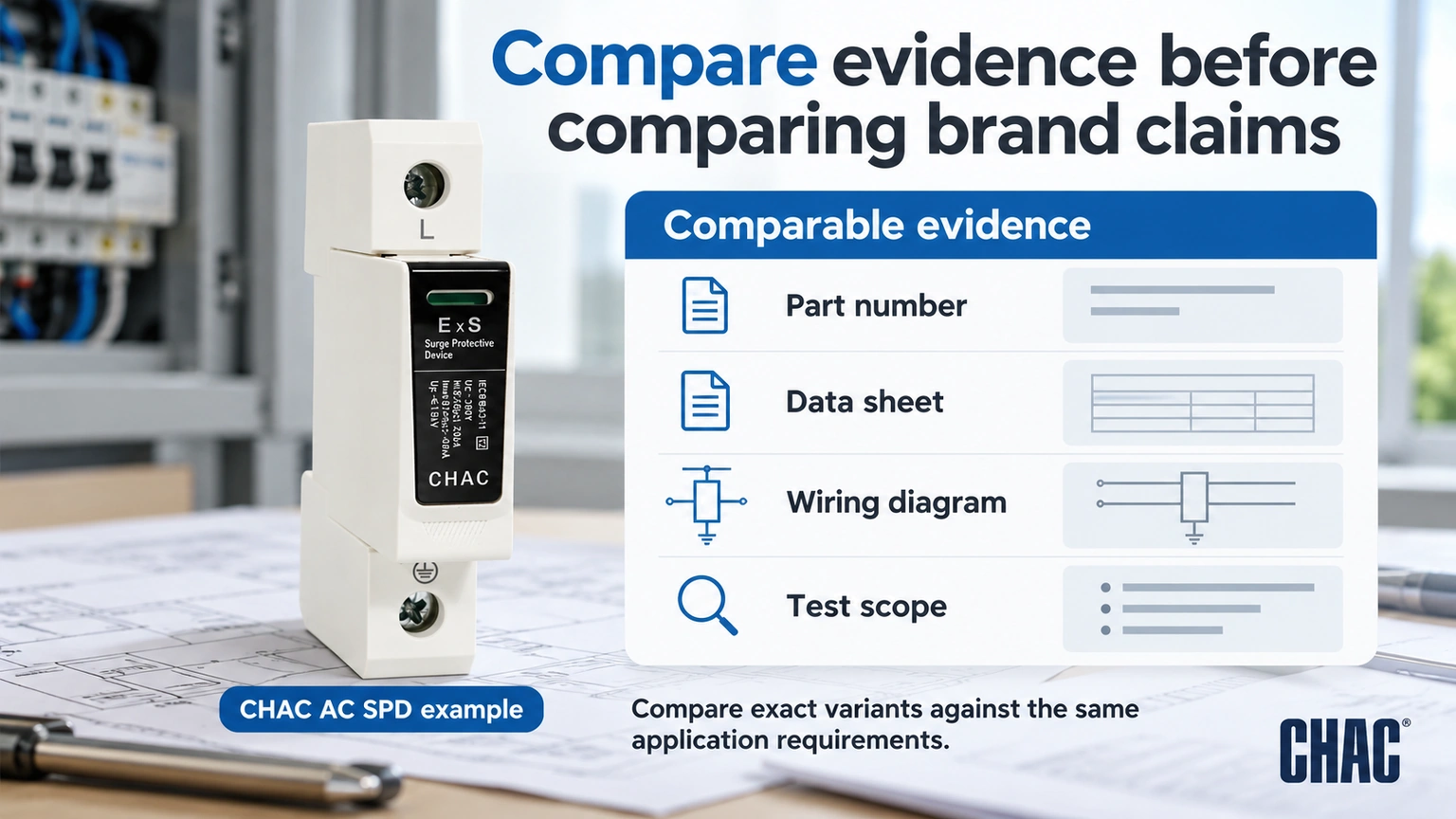
Do not infer protection quality from a single high ampere value. A larger Imax number does not automatically mean a lower Up, better coordination, or suitability for a particular earthing system. Ask for the data sheet, wiring diagram, test standard, and installation instructions for the exact product variant; model families can contain different voltage, pole, and contact configurations.
| Comparison dimension | Was zu überprüfen ist | Why it affects selection |
|---|---|---|
| System fit | Supply voltage, frequency, earthing arrangement, poles, and protection modes | Verhindert, dass ein Gerät außerhalb seiner vorgesehenen elektrischen Topologie angeschlossen wird. |
| Kontinuierliche Bewertung | Uc und jede angegebene Fähigkeit zur Aufnahme von vorübergehenden Überspannungen | Trägt dazu bei, dass die SPD unter normalen und abnormalen Versorgungsbedingungen stabil bleibt. |
| Entladetestschicht | In, Imax, impulse/current waveform, and declared test scope | Allows like-for-like comparison instead of treating marketing terms as test results. |
| Residual voltage | Up and the test conditions used to declare it | Shows whether the expected let-through voltage is compatible with downstream equipment. |
| Installation and service | Backup-device guidance, conductor length, torque, enclosure, remote contact, and status indication | Determines installation quality, inspection effort, and replacement workflow. |
Which application should each protection approach serve?
Selection begins at the point where transient energy enters or travels through the installation. A service entrance or main distribution board may need a coordinated upstream layer; a sub-panel, automation cabinet, or sensitive load may need a downstream device selected for the remaining surge environment and equipment withstand. Signal, data, photovoltaic DC, and battery circuits require products designed for their own voltage and connection conditions rather than a direct substitution of an AC device.
The installation path matters as much as the device label. Short, direct conductors and a verified protective-earth path reduce added inductive voltage during a fast impulse. Separation from sensitive conductors, correct tightening, and the specified upstream protective device should be checked during commissioning. A point-of-use protector cannot correct a poor bonding arrangement or replace a coordinated panel design.
| Application context | Primary selection questions | Nachweis zu beantragen |
|---|---|---|
| Main low-voltage board | Where is the service boundary, what is the earthing system, and what upstream protection is required? | Single-line diagram, SPD type/class information, Uc/Up/In/Imax data, and installation instructions. |
| Sub-distribution panel | What upstream SPD is already installed, and what residual voltage can the load tolerate? | Coordination guidance, conductor-length limits, and equipment withstand information. |
| Industrial control cabinet | Are power, control, and signal circuits exposed to different transient paths? | Separate circuit ratings, wiring diagram, status/remote-contact details, and maintenance instructions. |
| OEM or distributor program | Can the supplier maintain variant consistency across markets and revisions? | Controlled datasheets, test reports or declarations within scope, change notification, and traceable part numbers. |
How can a buyer compare good surge protector brands without inventing a ranking?
A defensible comparison uses a scorecard rather than a numbered list. Record the same fields for each candidate, identify missing evidence, and separate a product’s tested characteristics from the supplier’s service capability. The following framework is suitable for an RFQ review and does not assume that any brand is universally superior. Include how failed protection is identified and replaced. Surge protectors can go bad while connected equipment still runs, so a power light is useful only if the manual defines what it indicates. Ask each supplier how to determine whether its surge protector is still providing protection.
| Scorecard area | Strong evidence | Procurement warning |
|---|---|---|
| Technical transparency | Exact part number, ratings table, wiring diagram, and stated standard/test scope | Only a family name or a headline current value is provided. |
| Application coverage | Separate AC, DC, signal, and enclosure options with clear boundaries | One generic device is presented as suitable for every circuit. |
| Installation support | Backup protection, conductor, torque, coordination, and replacement guidance | Installer is expected to infer wiring from a product photograph. |
| Quality and continuity | Traceable revisions, repeatable documentation, and an agreed change-control process | Equivalent substitutions can occur without engineering review. |
| Total cost of ownership | Purchase, installation, inspection, spare modules, downtime exposure, and service access considered together | Lowest unit price is treated as the complete economic comparison. |
Which standards and compliance checks apply?
IEC 61643-11 is the supplied official reference for low-voltage AC SPDs and their requirements and tests. UL’s surge protective device service page explains the role of evaluation services in the UL framework. These references help define the evidence a buyer should seek, but a standard or listing must be checked for the exact product, market, edition, and intended use. A test method is not the same as a blanket installation approval.
Before release, map the device to the destination market’s adopted electrical code, installation rules, and authority requirements. Keep the product data sheet, applicable declaration or listing, single-line diagram, and commissioning record together. Unsupported claims about certification, lightning immunity, energy savings, or guaranteed equipment survival can create rework, delayed approvals, warranty disputes, and liability exposure.
What should an electrical buyer do before placing an order?
- Define the system: record nominal voltage, frequency, earthing arrangement, poles, available fault conditions, and the circuit type.
- Define the exposure: identify the installation point, incoming service arrangement, cable routing, lightning or switching exposure, and equipment withstand requirement.
- Request exact evidence: require Uc, In, Imax, Up, protection modes, test scope, backup-device guidance, wiring diagram, and replacement indication for the exact part number.
- Review installation: confirm conductor length, bonding, torque, enclosure space, labeling, and status inspection before energization.
- Planungsdienstleistung: decide how failed or end-of-life modules will be identified, isolated, replaced, and recorded across the installed base. Ask whether the manufacturer specifies an inspection interval or surge protector expiration date. Surge protector life expectancy is not a universal number of years. How often surge protectors should be replaced depends on the model’s condition, service history and instructions, not simply its brand or purchase date.
CHAC Electric provides low-voltage surge protection options for review against a project-specific specification. Buyers can start with the CHAC surge protection products category and verify the exact ratings and application documents before approval. The product page for an AC surge protector product should be read as a model-specific source, not as a substitute for the installation design.
Frequently asked questions about surge protector brands
What is the best whole home surge protector for 2026?
There is no universal best model for every home or service. The suitable choice depends on the service voltage, earthing arrangement, panel position, required protection modes, declared ratings, and the rules adopted in the installation market. For that reason, what is the best power surge protector is answered by application data, not by a generic ranking. Compare exact documentation and have the installation checked by a qualified electrician.
What is the best brand for surge protectors?
The best brand is the supplier that can document a product for the intended application and support correct installation, inspection, and replacement. In practice, good surge protector brands make those boundaries and documents easy to verify. Use a consistent scorecard covering standard/test scope, ratings, wiring, continuity, and service rather than relying on a global ranking that has no defined method or date.
Is Anker or Belkin better surge protector?
That comparison cannot be answered responsibly without the exact models, market, load, and use case. Consumer power strips and low-voltage panel SPDs serve different applications, so compare declared protection characteristics, approval scope, connected-load limits, and installation requirements for the specific product.
What should never be plugged into a surge protector?
Do not connect a load that exceeds the protector’s voltage, current, or outlet rating, and do not use a consumer strip as a substitute for a correctly designed panel device. High-demand or permanently wired equipment should follow the equipment instructions and local electrical requirements. When the load or wiring is uncertain, obtain an electrician’s review before connection.
What is top rated surge protectors and what does it protect?
“Top rated surge protectors” is a search phrase, not a defined technical category. A surge protective device limits specified transient overvoltage by diverting surge current through its designed connection path; it does not automatically provide overload, short-circuit, or residual-current protection. Check the product’s ratings, modes, test scope, and installation instructions.
Where should top rated surge protectors be installed?
Install an SPD at the location identified by the electrical design, commonly at a service or distribution point and, when required, at downstream equipment. Keep conductors short and direct, maintain the specified protective-earth path, and coordinate upstream and downstream devices. The device’s wiring diagram and local code determine the final arrangement.
References for verifying ratings and application scope
- IEC 61643-11, Low-voltage surge protective devices (official IEC publication and scope reference).
- Dienstleistungen von UL Surge Protective Devices (official UL overview of evaluation services).
- NFPA 70, National Electrical Code (official code information; apply the edition adopted for the project).
The practical answer to “what is the best power surge protector?” is a documented match between the system, the installation point, and the equipment’s withstand requirements. Confirm the electrical conditions first, compare the complete ratings and test scope second, and verify wiring, coordination, and service access before release. Do not skip the destination-market compliance check simply because a product name is familiar. For a project-specific review of AC SPD options, request application guidance from CHAC Electric with the single-line diagram, supply details, and target market available.