Eine geringere Reststromauslöseempfindlichkeit ist nicht automatisch für jeden Stromkreis die richtige Wahl. Ein 10mA-Gerät bietet eine niedrigere Auslöseschwelle als ein 30mA-Gerät, doch bei einem Stromkreis mit erheblicher normaler Ableitstrombelastung kann es dann zu einer Versorgungsunterbrechung kommen, ohne dass ein neuer Isolationsfehler vorliegt. Die Wahl der Empfindlichkeit lässt zudem weitere Entscheidungen unbeantwortet: Die Form des Reststroms, die Erdungsanordnung, das erforderliche Abschaltverhalten und der separate Überstromschutz bleiben weiterhin von Bedeutung. Diese Gegenüberstellung erläutert diese Entscheidungen der Reihe nach. Sie konzentriert sich darauf, wie Planer von Verteilerschränken die Empfindlichkeit und die Unterteilung der Stromkreise begründen sollten, anstatt 10mA als universelle Sicherheitsverbesserung oder 30mA als Erlaubnis, Leckagen zu ignorieren, darzustellen.
Die kurze Antwort ist, dass ein 30mA RCCB wird häufig als zusätzlicher Schutz eingesetzt, wenn die geltenden Installationsvorschriften dies vorschreiben; ein 10mA RCCB sollte nur unter Berücksichtigung der jeweiligen Anwendung und der Kompatibilität betrachtet werden. Der Elektroinstallationsleitfaden von Schneider beschreibt zusätzlichen Schutz mit hoher Empfindlichkeit als 30mA oder weniger, vorbehaltlich der darin erörterten Installationsanforderungen. Die Empfindlichkeit ist keine Laststrombewertung und bestimmt nicht die Art des Fehlerstromschutzschalters. Keine der beiden Bewertungen ersetzt eine sichere Installation, die Erdung oder den Überstromschutz. Beurteilen Sie die normale Ableitstromstärke und die erforderliche Schaltungsanordnung, bevor Sie ein empfindlicheres Gerät zulassen.
Was beschreiben 10mA und 30mA?
Sie beschreiben den Nennrestfehlerstrom, der üblicherweise mit IΔn bezeichnet wird. Dieser bezieht sich auf eine Unsymmetrie in den überwachten Stromkreisleitern und nicht auf den Gesamtstrom, den das Gerät führen kann. Die Nennstromstärke eines Geräts in Ampere und seine Empfindlichkeit in Milliampere beantworten daher unterschiedliche Fragestellungen.
| Charakteristisch | 30mA-Option | 10mA-Option |
|---|---|---|
| Bemessender Restfehlerstrom | 30mA | 10mA |
| Auswahlgrundlage | Anwendbare zusätzliche Schutzanforderungen | Spezifische Anforderung an eine höhere Empfindlichkeit und Schaltungsbeurteilung |
| Normale Leckagebewertung | Noch erforderlich | Geringerer Spielraum bei gleicher Leckage |
| Wellenform- und Laststromangaben | Getrennte Auswahlmöglichkeiten | Getrennte Auswahlmöglichkeiten |
Der Vergleich basiert auf den Nennschwellenwerten und öffentlichen Richtlinien, die am 10, 2026 überprüft wurden. Es wird nicht behauptet, dass jeder Fehler genau bei der gedruckten Nennleistung auslöst oder dass eine bestimmte Nennleistung in allen Märkten vorzuziehen ist.
Wann sollte eine höhere Empfindlichkeit in Betracht gezogen werden?
Schneider’s high-sensitivity RCD guidance, edited August 2026, discusses additional protection at 30mA or less and references IEC 60364-4-41. National adoption, circuit use and special-location requirements still need checking. The guidance is not a blanket requirement to fit 10mA on every bathroom, appliance or outdoor circuit.
A higher-sensitivity proposal should name the applicable equipment or installation requirement and identify the circuit it protects. Check whether the normal operating leakage and switching transients are compatible. If not, review the circuit arrangement instead of simply reducing the threshold on a whole group of loads.
Wie verändert stehende Leckage die Entscheidung?
Cables and filtering capacitors can contribute standing leakage current without a newly developed insulation fault. The sum changes as equipment is connected and operated. Measure or obtain supported leakage data for the intended load mix; do not classify every trip as nuisance before investigating it.
Der Electrical Installation Guide’s disturbance discussion notes that relevant RCDs may trip between 0.5 IΔn and IΔn, and recommends considering subdivision when Reststrom exceeds the lower value. Applied arithmetically, half of 10mA is 5mA and half of 30mA is 15mA. These values illustrate why margins differ; they are not universal design targets or a promise of immunity below them.
Separating circuits can also reduce the consequences of a single trip. Do not increase sensitivity thresholds to conceal a fault or sacrifice required additional protection merely to keep equipment running.
Warum muss der Fehlerstromschutzschalter separat ausgewählt werden?
AC, A, F and B designations concern residual-current waveforms, not 10mA versus 30mA sensitivity. Electronic equipment and drives can change the waveform the protection must detect. Use the equipment instructions and local rules to establish the required type.
Schneider’s RCD-type guide distinguishes sinusoidal AC, pulsating DC and other waveform conditions. Selecting a lower sensitivity does not correct an unsuitable type. Time delay and upstream/downstream selectivity are additional decisions; two sensitivities alone do not establish a coordinated arrangement.
Welchen Schutz bietet ein Fehlerstromschutzschalter (RCCB) nicht?
An RCCB does not incorporate overload and short-circuit protection in the way an RCBO does. Specify the coordinated fuse or breaker, rated carrying current and applicable conditional short-circuit data. Do not treat a conditional fault-current figure as the RCCB’s independent overcurrent-interruption capability.
| Panel decision | Nachzuweisende Beweise |
|---|---|
| Sensitivity | Application rule and leakage assessment |
| Fehlerstromtyp | Equipment waveform requirements |
| Strom und Pole | Load, neutral arrangement and conductor design |
| Fehlersicherung | Exact upstream protective-device combination |
| Subdivision | Leakage margin and acceptable outage extent |
Welche PXL9-63-Empfindlichkeiten werden tatsächlich veröffentlicht?
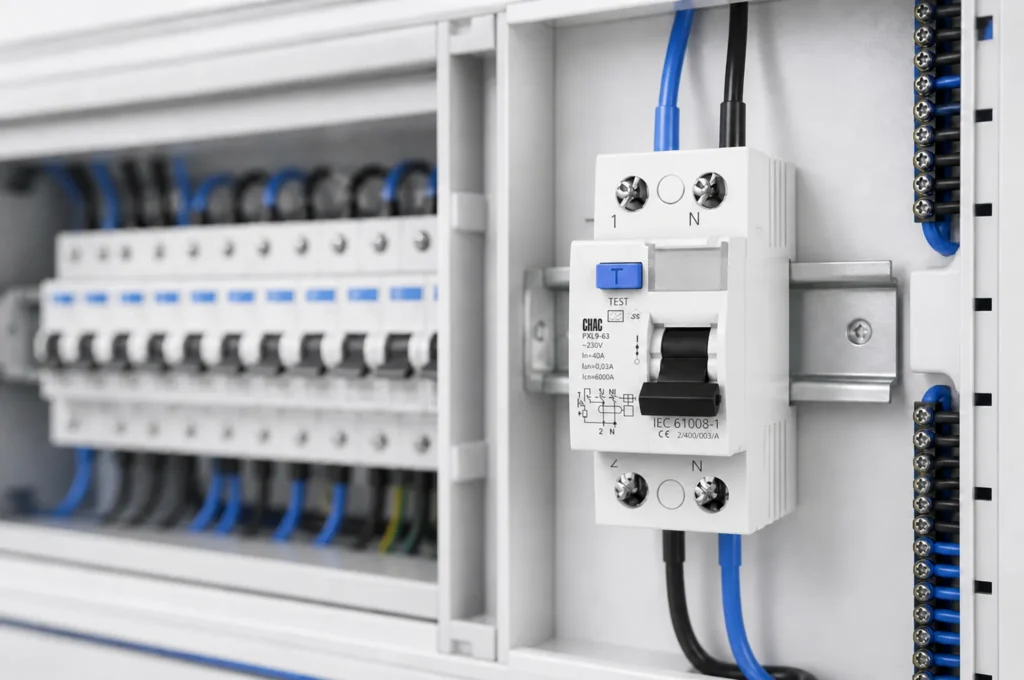
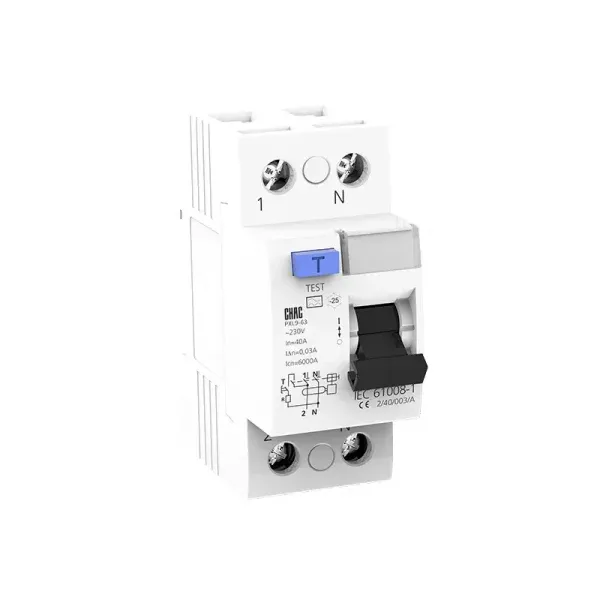
CHACs Reststromschützung page lists PXL9-63 options at 30, 100 and 300mA. It does not list 10mA. Therefore, this general comparison must not be read as an offer of a PXL9-63 10mA variant. The published record also lists 2P/4P and residual-current protection without overcurrent protection.
Verwenden Sie die RCCB category for other documented choices, or review the FI/LS-Schalter category when combined functions are required. Model-specific waveform options and their availability need confirmation for the ordered configuration.
Was sollte das Protokoll über die Panelabnahme enthalten?
Record the installed model, sensitivity, type, poles, upstream protection and measured or justified leakage basis. Retain authorized functional and installation test results under the applicable procedure. A test button is useful for its documented purpose, but is not a complete verification of earthing, wiring or every required disconnection condition.
Häufig gestellte Fragen
Is 10mA always better than 30mA?
No. Higher sensitivity needs an application basis and compatible circuit leakage; it does not replace other protection decisions.
Does a 63A RCCB trip on a 63A overload?
Its carrying-current rating is not integral overload protection. Provide the coordinated overcurrent device.
Can electronic loads cause leakage without an insulation fault?
Yes, filtering and capacitance can contribute normal leakage. Still investigate trips before deciding they are unwanted operation.
Does Type A mean a lower trip threshold than Type AC?
No. Those designations concern waveform capability; sensitivity is specified separately.
Does PXL9-63 offer 10mA in its published table?
No. The record checked lists 30, 100 and 300mA. Any other proposal needs separate verified documentation.
Can subdivision replace fixing an insulation fault?
No. Subdivision can address accumulated normal leakage and outage extent, but faults still require correction.
Verweise
- Schneider Electric Electrical Installation Guide: high-sensitivity RCD additional protection.
- Schneider Electric Electrical Installation Guide: RCD sensitivity to disturbances.
- Schneider Electric Electrical Installation Guide: RCD waveform types.
Choose sensitivity as part of the complete circuit design. Establish the applicable protection requirement first, then assess load waveforms and normal leakage, and finally confirm carrying current, poles and the coordinated overcurrent device. Where greater sensitivity is justified, make sure the circuit arrangement supports it without undermining required availability. Never use a lower threshold to compensate for the wrong residual-current type, or a higher threshold to conceal a fault. CHAC’s published PXL9-63 information supports review of the listed configurations, not an undocumented 10mA option. Kontaktieren Sie CHAC with the sensitivity basis and circuit details for an appropriate model review.