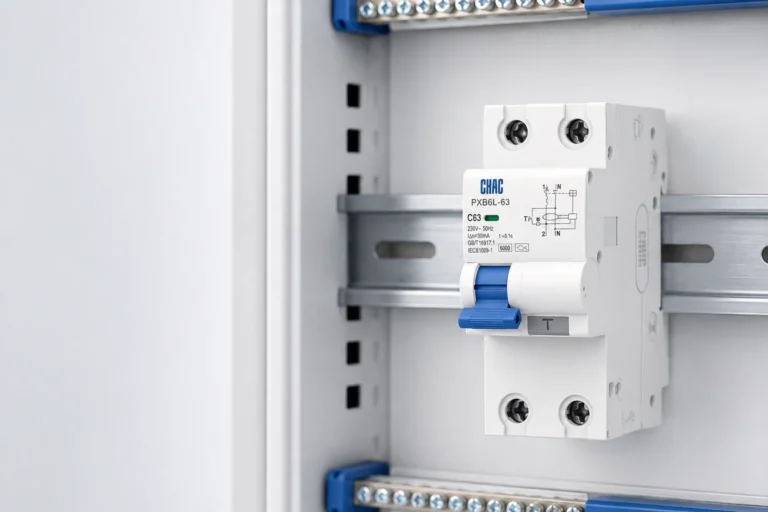
When a panel builder in Manchester encountered a scorched breaker window moments after energizing a new board, he isolated the supply and blamed a faulty batch. The review reversed that conclusion: a 6kA device had been specified where calculated installation-point fault current exceeded its standalone rating. Selection, not merely product quality, caused the failure.
Resumen: In a 6kA vs 10kA MCB decision, the breaker’s rated short-circuit capacity must be at least the prospective short-circuit current at its installation point under the applicable standard and project rules. A 6kA rating represents 6,000A and a 10kA rating 10,000A under defined test conditions; neither value describes normal load current. Calculate or measure the fault level, check voltage and standard, and verify any upstream back-up arrangement before approving the device.
What Do 6kA and 10kA Actually Mean?
MCB breaking capacity is the fault current a miniature circuit breaker is rated to interrupt safely under a specified test sequence. For household and similar AC installations, IEC 60898-1 uses the rated short-circuit capacity Icn. A number printed on the front is therefore meaningful only with the device voltage, product standard, poles, and manufacturer documentation.
Breaking capacity is not the same as current rating or trip curve. A 32A MCB protects a circuit carrying tens of amperes in normal service; its 6kA or 10kA marking addresses a rare short circuit involving thousands of amperes. Likewise, B, C, and D curves describe instantaneous-trip ranges, not the maximum fault the device can interrupt.
Why the Installation-Point Fault Level Controls the Choice
Corriente prospectiva de cortocircuito is the current that would flow at a defined location through a negligible-impedance fault, before protective-device limitation. It is generally higher near a low-impedance source and lower after long cables. Transformer impedance, parallel sources, conductor size, material, and length all affect the result.
Calculate or measure at the actual breaker location: a main board and a remote final-circuit board can have very different levels. Use an impedance-based short-circuit calculation or suitable loop/PSC instrument under the project method; record voltage, source contribution, operating configuration, assumptions, and date.
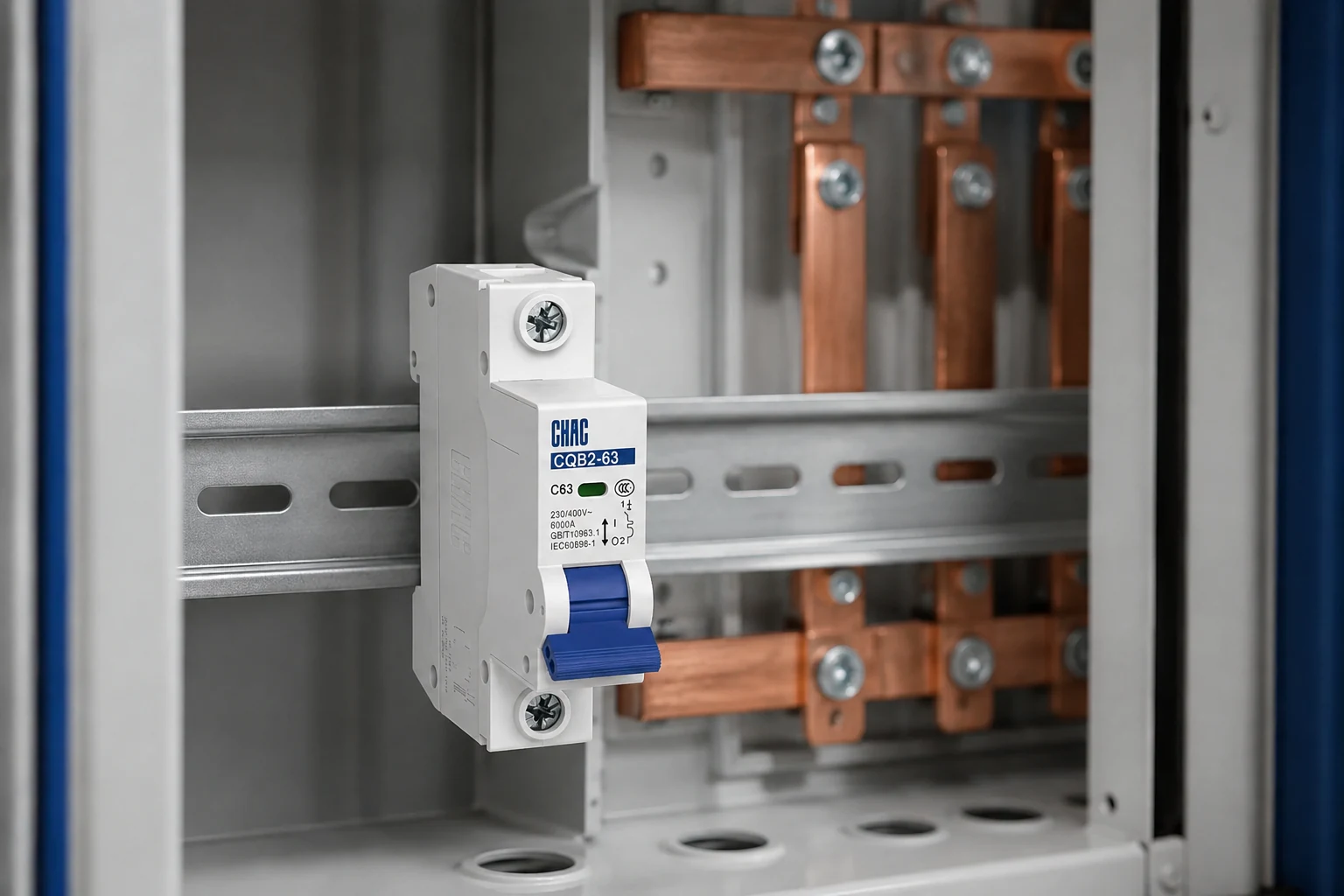
Transformers, generators, bus ties, or cable upgrades can change fault current. A low initial price becomes expensive if it causes redesign, replacement, or shutdown; rating headroom reduces risk but never replaces evidence.
6kA vs 10kA MCB Comparison
| Dimensión de decisión | 6kA MCB | 10kA MCB |
|---|---|---|
| Rated short-circuit capacity | 6,000A under the stated standard and test conditions | 10,000A under the stated standard and test conditions |
| Possible context | Verified point fault level within 6kA | Verified level above 6kA but within 10kA |
| Design margin | Less headroom for system changes | More headroom; study still required |
| Unit-cost tendency | Often lower, subject to configuration and market | Often higher because of greater interruption duty |
| Compatibility | Voltage, poles, curve, assembly, and destination requirements must match | |
| Back-up protection | Requires manufacturer combination data | |
| Lifecycle effect | Economical when verified | May reduce upgrade risk; overspecification still costs more |
How Upstream Protection and Let-Through Affect the Decision
A current-limiting upstream fuse or breaker can reduce peak current and let-through energy, expressed as I²t. That does not automatically reduce the prospective current used for a standalone downstream rating. A lower-rated MCB is acceptable in a cascading arrangement only when the manufacturer has verified the exact combination, voltage, fault level, and standard.
Back-up protection shows that two devices can clear a high fault safely. Selectivity aims for the downstream device alone to operate so healthy circuits remain energized. A combination may provide back-up protection without full selectivity, increasing downtime.
Do not infer coordination from individual ratings or generic I²t data. Check both models, settings, voltage, fault range, and the manufacturer table. If the combination is unlisted, use the downstream standalone rating or obtain project-specific verification.
Selection Matrix by Verified Fault Level
| Evidence at the breaker location | 6kA option | 10kA option | Required action |
|---|---|---|---|
| Fault level below 6kA | May be suitable | May add headroom | Verify all ratings and project rules |
| Above 6kA, up to 10kA | Not suitable standalone | May be suitable | Confirm the value and documents |
| Above 10kA | Not suitable standalone | Not suitable standalone | Use higher capacity or verified coordination |
| Unknown or changing | Do not approve | Rating alone is insufficient | Complete the fault-current study |
| Upstream back-up proposed | Possible only within a tested combination | Retain the manufacturer table and study in the project file | |
Standards and Compliance Context
IEC 60898-1 covers overcurrent circuit breakers for household and similar installations and defines ratings and test sequences. It is a product standard, not a certification. IEC 60947-2 covers circuit breakers within low-voltage switchgear and controlgear and uses concepts such as Icu and Ics. Do not compare “10kA” markings across standards without reviewing the test basis.
IEC 60364-4-43 addresses installation protection against overcurrent. In North America, adopted NFPA 70 and local rules govern installation; OSHA 1910.303(b)(4) requires interrupting equipment to be rated for nominal voltage and available current. Unsupported claims can delay approval and force replacement.
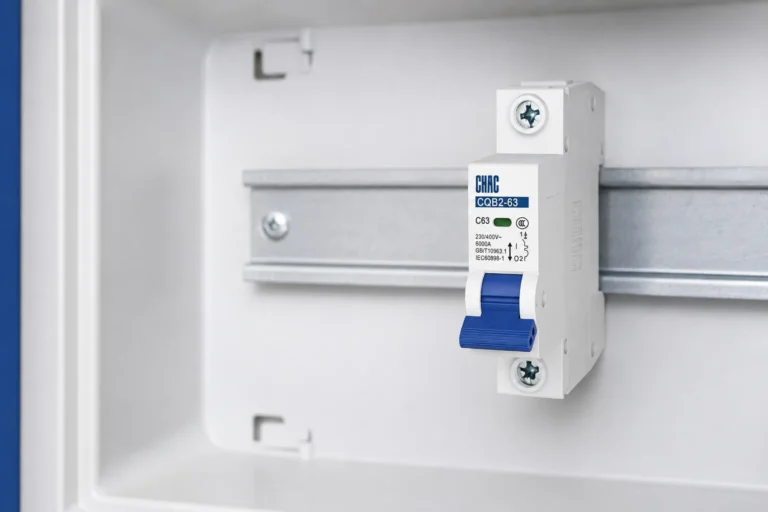
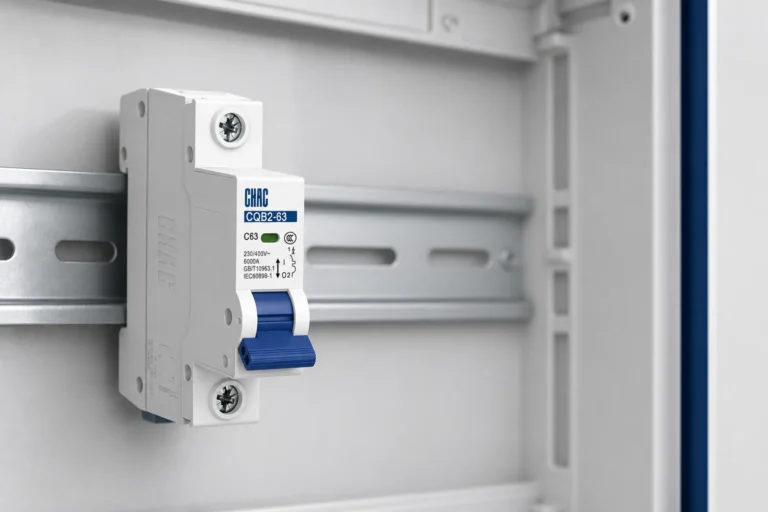
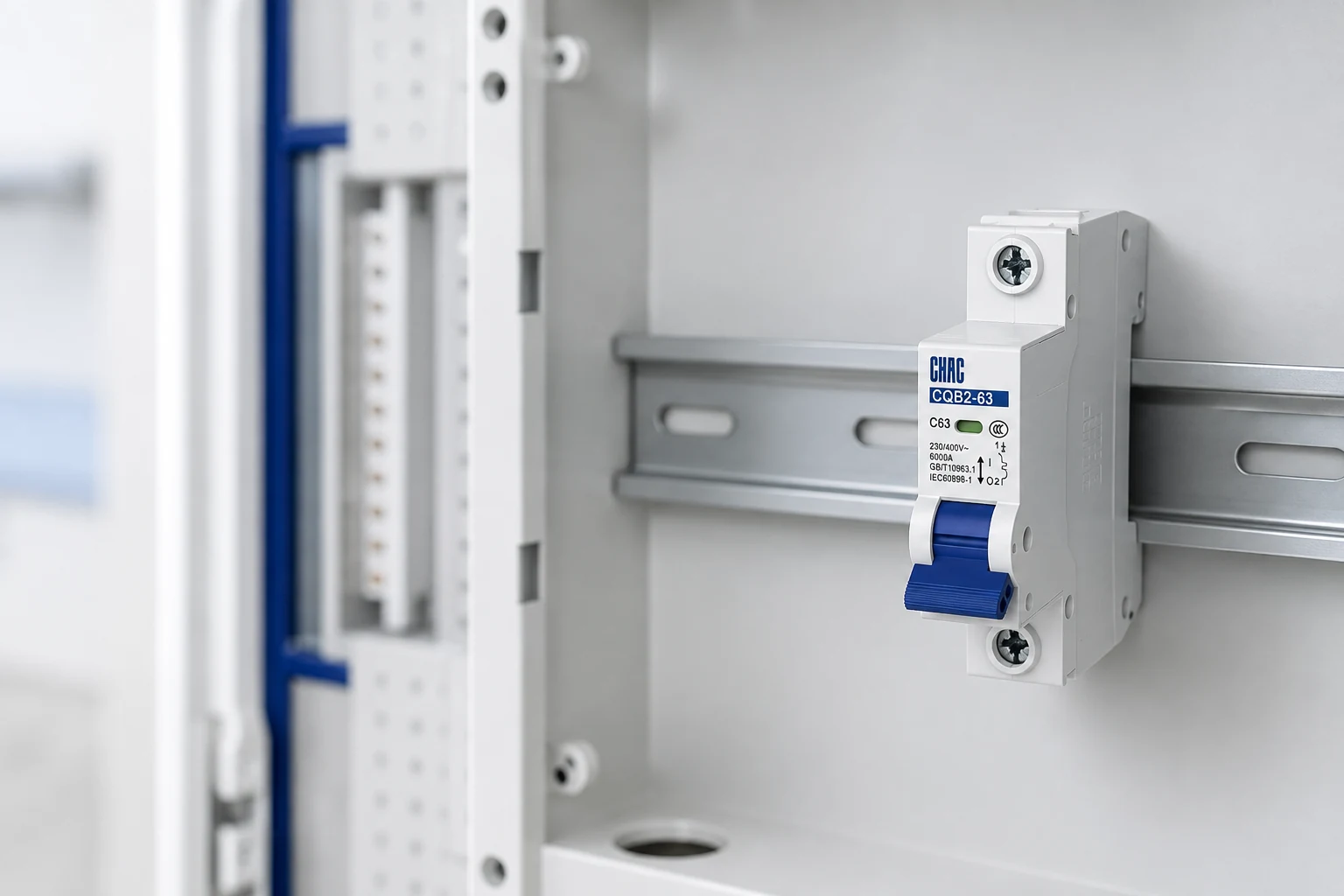
For the CHAC CQB2-63, CCC is the certification currently confirmed on the product page; IEC 60898-1 is stated as its standard. Confirm the precise model, destination market, and documentary scope for every order.
How to Select and Procure the Right MCB
- Establish the maximum point fault current for every credible supply configuration and planned upgrade.
- Choose capacity at least equal to the verified level, including the project’s required allowance.
- Separately confirm voltage, current, curve, poles, conductors, enclosure, and market rules.
- Require model-specific test and coordination evidence; record upstream device settings and combination limits.
- Compare approval effort, replacement exposure, downtime, and unit cost.
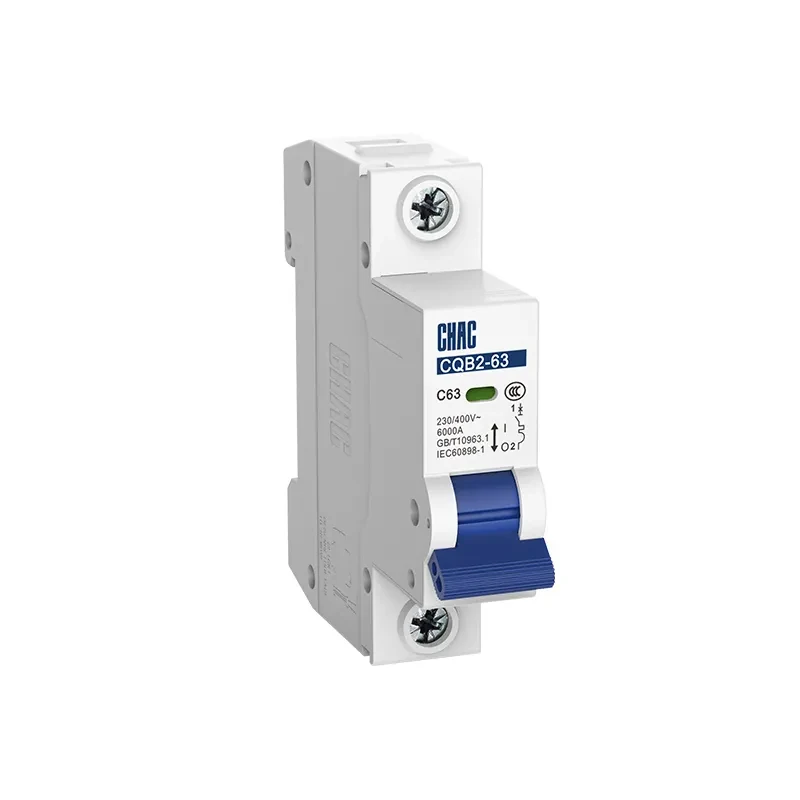
CHAC Electric offers the CQB2-63 6kA miniature circuit breaker for appropriately verified final-distribution duties. Its guidance on when 6kA is not enough reinforces the need to check point fault level. Where the study requires more capacity, review the CQB2-125 10kA MCB option and request the exact model documentation before specification.
Preguntas frecuentes
Is a 10kA MCB always better than a 6kA MCB?
No. It has higher interruption capability, but suitability also depends on voltage, current, curve, poles, standard, panel compatibility, and documentation. Select it when the fault study supports the choice.
Can I use a 6kA MCB if the prospective fault current is 7kA?
Not as a standalone device, because 7kA exceeds its rating. Use a suitably rated breaker or a manufacturer-verified combination covering the exact devices, voltage, and fault level.
Does a longer cable run reduce prospective short-circuit current?
Often yes, but length is only one input. Include conductor size and material, source impedance, parallel paths, and supply configuration in the calculation or measurement.
Can an upstream fuse make a 6kA MCB acceptable on a higher-fault system?
Only when the precise fuse-and-MCB combination has verified back-up data for the applicable fault level and voltage. Current limitation and let-through energy cannot be converted into a blanket permission to use any lower-rated downstream breaker.
How often should the fault-level assessment be reviewed?
Review it when the source, transformer, generator, bus tie, cable, or operating configuration changes, and at the interval required by the project’s electrical-safety program. Update labels and protective-device records where local rules require them.
Referencias
- International Electrotechnical Commission, IEC 60898-1: Circuit-breakers for overcurrent protection for household and similar installations.
- International Electrotechnical Commission, IEC 60947-2: Low-voltage switchgear and controlgear—Circuit-breakers.
- International Electrotechnical Commission, IEC 60364-4-43: Protection for safety—Protection against overcurrent.
- National Fire Protection Association, NFPA 70 (National Electrical Code) development and scope.
- Occupational Safety and Health Administration, 29 CFR 1910.303, General electrical requirements.
The reliable rule is simple: select the breaker from the fault current available where it will operate, not from habit or a catalogue number viewed in isolation.
For a project-specific review, share the single-line diagram, system voltage, calculated fault level, upstream protective device, required curve and poles, destination market, and documentation needs. Contact CHAC Electric to discuss the appropriate MCB configuration.