When a service electrician in Denver encountered a 60 amp feeder with warm terminations, she shut down the panel and traced the schedule instead of simply tightening every lug. The inspection found a mismatch between conductor material, lug listing, and the assumed temperature column. The failure was a coordination problem, not proof that a larger breaker was needed.
Summary: A 60 amp circuit is often evaluated with 6 AWG copper or a properly selected aluminum conductor, yet the correct 60 amp breaker wire size is set by ampacity, insulation, terminals, correction factors, voltage drop, and local code. “6 Romex” or “8 AWG” is not enough information. Verify the wiring method, equipment nameplate, and breaker listing under the locally adopted NEC before installation.
What a 60 amp breaker wire size chart can and cannot tell you
NEC Article 310 ampacity tables provide the starting point. The designer then applies ambient-temperature correction, adjustment for current-carrying conductors, and the lowest temperature rating of the conductor, breaker, and termination. For equipment rated 100 amps or less, the 60 C column can be important unless the complete assembly is listed for the 75 C column. A chart cannot see those field conditions.
Feeder calculations also include demand, grounding and bonding, disconnect location, and panel ratings. A 60 amp breaker protects the feeder from overcurrent; it does not make an undersized conductor safe. Continuous loads are generally calculated at 125 percent under NEC 215.2 and 215.3 concepts, with the adopted edition and equipment instructions controlling the final result.
| Check | Por qué importa | Evidencia a conservar |
|---|---|---|
| Conductor type | Copper, aluminum, or cable assembly changes ampacity and termination practice. | Manufacturer marking and data sheet |
| Insulation rating | Wet locations, heat, and raceway conditions can limit usable ampacity. | Wire marking and installation method |
| Termination rating | Lugs may restrict the temperature column or conductor size. | Panel and breaker instructions |
| Load and distance | Continuous current and voltage drop may justify a larger conductor. | Load schedule and voltage-drop calculation |
Is 6 AWG or 8 AWG suitable for 60 amps?
The honest answer is conditional. 6 AWG copper is frequently considered in preliminary designs because common ampacity values can align with a 60 amp protective device under ordinary assumptions. However, insulation temperature, bundling, ambient heat, and terminal ratings can change the permitted ampacity. 8 AWG may be acceptable only under a specific table entry or code allowance; it should never be selected from a generic internet chart alone.
“Romex” is a trade name often used for Type NM-B cable, not a universal conductor rating. The cable jacket, conductor insulation, installation location, and terminal markings must be checked together. A 60 amp circuit in a dwelling may also invoke dwelling-service or feeder rules, but those rules do not excuse incompatible lugs or an incorrect cable type.
THHN is an insulation designation commonly used for individual conductors in raceway. Confirm whether the marking is THHN/THWN-2 for the actual environment, then size the conductor using the applicable ampacity and terminal limits. Pulling larger THHN may improve voltage drop but can increase conduit fill, bending radius, and labor.

How do distance, voltage drop and conductor material change the choice?
| Design path | Strength | Trade-off | Required verification |
|---|---|---|---|
| 6 AWG copper branch or feeder | Compact conductor with familiar termination practice | Higher material cost and weight | Temperature column, lugs, voltage drop |
| 6 AWG aluminum | Lower mass and potential feeder cost advantage | Different ampacity and preparation requirements | Alloy, listed lugs, torque, oxide instructions |
| 8 AWG copper under a specific allowance | Smaller raceway fill in limited cases | Less design margin and higher sensitivity to conditions | Exact code allowance and equipment listing |
| Larger conductor | Lower voltage drop on a long route | Cost, conduit space, and termination range | Pulling tension, bending space, lug capacity |
Voltage drop is a design quality issue rather than a simple ampacity rule. The familiar 3 percent branch-circuit and 5 percent feeder-plus-branch targets appear as NEC informational guidance. Calculate using actual one-way distance, current, conductor resistance, phase arrangement, and power factor where relevant. Motor starting current can make a short circuit behave differently from a steady resistive load.
Safety checks before energizing
Confirm the source and load voltage, breaker pole configuration, interrupting rating, panel bus rating, and available fault current. Check that the breaker is listed for the panelboard and that the conductors fit the lug range. Torque every termination to the manufacturer’s value and document the result; “tight” is not a measurement. Inspect conductor insulation for damage and maintain the required working space.
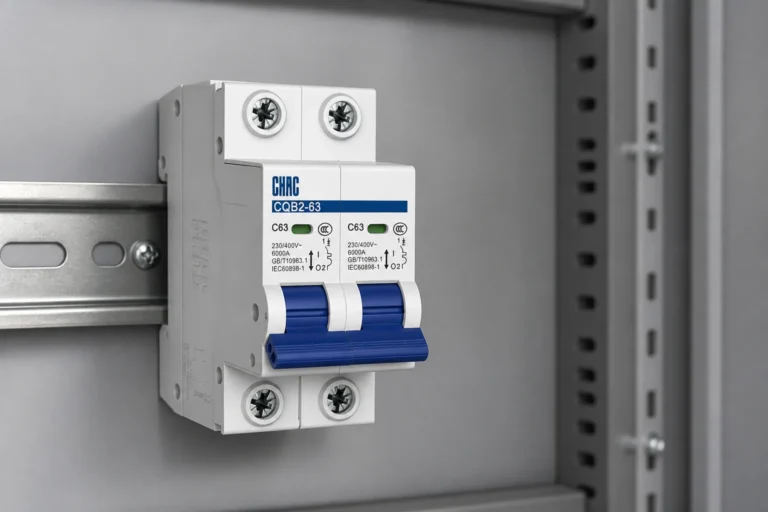
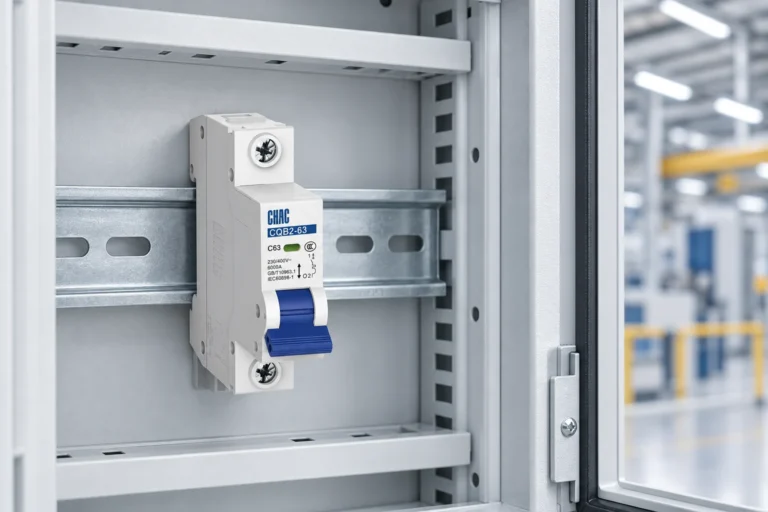
For a coordinated panel, a listed CHAC miniature circuit breaker can be evaluated alongside the enclosure and feeder schedule. The CQMG20B distribution box page can help confirm enclosure information, while leakage-sensitive applications may require a separately specified residual-current device. These products do not replace the engineer’s code calculation.
Standards and procurement discipline
Use the adopted NFPA 70 NEC for U.S. projects and the relevant national wiring rules elsewhere. IEC 60898-1 covers certain low-voltage AC circuit breakers for household and similar applications; it is a product standard, not a complete feeder-design manual. OSHA’s electrical installation requirements address guarding, identification, and safe use in covered workplaces.
Ask suppliers for conductor compatibility, terminal temperature, short-circuit rating, installation instructions, and test documentation. Avoid unsupported claims that a product is automatically code compliant in every market. The commercial risk of an incorrect 60 amp wire size includes rework, inspection delay, overheating, and equipment downtime.
Preguntas frecuentes
Is 6 romex good for 60 amps?
It may be suitable only when the exact cable type, ampacity, terminal ratings, installation conditions, and code allowances support it. “6 Romex” is not a complete specification. Have the electrician verify the cable marking and the 60 amp breaker coordination before use.
Is 8 AWG good for 60 amps?
Do not assume so. The answer depends on conductor insulation, temperature column, adjustment factors, and any specific dwelling or equipment rule. A generic chart cannot authorize an 8 AWG installation.
How far can you run 6 gauge wire for 60 amps?
Distance is limited by voltage drop, installation method, and the actual load rather than by a single universal number. Calculate the two-way length and compare the result with the project target. Also confirm conduit fill and termination capacity.
What size THHN wire should I use for a 60 amp breaker?
Start with the applicable NEC ampacity table and the lowest terminal temperature rating, then adjust for ambient temperature and conductor count. Confirm whether the environment requires THWN-2 or another wet-location marking. The breaker and lugs must be listed for the selected conductor.
What wire size is normally used for 60 amp breaker wire size?
6 AWG copper is a common preliminary reference, but it is not a universal prescription. Continuous load, distance, material, insulation, and terminals can require another size. Document the calculation instead of copying a chart.
How does copper compare with aluminum for 60 amp breaker wire size?
Aluminum can require a different gauge and careful termination because its electrical and mechanical properties differ from copper. Use listed conductor-lug combinations, follow preparation and torque instructions, and check the correct ampacity column. Do not exchange one material for the other by gauge alone.
Which official sources should buyers verify?
Reliable feeder design starts with the load schedule and ends with documented terminations. At the buying stage, review CHAC Electric’s 60 amp circuit protection options against your panel, conductor, and destination-market requirements, then contact the technical team for the applicable product documents.