Un tercer interruptor podría parecer requerir solo una abertura ligeramente más ancha, pero la decisión de compra implica algo más que añadir otra posición para el dispositivo. La construcción de la caja, las bridas de montaje, las tapas, los tabiques y las entradas de cables pueden modificar el espacio necesario en la pared. Por lo tanto, un instalador puede solicitar el número correcto de posiciones y aun así recibir una caja que no coincida con la abertura ni con la tapa ya seleccionadas. Esta guía resuelve la cuestión del ancho con ejemplos reales de fabricantes y, a continuación, detalla las verificaciones dimensionales y de cableado necesarias para evitar que un conjunto de dos o tres posiciones requiera cambios tardíos durante la instalación.
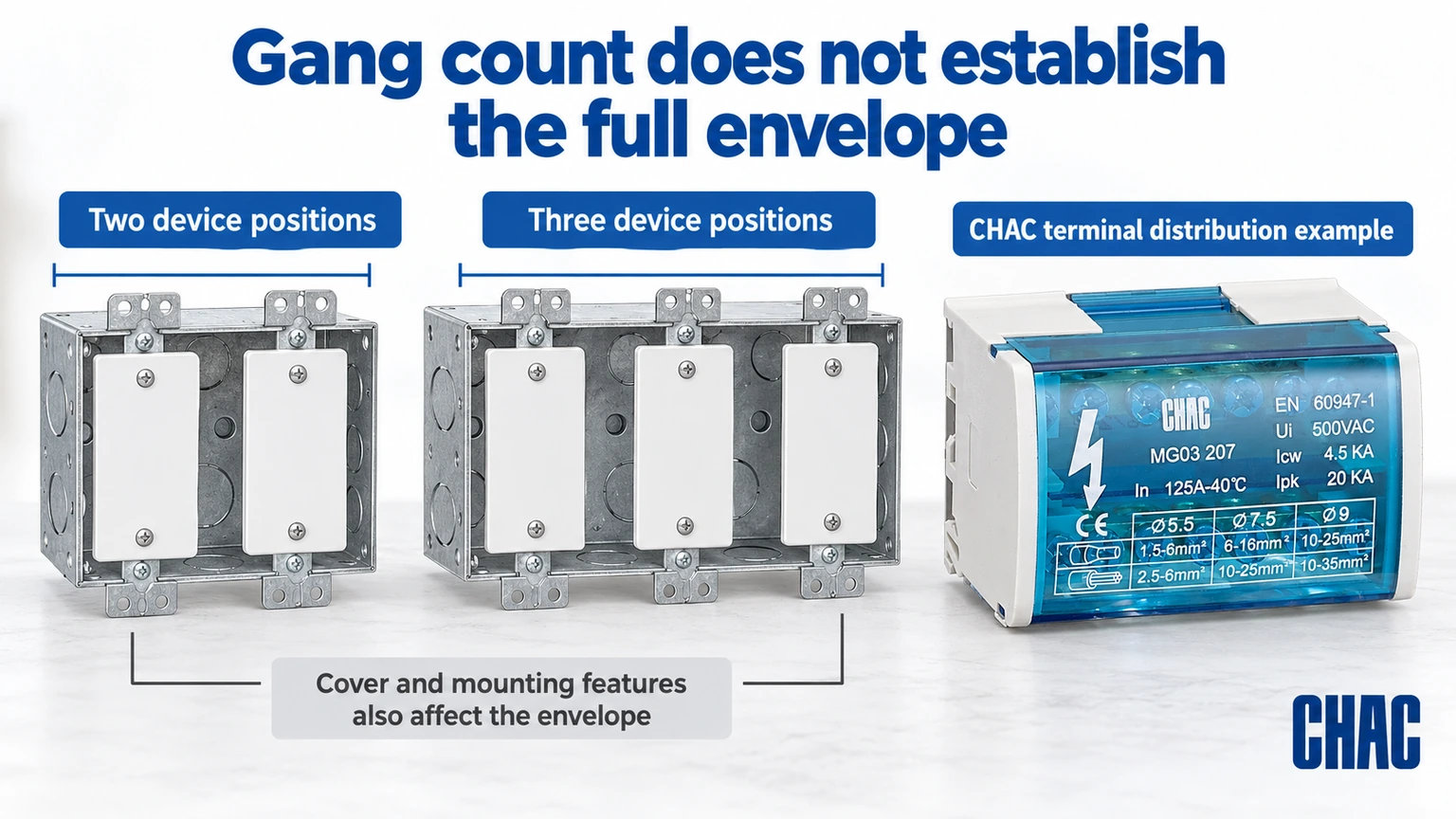
No existe un ancho universal para Dimensiones de la caja eléctrica de la serie 2. Como comparación específica, Hubbell RACO enumera su caja soldada de dos tomas 941 con una anchura de 6.813 y su caja soldada de tres tomas 942 con una anchura de 8.625. Ambas tienen una altura de 4.5 y una profundidad de 2.5, con capacidades de 70 y 90 pulgadas cúbicas, respectivamente. Estos son ejemplos de cajas comerciales soldadas, no dimensiones típicas para cada caja de empotrar residencial. Utilice el plano del modelo elegido, junto con las instrucciones de la cubierta y de montaje correspondientes, para determinar la abertura real en la pared.
¿Cuánto mide de ancho una caja triple en comparación con una caja doble?
La comparación precisa se realiza entre productos identificados de la misma familia. El RACO 941 registro de dos módulos y RACO 942 registro de tres módulos proporciona un ejemplo coincidente, verificado el 19 de octubre, 2026. Restar sus anchos publicados da como resultado 1.812 en de ancho adicional para este par. No establece el espaciado ni el ancho añadido de las cajas de otro fabricante.
| Especificación publicada | RACO 941 | RACO 942 |
|---|---|---|
| Cuenta de pandillas | 2 | 3 |
| Ancho | 6.813 en | 8.625 en |
| Altura | 4.5 en | 4.5 en |
| Profundidad | 2.5 en | 2.5 en |
| Capacidad publicada | 70 pulg. cúb. | 90 pulg. cúb. |
La tabla compara únicamente las dimensiones y la capacidad. No constituye una recomendación para utilizar estas cajas específicas en todas las paredes residenciales. Una caja residencial moldeada o una caja de empotrar de otro mercado puede tener unas dimensiones exteriores sustancialmente diferentes. Una especificación debe identificar la familia de productos antes de que se convierta el número de módulos en una abertura de instalación.
¿Por qué el tamaño de la cubierta es diferente a la abertura de la caja?
Una cubierta o placa decorativa remata la superficie visible; el cuerpo de la caja y las piezas de montaje quedan ocultos detrás de ella. Un anillo de yeso puede añadir otra abertura y otra proyección desde el cuerpo. Por lo tanto, medir el exterior de una placa decorativa no le indica al instalador cuánto material de la pared debe retirar.
Para el dimensiones de la caja eléctrica de grupo 2 En el caso de conjuntos, solicite la cubierta o el anillo correspondiente mediante el número de pieza. Verifique la disposición del dispositivo, las posiciones de los tornillos y el desplazamiento respecto a la superficie acabada de la pared. Dos dispositivos instalados uno al lado del otro también deben respetar la separación permitida; esta debe obtenerse del sistema compatible, en lugar de una abertura dibujada a mano que solo parezca simétrica.
¿Una caja triple siempre ofrece suficiente espacio para el cableado?
More device positions do not remove the need for a fill calculation. Three deep electronic controls can consume more practical space than three simple switches. Connectors, conductor entries, partitions and the wiring method affect how much of the available enclosure can be used.
Use the marked capacity and the adopted counting rules for the actual installation. Do not divide external width by gang count to estimate allowable conductors. Likewise, do not assume a low-voltage partition permits every combination of power and communication circuits. The partition, enclosure and circuit arrangement must be suitable together.
| Condición del proyecto | Two-gang check | Three-gang check |
|---|---|---|
| Disposición del dispositivo | Confirm two supported positions | Confirm three positions and compatible plate |
| Wall cavity | Body plus mounting projections | Wider span, studs and adjacent services |
| Cables | Actual fill and connector access | Additional devices and conductor paths |
| Mixed circuit functions | Permitted separation arrangement | Partition fit and usable volume |
| Future replacement | Device depth and access | Access to all terminals after assembly |
Can several electronic controls share the box at their individual load ratings?
Check each control’s installation instructions for the actual grouped arrangement. A dimmer, smart control and ordinary switch do not necessarily have the same depth, wiring or installation conditions. If a manufacturer’s instructions specify restrictions or load derating when devices are grouped, record those conditions with the device schedule. Do not infer an electrical rating from the fact that three faces fit a three-gang plate.
Review the selected devices side by side with their conductors, required neutral connections and permitted partitions where relevant. Any restriction must come from those products and the applicable installation rules; there is no generic derating percentage established by the RACO width comparison. This keeps a mechanical sizing guide from being mistaken for approval of an arbitrary combination of electronic loads and controls.
When do material and mounting method change the width decision?
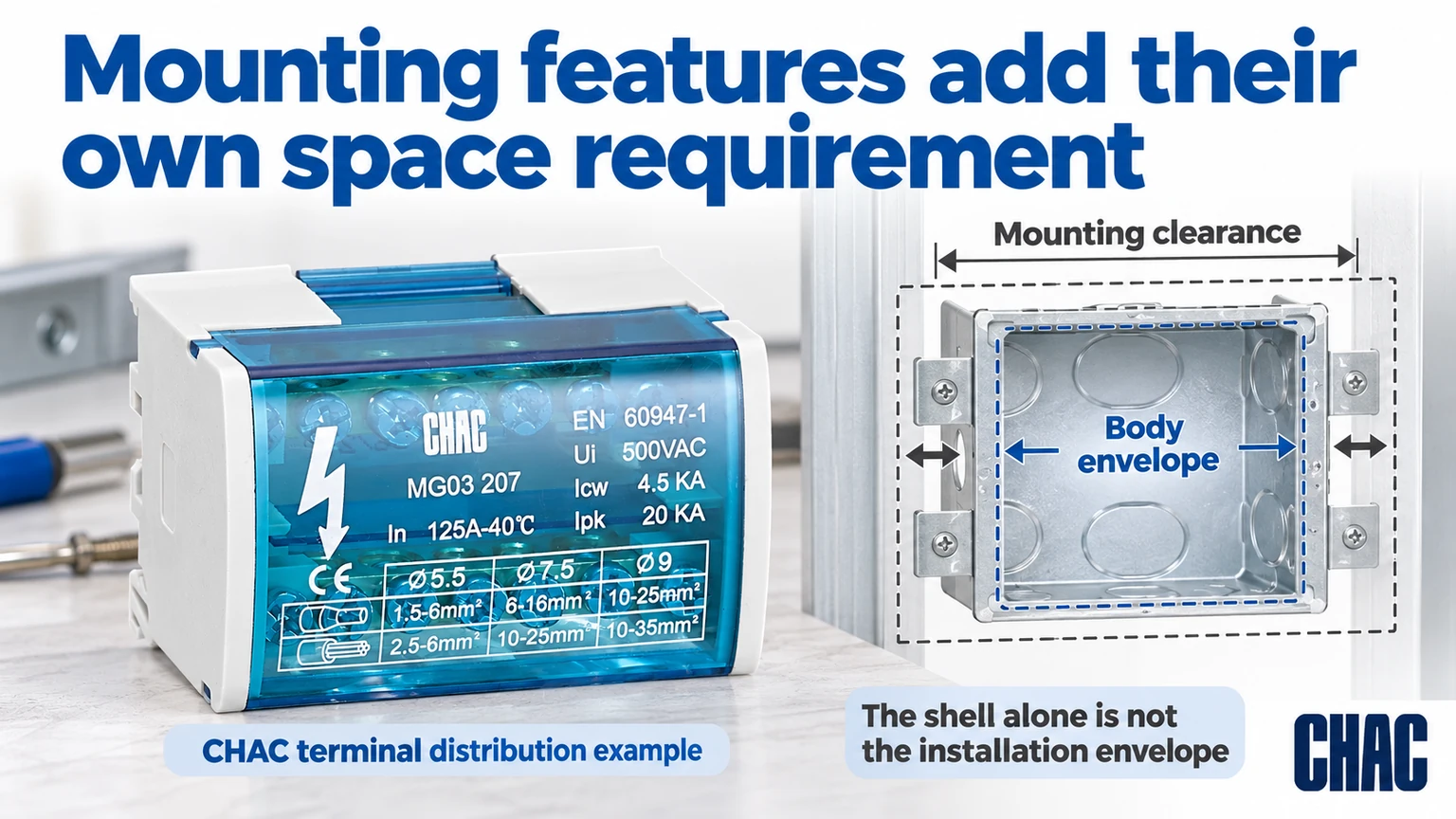
A welded steel box, a gangable metal assembly and a molded nonmetallic box do not use the same construction. External seams, lugs or brackets may create installation clearances that are absent from the nominal device opening. Select the material for the wiring method, environment and mechanical conditions, then check the appropriate grounding or bonding provisions.
New-work and retrofit mounting also create different constraints. A large open framing bay does not prove that the same box can be inserted through a finished wall. Old-work clamps need room and a suitable supporting surface. Confirm the installation sequence before buying the enclosure, rather than discovering the mounting limitation after the opening is enlarged.
Does an unused third position guarantee space for a future circuit?
A spare device position is only one part of an expansion plan. The later device may need additional conductors, connectors, a different entry route or separation from another circuit. Review the intended future use explicitly and distinguish reserved mounting width from the capacity and circuit arrangements actually approved. A blank plate does not, by itself, establish those permissions.
Document the planned device family and the constraints that remain unresolved. If no future circuit has been designed, describe the position as spare physical space rather than a ready-to-use electrical provision. When an extension is proposed, repeat the relevant box-fill, device-instruction, entry and separation checks using the actual parts. This avoids paying for a wider enclosure now and discovering later that the planned addition still needs a different installation.
What information should a purchase order include?
Instead of asking only how wide is a 3 gang electrical box, specify the body dimensions, mounting system, required capacity, entry layout, approved wiring method and exact cover. Attach a dimensioned drawing with the finished-wall reference marked. A supplier can then confirm a defined assembly rather than quote an arbitrary three-gang item.
For distribution projects, CHAC’s bus and terminal distribution junction box is a different product category. Its variants are not substitutes for these wall device boxes. Review the Gamma de productos de distribución eléctrica by function, and request the appropriate model drawing for each part of the project. This distinction avoids ordering a terminal assembly when the specification actually requires a two-gang or three-gang wall enclosure.
What do buyers ask about two-gang and three-gang sizes?
What is the standard size for a 2 gang outlet box?
Two gang identifies the device arrangement, not a universal shell size. The chosen series determines width, height, depth, mounting and volume.
What are the standard sizes of electrical gang boxes?
Single-, two- and three-gang families are common descriptions, but their dimensions differ by product and market. Obtain the actual drawing and compatible cover before defining an opening.
What are the dimensions of a 2-gang back box?
They depend on the model. For example, RACO 941 is listed as 6.813 inches wide, 4.5 inches high and 2.5 inches deep; this welded-box example should not be generalized to other back-box systems.
What are the dimensions of a standard electrical box?
There is no single standard envelope across wall, ceiling, surface and distribution boxes. Identify the installation task first, then compare model dimensions and approvals.
What are the standard sizes for 2 gang electrical box dimensions?
Use manufacturer-specific sizes rather than one generic value. Check the box body, cover or ring, mounting projections and required wall opening as separate items.
How deep should 2 gang electrical box dimensions be for the wiring inside?
The box must provide the required calculated capacity and practical room for both devices, conductors and connectors. Wall depth and entry fittings must also be checked.
Referencias
- Hubbell RACO 941: two-gang dimensions and capacity; accessed October 19, 2026
- Hubbell RACO 942: three-gang dimensions and capacity; accessed October 19, 2026
- Hubbell RACO multi-gang boxes and matching covers; accessed October 19, 2026
Conclusión
A useful two-gang versus three-gang comparison begins with a matched product family, not a universal width rule. Confirm the number and type of devices, identify the matching box and cover, and then check the complete assembly against the wall cavity and opening. Capacity, separation and access still need evaluation even when the wider box physically fits. Avoid cutting a finished wall from a faceplate measurement or assuming that a commercial welded enclosure shares the dimensions of a residential back box. CHAC provides distribution and connection product information for the functions its published models actually perform. Keeping those records distinct from wall-box drawings gives buyers a clearer purchase specification and a more reliable installation review.
Para los dibujos de los modelos y la documentación del proyecto relevantes, Contacte a CHAC con los requisitos del circuito.