Un troisième interrupteur peut sembler ne nécessiter qu’une ouverture à peine plus large, mais la décision d’achat implique bien plus que la simple addition d’un emplacement supplémentaire pour un appareil. La conception du boîtier, les brides de montage, les couvercles, les cloisons et les entrées de câbles peuvent tous modifier l’espace requis dans le mur. Un installateur peut donc commander le bon nombre de postes tout en recevant un boîtier qui ne correspond pas à l’ouverture ou au couvercle déjà sélectionnés. Ce guide répond à la question de la largeur en s’appuyant sur des exemples concrets fournis par les fabricants, puis détaille les vérifications dimensionnelles et de câblage permettant d’éviter que l’ensemble deux postes ou trois postes ne doive faire l’objet d’une modification tardive lors de l’installation.
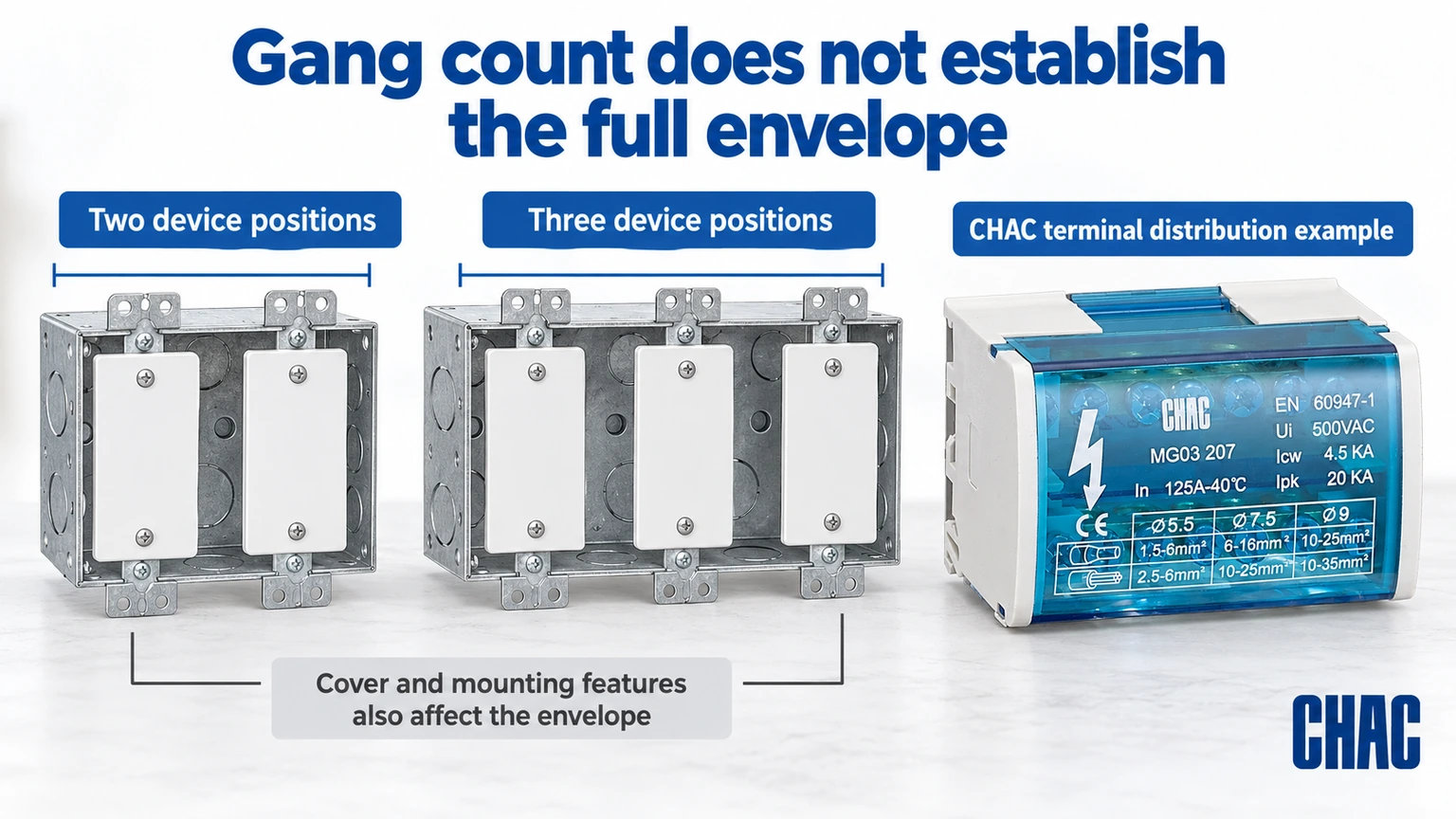
Il n’existe pas de largeur universelle pour Dimensions de la boîte électrique 2. À titre de comparaison spécifique, Hubbell RACO indique que sa boîte double soudée 941 mesure 6.813 de large et que sa boîte triple 942 mesure 8.625 de large. Toutes deux mesurent 4.5 de haut et 2.5 de profondeur, avec des capacités respectives de 70 et 90 pouces cubes. Il s’agit d’exemples de boîtiers soudés commerciaux, et non des dimensions typiques pour chaque boîtier arrière résidentiel. Utilisez le plan du modèle choisi, ainsi que les instructions de montage et de pose du couvercle correspondant, pour déterminer l’ouverture murale réelle.
Quelle est la largeur d’une boîte triple par rapport à une boîte double ?
La comparaison précise s’effectue entre des produits identifiés appartenant à la même gamme. Le RACO 941 double enregistrement et RACO 942 prise triple fournir un exemple correspondant, vérifié le 19, 2026. La soustraction des largeurs publiées donne 1.812 pouces de largeur supplémentaire pour cette paire. Cela ne permet pas d’établir l’espacement ni la largeur ajoutée des boîtes d’un autre fabricant.
| Spécification publiée | RACO 941 | RACO 942 |
|---|---|---|
| Nombre de gangs | 2 | 3 |
| Largeur | 6.813 dans | 8.625 dans |
| Hauteur | 4.5 dans | 4.5 dans |
| Profondeur | 2.5 dans | 2.5 dans |
| Capacité publiée | 70 pouce cube. | 90 pouce cube. |
Le tableau compare uniquement les dimensions et la capacité. Il ne constitue pas une recommandation d’utiliser ces boîtiers spécifiques dans tous les murs d’habitation. Un boîtier résidentiel moulé ou un boîtier arrière issu d’un autre marché peut présenter des dimensions extérieures sensiblement différentes. Une spécification doit préciser la famille de produits avant que le nombre de postes ne soit converti en dimensions d’ouverture de montage.
Why is the cover size different from the box opening?
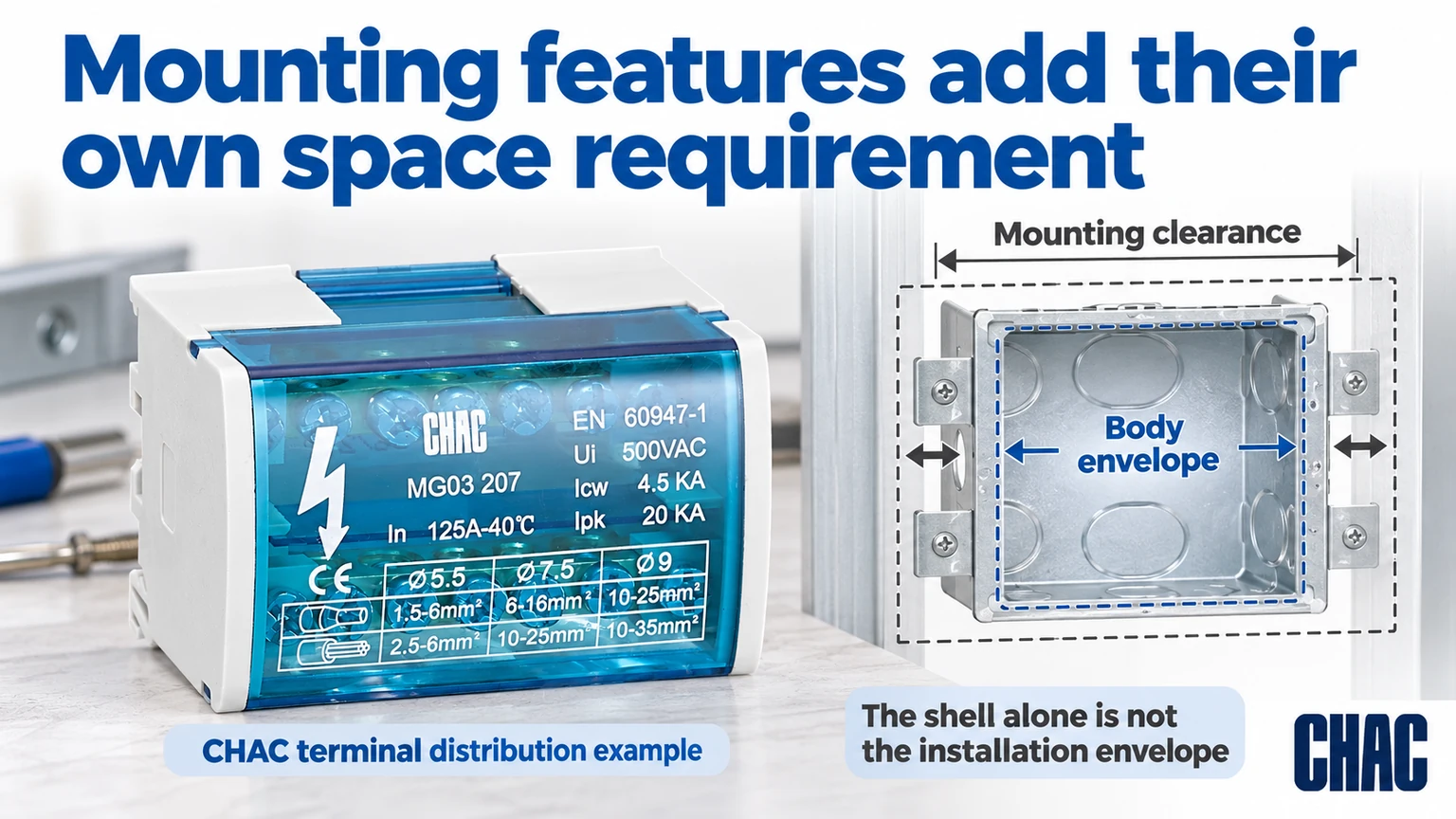
A cover or device plate finishes the visible surface; the box body and mounting parts sit behind it. A plaster ring may introduce another opening and another projection from the body. Measuring the outside of a decorative plate therefore does not tell an installer how much wall material to remove.
For the dimensions of 2 gang electrical box assemblies, request a matching cover or ring by part number. Check the device arrangement, screw positions and finished-wall offset. Two devices fitted side by side also need their permitted spacing; this should come from the compatible system, rather than a hand-drawn opening that merely looks symmetrical.
Does a three-gang box always provide enough wiring space?
More device positions do not remove the need for a fill calculation. Three deep electronic controls can consume more practical space than three simple switches. Connectors, conductor entries, partitions and the wiring method affect how much of the available enclosure can be used.
Use the marked capacity and the adopted counting rules for the actual installation. Do not divide external width by gang count to estimate allowable conductors. Likewise, do not assume a low-voltage partition permits every combination of power and communication circuits. The partition, enclosure and circuit arrangement must be suitable together.
| État du projet | Two-gang check | Three-gang check |
|---|---|---|
| Disposition des appareils | Confirm two supported positions | Confirm three positions and compatible plate |
| Wall cavity | Body plus mounting projections | Wider span, studs and adjacent services |
| Câblage | Actual fill and connector access | Additional devices and conductor paths |
| Mixed circuit functions | Permitted separation arrangement | Partition fit and usable volume |
| Future replacement | Device depth and access | Access to all terminals after assembly |
Can several electronic controls share the box at their individual load ratings?
Check each control’s installation instructions for the actual grouped arrangement. A dimmer, smart control and ordinary switch do not necessarily have the same depth, wiring or installation conditions. If a manufacturer’s instructions specify restrictions or load derating when devices are grouped, record those conditions with the device schedule. Do not infer an electrical rating from the fact that three faces fit a three-gang plate.
Review the selected devices side by side with their conductors, required neutral connections and permitted partitions where relevant. Any restriction must come from those products and the applicable installation rules; there is no generic derating percentage established by the RACO width comparison. This keeps a mechanical sizing guide from being mistaken for approval of an arbitrary combination of electronic loads and controls.
When do material and mounting method change the width decision?
A welded steel box, a gangable metal assembly and a molded nonmetallic box do not use the same construction. External seams, lugs or brackets may create installation clearances that are absent from the nominal device opening. Select the material for the wiring method, environment and mechanical conditions, then check the appropriate grounding or bonding provisions.
New-work and retrofit mounting also create different constraints. A large open framing bay does not prove that the same box can be inserted through a finished wall. Old-work clamps need room and a suitable supporting surface. Confirm the installation sequence before buying the enclosure, rather than discovering the mounting limitation after the opening is enlarged.
Does an unused third position guarantee space for a future circuit?
A spare device position is only one part of an expansion plan. The later device may need additional conductors, connectors, a different entry route or separation from another circuit. Review the intended future use explicitly and distinguish reserved mounting width from the capacity and circuit arrangements actually approved. A blank plate does not, by itself, establish those permissions.
Document the planned device family and the constraints that remain unresolved. If no future circuit has been designed, describe the position as spare physical space rather than a ready-to-use electrical provision. When an extension is proposed, repeat the relevant box-fill, device-instruction, entry and separation checks using the actual parts. This avoids paying for a wider enclosure now and discovering later that the planned addition still needs a different installation.
What information should a purchase order include?
Instead of asking only how wide is a 3 gang electrical box, specify the body dimensions, mounting system, required capacity, entry layout, approved wiring method and exact cover. Attach a dimensioned drawing with the finished-wall reference marked. A supplier can then confirm a defined assembly rather than quote an arbitrary three-gang item.
For distribution projects, CHAC’s bus and terminal distribution junction box is a different product category. Its variants are not substitutes for these wall device boxes. Review the gamme de produits de distribution électrique by function, and request the appropriate model drawing for each part of the project. This distinction avoids ordering a terminal assembly when the specification actually requires a two-gang or three-gang wall enclosure.
What do buyers ask about two-gang and three-gang sizes?
What is the standard size for a 2 gang outlet box?
Two gang identifies the device arrangement, not a universal shell size. The chosen series determines width, height, depth, mounting and volume.
What are the standard sizes of electrical gang boxes?
Single-, two- and three-gang families are common descriptions, but their dimensions differ by product and market. Obtain the actual drawing and compatible cover before defining an opening.
What are the dimensions of a 2-gang back box?
They depend on the model. For example, RACO 941 is listed as 6.813 inches wide, 4.5 inches high and 2.5 inches deep; this welded-box example should not be generalized to other back-box systems.
What are the dimensions of a standard electrical box?
There is no single standard envelope across wall, ceiling, surface and distribution boxes. Identify the installation task first, then compare model dimensions and approvals.
What are the standard sizes for 2 gang electrical box dimensions?
Use manufacturer-specific sizes rather than one generic value. Check the box body, cover or ring, mounting projections and required wall opening as separate items.
How deep should 2 gang electrical box dimensions be for the wiring inside?
The box must provide the required calculated capacity and practical room for both devices, conductors and connectors. Wall depth and entry fittings must also be checked.
Références
- Hubbell RACO 941: two-gang dimensions and capacity; accessed October 19, 2026
- Hubbell RACO 942: three-gang dimensions and capacity; accessed October 19, 2026
- Hubbell RACO multi-gang boxes and matching covers; accessed October 19, 2026
Conclusion
A useful two-gang versus three-gang comparison begins with a matched product family, not a universal width rule. Confirm the number and type of devices, identify the matching box and cover, and then check the complete assembly against the wall cavity and opening. Capacity, separation and access still need evaluation even when the wider box physically fits. Avoid cutting a finished wall from a faceplate measurement or assuming that a commercial welded enclosure shares the dimensions of a residential back box. CHAC provides distribution and connection product information for the functions its published models actually perform. Keeping those records distinct from wall-box drawings gives buyers a clearer purchase specification and a more reliable installation review.
Pour les dessins de modèle et la documentation de projet correspondants, contactez CHAC pour connaître les exigences du circuit.