Distribution board rfq selection starts with the circuit role, the project requirement, and selected-model documentation. Distribution Board Way-Count RFQ Guide for Panel Programs helps panel builders organize those checks before a device is specified or an RFQ is issued. Way count and spare policy stay with the approved device schedule; the enclosure family only hosts what that schedule authorizes.
Índice
Part 1. What is a way-count RFQ trying to decide?
A distribution-board way-count RFQ asks how many outgoing ways, spare capacity, and enclosure constraints the program needs before a board family is shortlisted. The decision is about assembly planning inputs, not a promise that one enclosure fits every future expansion.
Part 2. Which device-schedule inputs drive way count?
List incomers, outgoing circuits, reserved spares, accessory modules, and any metering or control devices that consume rail or way space. Count only what the approved schedule shows, then add spare policy as a separate, explicit field.
Part 3. How should enclosure and installation constraints be captured?
Record mounting location, ingress expectations, cable entry preferences, ambient conditions, and service access. These constraints often change which board format can host the requested way count.
Importante: Way count is an assembly capacity input, not a guarantee that every future circuit can be added without revisiting heat, cabling, and protection coordination. (fuente — IEC low-voltage assembly references via IEC webstore)
Part 4. Where do heat, cable, and labeling checks belong?
Even when way count looks sufficient on paper, the design still needs space for conductors, separators, and labels. Ask the panel team to confirm that the enclosure layout sketch supports termination and maintenance access.
Part 5. What should the distribution board RFQ contain?
Include the device schedule, requested ways and spares, enclosure constraints, target market documentation, branding or packaging needs, and the drawing revision. Require suppliers to map the response to a concrete product route and model evidence.
Una lista de entradas de RFQ compacta facilita la comparación de las respuestas de los proveedores:
| El comprador debe proporcionar | Por qué importa | Error común |
|---|---|---|
| Conjunto de planos actual | Define el límite del circuito | Envío del nombre de un producto sin un diagrama |
| Funciones requeridas | Hace que la solicitud sea revisable | Tratar opciones no verificadas como estándar |
| Contexto de instalación | Identifica las condiciones del proyecto para confirmar | Asumiendo que la copia de la categoría es una aprobación del proyecto |
| Solicitud de documentación | Conecta la RFQ con la evidencia exacta | Aceptando afirmaciones genéricas en lugar de datos del modelo |
| Enviar con cotización | Hace que la comparación de proveedores sea verificable | Citando sin el paquete de evidencia solicitado |
Para un contexto más amplio, revise el distribution board RFQ product family y lo relacionado página de línea de productos.
Part 6. Which CHAC product route supports early discussion?
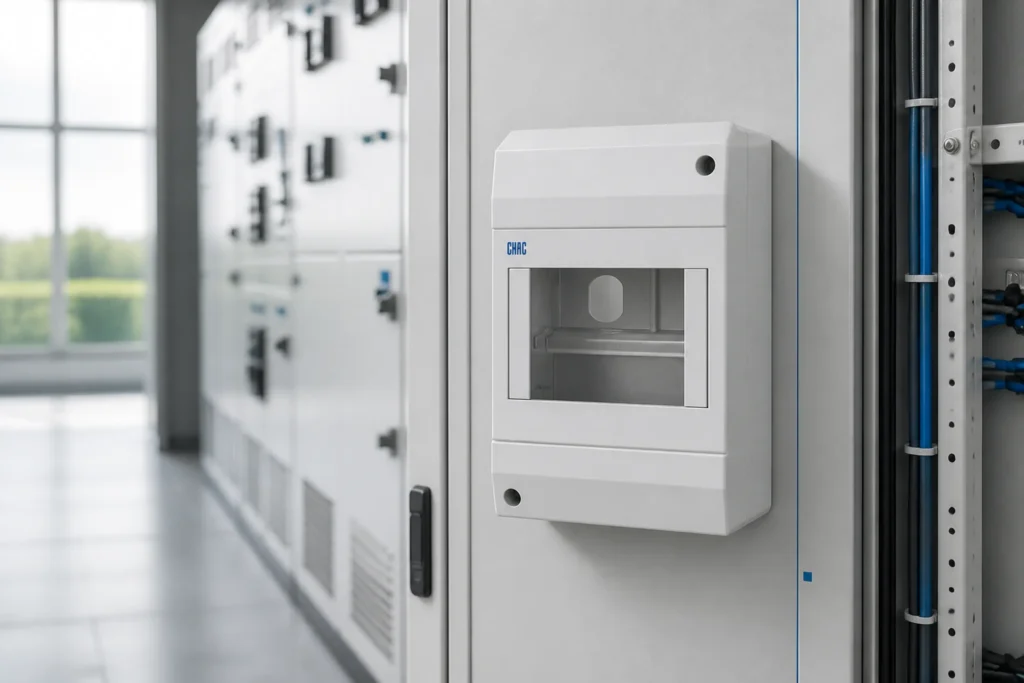
The CQMG05 distribution box product route can start an enclosure discussion after way-count inputs are listed, while the distribution-box category provides family navigation. Treat both as sourcing aids, not as an approved board design.
Recomendación de producto
CQMG05 Series Garage/Workshop Distribution Box | CHAC Electric

Utilice el publicado página de producto CHAC relevante as a documented product route starting point for a product discussion only after the RFQ inputs are complete. OEM board packaging and labeling can be discussed on the power-distribution customization page. An enclosure photo with many ways does not prove heat, cable, or service access for a future expansion.
Part 7. Where does way-count RFQ planning hand off to assembly design?
This article helps buyers structure a clearer board RFQ. It is not an IEC 61439 design verification, a thermal study, or authorization to expand circuits beyond the approved schedule without design review. Require a drawing review of way count against cable entries and spare policy before freezing the board family.
Fit Boundary: way-count RFQ planning does not replace assembly design verification or thermal studies.
Lectura relacionada: un artículo de CHAC más específico y ya publicado está enlazado por contexto, no como un sustituto del alcance de decisión de este artículo.
Share the device schedule and spare policy with Contactar a CHAC Electric when you need a distribution-board product route.
Preguntas frecuentes
What does way count mean in a board RFQ?
It is the planned number of outgoing ways plus any explicitly requested spare capacity on the assembly.
Should spare ways be assumed by the supplier?
No. State spare policy as an explicit RFQ field.
Can enclosure size be inferred from way count alone?
No. Cable entries, accessories, and service access also affect enclosure selection.
How does this differ from a junction-box decision?
A junction-box versus distribution-box boundary is a different installation question; keep it on its own article inputs.
What documents should accompany the RFQ?
Provide the device schedule, layout constraints, and the documentation pack required for the target market.
When should way count be frozen?
Freeze it after the circuit schedule and spare policy are approved, before purchasing the enclosure family.