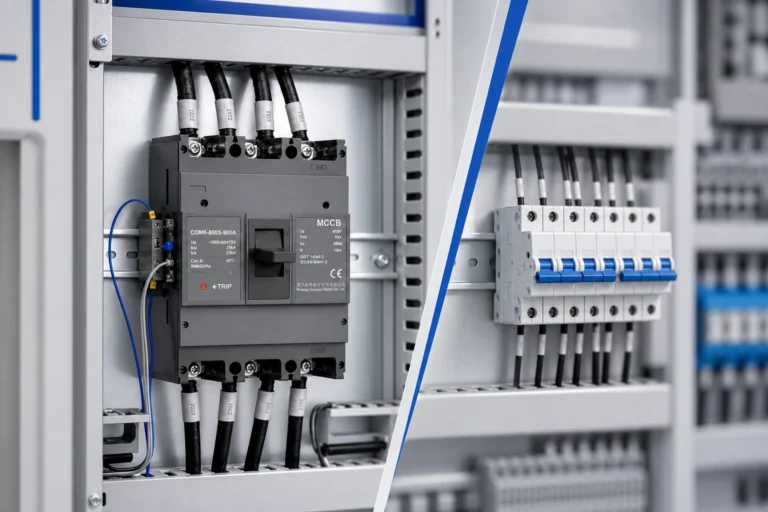
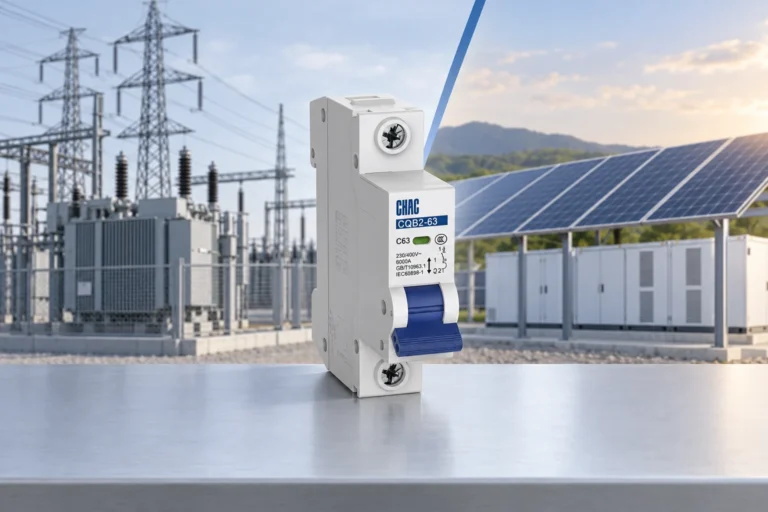
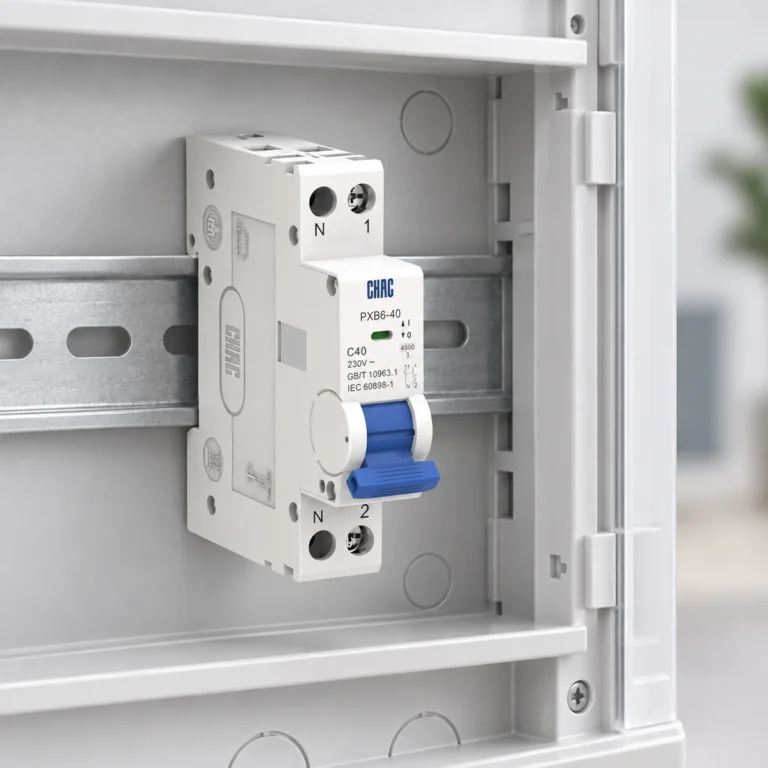
Because of the increasing demand for safer electrical systems, RCBO has become an essential solution for modern circuit protection systems. As electrical installations become too sophisticated in residential, commercial, or even industrial applications, traditional electric devices will no longer guarantee the safety from different electrical faults. The residual current circuit breaker with overload can provide residual current protection, overload protection, and even short-circuit protection in a single device for electrician installations.
The worldwide electrical protective equipment market is moving towards compact, integrated, and smart solutions. Increased complexity in the current accordance of electrical standards, rise in awareness among the public regarding electric shock hazards, and expansion of application areas like smart homes, electric vehicle stations, etc. are the driving forces behind this move.
For a professional installation person, being able to really have the right kind of protection is not just about having adequate electrical protection, but also ensuring that troubleshooting time is reduced, installation made easier and also customer satisfaction improved. The RCBO circuit protection allows for the protection of each of the individual circuits independently which limits the effects of faults and makes it easier to find the faults.
Nevertheless, people show hesitation to select RCBOs due to many factors including compatibility with current wiring setups, current ratings, protection sensitivity, certification, and long-term performance in mind. Thus, knowledge of the operational functions of RCBOs, their protection function, and how to choose them is necessary for electricians to make informed choices regarding RCBOs.

What Is an RCBO and Why Is It Important for Electricians?
If you want to know what Interruptor automático magnetotérmico modular con protección contra sobreintensidad y corriente de fuga a tierra is, you only need to take a look at its full term, Residual current breaker with overcurrent protection. This device is indeed a safety device used for electricity and it performs the two functions at a time. It’s an electrical safety device that acts as both residual current and overcurrent devices.
This device is very important for the electricians. Nowadays, many consumer units have limited space. Therefore, an electrician may install a RCBO switch rather than the separate ones for leakage and the overcurrent. This technique reduces the amount of space the devices take on the DIN rail. Moreover, it can also be important from the diagnostic point of view. The essence of the whole idea is that in the case of a failure in one of circuits, the corresponding RCBO breaker will be switched off only then, while the others will be functioning normally.
DIN Rail: This is an internationally agreed metal rail (usually 35mm wide) which is employed for mounting modules securely inside a distribution board using an easy snap-on mechanism.
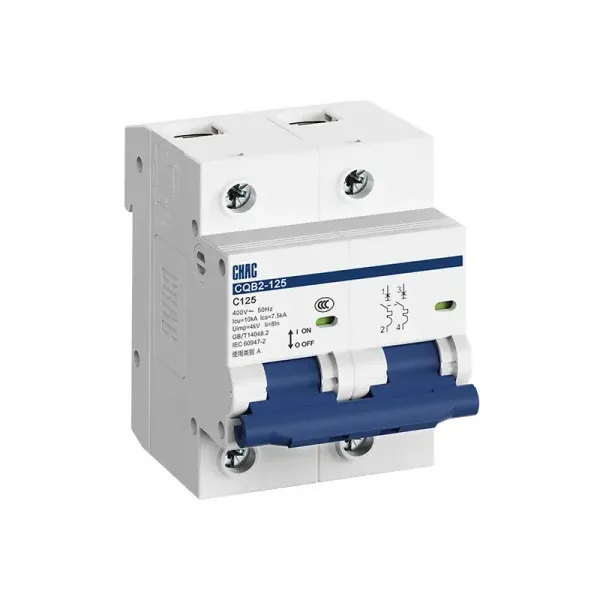
How to Prevent RCBO Nuisance Tripping?
A common problem that both electricians and homeowners deal with regularly is an RCBO tripping without any apparent cause. When the RCBO continues to trip, it usually indicates that it is not actually the breaker that has failed but that there is another problem in the circuit.
To prevent nuisance tripping, follow these best practices:
Reason for Cumulative Leakage Identification: The presence of various appliances like computers and printers creates natural leakage current in devices being used. In order to prevent galvonic or harmful leakage everyone should use several RCBOs by spreading the load accordingly.
Choosing the Right Type: With the emergence of electronic equipment like EV chargers and solar inverters, standard type AC RCBOS are no longer enough. Switching to a Type A RCBO (which also protects against fluctuating DC current) or even a Type B RCBO could save you from false tripping caused by modern power supply technology.
Regular Checks: Carry out regular inspections on the apparatus. If the test button on the unit is not functional, the operating unit may be faulty.
RCBO Standards and Safety Requirements Electricians Should Know
Following international safety regulations such as IEC 61009 is mandatory for any installation involving electrical panels. Electricians have to check that they choose adequately specified devices for the location of the installation.
The sensitivity of the breaker is an important aspect. A 30mA RCBO has become the standard all over the world for protection of people as it is designed to open quickly enough so that fatal shocks may be avoided in homes and offices. On the other hand, equipment protection and fire protection normally require a 100mA or 300mA rating, which does not concern the safety of people directly.
In addition, installation must be carried out correctly. Electricians are required to follow the RCBO wiring diagram provided by the manufacturer. It is important to know how to wire an RCBO correctly because without knowing how to ensure that the line and neutral connections are in the right position it cannot work properly.
Recommended Products:
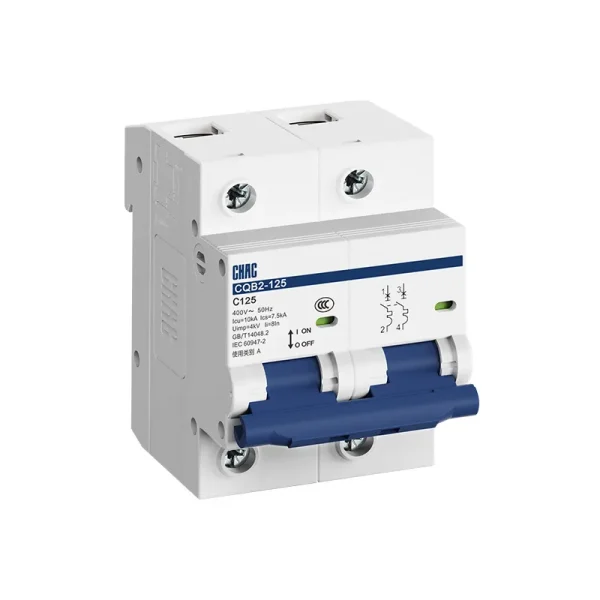
CQB2LE Series Electronic Leakage Circuit Breaker RCBO | CHAC Electric
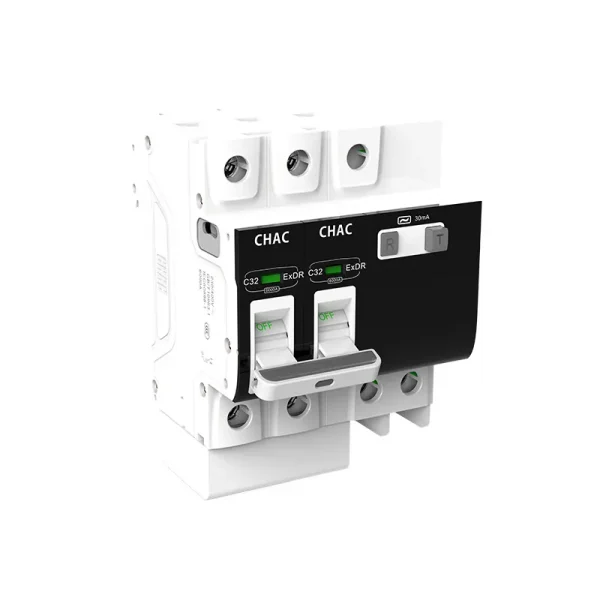
Minidisyuntor de corriente de fuga electrónico de la serie CQB3LE-63 | CHAC Electric
RCBO vs RCCB vs MCB: Which Protection Device Should Electricians Choose?
Knowing the various differences between RCD and RCBO, as well as the use of other kinds of breakers, is something which electrical engineers will have to do every day. The debates on the use of RCBO against RCD or RCCB and also RCBO against IGD is something which is very common in the field of electrical engineering when doing the designs of distribution boards.
We have prepared a comparison of their main protective features to help you choose the right one.
| Protection Device | Overcurrent Protection (Overload & Short Circuit) | Earth Leakage Protection (Shock & Fire Risk) | Space Efficiency in Consumer Unit | Best Use Case |
| IGD | Sí | No | High | Standard circuits without direct human contact risks. |
| RCCB / RCD | No (Requires a separate MCB) | Sí | Low (Takes up more DIN rail space with MCBs) | Group protection for multiple circuits. |
| Interruptor automático magnetotérmico modular con protección contra sobreintensidad y corriente de fuga a tierra | Sí | Sí | High | Individual circuit protection requiring maximum safety. |
Common Applications of RCBO in Residential and Commercial Electrical Systems
Due to its versatile features, RCBO finds application in various areas. Electricians can make different configurations depending on the load conditions and safety requirements in the area.
The sections below provide an examination of the application of different RCBO ratings and poles in practice.
| RCBO Configuration | Typical Current Rating | Common Application Scenarios |
| Single Pole / 1P+N | 6A, 10A, 16A RCBO | Residential lighting, standard power sockets, security alarms. |
| Single Pole / 1P+N | 20A, 32A RCBO, 40A | Kitchen ring circuits, water heaters, residential air conditioners. |
| Double Pole (2 Pole) | 16A – 63A | IT server rooms, hospitals, and sensitive systems requiring full neutral isolation. |
| 3 Phase RCBO | 32A – 100A+ | Industrial machinery, commercial HVAC systems, EV charging stations. |
The Next Level of Circuit Protection: Why Future Consumer Units Need an RCBO with AFDD
As the international electrical safety standards update further, it’s not enough to be protected against the overcurrent or earth leakage. There has been a big change in the European regulations, particularly in the BS7671 RCBO requirements (18th Edition Amendment 2) where the emphasis has been placed on reducing not only the risks of electric shock but also the fire hazards caused by electrical arcs. Thus, the work of electricians is changing with regard to their design and refurbishment of distribution boards.
The debate between AFDD and RCBO has recently gained importance in electrical engineering. The truth is that, despite the fact that an RCBO provides reliable detection system for earth faults and overloads, the internal mechanism does not pick up high-frequency characteristics of an alternative parallel or inclusive fault. The arc faults are created by chances of crushed wires, bad connections, and old insulations, and they constitute a major cause of electrical fires. The AFDD works in a functioning sense that it sensitively detects the erratic bursts by tracking the waveform.
Parallel or Series Arc Fault: Series arcs are mainly caused by broken wires or loose terminal connections and Parallel arcs occur due to damaged insulation on two wires; both of which are major reasons behind electrical fires.
The current great new technology is the RCBO with AFDD, which combines MCB and RCD in one compact module, unlike the cumbersome installation of two separate devices. From the builders’ perspective, this integration gives them a unique opportunity to install a single component with three functional groups instead of two bulky components. By combining these three devices, the panel builders save space on the DIN rail, ease the process of wiring, and comply with strict normative requirements.
AFDD: A special protective equipment which serves to find out dangerous arcs through detection of the high frequency currents.
Adapting to Renewable Energy: The Rise of the Bi-directional RCBO
With the increase of the use of solar photo-voltaic (PV) cells and home battery systems globally, the dynamics of electricity flow through the distribution board have changed. Earlier, electricity flowed solely from the utility network to the home appliance and in one direction, without any feedback into the grid. However, the current systems have the capacity to send back the excess power generated through solar panels to the electrical grid.
The bi-directional nature of electricity flow creates an unexpected problem for standard protection systems in that when you install circuit breakers in systems involving solar panels or batteries, there is a risk of their malfunctioning. When electricity flows in reverse, standard circuit breakers with arc cones and other tripping mechanisms don’t work properly, and therefore if any fault occurs, the arc cannot be extinguished.
A bi-directional RCBO is designed in such a way that it employs the same design in each of its two internal circuits. It is capable of fault detection and interruption of short circuit currents irrespective of the direction of current flow. In use with PV inverters and AC-coupled battery storage systems, it is essential to use a reverse-feeding RCBO.
Arc Chutes:An expert internal part of a breaker made up of several metallic plates designed to cool, stretch, and put off the perilous presence of electrical arcs whenever current is broken off abruptly.

RCBO Selection Questions Electricians Ask Before Wiring
Good RCBO selection for electricians begins by separating three duties: overload protection, short-circuit protection and residual-current protection. An RCBO can combine these functions, but the exact type, pole arrangement and residual operating current still have to match the circuit and local rules.
- Choose the residual-current type from the waveform. Type AC, A, F or B is not a marketing preference. Check the connected equipment, possible pulsating or smooth DC components and the manufacturer’s application guidance.
- Confirm the neutral arrangement. A 1P+N or 2P device may have different switching and protection arrangements. Follow the product diagram; never borrow a neutral from another RCBO circuit.
- Set the sensitivity from the protection objective. 30 mA is a common personnel-protection value in many applications, but the required value and time depend on the jurisdiction, installation and coordination design.
- Keep SPD and over/under-voltage protection separate. An RCBO does not replace a surge protection device or a voltage-monitoring protector.
For troubleshooting, record which circuit trips, whether the event occurs at energization or under load, and whether the built-in test button operates. This evidence is more useful than repeatedly resetting the handle. The related RCD wiring guide explains the separation between residual-current protection and ordinary overcurrent protection.
When Solar, EV or Electronic Loads Change the Review
Inverter-fed, battery, EV and power-electronic loads can change the residual-current waveform and may introduce bidirectional or DC components. Do not assume a standard AC RCBO is suitable. Confirm the inverter or charger manufacturer’s requirement, the applicable installation standard and the RCBO’s declared type before approval.
Source check: Compare the device definition with CHINT’s RCBO guide and the relevant IEC 61009 product documentation. The final selection is installation-specific and should be verified by a qualified electrician.
Preguntas frecuentes
Is it permissible to swap an MCB for an RCBO?
Yes, in certain circumstances, you can upgrade a Miniature Circuit Breaker (MCB) to a Residual Current Circuit Breaker (or RCBO) to provide earth fault protection. However, this involves ensuring that both live and neutral connections are available for the RCBO, which requires additional wiring work to be done by a qualified electrician in the consumer unit.
What does "30mA" mean on an RCBO?
The 30mA rating stands for residual operating current (earth leakage sensitivity). A 30mA RCBO is specifically intended for the protection of human life, as it disconnects the circuit within milliseconds as soon as it detects a leakage of 30mA and thus ensures protection against electric shocks. In other cases, ratings like 100mA or 300mA offer protection only for equipment or fire, but not for saving lives.
Why does my RCB keep tripping for no reason?
Nuisance tripping is not usually a problematic breaker and is instead caused by a combination of leakage from regular equipment (such as computers or washing machines) and dampness getting into outside sockets. You can resolve the problem by changing the type of RCB used from a Type A to another.
Should I choose Type AC or Type A RCBO?
Type A RCBO is advisable in all recent and new systems, particularly due to the introduction of specific regulations that have made them compulsory. Type AC will really be limited to the detection of only alternating current (AC) faults; hence Type A can be very beneficial as it will not only detect AC faults but can also find the problems with pulsating direct current that may arise from the equipment being used, such as LED drivers, EV chargers, and smart electronics.
Is it necessary to have an RCD and an RCBO in my consumer unit?
You generally do not require both. An RCBO is basically both an RCD and a circuit breaker in a single box. Electrical engineers may use either of the following methods to install circuits in a consumer unit: a main switch with various RCBOs (the best option for reasonable switching off) or a split load board that uses RCD and circuit breakers.
When should an RCBO testing be done?
Many of the electrical safety standards recommend users to test their RCBO by pressing the Test button in every six months. The press of the “Test” (T) button simulates the occurrence of earth fault and verifies whether the internal mechanical and electronic components are still in optimum working condition. If the RCBO fails during this test, then it is required to take immediate action and replace the entire unit.
Is it possible to employ a regular RCBO in a solar PV installation?
The answer is usually negative. This is due to the fact that inverters for solar energy and the system for storage of energy may introduce energy back into the electrical grid. A normal RCBO (that has one direction of the current flow) may cease to function or even break down because of back current. The correct way in which reverse feeding of electricity may be accommodated is to use a special RCBO designed for this role.
Can an RCBO offer protection from voltage spikes or lightening strikes?
The answer is No. An RCBO is responsible only for protecting against overcurrents (overloads and short circuits) and earth leakage (shock from electric current). If you want to protect sensitive electronics from voltage spikes due to grid fluctuations or lightning strikes, you’ll need to get a Surge Protection Device (SPD) fixed in the distribution board.
Referencias
Fortune Business Insights – Circuit Breaker Market Share
https://www.fortunebusinessinsights.com/industry-reports/circuit-breaker-market-100765
IET Electrical – The impact of Amendment 2 of the 18th edition
https://electrical.theiet.org/wiring-matters/years/2020/83-november-2020/the-impact-of-amendment-2-of-the-18th-edition-bs-76712018plusa22022/
Europa – Amendment 2: 18th Edition Wiring Regulations
https://www.europa-plc.com/amendment-2-18th-edition-wiring-regulations