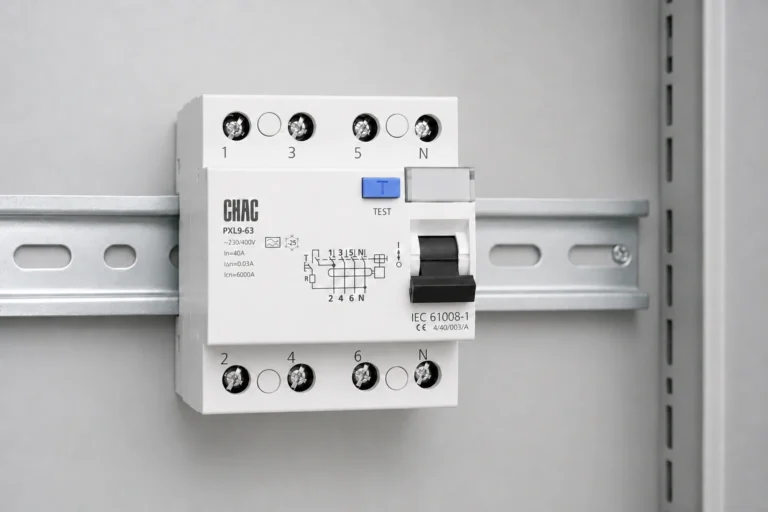
Choosing an RCBO for a modern circuit is not just a matter of matching its ampere rating to the load. An EV charger, variable-speed appliance or solar inverter can change the residual-current waveform that the protective device must detect. A board with limited space also raises questions about neutral switching, compatible terminals and fault isolation. Getting these details wrong can leave a circuit with an unsuitable protection arrangement or create repeated trips that interrupt otherwise healthy loads. This guide explains how electricians can distinguish the protection functions, select the residual-current type and check the installation conditions before wiring. It also separates two easily confused questions: whether a device detects DC residual current and whether it is approved for reverse feeding.
The short answer is that an RCBO combines residual-current protection with overload and short-circuit protection, while an RCCB needs coordinated overcurrent protection. For RCBO for electricians applications, verify the device’s declared product standard, current rating, breaking capacity, residual operating current, waveform type and pole arrangement. IEC 61009 is relevant to household and similar RCBOs; it is not a universal installation rule or proof of certification for a particular model. Electronic loads require additional scrutiny: Type A, F and B have different detection characteristics. Check the equipment manual and applicable local installation rules before choosing a device.

What is an RCBO, and how does it differ from an RCCB or MCB?
RCBO means residual current operated circuit-breaker with integral overcurrent protection. Its residual-current function responds to an imbalance between the monitored live conductors, while its overcurrent functions address overloads and short circuits. RCD is the broader term for residual-current devices, not a guarantee that overcurrent protection is included. An RCCB is an RCD without integral overcurrent protection.
Individual-circuit RCBO circuit protection can reduce the number of circuits disconnected by a downstream residual-current fault compared with a shared RCCB arrangement. That benefit depends on the board design and coordination with upstream devices; it does not guarantee that every fault trips only the final-circuit RCBO. Compactness also depends on the actual device dimensions, not the abbreviation on its label.
| Device | Overload and short-circuit protection | Residual-current protection | Design implication |
|---|---|---|---|
| MCB | Yes | No | Add suitable residual-current protection where the circuit requires it. |
| RCCB | No | Yes | Provide coordinated overcurrent protection; its ampere rating is not an overload trip setting. |
| RCBO | Yes | Yes | Check both sets of protection characteristics for the individual circuit. |
The Schneider Electric Electrical Installation Guide: Form factors of RCDs distinguishes integrated, add-on and separate residual-current arrangements and their product-standard contexts. Its examples describe Schneider equipment and do not establish another manufacturer’s ratings or conformity.
Should electricians choose Type AC, A, F or B?
Choose the residual-current type from the possible fault waveform and equipment requirements, not from a general claim that one type is suitable for all modern installations. The Schneider Electric Electrical Installation Guide: Types of RCDs, updated on August 5, 2026, explains the waveform distinctions with reference to IEC 60755 and IEC 62423.
| Residual-current type | Detection distinction | What to verify before selection |
|---|---|---|
| Type AC | Sinusoidal AC residual current | Whether the load can produce other waveforms and whether local rules permit this type for the circuit. |
| Type A | Sinusoidal AC and pulsating DC residual current | Equipment requirements and any need for protection against smooth DC residual current. |
| Type F | Type A characteristics plus specified composite-frequency residual currents associated with single-phase variable-speed drives | The drive or appliance manufacturer’s specified protection; Type F is not a general substitute for Type B. |
| Type B | Includes smooth DC and specified composite-frequency residual currents | The equipment’s fault-current characteristics, installation requirements and the exact device specification. |
Type A detects pulsating DC, not smooth DC merely because both have “DC” in their descriptions. Similarly, the “Type B” residual-current classification is different from a B-curve overcurrent characteristic. One describes residual-current detection; the other describes overcurrent tripping. Keep both fields separate on a procurement schedule.
What must be checked before using an RCBO for an EV charger?
An EV charging circuit needs a documented protection arrangement, not a universal recommendation for Type A or Type B. Confirm the charger’s required external RCD type, whether it includes a DC residual-current detection function, and what that built-in function actually disconnects or controls. A manual mentioning DC detection does not automatically mean that all required AC residual-current protection is built in.
Type A can be appropriate only when the charger documentation and applicable installation rules accept the complete arrangement, including any required protection against smooth DC residual current. Where smooth DC detection must be provided externally, a suitable Type B device may be needed. Type F should not be selected solely because the charger contains electronics. The waveform comparison above explains why the equipment-specific requirement matters.
A scoped example appears in Wallbox’s explanation of the May 2024 Swedish SEK Handbook 444 requirements: the manufacturer describes Type A or F with an RDC-DD conforming to IEC 62955, or a Type B arrangement, for the DC residual-current issue. It also identifies different external protection needs for its own charger models. Its discussion of 6 mA DC detection concerns the additional DC protection function, not a replacement for a 30 mA additional-protection RCD. This Swedish, model-specific example demonstrates why built-in detection must be checked; it is not a worldwide prescription or a declaration about CHAC products.
How should the charger’s current rating be translated into an RCBO specification?
Start with the charger’s declared supply requirements and configured charging current, then check the conductor capacity, installation method, ambient conditions, board capacity and applicable circuit-sizing rules. Select the overcurrent curve and breaking capacity from the actual installation conditions. The residual-current sensitivity is a separate parameter; it is not the current the charger can draw.
The Schneider Electric guide to fundamental circuit-breaker characteristics identifies voltage, rated current, tripping characteristics and short-circuit breaking capacity as distinct selection fields. A familiar current rating alone is therefore not enough to approve an EV circuit.
How can electricians investigate repeated RCBO tripping?
A trip without an obvious cause is not evidence that the RCBO is defective or that its sensitivity should be increased. Record the affected circuit, connected equipment and whether the event occurs during energization, sustained operation or wet conditions. Distinguish an overload or short-circuit trip from a residual-current trip where the device provides suitable indication.
- Investigate cumulative equipment leakage, insulation problems and moisture rather than assuming every trip is a nuisance event.
- Check for shared or borrowed neutrals and wiring that does not follow the device diagram. Each protected circuit needs the correct conductor routing.
- Review the load’s residual-current waveform and the specified device type. Changing type is not a substitute for finding a genuine fault.
- Have a qualified electrician carry out the necessary measurements and inspection with safe isolation. Do not repeatedly reset a circuit with an unresolved fault.
The test button is a functional check specified by the manufacturer. It does not replace installation testing, prove the earthing arrangement is correct or identify the cause of a downstream fault. Follow the exact device instructions for the test interval and response to a failed test; do not apply a generic interval to every installation.
Which wiring, standards and documents should electricians verify?
For RCBO selection for electricians, review the product and the installation together. A household RCBO’s IEC 61009 declaration is not interchangeable with an industrial breaker specification under IEC 60947-2. Product standards define device requirements; the adopted installation rules determine where and how protection must be provided.
- Confirm the exact model, rated voltage, current, breaking capacity, residual-current type and sensitivity against the circuit design.
- Verify the pole arrangement, which conductors are switched and protected, line/load markings, neutral connection and any auxiliary lead. A 1P+N or 2P label alone does not replace the wiring diagram.
- Check distribution-board compatibility, busbar arrangement, dimensions, terminal conductor limits and installation torque from the relevant manuals.
- Review upstream protection and selectivity. Additional RCDs may be required for the installation; an individual RCBO does not remove that design review.
- Request model-specific conformity documentation and commissioning records. Do not infer an EV, bidirectional or certification claim from a general category page or product photograph.
For EEA procurement, the European Commission’s CE marking guidance explains that CE marking is the manufacturer’s declaration under applicable legislation, not approval of safety by the EU or another authority. Check the actual declaration and model scope rather than treating a logo as independent certification.
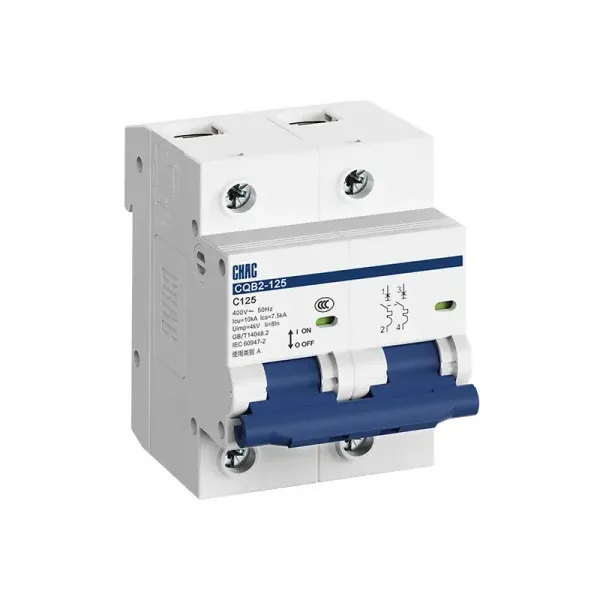
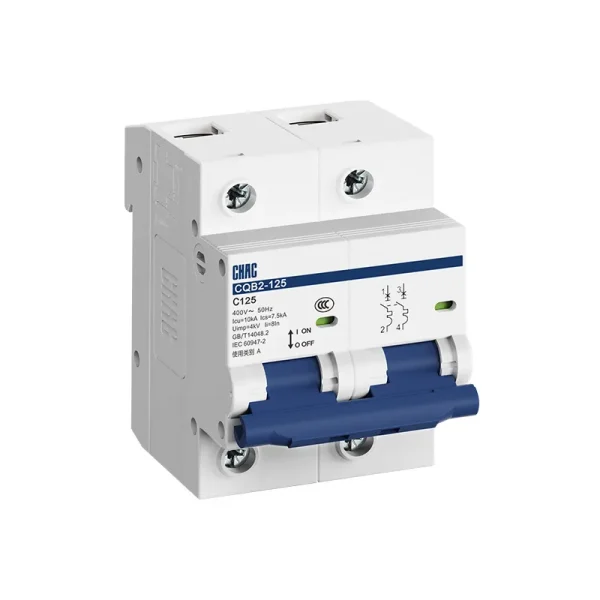
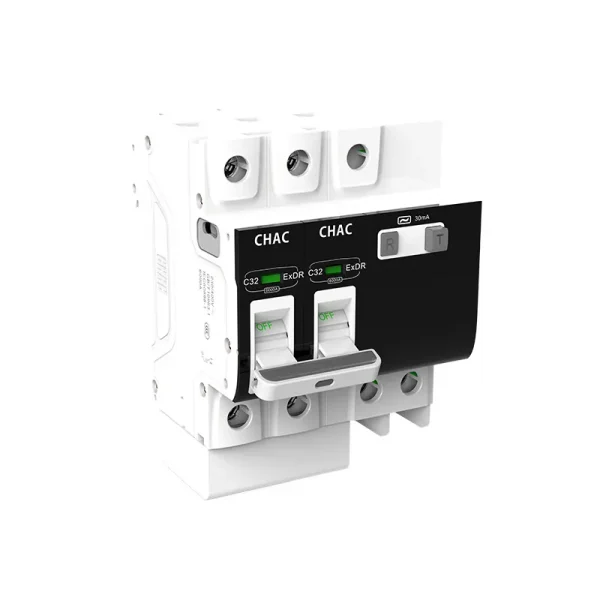
CHAC’s RCBO product range provides a starting point for requesting model-specific documentation. For the pictured CQB2LE device, review the CQB2LE-125 electronic RCBO page, then confirm the required variant with the supplier. The other product photograph shows the CQB3LE-63 series. Neither photographs nor these links establish suitability for every charger or inverter.
Does reverse feeding require a different RCBO from DC residual-current detection?
Yes, these are separate selection questions. Solar PV and battery systems can feed energy back through an AC distribution board. The RCBO’s suitability for that power-flow direction must be established from the exact manufacturer’s declaration, terminal markings and wiring instructions. Do not assume that every ordinary RCBO fails under reverse feeding, or that an unmarked device is approved for it.
The residual-current type answers a different question: what fault waveform the device detects. A Type B label does not by itself establish reverse-feed suitability, an AC/DC operating-voltage rating or approval for a particular inverter. Conversely, a bidirectional declaration does not establish smooth DC residual-current detection. Obtain both answers for the intended installation.

Frequently asked questions
Is it permissible to swap an MCB for an RCBO?
It can be possible, but only after checking board compatibility, circuit requirements, neutral routing and the exact RCBO wiring instructions. A qualified electrician must verify the replacement and test the installation; matching the current rating or physical width alone is insufficient.
What does "30mA" mean on an RCBO?
It is the rated residual operating current, not the circuit’s load-current rating. A 30 mA device is used for additional protection in many specified applications, but it cannot guarantee protection against every electric shock. The required sensitivity and operating characteristics depend on the installation rules and protection objective.
Why does my RCB keep tripping for no reason?
Possible causes include equipment leakage, moisture, damaged insulation, incorrect neutral routing or an overcurrent condition. The abbreviation RCB does not identify the device’s exact functions. Have the device and circuit identified and investigated before changing ratings, waveform type or repeatedly resetting it.
Should I choose Type AC or Type A RCBO?
Type AC detects sinusoidal AC residual current; Type A also detects pulsating DC residual current. Choose from the connected equipment’s requirements and local rules. Neither label alone establishes protection against smooth DC residual current or suitability for an EV charger.
Is it necessary to have an RCD and an RCBO in my consumer unit?
An RCBO already includes residual-current protection, so a separate RCCB is not automatically required for the same final circuit. However, upstream RCD protection may still be needed for the earthing arrangement or installation design. Any combination needs appropriate coordination rather than a blanket rule to remove one device.
When should an RCBO testing be done?
Use the test-button interval stated by the manufacturer and any applicable local requirements. Installation verification and periodic inspection are separate from pressing the button. If the prescribed functional test fails, have a qualified electrician investigate and follow the manufacturer’s instructions before returning the circuit to use.
Is it possible to employ a regular RCBO in a solar PV installation?
Possibly, if its documented supply-direction, voltage, waveform and protection characteristics meet the inverter and installation requirements. Check reverse-feed suitability separately from the residual-current type. Do not assume that an ordinary RCBO is either universally prohibited or universally suitable.
Can an RCBO offer protection from voltage spikes or lightning strikes?
An ordinary RCBO is not a surge protection device. Its residual-current and overcurrent functions do not establish protection against transient overvoltages. Where surge protection is required, select and coordinate a suitable SPD as part of the installation design.
Can I use type A RCBO for EV charger?
Only when the charger documentation and applicable installation rules accept Type A as part of the complete protection arrangement. Check whether the charger includes the required DC residual-current detection and what external protection remains necessary. Type A alone does not detect smooth DC residual current.
What type of RCCB is needed for an EV charger?
The required type depends on the charger’s residual-current protection and DC detection provisions, together with local installation rules. Type B may be needed where smooth DC detection must be provided externally; an accepted Type A arrangement requires the appropriate additional DC protection. An RCCB also needs coordinated overcurrent protection because it does not provide it itself.
What size RCBO should I use for my EV charger?
There is no universal ampere rating for all EV chargers. Determine it from the charger supply requirements and configured charging current, then verify conductor capacity, installation conditions and applicable sizing rules. Check the residual-current sensitivity, type, curve and breaking capacity separately.
What breaker is recommended for EV chargers?
Use the protection arrangement specified for the exact charger and accepted by the installation rules, which may involve an RCBO or coordinated separate devices. A breaker recommendation must cover overcurrent protection, residual-current protection and any required DC detection. Do not choose solely from the charger category or a familiar breaker rating.
Which sources support these selection distinctions?
Technical comparison checked October 7, 2026. The following public sources support general device-selection principles, not certification or EV suitability of a named CHAC model. CHAC is the commercial publisher of this article.
- Schneider Electric Electrical Installation Guide: Types of RCDs, updated August 5, 2026.
- Schneider Electric Electrical Installation Guide: Form factors of RCDs, updated August 5, 2026.
- Schneider Electric Electrical Installation Guide: Fundamental characteristics of a circuit-breaker, updated August 5, 2026.
- European Commission: CE marking, accessed October 7, 2026.
- Wallbox: Wallbox’s Commitment to EV Charging Standards, explaining the May 2024 Swedish requirements and Wallbox model arrangements; accessed October 7, 2026.
How should an electrician make the final RCBO decision?
The useful distinction is not simply RCBO versus another device: it is whether the complete protection arrangement matches the circuit. First identify the supply, equipment requirements and possible residual-current waveform. Then check overcurrent rating, breaking capacity, sensitivity, poles and board compatibility. For an EV charger or inverter, resolve built-in DC detection and reverse-feed suitability as separate questions rather than assuming one label covers both. Finally, verify the model documentation and commission the installation under the applicable rules. A convenient footprint or a successful test-button operation cannot replace those checks. CHAC’s product pages can help buyers identify candidate devices, but the procurement decision should follow confirmation of the exact variant and its documentation with the supplier.