Quel disjoncteur Wi‑Fi convient à une modernisation de l’installation domestique : celui qui offre le plus d’options via application, ou celui dont la compatibilité avec le tableau électrique et les circuits est bien documentée ? La distinction est importante, car la commande à distance, la mesure de la consommation énergétique et la protection contre les surcharges sont des fonctions distinctes. Un appareil compatible avec un rail DIN ou contrôlable depuis un smartphone n’est pas automatiquement un remplacement autorisé. Se fier uniquement à la connectivité peut conduire l’installateur à se retrouver avec un ensemble incompatible, un système de surveillance non pris en charge, ou l’absence de procédure claire en cas de déclenchement. Ce guide compare les caractéristiques de protection, les fonctionnalités connectées et la documentation fournie par les fabricants, afin d’aider les acheteurs à réduire leur sélection avant de procéder à l’installation.
La réponse courte est que Wi-Fi intelligent Disjoncteurs Il est possible d’ajouter une fonction de surveillance ou de contrôle à distance à la protection des circuits, mais la combinaison effective dépend du modèle. Vérifiez la catégorie de l’appareil électrique avant l’application : les disjoncteurs UL 489 et les protecteurs supplémentaires UL 1077 ne sont pas interchangeables pour la protection des circuits de dérivation. Puis, vérifiez la compatibilité du tableau, la tension nominale, le courant et la capacité de coupure. Un contrôle connecté peut être utile pour une tâche définie de gestion des circuits, mais il n’assure ni la précision de la mesure ni une isolation sûre. Renseignez-vous sur ce qui reste disponible sans WiFi, Internet ou service cloud, et exigez une procédure locale de protection et de fonctionnement documentée.
Services de disjoncteurs et de protections complémentaires d’UL Solutions Il est précisé que les dispositifs de protection supplémentaires ne sont pas destinés à assurer la protection contre les surintensités du circuit de branchement requise par le NEC. Il s’agit d’une distinction relative à la catégorie du dispositif, et non d’une affirmation selon laquelle tel ou tel fabricant mentionné dans cet article possède une certification particulière.
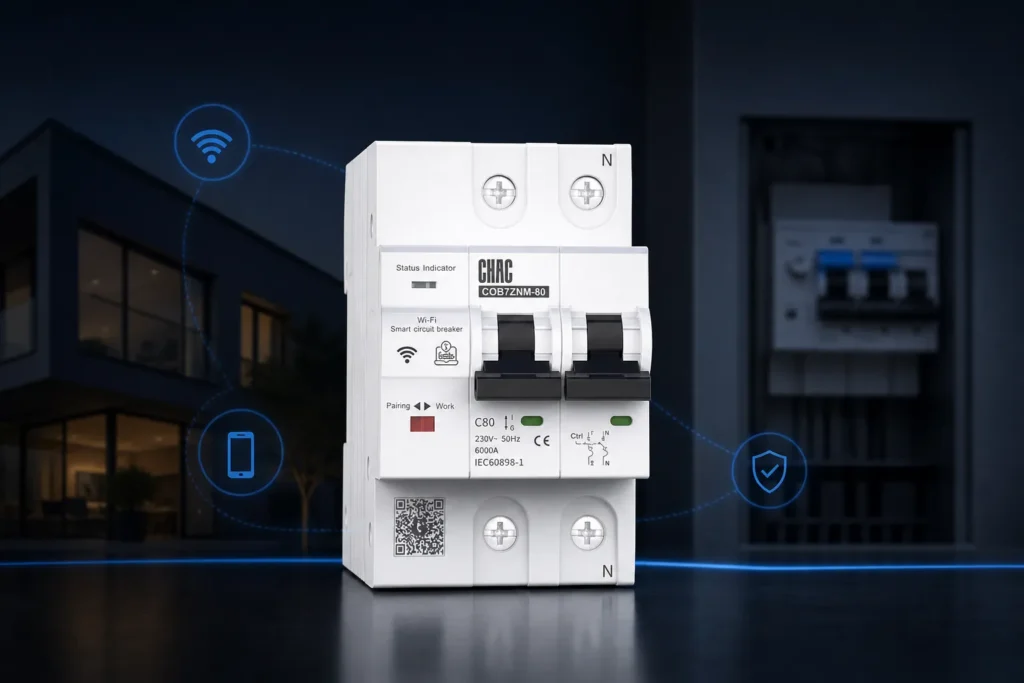
Comment fonctionnent les disjoncteurs intelligents ?
Un disjoncteur intelligent combine un dispositif de protection électrique avec une couche connectée de surveillance ou de contrôle. Les disjoncteurs traditionnels ne se limitent pas nécessairement à des mécanismes thermomagnétiques ; des unités de déclenchement électroniques existent également. De même, un dispositif connecté peut utiliser des composants distincts pour la commutation, la détection et la protection. Son architecture interne doit être tirée de la documentation spécifique au modèle concerné, et non de l’adjectif “ intelligent ”.”
Quelles fonctions relèvent de la protection, de la mesure et de la commande ?
| Fonction | Ce qu'il fait | Ce que l’acheteur doit vérifier |
|---|---|---|
| Protection contre les surtensions | Interrompt un circuit conformément aux caractéristiques de protection de l’appareil. | Classe du dispositif, valeurs nominales, caractéristiques de déclenchement et conditions d’installation |
| Mesure | Peut afficher la tension, le courant, la puissance ou l’énergie cumulée. | Canaux disponibles, spécification de précision et conditions de mesure |
| Commutation à distance | Peut accepter une commande d’ouverture ou de fermeture via un chemin de commande pris en charge. | Permitted operations, interlocks, permissions and behavior after a protective trip |
| Communication | Transfers supported status, readings or commands | Network requirements, gateway dependencies and cloud or local operation |
| Local operation | Provides the operations described in the device manual | Manual operating procedure and suitability for isolation where required |
Measurement, processing, communication and user control describe an information path, not a universal trip sequence. A protective function must not be assumed to wait for a smartphone or cloud command. Ask the manufacturer to identify the local trip function and its behavior under communication failure; an app notification is not evidence that fault interruption has occurred.
Which specifications matter before smart-home integration?
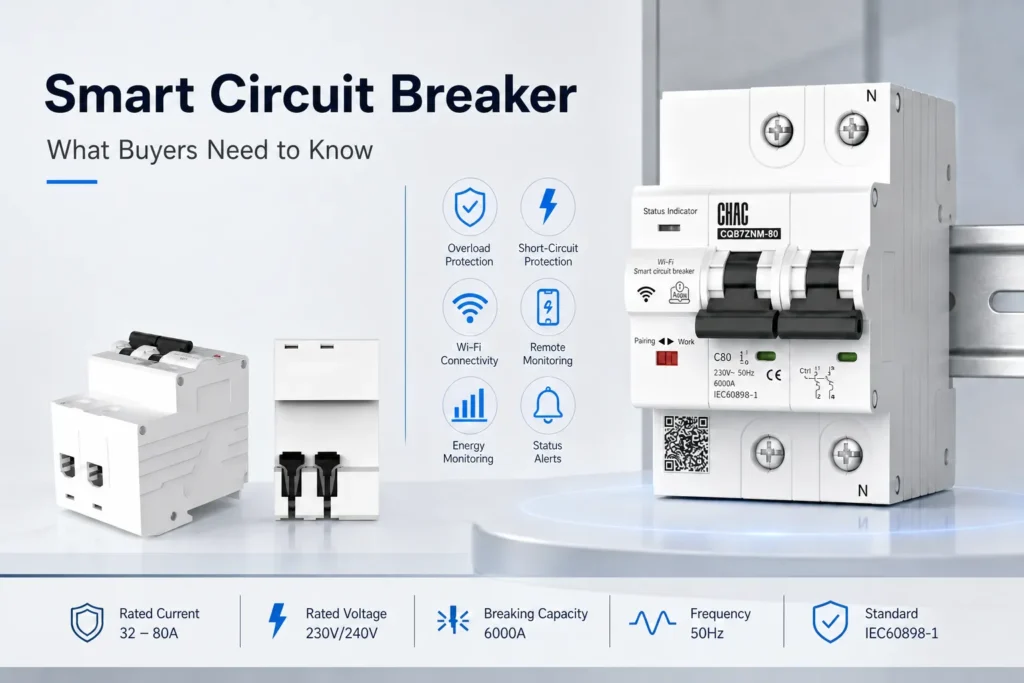
Electrical suitability comes before Tuya, Alexa, Google Home, HomeKit or Matter support. None of these integrations can be inferred from WiFi connectivity. Confirm the exact platform, gateway, supported functions and software version rather than accepting a generic compatibility logo.
How should voltage, current and breaking capacity be checked?
Rated operational voltage is not simply the highest voltage a device can withstand. It identifies an operating condition for the breaker, and the relevant AC or DC rating must match the circuit. Rated current also depends on stated conditions such as ambient temperature. A lighting, HVAC or EV-charging label is not enough to select an ampere rating: the installer must evaluate the load, conductors, equipment instructions and applicable installation rules.
Breaking capacity concerns prospective fault current at a specified voltage and under the relevant test conditions. It is not the normal load-current rating, and it does not mean that every interrupted fault leaves the device undamaged or ready for immediate reuse. Schneider Electric’s Caractéristiques fondamentales d’un disjoncteur, updated August 5, 2026, distinguishes rated operational voltage, rated current and short-circuit breaking ratings, including Icn and Icu. Product-specific ratings and post-fault instructions still govern the selected device.
| Article sélectionné | Preuves à demander | Misleading shortcut to avoid |
|---|---|---|
| Voltage and supply type | Exact AC/DC voltage rating, frequency and wiring diagram | Choosing by country name or assuming an AC rating also covers DC |
| Current and trip characteristics | Nameplate, trip curve or settings and temperature conditions | Treating a displayed current value as a validated protection setting |
| Interruption de défaut | Breaking rating at the circuit voltage and available-fault-current assessment | Confusing amperes carried with fault current interrupted |
| Poles and neutral arrangement | Protected and switched poles, neutral requirements and common operation | Defining poles as separate independent circuits |
| Assembly compatibility | Panel markings, installation instructions and documented permitted devices | Assuming physical fit establishes approval |
Does CE marking or a UL claim establish compatibility?
No. The European Commission’s CE marking guidance states that CE marking is a manufacturer’s declaration under applicable legislation, not approval of a product as safe by the EU or another authority. Request the declaration of conformity for the exact model and applicable requirements; “CE certified” alone is insufficient evidence.
For a UL claim, verify the exact model, certification category and conditions rather than a supplier-wide logo. The UL Solutions Panelboards Guide explains panelboard markings and field-installed equipment identification. UL’s breaker guidance also cautions that a replacement-breaker investigation does not automatically investigate the end application or a series combination. Breaker certification and permission to install it in a particular panel are separate checks.
How does a smart breaker compare with a traditional breaker or smart panel?
A smart breaker targets a circuit-level device; a smart panel involves an assembly-level monitoring or control system. Neither description guarantees a specific feature set. Existing-panel upgrades are feasible only when the proposed device and assembly are documented as suitable together.
| Décision | Traditional breaker | Smart Disjoncteur | Smart panel system |
|---|---|---|---|
| Protection | Defined by device ratings and trip characteristics | Must be verified independently of connected features | Depends on the protective devices and assembly design |
| Visibility | Local indication; additional monitoring may be separate | Only documented measurement and event channels | Only circuits and measurements covered by the system |
| Control | Local operation; accessories may add functions | Remote operations depend on model and control path | System-level control depends on the installed configuration |
| Upgrade boundary | Replacement must suit the panel and circuit | Space, wiring, panel permission and network access all matter | Assembly changes and commissioning may be required |
| Lifecycle cost | Installation, inspection and replacement | Add connectivity, accounts, software support and monitoring maintenance | Add system integration and assembly-level support |
There is no universal low-medium-high cost ranking. Compare installed scope, not unit price: equipment, permitted panel modifications, electrician labor, gateways, subscriptions if applicable, commissioning, support and eventual replacement. Energy monitoring alone does not promise savings. A business case needs a defined action, such as investigating an unexplained base load, and evidence that the action changes consumption.
What happens when WiFi, internet or cloud service is unavailable?
These are different failure conditions. Losing WiFi removes a wireless connection; losing internet may leave a local network available; losing a cloud service may leave hardware powered but make remote accounts or commands unusable. Local control should not be described as inherently more reliable without checking its own dependencies.
| État | Question for the supplier | Evidences d'acceptation |
|---|---|---|
| WiFi unavailable | Which local protective and manual operations remain functional? | Written operating instructions and an approved commissioning check |
| Internet ou cloud indisponible | Do local schedules, readings or commands still work, and where are they stored? | Model-specific dependency description; no assumption of offline automation |
| Power returns after an outage | What state returns, and can any saved command or schedule energize the circuit? | Documented restart behavior and the site’s approved control policy |
| Protection trips | Can remote reset or closing occur, and what restrictions apply? | Device instructions, permissions and a fault-investigation procedure |
Local protective operation should be a procurement requirement, not an unverified promise about every device marketed as a WiFi breaker. Ask separately about loss of communication, loss of electronics power and firmware failure. Do not provoke an overload or short circuit to test these claims in an occupied installation; protective testing requires appropriate procedures and qualified personnel.
Is an app’s OFF command sufficient for maintenance isolation?
No. A remote command, status icon or zero-current reading is not proof that equipment is de-energized or secured against reconnection. Verify the breaker’s documented suitability for isolation, follow the applicable safe-work procedure, address every supply and confirm absence of voltage with appropriate equipment. Schneider’s fundamental-characteristics guide treats suitability for isolation as a specific property, not a consequence of connectivity.
What should buyers verify about energy readings and firmware support?
An app showing watts or kWh demonstrates a displayed value, not a verified accuracy class. Request the accuracy specification, applicable range, reference conditions, calibration or test evidence, update interval and handling of missing data. Voltage, current, active power and energy are distinct quantities; a current reading alone does not establish actual energy consumption.
If the project needs billing or tenant cost allocation, check the applicable metering requirements and obtain evidence for that use. Until then, treat readings as indications for investigation rather than revenue-grade measurements. A comparison with a suitable reference instrument can support commissioning, but does not by itself establish a certification or accuracy class.
Which support commitments need to be written down?
- How long will firmware, security updates and the app or cloud service be supported, and what happens when support ends?
- Who owns the accounts, can access be revoked, and how are permissions transferred when the building changes operator?
- Who authorizes updates or changes to settings, and what records show the device identity, firmware version and approved configuration?
- Can readings and event records be exported, and does that require a subscription or an available cloud service?
- What prevents an unauthorized or scheduled command from closing a circuit during maintenance or after a protective trip?
These are questions to verify, not capabilities attributed to the listed suppliers. Support lifetime, encryption, authenticated updates, local integration and automatic reclosing must not be inferred from a brand name. If the supplier cannot document a necessary function, exclude that function from the purchase specification.
What should a smart-breaker pilot record before a wider rollout?
Un outil utile Interrupteur intelligent pilot compares documented requirements with observed behavior on the exact hardware and software version. Record the device identifier, firmware and app versions, account ownership, approved schedules and permissions. For each required function, state the expected outcome from the supplier’s instructions and retain the commissioning result. A demo on another firmware version is not a substitute.
Include an operator handover scenario: can the authorized administrator remove the former operator’s access, transfer ownership and confirm the remaining schedules? Also agree which configuration checks must be repeated after an update or replacement. These are proposed acceptance questions, not a claim that every device offers those features.
Keep switching permissions separate from the electrical protection record. If a protective function or control behavior is undocumented, do not fill the gap with an app screenshot. The MCB specification guide provides the electrical-rating checks that remain necessary alongside the connected functions.
How should Leviton, Eaton, Siemens and CHAC be compared?
The original supplier shortlist includes Leviton, Eaton, Siemens and CHAC. Retaining those names does not make every supplier’s product a directly interchangeable WiFi breaker. The comparison below is a documentation checklist reviewed October 7, 2026, not an observed performance test, ranked recommendation or price benchmark. CHAC publishes this article and has a commercial interest in its own products; no independent comparative test results are presented.
| Supplier on the shortlist | Question before selecting a model | Preuves nécessaires pour la comparaison |
|---|---|---|
| Leviton | Which exact breaker, load center and communication components are required? | Current model instructions, compatible assembly list and supported functions |
| Eaton | Is the proposed solution a connected breaker, accessory or wider energy-management system? | Exact device class, panel suitability and documented control path |
| Siemens | Which product and installed configuration meet the project’s circuit-level requirements? | Model-specific ratings, assembly instructions and supported communication functions |
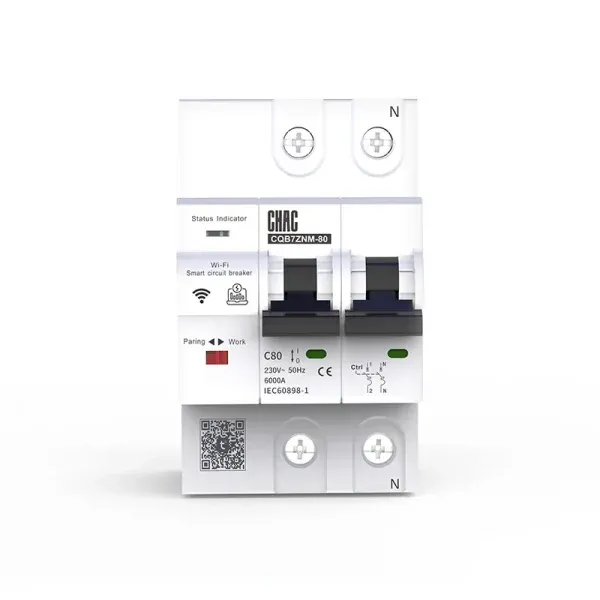
| CHAC | Does the proposed CQB7ZM configuration meet the destination market and circuit requirements? | Exact variant documentation, conformity evidence, wiring requirements and support terms |
Supplier reputation and manufacturing history do not establish a particular model’s breaking capacity, metering accuracy, cybersecurity controls or software lifetime. Request equivalent documents from each supplier and compare only the functions supported for the proposed configuration.
How can common installation and connection problems be avoided?
What should be checked when pairing fails?
Check the exact model’s supported WiFi band, authentication method, app, gateway and pairing procedure. Do not assume every device requires 2.4 GHz or supports the same router settings. Panel location and enclosure construction can affect coverage, but resolving a connection problem must not involve opening energized equipment or making unapproved enclosure modifications.
What should be checked when a breaker does not fit the panel?
Stop the replacement and check the panel’s permitted devices, connection system, space and wiring instructions. Physical dimensions are only one part of compatibility. Do not alter the busbar, terminal or enclosure to accommodate a device without documented authorization and the necessary assessment.
What should happen after an unexplained trip?
Identify and correct the cause before returning the circuit to service. Do not repeatedly issue remote close commands or increase a protection setting to suppress the symptom. Use the exact device’s fault and reset instructions; app logs can assist diagnosis, but they cannot replace inspection by qualified personnel when needed.
Future features such as predictive analytics, solid-state switching, Matter support or coordination with solar, batteries and EV chargers should be evaluated only when offered and documented for the selected system. A technology trend is not evidence that an existing breaker supports it, and connected scheduling is not automatically an approved load-management system.
What should buyers verify before ordering a WiFi smart breaker?
- Define the circuit and destination market, including supply, load, conductors, fault level and permitted panel configuration.
- Confirm the protective device class, exact ratings, conformity evidence and installation instructions before comparing connected features.
- Specify which readings and controls are needed, then obtain model-specific accuracy and communication-dependency documentation.
- Agree on offline behavior, account ownership, update approval, support lifetime and closing restrictions before commissioning.
- Record the installed model, circuit label, approved settings, software version and commissioning checks for future maintenance.
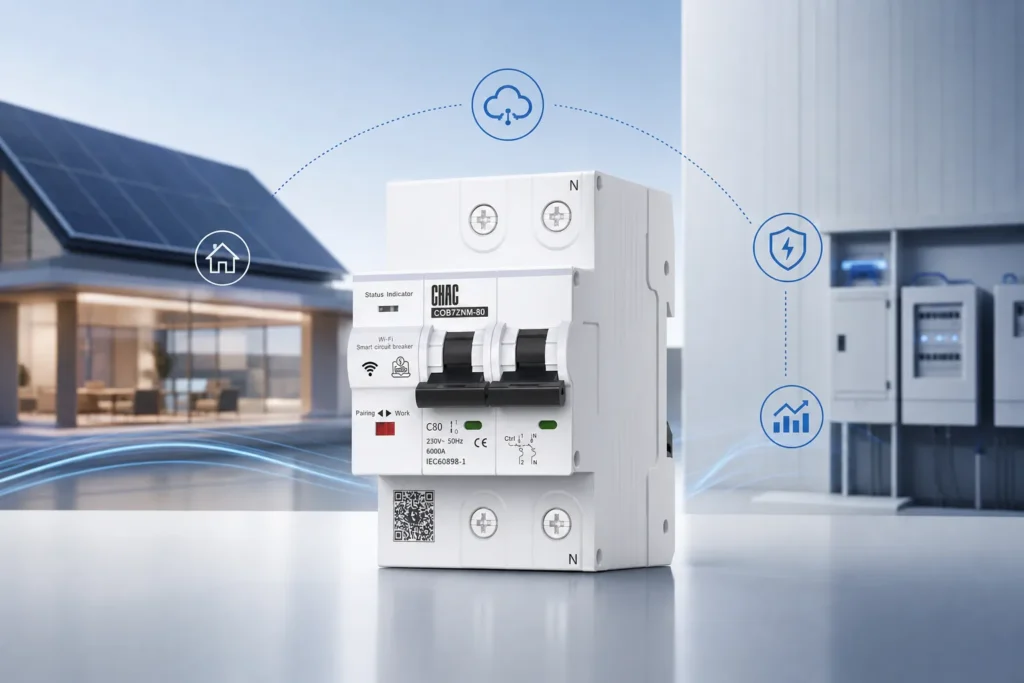
Le CHAC disjoncteurs intelligents category provides a relevant product-selection route. For a specific inquiry, use the CQB7ZM WiFi smart circuit breaker page and request documentation for the exact configuration. The linked product name is not a substitute for checking its ratings, certification scope or installation suitability.
What other questions do WiFi breaker buyers ask?
À quoi sert un disjoncteur Wi‑Fi ?
Un disjoncteur Wi‑Fi peut communiquer son état de fonctionnement ou ses mesures et peut accepter des commandes de commutation à distance. Les fonctions exactes dépendent du modèle et de la configuration du système. La seule connectivité Wi‑Fi ne garantit ni la protection contre les surintensités, ni la précision de la mesure, ni l’adéquation à un tableau électrique spécifique.
Les disjoncteurs intelligents valent-ils le coup ?
Ils peuvent mériter d’être pris en considération lorsqu’une tâche de surveillance ou de contrôle bien définie justifie les coûts d’installation et d’exploitation. Comparez les avantages par rapport à une surveillance décentralisée ou à des équipements conventionnels, et tenez compte des besoins en matière de support logiciel et de connectivité. Ne supposez pas que l’ajout du Wi‑Fi améliore automatiquement la sécurité ou réduit les factures d’électricité.
Quelle est la différence entre un disjoncteur intelligent et un disjoncteur classique ?
Un disjoncteur classique assure les fonctions de protection et de manœuvre spécifiées pour cet appareil. Un disjoncteur intelligent ajoute, selon le cas, une fonction de surveillance connectée ou de commande. Ces fonctions supplémentaires ne dispensent pas de vérifier les caractéristiques de protection et la compatibilité des composants lors du montage.
Les disjoncteurs intelligents nécessitent-ils une installation par un professionnel ?
L’installation doit être effectuée par du personnel qualifié en électricité, en respectant strictement les instructions du produit et les prescriptions locales applicables. La connexion à une application est distincte de l’évaluation du circuit, du câblage de l’appareil et de la vérification de l’installation au tableau électrique. Une connexion réussie ne constitue pas la preuve d’une installation électrique sûre.
Qu’est-ce qu’un MCB Wi‑Fi ?
Le MCB Wi‑Fi est une dénomination commerciale généralement utilisée pour un disjoncteur miniature connecté. Les acheteurs doivent vérifier si l’appareil en question est bien documenté comme un disjoncteur de protection contre les surintensités, et non pas simplement comme un interrupteur télécommandé ou un dispositif de protection supplémentaire. Sa dénomination ne constitue pas une preuve de conformité à une norme, d’obtention d’une certification ni de respect d’un ensemble de caractéristiques.
Which official sources support these selection checks?
- UL Solutions : Services de disjoncteur et de protection complémentaire – device-class and replacement-investigation boundaries; retrieved October 7, 2026.
- Guide d’installation électrique Schneider Electric : Caractéristiques fondamentales d’un disjoncteur – ratings and suitability for isolation; updated August 5, 2026.
- UL Solutions: Panelboards Guide – assembly markings and permitted field-installed equipment; retrieved October 7, 2026.
- Commission européenne : marquage CE – declaration responsibilities and limits of the mark; retrieved October 7, 2026.
What is the deciding principle for choosing a smart breaker?
The deciding principle is to separate electrical protection from connected convenience, then verify how the two operate together. Start with the circuit and panel, confirm the device class and ratings, and only then compare readings, commands and integration options. The most useful connected feature is one with a defined purpose and documented limitations, not simply the largest number of app screens. Before installation, settle what happens without communication, who may change settings and how maintenance isolation prevents reconnection. Do not accept an app status as proof of de-energization or a supplier logo as proof of model-level conformity. CHAC’s listed product routes can support a focused sourcing discussion; contact the supplier with the required configuration and request the documentation needed for the installer’s decision.