Which WiFi breaker is suitable for a home upgrade: the one with the most app features, or the one documented for the electrical panel and circuit? The distinction matters because remote switching, energy readings and overload protection are different functions. A device that fits on a rail or responds to a phone is not automatically an approved replacement breaker. Buying on connectivity alone can leave the installer with an incompatible assembly, an unsupported monitoring system or no clear procedure after a trip. This guide compares protection, connected features and supplier documentation so buyers can narrow a shortlist before committing to installation.
The short answer is that WiFi smart circuit breakers can add monitoring or remote control to circuit protection, but the actual combination depends on the model. Verify the electrical device class before the app: UL 489 circuit breakers and UL 1077 supplementary protectors are not interchangeable for branch-circuit protection. Then check panel suitability, rated voltage, current and breaking capacity. Connected control can be useful for a defined circuit-management task, but it does not establish metering accuracy or safe isolation. Ask what remains available without WiFi, internet or cloud service, and require a documented local protection and operating procedure.
UL Solutions’ Circuit Breaker and Supplementary Protector Services explains that supplementary protectors are not intended to provide the branch-circuit overcurrent protection required by the NEC. This is a device-class distinction, not a statement that any supplier in this article holds a particular certification.
How do smart circuit breakers work?
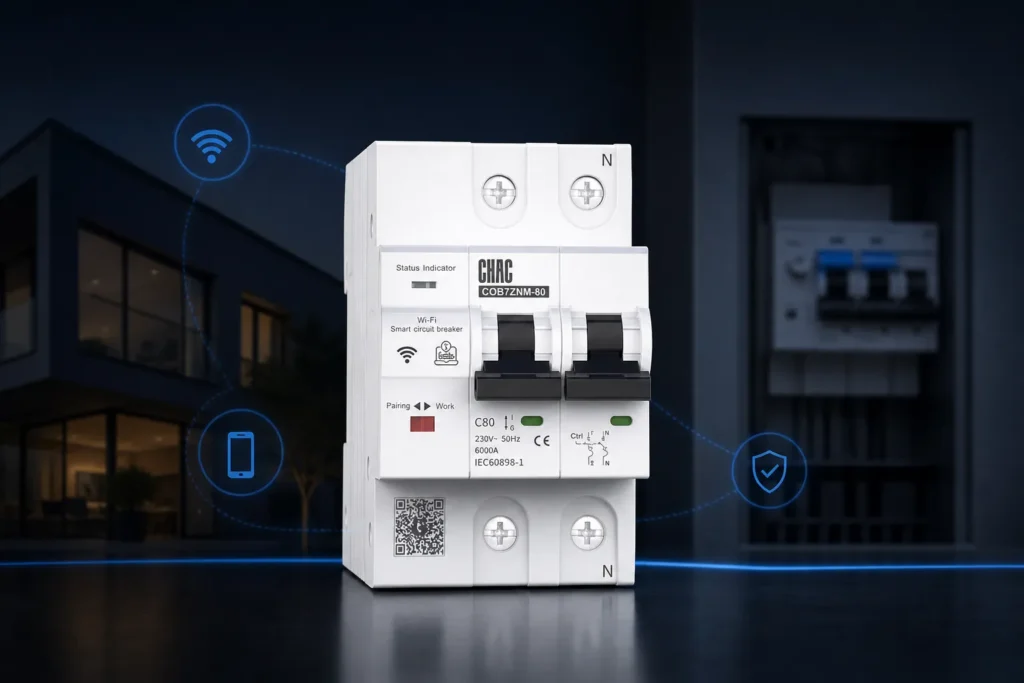
A smart breaker combines an electrical protective device with a connected monitoring or control layer. Traditional breakers are not necessarily limited to thermal-magnetic mechanisms; electronic trip units also exist. Likewise, a connected device may use separate switching, sensing and protection components. Its internal architecture must come from the exact model’s documentation, not from the word “smart.”
Which functions belong to protection, measurement and control?
| Function | What it does | What the buyer must verify |
|---|---|---|
| Overcurrent protection | Interrupts a circuit according to the device’s protective characteristics | Device class, ratings, trip characteristics and installation conditions |
| Measurement | May report voltage, current, power or accumulated energy | Available channels, accuracy specification and measurement conditions |
| Remote switching | May accept an open or close command through a supported control path | Permitted operations, interlocks, permissions and behavior after a protective trip |
| Communication | Transfers supported status, readings or commands | Network requirements, gateway dependencies and cloud or local operation |
| Local operation | Provides the operations described in the device manual | Manual operating procedure and suitability for isolation where required |
Measurement, processing, communication and user control describe an information path, not a universal trip sequence. A protective function must not be assumed to wait for a smartphone or cloud command. Ask the manufacturer to identify the local trip function and its behavior under communication failure; an app notification is not evidence that fault interruption has occurred.
Which specifications matter before smart-home integration?
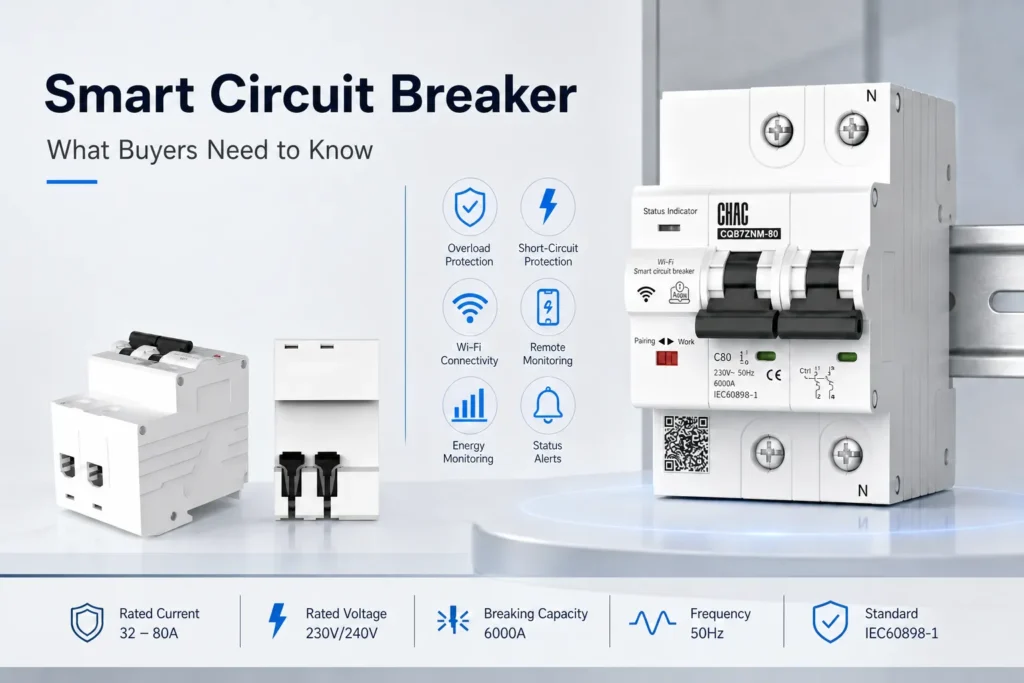
Electrical suitability comes before Tuya, Alexa, Google Home, HomeKit or Matter support. None of these integrations can be inferred from WiFi connectivity. Confirm the exact platform, gateway, supported functions and software version rather than accepting a generic compatibility logo.
How should voltage, current and breaking capacity be checked?
Rated operational voltage is not simply the highest voltage a device can withstand. It identifies an operating condition for the breaker, and the relevant AC or DC rating must match the circuit. Rated current also depends on stated conditions such as ambient temperature. A lighting, HVAC or EV-charging label is not enough to select an ampere rating: the installer must evaluate the load, conductors, equipment instructions and applicable installation rules.
Breaking capacity concerns prospective fault current at a specified voltage and under the relevant test conditions. It is not the normal load-current rating, and it does not mean that every interrupted fault leaves the device undamaged or ready for immediate reuse. Schneider Electric’s Fundamental characteristics of a circuit-breaker, updated August 5, 2026, distinguishes rated operational voltage, rated current and short-circuit breaking ratings, including Icn and Icu. Product-specific ratings and post-fault instructions still govern the selected device.
| Selection item | Evidence to request | Misleading shortcut to avoid |
|---|---|---|
| Voltage and supply type | Exact AC/DC voltage rating, frequency and wiring diagram | Choosing by country name or assuming an AC rating also covers DC |
| Current and trip characteristics | Nameplate, trip curve or settings and temperature conditions | Treating a displayed current value as a validated protection setting |
| Fault interruption | Breaking rating at the circuit voltage and available-fault-current assessment | Confusing amperes carried with fault current interrupted |
| Poles and neutral arrangement | Protected and switched poles, neutral requirements and common operation | Defining poles as separate independent circuits |
| Assembly compatibility | Panel markings, installation instructions and documented permitted devices | Assuming physical fit establishes approval |
Does CE marking or a UL claim establish compatibility?
No. The European Commission’s CE marking guidance states that CE marking is a manufacturer’s declaration under applicable legislation, not approval of a product as safe by the EU or another authority. Request the declaration of conformity for the exact model and applicable requirements; “CE certified” alone is insufficient evidence.
For a UL claim, verify the exact model, certification category and conditions rather than a supplier-wide logo. The UL Solutions Panelboards Guide explains panelboard markings and field-installed equipment identification. UL’s breaker guidance also cautions that a replacement-breaker investigation does not automatically investigate the end application or a series combination. Breaker certification and permission to install it in a particular panel are separate checks.
How does a smart breaker compare with a traditional breaker or smart panel?
A smart breaker targets a circuit-level device; a smart panel involves an assembly-level monitoring or control system. Neither description guarantees a specific feature set. Existing-panel upgrades are feasible only when the proposed device and assembly are documented as suitable together.
| Decision | Traditional breaker | Smart circuit breaker | Smart panel system |
|---|---|---|---|
| Protection | Defined by device ratings and trip characteristics | Must be verified independently of connected features | Depends on the protective devices and assembly design |
| Visibility | Local indication; additional monitoring may be separate | Only documented measurement and event channels | Only circuits and measurements covered by the system |
| Control | Local operation; accessories may add functions | Remote operations depend on model and control path | System-level control depends on the installed configuration |
| Upgrade boundary | Replacement must suit the panel and circuit | Space, wiring, panel permission and network access all matter | Assembly changes and commissioning may be required |
| Lifecycle cost | Installation, inspection and replacement | Add connectivity, accounts, software support and monitoring maintenance | Add system integration and assembly-level support |
There is no universal low-medium-high cost ranking. Compare installed scope, not unit price: equipment, permitted panel modifications, electrician labor, gateways, subscriptions if applicable, commissioning, support and eventual replacement. Energy monitoring alone does not promise savings. A business case needs a defined action, such as investigating an unexplained base load, and evidence that the action changes consumption.
What happens when WiFi, internet or cloud service is unavailable?
These are different failure conditions. Losing WiFi removes a wireless connection; losing internet may leave a local network available; losing a cloud service may leave hardware powered but make remote accounts or commands unusable. Local control should not be described as inherently more reliable without checking its own dependencies.
| Condition | Question for the supplier | Acceptance evidence |
|---|---|---|
| WiFi unavailable | Which local protective and manual operations remain functional? | Written operating instructions and an approved commissioning check |
| Internet or cloud unavailable | Do local schedules, readings or commands still work, and where are they stored? | Model-specific dependency description; no assumption of offline automation |
| Power returns after an outage | What state returns, and can any saved command or schedule energize the circuit? | Documented restart behavior and the site’s approved control policy |
| Protection trips | Can remote reset or closing occur, and what restrictions apply? | Device instructions, permissions and a fault-investigation procedure |
Local protective operation should be a procurement requirement, not an unverified promise about every device marketed as a WiFi breaker. Ask separately about loss of communication, loss of electronics power and firmware failure. Do not provoke an overload or short circuit to test these claims in an occupied installation; protective testing requires appropriate procedures and qualified personnel.
Is an app’s OFF command sufficient for maintenance isolation?
No. A remote command, status icon or zero-current reading is not proof that equipment is de-energized or secured against reconnection. Verify the breaker’s documented suitability for isolation, follow the applicable safe-work procedure, address every supply and confirm absence of voltage with appropriate equipment. Schneider’s fundamental-characteristics guide treats suitability for isolation as a specific property, not a consequence of connectivity.
What should buyers verify about energy readings and firmware support?
An app showing watts or kWh demonstrates a displayed value, not a verified accuracy class. Request the accuracy specification, applicable range, reference conditions, calibration or test evidence, update interval and handling of missing data. Voltage, current, active power and energy are distinct quantities; a current reading alone does not establish actual energy consumption.
If the project needs billing or tenant cost allocation, check the applicable metering requirements and obtain evidence for that use. Until then, treat readings as indications for investigation rather than revenue-grade measurements. A comparison with a suitable reference instrument can support commissioning, but does not by itself establish a certification or accuracy class.
Which support commitments need to be written down?
- How long will firmware, security updates and the app or cloud service be supported, and what happens when support ends?
- Who owns the accounts, can access be revoked, and how are permissions transferred when the building changes operator?
- Who authorizes updates or changes to settings, and what records show the device identity, firmware version and approved configuration?
- Can readings and event records be exported, and does that require a subscription or an available cloud service?
- What prevents an unauthorized or scheduled command from closing a circuit during maintenance or after a protective trip?
These are questions to verify, not capabilities attributed to the listed suppliers. Support lifetime, encryption, authenticated updates, local integration and automatic reclosing must not be inferred from a brand name. If the supplier cannot document a necessary function, exclude that function from the purchase specification.
How should Leviton, Eaton, Siemens and CHAC be compared?
The original supplier shortlist includes Leviton, Eaton, Siemens and CHAC. Retaining those names does not make every supplier’s product a directly interchangeable WiFi breaker. The comparison below is a documentation checklist reviewed October 7, 2026, not an observed performance test, ranked recommendation or price benchmark. CHAC publishes this article and has a commercial interest in its own products; no independent comparative test results are presented.
| Supplier on the shortlist | Question before selecting a model | Evidence needed for comparison |
|---|---|---|
| Leviton | Which exact breaker, load center and communication components are required? | Current model instructions, compatible assembly list and supported functions |
| Eaton | Is the proposed solution a connected breaker, accessory or wider energy-management system? | Exact device class, panel suitability and documented control path |
| Siemens | Which product and installed configuration meet the project’s circuit-level requirements? | Model-specific ratings, assembly instructions and supported communication functions |
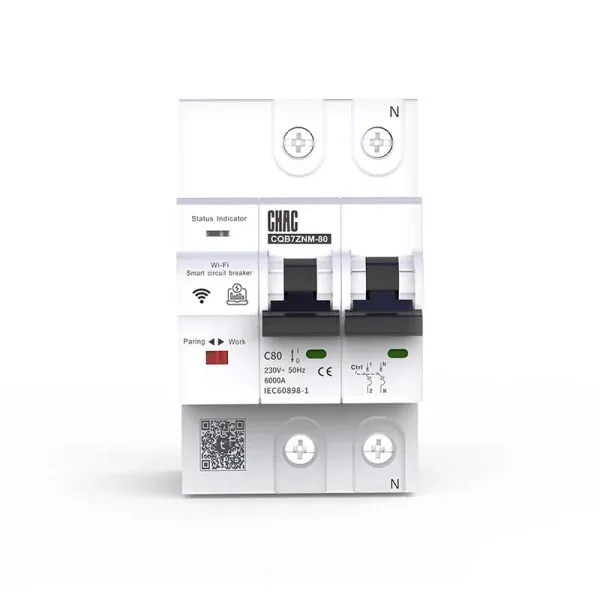
| CHAC | Does the proposed CQB7ZM configuration meet the destination market and circuit requirements? | Exact variant documentation, conformity evidence, wiring requirements and support terms |
Supplier reputation and manufacturing history do not establish a particular model’s breaking capacity, metering accuracy, cybersecurity controls or software lifetime. Request equivalent documents from each supplier and compare only the functions supported for the proposed configuration.
How can common installation and connection problems be avoided?
What should be checked when pairing fails?
Check the exact model’s supported WiFi band, authentication method, app, gateway and pairing procedure. Do not assume every device requires 2.4 GHz or supports the same router settings. Panel location and enclosure construction can affect coverage, but resolving a connection problem must not involve opening energized equipment or making unapproved enclosure modifications.
What should be checked when a breaker does not fit the panel?
Stop the replacement and check the panel’s permitted devices, connection system, space and wiring instructions. Physical dimensions are only one part of compatibility. Do not alter the busbar, terminal or enclosure to accommodate a device without documented authorization and the necessary assessment.
What should happen after an unexplained trip?
Identify and correct the cause before returning the circuit to service. Do not repeatedly issue remote close commands or increase a protection setting to suppress the symptom. Use the exact device’s fault and reset instructions; app logs can assist diagnosis, but they cannot replace inspection by qualified personnel when needed.
Future features such as predictive analytics, solid-state switching, Matter support or coordination with solar, batteries and EV chargers should be evaluated only when offered and documented for the selected system. A technology trend is not evidence that an existing breaker supports it, and connected scheduling is not automatically an approved load-management system.
What should buyers verify before ordering a WiFi smart breaker?
- Define the circuit and destination market, including supply, load, conductors, fault level and permitted panel configuration.
- Confirm the protective device class, exact ratings, conformity evidence and installation instructions before comparing connected features.
- Specify which readings and controls are needed, then obtain model-specific accuracy and communication-dependency documentation.
- Agree on offline behavior, account ownership, update approval, support lifetime and closing restrictions before commissioning.
- Record the installed model, circuit label, approved settings, software version and commissioning checks for future maintenance.
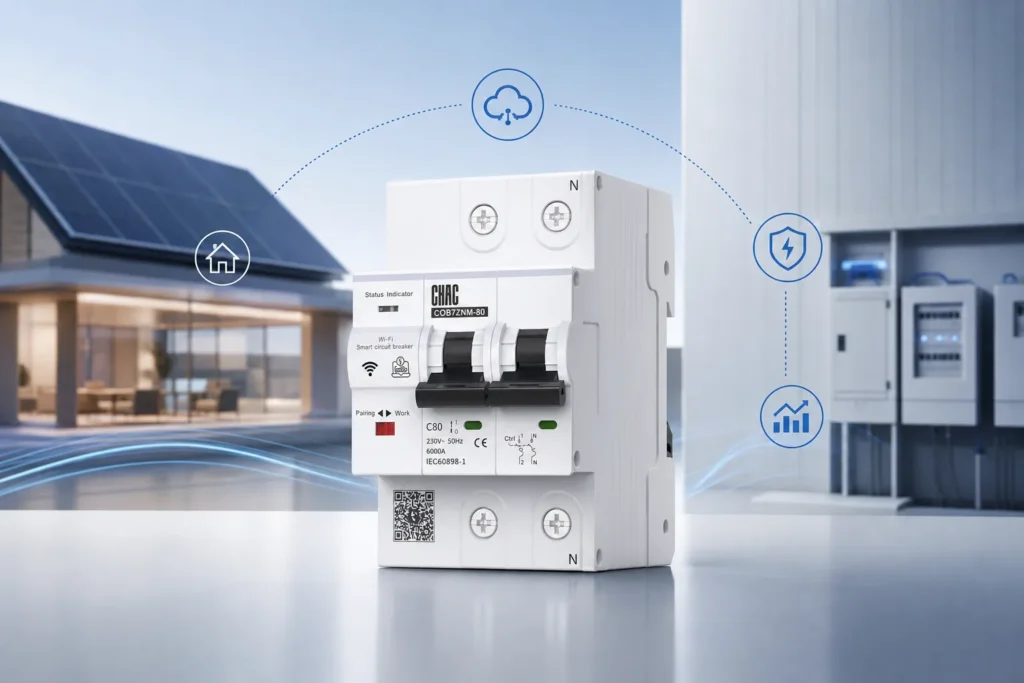
The CHAC smart circuit breakers category provides a relevant product-selection route. For a specific inquiry, use the CQB7ZM WiFi smart circuit breaker page and request documentation for the exact configuration. The linked product name is not a substitute for checking its ratings, certification scope or installation suitability.
What other questions do WiFi breaker buyers ask?
What does a WiFi breaker do?
A WiFi breaker can communicate supported status or measurements and may accept remote switching commands. The exact functions depend on the model and system configuration. WiFi connectivity alone does not establish overcurrent protection, metering accuracy or suitability for a particular panel.
Are smart circuit breakers worth it?
They can be worth considering when a defined monitoring or control task justifies the installed and ongoing costs. Compare the benefit with separate monitoring or conventional equipment, and include software support and connectivity requirements. Do not assume that adding WiFi automatically improves safety or reduces electricity bills.
What is the difference between a smart breaker and a regular breaker?
A regular breaker provides the protection and operating functions documented for that device. A smart breaker adds some combination of connected monitoring or control. The added functions do not remove the need to verify protection ratings and assembly compatibility.
Do smart breakers require professional installation?
Installation should be performed by qualified electrical personnel following the exact product instructions and applicable local requirements. Pairing an app is separate from assessing the circuit, wiring the device and verifying the panel installation. A successful connection does not prove a safe electrical installation.
What is WiFi MCB?
WiFi MCB is a marketing description generally used for a connected miniature circuit breaker. Buyers should check whether the exact device is documented as an overcurrent protective breaker rather than only a remotely controlled switch or supplementary protector. Its name does not prove a standard, certification or feature set.
Which official sources support these selection checks?
- UL Solutions: Circuit Breaker and Supplementary Protector Services – device-class and replacement-investigation boundaries; retrieved October 7, 2026.
- Schneider Electric Electrical Installation Guide: Fundamental characteristics of a circuit-breaker – ratings and suitability for isolation; updated August 5, 2026.
- UL Solutions: Panelboards Guide – assembly markings and permitted field-installed equipment; retrieved October 7, 2026.
- European Commission: CE marking – declaration responsibilities and limits of the mark; retrieved October 7, 2026.
What is the deciding principle for choosing a smart breaker?
The deciding principle is to separate electrical protection from connected convenience, then verify how the two operate together. Start with the circuit and panel, confirm the device class and ratings, and only then compare readings, commands and integration options. The most useful connected feature is one with a defined purpose and documented limitations, not simply the largest number of app screens. Before installation, settle what happens without communication, who may change settings and how maintenance isolation prevents reconnection. Do not accept an app status as proof of de-energization or a supplier logo as proof of model-level conformity. CHAC’s listed product routes can support a focused sourcing discussion; contact the supplier with the required configuration and request the documentation needed for the installer’s decision.