

Disjoncteur différentiel and RCCB selection is a protection-boundary decision. An RCBO combines residual-current and overcurrent protection in one documented device arrangement. An RCCB provides residual-current protection, while suitable overcurrent protection must be provided elsewhere. The right choice depends on how the single-line diagram divides circuits and neutral returns.
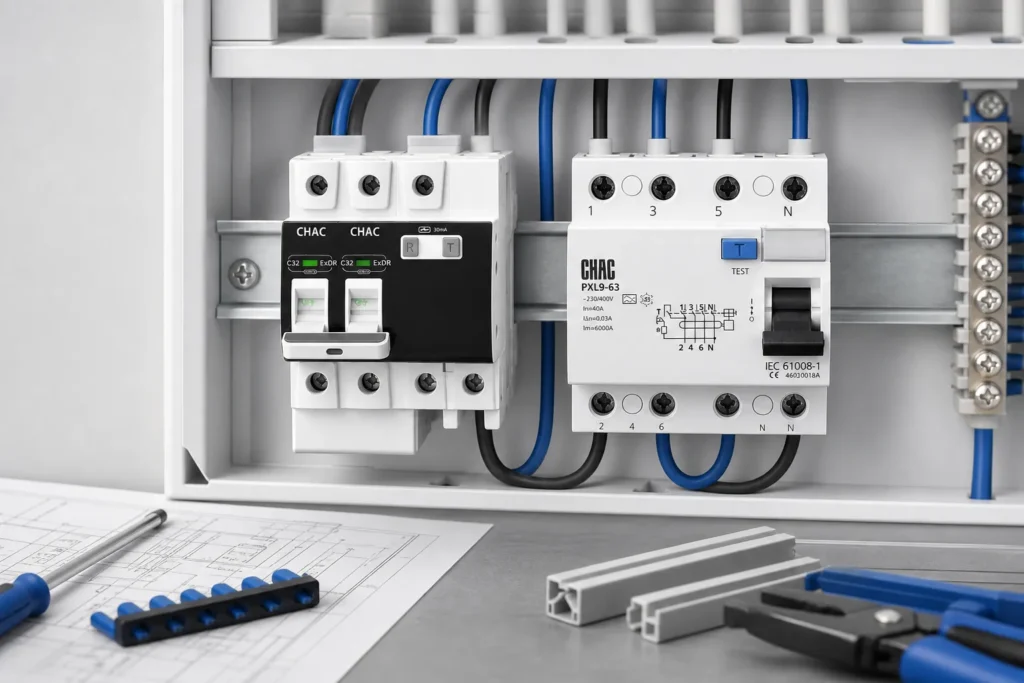
Map the two protection functions before comparing devices
Mark where overload and short-circuit protection are provided, which circuits share residual-current protection, and how each neutral returns. The RCBO product route and an RCCB route should be compared only after those functions are visible on the drawing.
What is the functional difference between an RCBO and an RCCB?
An RCBO can isolate a single outgoing circuit for both residual-current and overcurrent events when the model is designed for that duty. An RCCB can protect a group against residual current, but downstream MCBs or another verified overcurrent arrangement are still required.
Which circuit inputs expose the real duty split?
Record load type, rated current, neutral arrangement, residual-current type, prospective fault current, selectivity needs and the consequence of one device disconnecting several circuits. Electronic loads and variable-speed equipment may change the required residual-current waveform type.
How should the drawing keep the functions separate?
Show the overcurrent device, residual-current device, neutral bar and downstream circuit boundaries explicitly. Do not mix neutrals between independently protected RCBO circuits, and do not assume that an RCCB adds overcurrent protection.

When can individual RCBOs improve circuit subdivision?
Individual RCBOs may be useful when the design wants one circuit’s residual-current event to avoid interrupting unrelated circuits. A grouped RCCB-plus-MCB arrangement may still be suitable when the project accepts group interruption and the coordination is documented.
What should a comparison request contain?
List the device function, rated current, poles and neutral treatment, residual-current type and sensitivity, breaking capacity, installation format, selectivity requirements and the evidence required for the target market. Keep sensitivity selection separate from the basic RCBO-versus-RCCB boundary.
Which CHAC pages can support the shortlist?
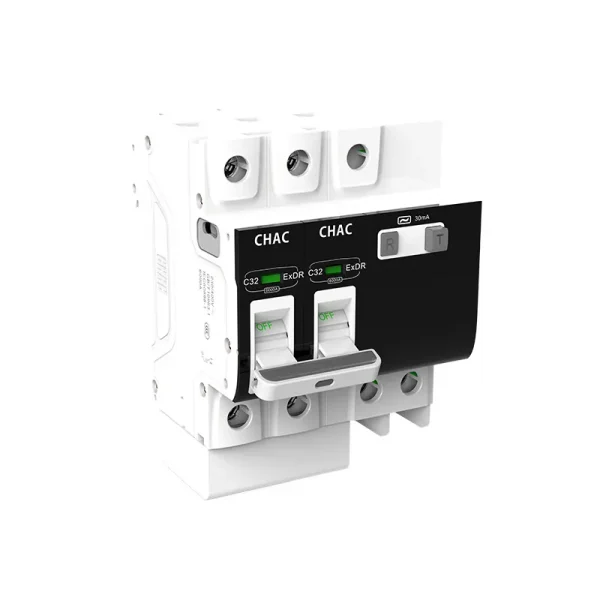
Compare the CQB3LE-63 electronic RCBO with the PXL9-63 leakage breaker only after confirming each model’s documented function and configuration.
Who owns the final protection boundary?
The responsible project designer owns the final choice. Use IEC 61008-1 et IEC 61009-1 as standards references, then verify the exact model, neutral routing, type and local installation requirements.
The schedule should name the required residual-current protection function and its neutral arrangement so that a supplier cannot replace an RCBO with an RCCB without exposing the missing overcurrent duty.
FAQ
Is an RCBO simply an RCCB with a different name?
No. An RCBO is reviewed when residual-current and overcurrent functions are intended in one documented device arrangement.
Can an RCCB replace an RCBO without redrawing the circuit?
Only if the approved design still provides the missing overcurrent duty elsewhere and the selected models support that arrangement.
What drawing fields matter most in the comparison?
Residual-current duty, overcurrent duty, pole/neutral arrangement, and shared downstream circuits.
What should suppliers confirm in writing?
Exact model identification plus the documents that support only the duties requested in the RFQ.
How does this differ from a sensitivity selection guide?
Sensitivity is a separate residual-current setting question; this article focuses on combined versus split device duties.
Who owns the final protection boundary?
The responsible project electrical designer owns it using the approved drawings and selected-model evidence.


