When Maya, an electrical contractor in Phoenix, replaced a tripping rooftop PV breaker, the new device fitted the DIN rail but the inverter still showed a DC fault during commissioning. The purchase had been based on an ampere number and a familiar AC label; the string voltage, pole arrangement and wiring instructions had not been checked together. The visible failure was a selection and system-boundary problem, not evidence that every solar protection device is unreliable.
Résumé : A solar circuit breaker must match the PV circuit’s maximum voltage, design current, prospective fault current, polarity, pole connection and isolation plan; a nominal panel wattage or AC rating cannot establish compatibility. The National Electrical Code (NEC) is applied through the edition adopted by the project authority, while IEC 61853-1 is a PV module performance-testing publication rather than a breaker approval. Record the one-line diagram and exact product instructions first, then have a qualified designer verify the installation before ordering.
PV protection is a system decision. A string, combiner, inverter DC input, battery branch and AC output can have different sources, fault paths and switching duties. A product that is appropriate at one boundary is not automatically appropriate at the next, even when the front label appears similar.
What does a solar breaker protect?
A solar breaker is an overcurrent device intended for a defined DC or AC circuit. On the PV side, it may open a string or feeder when the documented current exceeds the device’s permitted conditions; it may also provide switching or isolation only when the exact product is designed and marked for that function. It does not automatically provide surge protection, residual-current protection, arc-fault detection or safe isolation of every source.
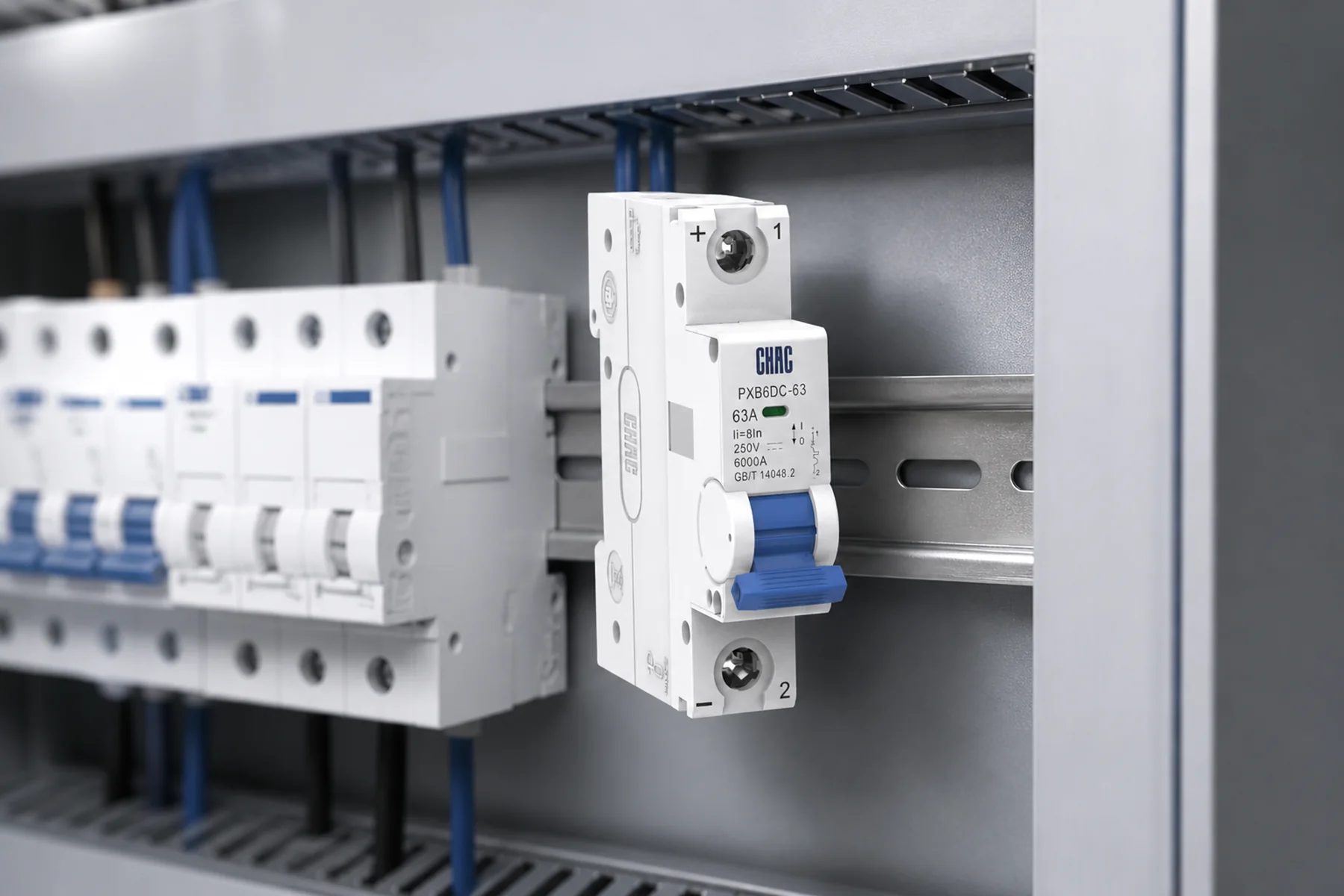
PV modules can remain energised in daylight, and a battery or inverter can feed a different part of the same installation. The open handle of one device therefore does not prove that all terminals are dead. Show each source and isolation point on the project one-line, and use the local safe-isolation procedure.
How do you check PV and DC breaker compatibility?
Start with the highest voltage that can appear across the device, not the module’s nominal operating voltage. For a series string, collect the module open-circuit voltage, temperature coefficient, series count and lowest design temperature specified by the project method. Then compare that result with the exact breaker’s published DC voltage for the permitted pole and terminal arrangement. If any input is missing, the defensible status is “selection pending,” not a guessed rating.
Current is a separate check. Record the source short-circuit or design current, parallel strings, conductor allowable current, ambient and installation conditions, and any battery or converter contribution. A solar panel breaker selected from watts divided by nominal voltage may be useful as an early estimate, but it does not establish interrupting duty, reverse-current exposure or conductor protection.
| Check | Evidence to collect | Boundary it supports |
|---|---|---|
| Maximum DC voltage | String layout, module open-circuit voltage, temperature data and design temperature | Device voltage rating and permitted pole connection |
| Continuous design current | Module or source data, parallel paths and applicable design method | Breaker rating or setting and conductor coordination |
| Prospective fault current | Fault study showing PV, battery, converter and backfeed contributions | Required interrupting capability and coordination |
| Polarity and poles | Grounding arrangement, conductors to open and exact manufacturer diagram | Terminal orientation and series-pole use, if permitted |
| Installation conditions | Enclosure, ambient, altitude, conductor limits, torque and access | Derating, fit, serviceability and inspection |
AC and DC interruption are not interchangeable assumptions. An AC nameplate is not a published DC rating, and a statement that a breaker is non-polarised does not prove that every fault direction is covered. For product screening, the MCB product category is only a starting point; request the exact model data sheet, wiring diagram and installation instructions.
Where are the wiring boundaries in a PV system?
Draw the protection boundary before choosing the device. The PV array and combiner may be exposed to string backfeed; the inverter DC terminals have their own switching and connection requirements; a battery branch can deliver fault current in a different direction; and the AC output follows another code and equipment scope. Do not merge those assumptions into one generic “solar breaker” specification.
| Boundary | Question for the designer | Typical procurement evidence |
|---|---|---|
| PV string or sub-array | What is the cold maximum voltage, source current and possible reverse current from parallel strings? | Array one-line, module data, string count and DC connection diagram |
| Combiner or DC feeder | Which strings and conductors contribute to a fault at this point? | Fault-current calculation, conductor schedule and coordination review |
| Inverter DC input | What switching, polarity and terminal conditions does the inverter manufacturer require? | Inverter manual, breaker instructions and isolation sequence |
| Battery or storage branch | Can the battery or converter feed the fault, and is the device approved for that duty? | Storage design, fault contribution and exact DC interrupting evidence |
| AC output and distribution | Which AC protective functions and local rules apply after conversion? | AC one-line, adopted code requirements and equipment ratings |
Keep DC conductors short, supported and separated as required by the installation design; observe the manufacturer’s terminal, torque, bending and enclosure limits. A wiring diagram from a similar model is not evidence for a substitute. If a device is polarity-sensitive, mark the required direction at the panel and verify it during commissioning.
Which protection option fits a new installation?
The honest answer depends on the circuit role. A string breaker, DC isolator, fuse, surge protective device and AC feeder breaker solve different problems. A new installation should map those functions separately, then select products that are documented for the same voltage, current, fault and connection conditions.
| Option | Use it to answer | Do not infer |
|---|---|---|
| DC circuit breaker | Can the device interrupt the specified overload or fault within its declared DC conditions? | That it provides surge, earth-fault or arc-fault protection |
| DC isolator/disconnector | Can qualified personnel isolate the defined circuit for service? | That it provides overcurrent interruption |
| PV fuse or string protection | Does the source and array design require a current-limiting protective element? | That a fuse can replace every required switching function |
| SPD or other supplementary protection | Is transient or fault protection required by the design and adopted rules? | That a breaker limits transient voltage |
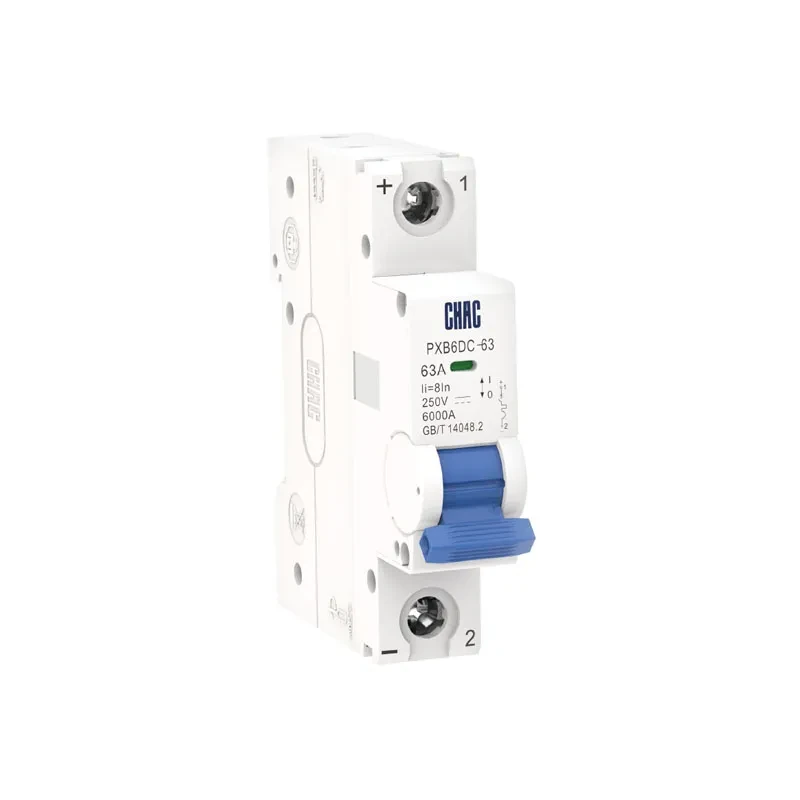
For a model-family review, CHAC’s PXB6DC-63 DC miniature circuit breaker et PXB6HDC-63 DC miniature circuit breaker pages can be included in a document request. Final suitability still depends on the exact variant, project data and destination-market requirements; this article does not assign a rating or certify an installation.
What does the 33% rule mean, and which code applies?
“The 33% rule” is not a universal solar-breaker sizing rule. The phrase is used informally in some design discussions for a calculation or code allowance, but its meaning depends on the adopted NEC edition, the exact section, the equipment arrangement and the authority having jurisdiction. Confirm the cited section and arithmetic with the responsible designer; never use the phrase to bypass a voltage, conductor or interrupting-duty check.
NFPA’s NEC resource provides the code framework, but a project must apply the edition and amendments adopted locally. The official IEC 61853-1 publication describes PV module performance testing and energy-rating methods; it does not certify a breaker, approve a wiring layout or prove compatibility with a storage circuit. Standards references are evidence of scope, not permission to infer a product rating.
Unsupported compliance claims can produce rejected submittals, inspection delays, substitutions, returns and field rework. Keep the adopted code reference, one-line diagram, data sheets, installation instructions, declarations or listings, and commissioning record together for the exact catalog number.
What mistakes should buyers avoid?
- Choosing by panel watts or an AC ampere label without checking maximum DC voltage and fault current.
- Copying a series-pole or polarity arrangement from another model’s diagram.
- Treating normal bidirectional current as proof of bidirectional fault interruption.
- Assuming a breaker also supplies isolation, surge, earth-fault or arc-fault functions.
- Accepting a substitute without repeating the same one-line, conductor, enclosure and code review.
Compare suppliers by documentation control as well as unit cost: exact part-number traceability, revision control, connection diagrams, terminal limits, environmental data and replacement support reduce total project risk. Ask the supplier to identify what is verified and what remains the installer’s responsibility.
Foire aux questions
Which breaker is best for solar?
The best breaker is the one whose published DC voltage, current, interrupting capability, polarity, pole arrangement and installation instructions match the documented circuit. There is no universal best model; PV string, inverter, battery and AC boundaries may require different products.
What is the 33% rule in solar panels?
It is an informal phrase, not a universal rating rule. Confirm the exact NEC section, edition, bus or conductor arrangement and local authority interpretation before applying any calculation; it does not replace PV voltage, current and fault checks.
Why is plug-in solar illegal?
Plug-in generation may be prohibited or restricted in a jurisdiction because backfeed, branch-circuit loading, disconnecting, grounding, labeling or rapid-shutdown requirements have not been demonstrated. Legality varies by market and installation, so obtain approval under the adopted code rather than relying on a generic kit claim.
Is there A breaker for solar panels?
Yes, DC-rated breakers and other protective devices are used in PV systems, but the correct choice depends on the string or feeder voltage, design current, fault contribution, polarity and wiring arrangement. A product described as “for solar” is not enough evidence without its exact instructions.
What is a PV breaker for solar? – Knowledge – Dabai Electric Zhejiang Dabai Electric Co. and Ltd.?
A PV breaker is a protective device specified for a defined photovoltaic circuit, normally with DC ratings and connection conditions stated by its manufacturer. The wording in this question does not establish a particular Dabai product, rating or certification; compare the exact technical document with the project one-line.
What is solar breaker used for?
It is used to interrupt or isolate a documented PV-related circuit when the device is designed and marked for that function. It does not automatically protect the inverter, battery, AC system, surge environment or every conductor in the installation.
Références
- NFPA National Electrical Code resource — code framework and adoption context for US projects.
- IEC 61853-1:2011 official publication — PV module performance testing and energy-rating scope.
- U.S. Department of Energy Solar Photovoltaic Technology Basics — public overview of PV system components and application context.
The dependable rule is simple: define the PV boundary, calculate from the real source data, and approve the exact wiring and device evidence together. If a rating, pole connection or fault direction is not documented, it is not yet a safe assumption. For model matching, wiring documentation or project-specific solar protection guidance, contact CHAC Electric with the one-line diagram, system data and destination market.