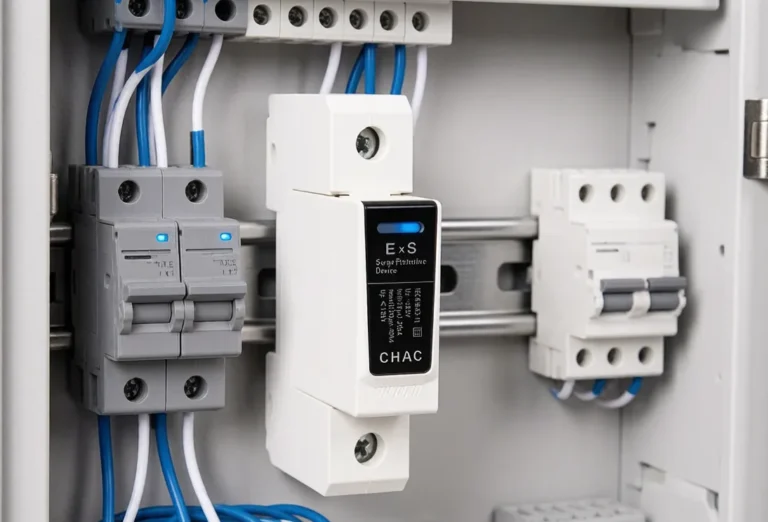
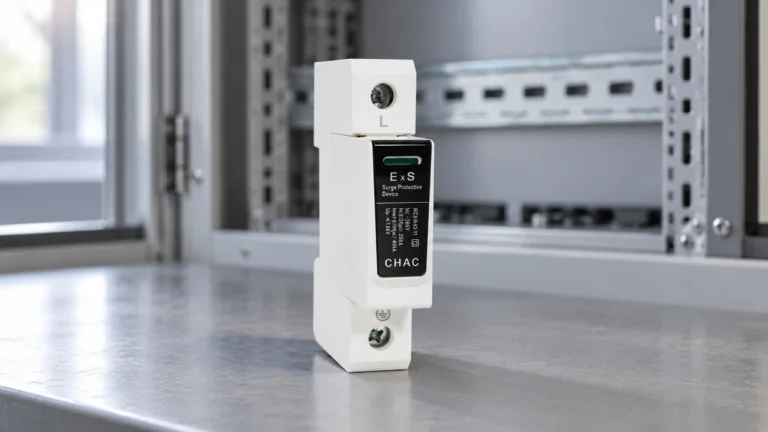
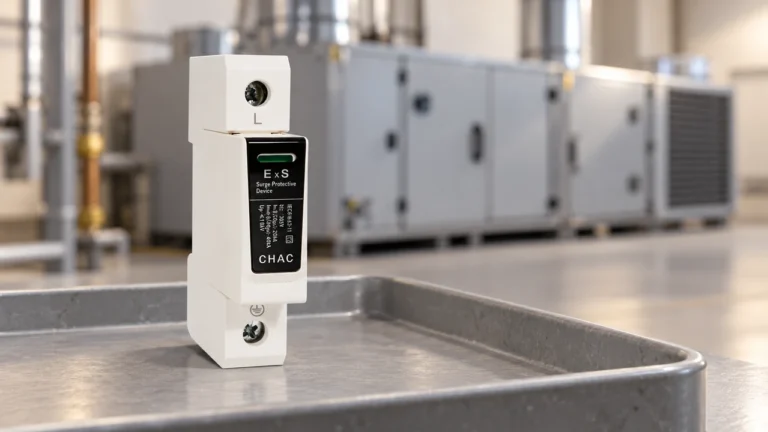
When Daniel, a panel engineer in Manchester, energised a replacement control cabinet after a storm, the PLC rebooted, a drive faulted, and the production line stopped within seconds. The cabinet had a new device labelled “surge protector,” but its continuous-voltage rating and connection arrangement did not match the supply system. The failure was a specification and coordination problem, not proof that every surge protective device is ineffective.
Ringkasan: SPD means surge protective device: equipment that limits specified transient overvoltage by diverting surge current through a designed connection path. IEC 61643-11 defines requirements and test methods for low-voltage AC SPDs; it is not a universal brand ranking or a blanket installation approval. Before purchase, document the system voltage, earthing arrangement, exposure, installation point, Uc/MCOV, In, Imax where stated, Up, backup protection, and applicable market requirements, then have the design checked by a qualified electrician or engineer.
Engineers encounter the abbreviation in single-line diagrams, panel schedules, product data sheets, and commissioning records. In each case, the device belongs to the installation as a system: its voltage, wiring, bonding, upstream protection, enclosure, and service method determine whether the intended protection can be achieved. A familiar product name cannot replace those checks.
What does SPD mean in an electrical system?
Dalam spd electrical documentation, an SPD is a surge protective device connected in parallel with the circuit it protects. During normal operation it should remain within its specified operating condition; during a transient event it provides a lower-impedance path for surge current so the voltage presented to connected equipment is limited to the declared protection level under the relevant test conditions.
An SPD is not a voltage regulator, an uninterruptible power supply, or a replacement for a circuit breaker, fuse, grounding, bonding, or residual-current protection. It also cannot promise that every connected component will survive every lightning or switching event. The result depends on the transient waveform, source impedance, conductor length, bonding arrangement, equipment withstand, and whether protection is coordinated across power and signal paths.
Lightning and surge protection therefore starts with the complete current path. A service or distribution SPD may reduce the incoming exposure, while a coordinated downstream device can address residual transients near a sensitive control cabinet. This is an engineering arrangement, not a reason to add devices without a documented one-line diagram.
Which SPD ratings should engineers compare?
Do not select an SPD from one headline current value. Compare the complete data sheet for the exact variant and connection configuration. The terms below describe different questions and should be read together.
| Rating or field | Apa yang digambarkan olehnya | Mengapa hal ini penting |
|---|---|---|
| Uc or MCOV | Maximum continuous operating voltage, using the terminology stated by the manufacturer | It must suit the normal system and relevant temporary overvoltage conditions. |
| Dalam | Nominal discharge current under the product standard’s declared test conditions | It supports a like-for-like comparison only when the test scope and waveform are also understood. |
| Imax, where stated | Maximum discharge-current test value declared for the product | A larger number does not automatically mean lower residual voltage or better system coordination. |
| Ke atas | Declared voltage protection level under specified test conditions | It should be considered against the withstand capability of downstream equipment. |
| Configuration and modes | Pole arrangement, line-to-line or line-to-earth modes, and system topology | The device must match the supply and earthing arrangement rather than only the nominal voltage. |
| Backup and service data | Specified backup fuse or breaker, status indication, remote contact, enclosure, and replacement method | These fields affect installation, fault isolation, inspection, and total ownership cost. |
For a practical define spd review, request the wiring diagram, installation instructions, test-standard reference, and market-specific conformity evidence for the exact part number. A family brochure may combine variants with different Uc, pole, contact, or enclosure options. Treat missing fields as a procurement question, not as permission to infer suitability.
Where should a surge protective device be installed?
The correct location is the point selected by the electrical design to limit transient voltage on the conductors feeding the protected equipment while keeping the device accessible for inspection. Depending on the installation, that may be at service equipment, a main or sub-distribution panel, a branch panel, or near a sensitive load. The product wiring diagram, adopted code, working-clearance rules, and local authority requirements control the final arrangement.
Keep SPD conductors short and direct within the manufacturer’s stated limits; fast impulses create additional voltage across inductive lead length. Verify protective-earth and bonding paths, terminal torque, conductor size, enclosure environment, and the upstream overcurrent or backup device. If power, control, data, photovoltaic DC, or battery circuits follow different routes, assess each circuit with a product intended for its voltage and connection conditions.
The following sequence helps panel builders and procurement teams coordinate the decision:
- Record nominal voltage, phase, frequency, earthing system, available fault conditions, and destination market.
- Map the service, feeder, panel, branch circuit, equipment, and any separate control or signal wiring.
- Identify lightning, long-cable, outdoor, motor-switching, and variable-speed-drive exposure without assuming a universal severity rating.
- Select a product whose Uc/MCOV, configuration, Up, discharge-current data, backup protection, and enclosure suit the documented point.
- Commission the installation: verify connections, torque, labels, status indication, inspection access, and the records needed for future replacement.
How do the main protection options differ?
Type terminology is meaningful only within the applicable product and installation standard. It should not be presented as a simple quality ranking. A staged design may use more than one location when the building, feeder length, exposure, and equipment sensitivity justify coordination.
| Approach | Typical design question | Trade-off to document |
|---|---|---|
| Upstream or service-level SPD | Where does surge energy enter the low-voltage installation? | It can address incoming exposure, but it does not automatically protect every downstream cable or control circuit. |
| Distribution-panel SPD | Which feeder or sub-panel supplies the equipment? | It is accessible for service, yet lead length and coordination still influence the voltage seen by loads. |
| Branch or point-of-use SPD | Is a sensitive load exposed to residual transients after upstream protection? | It must be intended for the connection point and cannot compensate for poor bonding or wrong system voltage. |
| Coordinated stages | Do long feeders, mixed indoor/outdoor paths, or critical controls require a system approach? | More devices add cost and documentation work; they should be selected as a coordinated design, not as unrelated additions. |
Selection by project condition and total cost
The unit price is only one part of the decision. Rework, panel modifications, inspection delays, spare-module logistics, downtime, and an inaccessible replacement point can dominate total cost. Label hypothetical cost calculations as illustrative and compare the same assumptions across candidates.
| Project condition | Soalan yang perlu dijawab | Procurement implication |
|---|---|---|
| Critical automation or process load | What equipment downtime or restart procedure follows a transient event? | Document coordination, status indication, spares, and inspection intervals rather than relying on a generic warranty statement. |
| Long feeder or exposed route | Where are the service, distribution, branch, and equipment boundaries? | Review staged protection and conductor routing with the engineer; one device may not cover every path. |
| Outdoor or harsh enclosure | What ingress, temperature, corrosion, and access conditions apply? | Confirm the enclosure and installation instructions for the exact model. |
| OEM or distributor programme | Can the supplier keep variants, drawings, and revisions controlled across markets? | Request traceable part numbers, change notification, controlled data sheets, and a replacement plan. |
Standards, testing, and compliance boundaries
IEC 61643-11 is the supplied IEC publication for low-voltage surge protective devices connected to low-voltage power systems; it establishes product requirements and test methods within its stated scope. A reference to the standard does not, by itself, prove that a particular model is certified for every country, installation, or configuration.
UL’s surge protective device service information explains the role of evaluation services in the UL framework. For a North American project, confirm the exact listing or evaluation, adopted electrical-code edition, and authority requirements for the model and installation. For another destination, map the product evidence to that market’s rules rather than copying a claim from a different jurisdiction.
Commercial consequences of unsupported claims include rejected submittals, delayed commissioning, returns, warranty disputes, and field rework. Keep the data sheet, wiring diagram, installation instructions, applicable declaration or listing, single-line diagram, and commissioning record together; the documentation is part of the protection decision.
What should buyers verify before ordering?
- Define the installation: provide the one-line diagram, system voltage, phase, earthing arrangement, fault conditions, and connection point.
- Compare complete ratings: check Uc/MCOV, In, Imax where stated, Up, modes, poles, enclosure, and backup protection for the exact variant.
- Ask for test scope: distinguish the product standard and test method from a market-specific certification or installation approval.
- Review the physical fit: verify conductor routing, lead length, torque, panel space, environmental conditions, status indication, and safe access.
- Plan service: specify how an end-of-life indication is recorded, isolated, replaced, and stocked across the installed base.
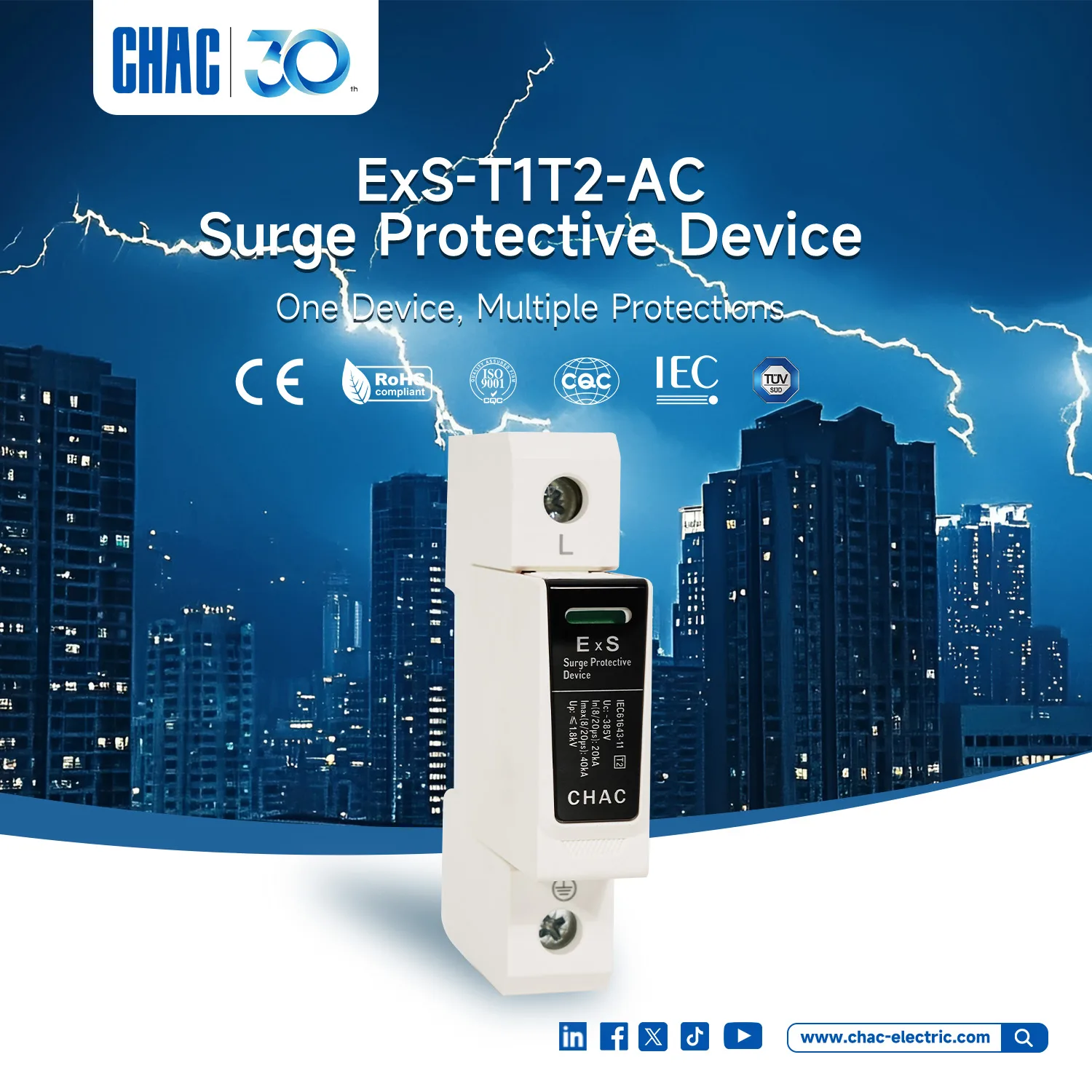
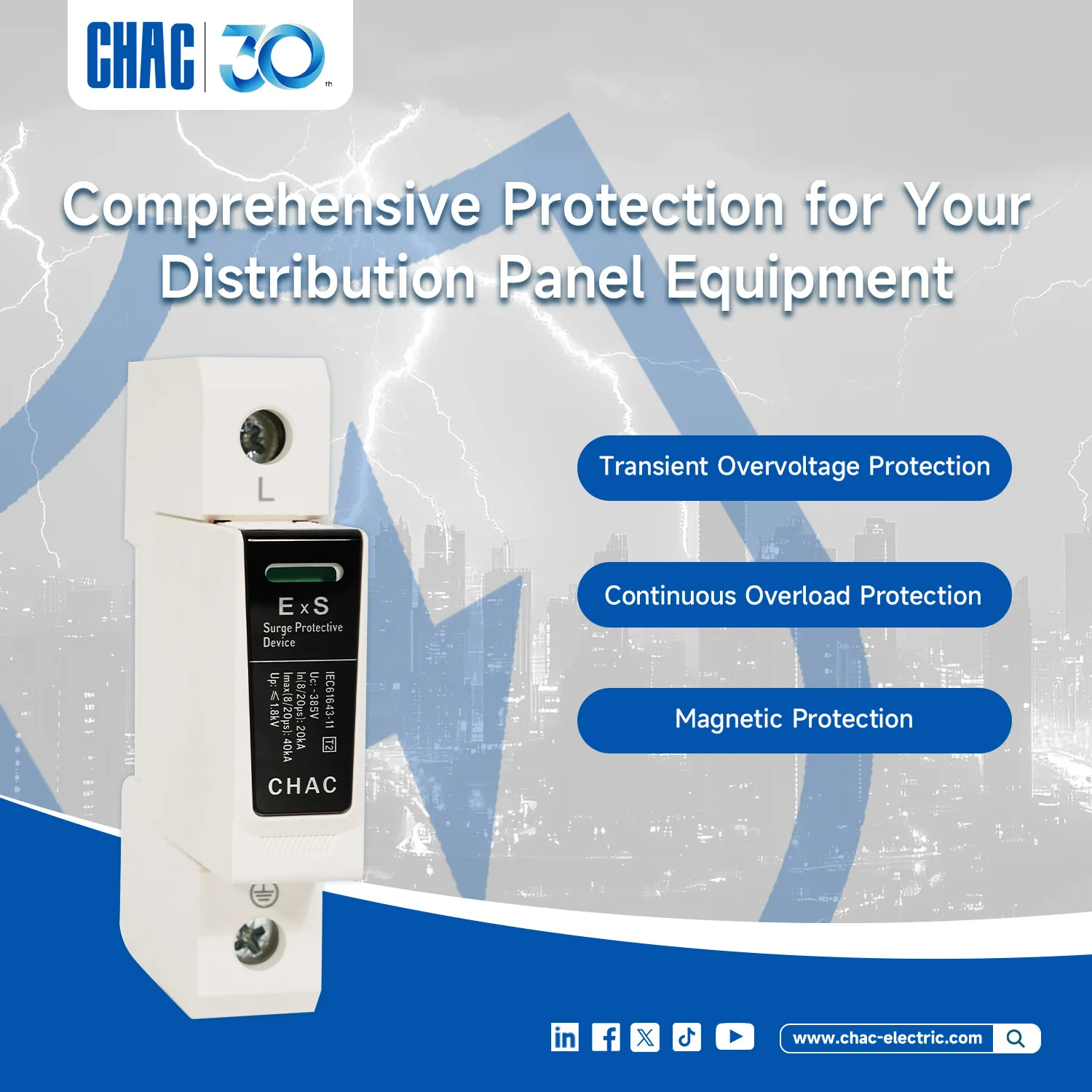
CHAC Electric supports OEM, panel-builder, and distributor reviews of low-voltage protection equipment. Start with the SPD product range and compare the project data with model-specific documentation. The CHAC EXS T1/T2 AC SPD can be reviewed as one product reference; final suitability still depends on the supply, installation, and destination-market requirements.
Pertanyaan yang sering diajukan
What does SPD stand for?
SPD stands for surge protective device. It is connected to a power circuit to limit specified transient overvoltage by diverting surge current through its designed path. It does not replace overcurrent protection, grounding, bonding, or normal-voltage regulation.
What is the difference between the protection options?
Protection options differ by connection point, circuit type, system configuration, and the transient exposure they are intended to address. An upstream device, a distribution-panel device, and a point-of-use device should be compared by their declared ratings, wiring instructions, and coordination requirements rather than by a simple type number or brand ranking.
Where should the device be installed?
Install the SPD at the code-permitted, accessible point selected by the electrical design to limit transient voltage on the intended conductors. Service, distribution, branch, and point-of-use locations are possible; the manufacturer’s wiring diagram, lead-length guidance, bonding path, working clearance, and local rules determine the final position.
What rating should I look for when buying one?
Begin with system compatibility: nominal voltage, earthing arrangement, phase, pole configuration, and Uc or MCOV. Then compare In, Imax where stated, Up, protection modes, backup-device requirements, enclosure, status indication, and the standard or evaluation evidence for the exact model. A single high current number is not enough to establish suitability.
What is define SPD and what does it protect?
To define SPD is to identify a surge protective device and its role in limiting transient overvoltage on a specified circuit. It can reduce stress on connected power equipment when correctly selected and installed, but it does not guarantee survival of every component or protect separate signal, data, DC, or control paths unless those paths have suitable protection.
Why does a surge protector keep tripping?
An SPD may disconnect or show an end-of-life condition after a surge, while repeated operation can also indicate wrong voltage selection, a wiring fault, excessive exposure, or an upstream protection issue. Do not bypass or repeatedly reset the device; isolate the circuit safely and have a qualified person check the status indicator, connections, system voltage, backup protection, and replacement procedure.
Referensi
- IEC 61643-11 official publication — requirements and test methods for low-voltage surge protective devices within the stated scope.
- UL Surge Protective Devices services — official information on UL evaluation services and SPD evidence.
- NFPA National Electrical Code information — code framework and adoption context; apply the edition and amendments adopted for the project.
The reliable answer to “what does SPD mean?” is not just an acronym: it is a documented relationship between a transient source, a circuit, a device, and the equipment that must remain in service. Define the system first, compare the complete ratings second, and verify installation and evidence before energisation. For model selection, wiring documentation, or project-specific sourcing support, contact CHAC application support with the one-line diagram, supply details, and destination market.