Sebuah kompor baru mungkin pas dengan bukaan dapur dan tetap tidak sesuai dengan rangkaian listrik yang ada. Sebuah mesin cuci mungkin dapat dicolokkan ke stopkontak yang tersedia, padahal petunjuk penggunaannya mengharuskan adanya sirkuit cabang khusus. Dalam kedua kasus tersebut, memilih pemutus arus hanya berdasarkan merek peralatan saja akan mengabaikan kondisi-kondisi yang menentukan instalasi. Pemutus arus yang lebih besar bukanlah solusi sederhana untuk mengatasi pemutusan arus, dan kabel yang sudah ada tidak serta-merta menjadi sesuai hanya karena peralatan penggantinya lebih baru. Panduan ini menjelaskan cara membaca persyaratan peralatan, mengevaluasi batasan konduktor, serta membedakan antara instalasi mesin cuci biasa dengan instalasi gabungan mesin cuci dan pengering listrik.
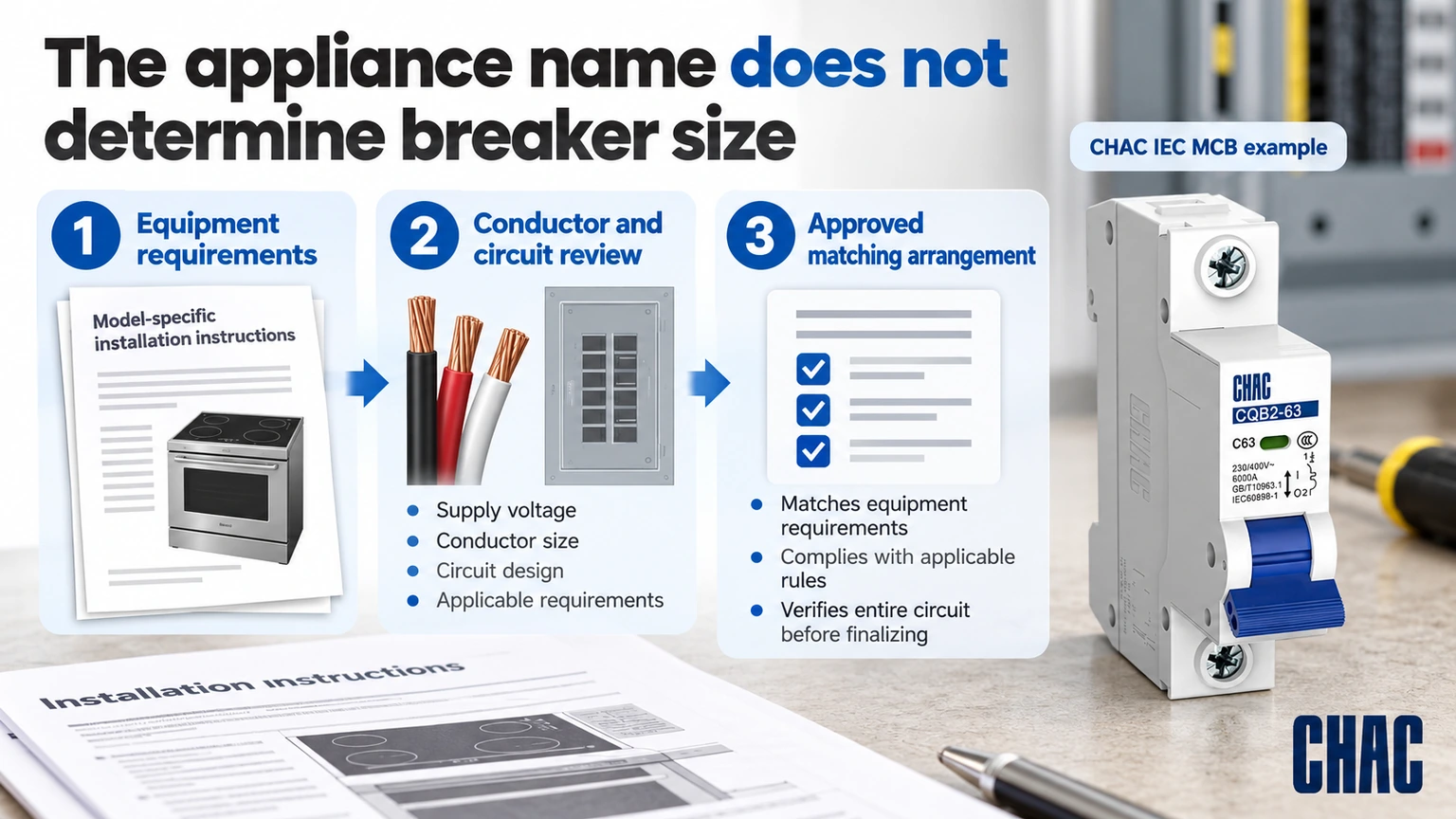
Yang benar ukuran pemutus sirkuit kompor listrik berasal dari instruksi pemasangan peralatan tertentu dan desain sirkuit yang berlaku. Tidak ada jawaban universal 40 A atau 50 A untuk setiap kompor atau cooktop. Untuk banyak mesin cuci GE AS yang terpisah, panduan umum pabrikan menetapkan sirkuit individual 120 V, 60 Hz yang dilindungi pada 15 A atau 20 A, sementara panduan untuk mesin cuci unit dengan pengering listrik menyarankan pengaturan 208/240 V, 30 A yang berbeda. Contoh-contoh ini tidak dapat dipertukarkan. Pastikan model, suplai, proteksi yang diizinkan, dan pemasangan konduktor sebelum memilih pemutus arus yang kompatibel dengan panel.
Apakah kompor listrik harus menggunakan pemutus arus 40 A atau 50 A?
Baca terlebih dahulu instruksi model yang tepat. Persyaratan untuk kompor, kompor atas, dan oven dinding berbeda-beda, bahkan dalam satu merek sekalipun. GE’s Panduan amperase monogram, diperiksa pada 19, 2026, mencantumkan 40 A untuk kompor induksi 30-inch dan 50 A untuk kompor induksi 36-inch, sambil secara eksplisit mengarahkan pembaca kepada instruksi pemasangan yang spesifik untuk setiap model. Ini adalah contoh dari persyaratan yang berbeda, bukan aturan bahwa hanya lebar saja yang menentukan rangkaian listrik.
Tegangan suplai, informasi pada papan nama, dan ketentuan beban peralatan memasak yang berlaku harus dipertimbangkan oleh perancang. Membagi daya nominal dengan tegangan dapat membantu menjelaskan arus beban, tetapi hal ini tidak menggantikan perhitungan rangkaian cabang yang diizinkan atau persyaratan arus lebih maksimum peralatan. Jangan meningkatkan proteksi dari 40 A menjadi 50 A tanpa memverifikasi keseluruhan rangkaian.
| Konteks peralatan | Manufacturer example | What still needs confirmation |
|---|---|---|
| 30-inch Monogram induction cooktop | 40 A in general brand guidance | Actual model instructions and circuit design |
| 36-inch Monogram induction cooktop | 50 A in general brand guidance | Actual model, conductors and connection |
| Separate GE washer | 120 V, 15 A or 20 A individual circuit | Specific washer and adopted laundry-circuit rules |
| GE unitized washer with electric dryer | 208/240 V, 30 A individual circuit | Exact combined-appliance instructions |
Why is a washer different from a washer-and-dryer combination?
Itu washing machine circuit breaker size must match what is actually being supplied. A separate washer and a unitized appliance with an electric dryer have different electrical requirements. A heat-pump combination appliance may differ again; its own instructions control. Do not apply an electric-dryer circuit specification to every product that washes clothes.
GE’s washer electrical-requirements guidance distinguishes these categories and calls for an individual, properly grounded branch circuit. The fact that its general washer guidance allows 15 A or 20 A protection does not establish every local laundry installation requirement. The adopted code, receptacle arrangement and model instructions must be reviewed together.
What should be compared when a replacement appliance uses the existing circuit?
Place the old and new installation requirements beside the verified circuit record. Compare supply voltage and frequency, required circuit arrangement, permitted overcurrent protection, conductor and termination requirements, connection method and any specified protective functions. A matching plug or a similar appliance width does not complete that comparison. Record the new appliance’s exact model and manual revision so the decision can be checked later.
Do not combine a cooker and a separate washer into one sizing exercise merely by adding their nameplate watts. Their instructions and the adopted rules may require individual circuits, and a unitized washer/dryer is a different appliance again. GE’s cited guidance specifically distinguishes washer categories. If the existing circuit cannot be identified well enough to complete the comparison, have it assessed before selecting a replacement breaker rather than treating the old installation as its own approval.
Can 8/3 copper cable serve the proposed stove circuit?
The cable description is only the starting point. Verify conductor material, insulation or cable type, terminal temperature limits, installation conditions and the appliance’s neutral and grounding requirements. Copper and aluminum of the same gauge do not automatically have the same allowable ampacity, and every terminal must be suitable for the conductor used.
Itu Cerrowire ampacity chart lists 8 AWG copper at 40 A in the 60°C column and 50 A in the 75°C column. Its stated basis is the 2017 NEC and it excludes required correction and adjustment factors. This illustrates why selecting the higher column simply because it matches the desired breaker is wrong. The applicable cable and termination rules determine which limits can actually be used.
| Conductor question | Mengapa hal itu memengaruhi seleksi | Evidence to use |
|---|---|---|
| Tembaga atau aluminium? | Ampacity and terminal suitability differ | Cable marking and device instructions |
| Which temperature limit applies? | The highest chart column may not be permitted | Wiring method and termination requirements |
| Are corrections or adjustments needed? | Heat and grouping can reduce allowable current | Actual installation and adopted code |
| How long is the run? | Voltage drop needs a separate check | Load, voltage, length and conductor data |
| Which conductors does the appliance need? | Neutral and grounding functions are distinct | Exact appliance connection instructions |
Does a longer cable run require a larger breaker?
No. A voltage-drop concern may require a different conductor design, but it is not a reason to raise the breaker rating. Calculate voltage drop from the actual current, supply voltage, run length and conductor characteristics. Then confirm that the resulting conductor arrangement still fits the terminals and permitted wiring method.
Undersized conductors or unsuitable terminations can overheat. If an existing circuit trips with the new appliance, distinguish overload, a connection problem and any separate protective function before changing components. The investigation should explain the trip rather than remove the protection that reported it.
Why does a low current reading during one cycle not approve a smaller circuit?
An operating snapshot describes one appliance state. A cooking element may be cycling off, or a washer may be in a stage that does not represent its highest intended load. A reading below the specified circuit rating therefore does not override the model instructions or establish the demand used for design. Record the operating stage with any measurements taken by qualified personnel.
The same distinction matters during a trip investigation. Note whether the overcurrent, ground-fault or arc-fault function reported the event, where the appliance was in its cycle and whether other loads were operating. Preserve that information before changing parts. A low steady current does not rule out every fault, starting event or connection problem, while a brief high reading does not by itself authorize a larger breaker. The remedy should follow the diagnosed condition and approved circuit requirements.
What changes when the appliance uses inverter electronics?
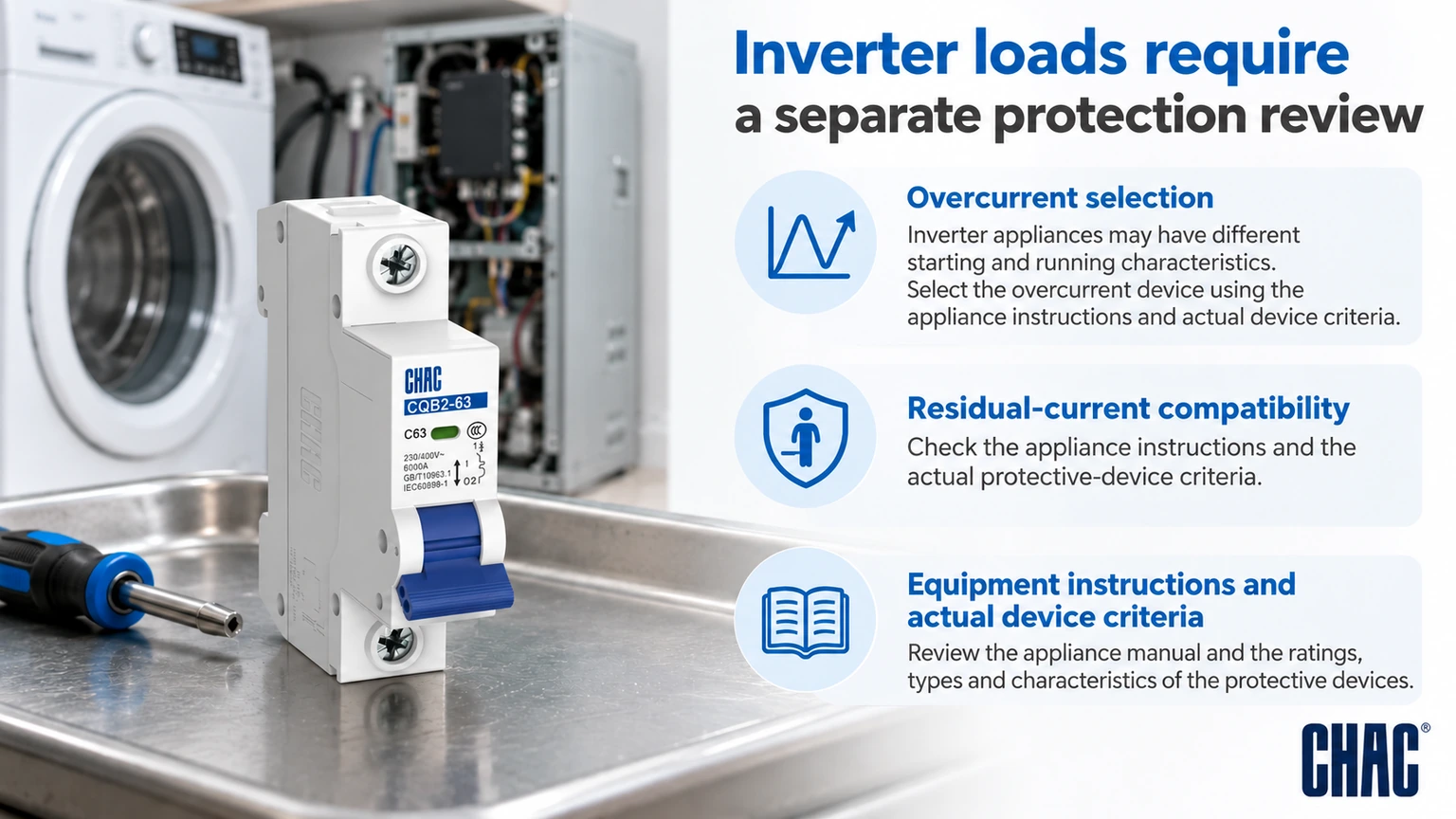
Ground-fault and arc-fault requirements need separate attention from ampere sizing. UL’s high-frequency GFCI guidance describes the optional HF rating introduced through the August 2025 UL 943 revision for evaluation involving high-frequency leakage. It is relevant to modern inverter loads, but it does not mean every GFCI has that rating or that every appliance-related trip is harmless.
Check required GFCI and AFCI functions against the adopted local rules, including any current code adoption and amendments. Where compatibility needs investigation, use the actual appliance and protective-device instructions. Do not bypass required protection or substitute a different residual-current threshold to keep the appliance running.
How should buyers specify the breaker and protection functions?
Write the appliance model, supply, circuit requirement, conductor design and panel compatibility into the specification. A branch-circuit breaker also needs the required interrupting capacity and permitted pole arrangement. Mechanical fit is not proof that a breaker is approved for a particular panel.
For IEC distribution projects, CHAC publishes the Pemutus sirkuit mini CQB2-63 dan PXB6L-63 RCBO as distinct protection options. Those product records do not establish US panel compatibility or UL Class A GFCI approval. For the underlying conductor checks, the circuit breaker size and rating guide explains why load, wire and protection must be reviewed together.
What do homeowners ask about stove circuit sizing?
Should I use a 40 or 50 amp breaker for my electric range?
Use the exact range installation instructions and the applicable circuit calculation. Confirm conductor ampacity, terminations, supply and panel compatibility before choosing either rating.
Can you run a 40 amp cooktop on a 30 amp breaker?
Do not assume a circuit specified at 40 A can be reduced to 30 A. Use the model instructions and an approved circuit design; otherwise the installation may be unsuitable and may trip during operation.
Are stoves 30 amp or 50 amp?
Different ranges, cooktops and ovens have different requirements. The product name does not determine the circuit; check the specific model and supply.
Can I use 8/3 wire for my electric stove?
Possibly, but the answer depends on conductor material, cable type, temperature limitations, installation conditions and the appliance requirement. The cable description alone is insufficient.
What wire size is normally used for electric stove circuit breaker size?
Choose conductor size from the required circuit and applicable ampacity rules, including corrections, adjustments and terminal limits. A generic stove wire size should not replace that evaluation.
How does copper compare with aluminum for electric stove circuit breaker size?
They can have different ampacities at the same gauge and require suitable terminals and installation methods. Verify the actual cable and device instructions rather than substituting gauge for gauge.
Referensi
- GE Appliances: Washer electrical requirements and breaker size; accessed October 19, 2026
- GE Appliances: Monogram appliance amperage guidance; accessed October 19, 2026
- Cerrowire ampacity chart, stated 2017 NEC basis; accessed October 19, 2026
- UL Solutions: High-Frequency Ground-Fault Circuit Interrupters; accessed October 19, 2026
Kesimpulan
The right appliance circuit begins with the model instructions, not a familiar breaker number. Separate a range from a cooktop, and a stand-alone washer from a combined washer-and-electric-dryer unit. Then verify supply, conductor ampacity, terminal limits, voltage drop and the required protection functions before selecting the device. A larger breaker does not repair an undersized cable or explain a ground-fault trip. Current local installation requirements and panel approval remain essential even when the ampere rating appears to match. CHAC provides model-specific miniature-breaker and RCBO information for relevant IEC distribution projects. Comparing those records with the actual destination requirements helps buyers specify the intended function without implying an approval or panel compatibility that has not been established.