Ketika seorang manajer proyek di Rotterdam mengikuti panduan pemasangan kabel dan menerima penawaran biaya rendah untuk panel kontrol baru, daftar periksa commissioning tampak lengkap. Namun, dalam waktu dua jam, gangguan-gangguan tak terduga menghentikan sebuah konveyor, loop sensor menunjukkan pembacaan yang tidak stabil, dan panel tersebut gagal dalam uji isolasi. Perangkat-perangkat tersebut tidak “buruk”; pemilihannya mencampurkan fungsi sinyal, switching, dan proteksi dengan asumsi rangkaian yang salah. Karena itulah, pertanyaan praktisnya bukan hanya tentang apa itu suatu perangkat elektronik, tetapi bagaimana perangkat dan rangkaian elektronik harus didiagnosis sebagai satu sistem yang terkoordinasi.
Ringkasan: Mulailah proses pemecahan masalah dengan memisahkan jalur daya, kontrol, dan sinyal; verifikasi tegangan, arus, polaritas, pembumian, serta jenis beban; kemudian uji perangkat proteksi sesuai dengan persyaratan IEC yang berlaku. Urutan pengukuran selama lima menit dapat mencegah keharusan melakukan pemasangan kabel ulang selama berjam-jam, sementara koordinasi yang tepat antara MCB, RCCB/RCBO, SPD, dan komponen kontrol akan mengurangi waktu henti serta risiko ketidakpatuhan.
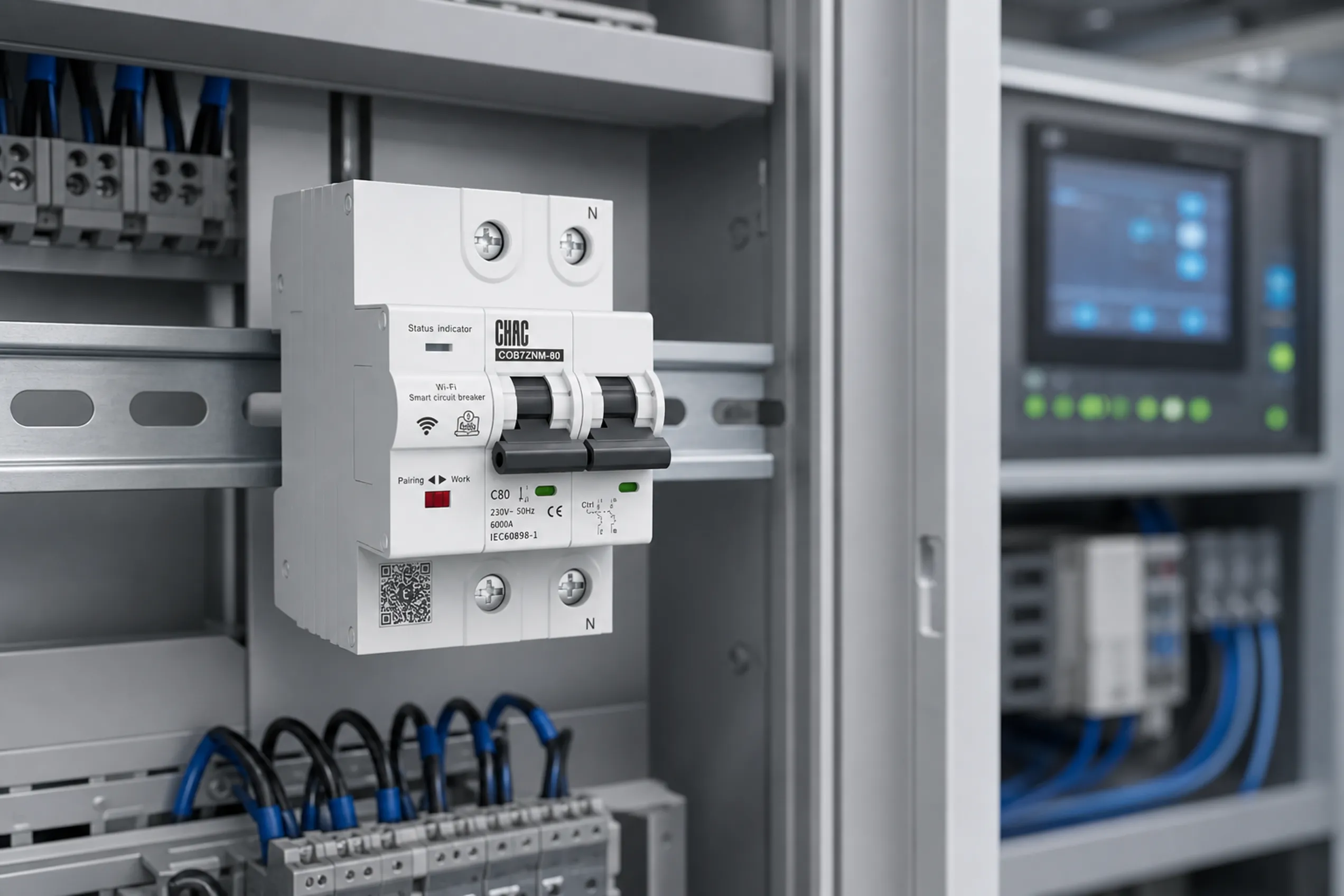
Tampilan aplikasi: pemutus sirkuit pintar yang terintegrasi ke dalam kabinet kontrol rel DIN.
Apa yang Dimaksud dengan Perangkat Elektronik, dan Apa yang Dimaksud dengan Rangkaian Elektronik?
Perangkat elektronik adalah komponen yang mengendalikan, mengonversi, mendeteksi, atau melindungi energi listrik; sirkuit elektronik adalah jalur penghubung yang membuat fungsi-fungsi tersebut bekerja secara bersamaan. Dalam sebuah panel, batas yang relevan bersifat fungsional dan bukan akademis, serta memberikan pandangan yang jelas tentang sirkuit elektronik membantu memisahkan jalur daya dari jalur sinyal:
Jalur daya: sumber, isolasi, perlindungan arus lebih, dan beban akhir.
Jalur kontrol: kontaktor, relay, perlindungan motor, timer, dan I/O PLC.
Rangkaian sinyal: sensor, indikator, antarmuka komunikasi, dan umpan balik tingkat rendah.
Perbedaan ini menjelaskan banyak kegagalan yang tampaknya misterius. Sensor VDC 24 dapat berfungsi dengan baik sementara referensi tegangan bersama 0 bising; kontaktor dapat menyala sementara MCB di hulu berukuran terlalu kecil; dan SPD dapat melindungi panel sementara jalur pentanahan yang buruk tetap memungkinkan tegangan sisa yang merusak.
Berapa Banyak Jenis Perangkat Elektronik yang Terdapat dalam Panel Kontrol pada Umumnya?
Untuk pemecahan masalah di lapangan, empat kelompok mencakup sebagian besar perakitan industri dan komersial. Kategori-kategori tersebut saling tumpang tindih, tetapi masing-masing mengacu pada metode pengukuran yang berbeda.
Perangkat pasif: resistor, kapasitor, induktor, terminal, dan filter. Periksa nilai komponen, polaritas jika berlaku, pemanasan, serta sambungan mekanis.
Perangkat aktif: dioda, transistor, IC, sensor, dan pengendali. Periksa tegangan bias, tegangan referensi, status peralihan, serta batas input/output.
Perangkat saklar dan kontrol: MCB, kontaktor, relay, dan perangkat proteksi motor. Periksa kurva trip, tegangan koil, rating kontak, serta koordinasi.
Perangkat proteksi: RCCB/RCBO dan SPD. Periksa sensitivitas arus sisa, kapasitas pemutusan hubung singkat, jalur kebocoran, kelas penjepitan, serta standar pemasangan.
Dalam praktiknya, elektronik dan perangkat Kegagalan dapat berupa rangkaian: suatu kejadian tegangan lebih dapat merusak sebuah pengendali, tetapi gejala yang tampak bisa berupa sebuah relai yang tidak lagi teraliri arus. Catatlah pengukuran abnormal yang pertama kali terjadi, bukan hanya komponen terakhir yang berhenti berfungsi. Prinsip yang sama berlaku setiap kali perangkat elektronik berbagi referensi kontrol.
Apa Tiga Cara Tercepat untuk Mengecek Rangkaian Elektronik?
1. Konfirmasikan titik referensi
Ukur tegangan antara garis dan netral, antara garis dan tanah, serta control-voltage-to-0 V; ketiga pembacaan tersebut harus sesuai dengan tujuan desain. Untuk rangkaian 230 VAC, praktik IEC 60364 mensyaratkan agar tindakan perlindungan diverifikasi pada tingkat instalasi, bukan disimpulkan dari papan nama.
2. Pisahkan kesalahan suplai dari kesalahan beban
Buka sambungan beban dan lakukan pengujian ulang. Jika perangkat proteksi tetap aktif saat beban terputus, periksa arus susulan, isolasi, arus mulai motor, atau kemungkinan koneksi yang terbalik. Jika perangkat tersebut tetap trip, maka gangguan berada di bagian hulu atau terkait dengan pemilihan perangkat proteksi yang digunakan.
3. Check the device against its ratings
Compare rated current, breaking capacity, trip curve, frequency, temperature derating, and terminal torque. A 6 kA device is not interchangeable with a 10 kA device simply because both are marked “C16.”
Electronic Devices vs. Electronic Circuits: Which Value Should Be Compared?
Procurement teams often compare a single device price; engineering teams should compare the installed result. The table below keeps the decision focused on performance and total cost of ownership.
Dimensi keputusan
Single-device view
Whole-circuit view
Recommended check
Lindungian
Rated current and poles
Coordination with cable and load
IEC 60898-1 / IEC 61009-1
Reliability
Bench test result
Heat, vibration, inrush, and duty cycle
Record operating temperature and switching cycles
Kesesuaian
Terminal fit
System voltage, neutral arrangement, accessories
Confirm wiring diagram and interface class
TCO
Purchase price
Downtime, replacement, labor, and spares
Use a five-year cost estimate
The honest answer is that the lower purchase price wins only when the device remains stable under the real duty cycle. For high-utilization panels, preventing one unplanned stop can outweigh a modest component premium; the total result depends on how electronics and devices perform together.
Where Do Electronic Devices Appear in Electrical Protection?
Aplikasi
Typical devices
Primary risk
Useful design action
Residential and light commercial
MCB, RCCB, RCBO, indicator
Shock, overload, nuisance tripping
Match sensitivity and circuit grouping
Automation panel
MCB, contactor, thermal relay, PLC I/O
Inrush, heat, control-voltage loss
Separate power and signal references
Outdoor or renewable system
DC breaker, isolator, SPD
Transient overvoltage and polarity error
Verify DC rating and earthing path
Motor-driven equipment
Contactor, overload relay, motor protector
Locked rotor and phase imbalance
Set protection from motor nameplate data
Which Standards Apply to Electronic Devices and Electronic Circuitry?
Compliance is a design input, not a final sticker. The following references are commonly relevant to low-voltage assemblies:
IEC 60364-4-41 — protection against electric shock in low-voltage installations.
IEC 60898-1 — circuit-breakers for overcurrent protection in household and similar installations.
IEC 61009-1 — residual current operated circuit-breakers with overcurrent protection.
IEC 61643-11 — surge protective devices connected to low-voltage power systems.
Ignoring the applicable standard can lead to failed type tests, rejected site inspections, warranty disputes, and expensive rework. CE or CB evidence is valuable only when the selected product, circuit arrangement, and installation method remain within the certified scope.
How Should a Buyer Select Electronic Devices?
Write the electrical baseline first: system voltage, frequency, prospective short-circuit current, load type, ambient temperature, and enclosure class.
Specify the failure action: trip, alarm, controlled shutdown, or continued operation with redundancy.
Reserve at least 20% panel space and spare terminals for expansion; crowded wiring hides heat and makes inspection harder.
Ask for test reports, wiring diagrams, and traceable batch information—not only a product photograph.
For repeated projects, standardize the interface and accessories so replacement stock remains interchangeable.
At this stage, CHAC provides peralatan listrik terminal with CE and CB certification options, supported by in-house R&D, tooling, testing, automated assembly, and more than 30 years of low-voltage manufacturing experience. Buyers can also review the peralatan distribusi listrik range and peralatan listrik untuk pengendalian industri when the project needs coordinated protection and control. For a connected project, the selection should keep electron devices and circuits aligned with the same ratings and documentation.
Electronic circuit troubleshooting works best as a controlled comparison: establish the reference point, confirm the supply under the correct load condition, inspect the signal path, and compare the device with its documented ratings. Disconnect power before any inspection that requires opening equipment, and follow the responsible person’s safety procedure.
Control-panel evidence For a control-panel review, separate the electronic device from the protective and switching equipment around it. CHAC’s terminal protection, distribution equipment, and industrial-control products help frame that system boundary without implying that a breaker diagnosis identifies a failed electronic component.
Device-versus-circuit diagnosis should end with a documented observation: what was measured, under which condition, against which reference, and what remains unverified. That record is more useful for repair and procurement than replacing parts based on a symptom alone.
They are the passive, active, switching, sensing, control, and protection components that create a defined electrical function. The correct list depends on the circuit purpose and voltage level; in a real panel, electron devices and circuits are diagnosed together.
What are the four types of electronic devices?
A practical field grouping is passive devices, active devices, switching/control devices, and protection devices. This is more useful for troubleshooting than memorizing a single academic taxonomy, and it gives procurement teams a common language for electronics and devices.
What are the seven basic electrical devices?
Common basics include a source, conductor, switch, resistor, capacitor, inductor, and load; a real control panel adds protection and measurement devices.
What are the three types of electronic circuits?
Most introductory explanations use analog, digital, and mixed-signal circuits. Industrial panels often contain all three, plus a separate power-protection layer.
How can a technician tell whether a device or circuit is faulty?
Isolate the load, verify reference voltages, test continuity and insulation safely, then compare measured values with the device rating and the approved wiring diagram. Stop and involve the manufacturer when a repeated trip, heat damage, or uncertain compliance boundary remains.
Referensi dan Keputusan Akhir
Gunakan sumber-sumber ini saat memeriksa desain, rencana pengujian, atau spesifikasi pengadaan:
The difference is not just in the device on the rail—it is in the measurements, standards, and decisions that let the whole circuit keep working. CHAC builds coordinated low-voltage protection and control solutions for that moment; explore the CHAC product center or contact the engineering team for a project-specific selection review.