Sebuah penggerak yang dipasang pada pintu dapat terlihat sesuai sambil tetap menyisakan poros yang tidak sejajar atau pola pemasangan yang belum diselesaikan. Bagi pembuat panel, titik pengecekan pembelian yang praktis adalah sebelum fabrikasi pintu: peroleh gambar pemutus arus dan pegangan yang telah dipilih secara bersamaan, lalu bandingkan dengan tata letak kabinet yang sebenarnya.
Apakah akan sebuah Pegangan putar MCCB Apakah sesuai dengan panel CQM7 Anda? Informasi keluarga yang diterbitkan tidak menetapkan hal tersebut. Kesesuaian memerlukan konfirmasi mengenai varian CQM7 yang tepat, mekanisme yang kompatibel, susunan poros, geometri pintu, dan fungsi yang dibutuhkan. CHAC’s Informasi produk CQM7 mengidentifikasi pilihan bingkai dan pemilihan aksesori sebagai bergantung pada konfigurasi; ini bukan pernyataan kompatibilitas pegangan yang bersifat universal.
Pengaturan pegangan putar mana yang dibutuhkan panel Anda?
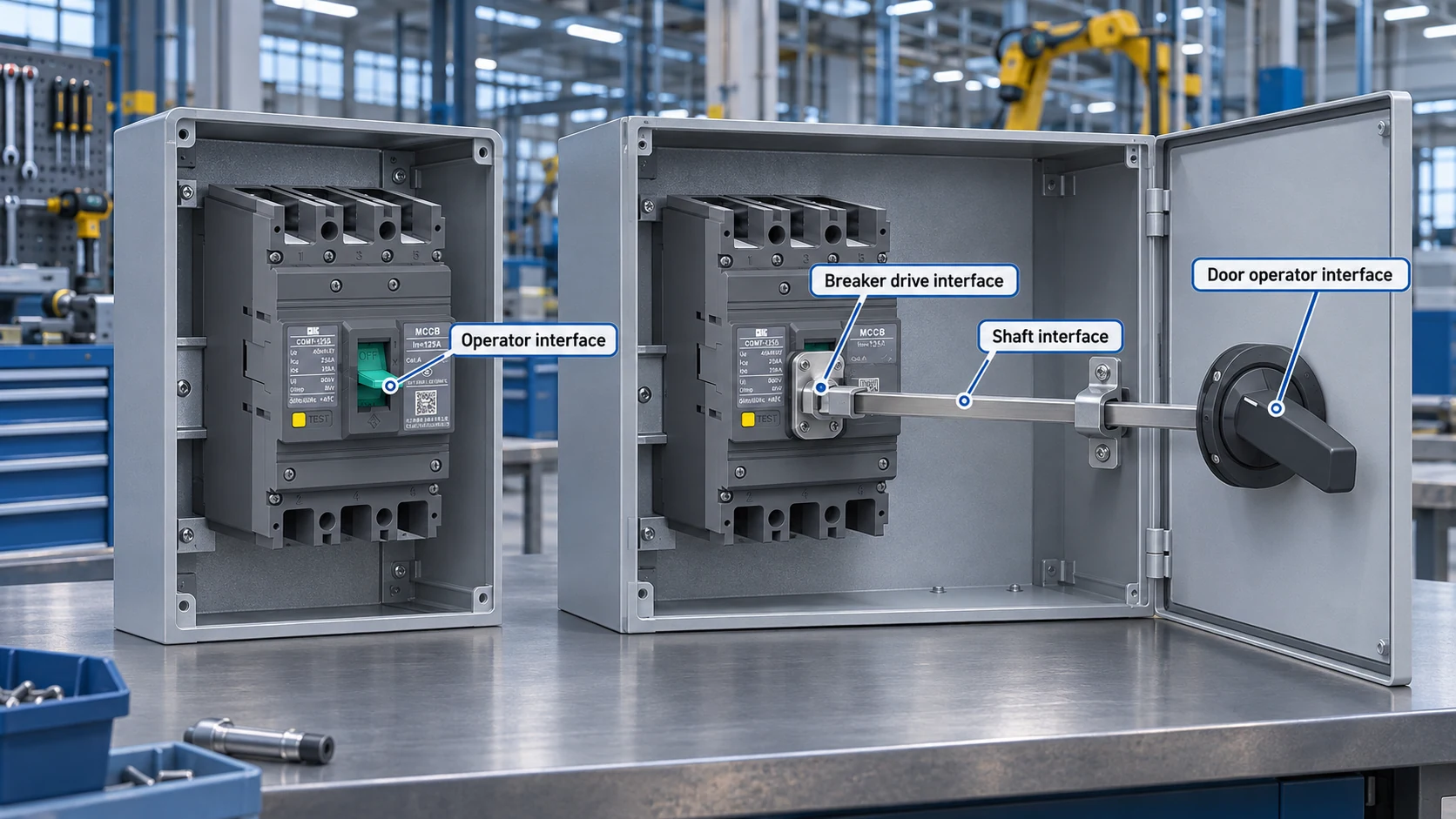
Pengaturan langsung dan pengaturan jarak jauh menyelesaikan masalah akses yang berbeda. Pegangan putar pemutus arus langsung beroperasi pada pemutus arus, sedangkan sebuah pegangan putar yang diperpanjang mentransmisikan operasi dari pengendali yang dipasang di pintu ke mekanisme pemutus arus. Ini adalah perbedaan arsitektur secara umum, bukan konfirmasi bahwa kedua pengaturan tersebut tersedia untuk setiap rangka CQM7.
| Pengaturan | Lokasi pengoperasian | Pemeriksaan fit utama |
|---|---|---|
| Direct handle | At the breaker-mounted mechanism | Mechanism compatibility, surrounding clearance and access |
| Extended door-mounted handle | At the enclosure door, through a shaft | Compatible drive, shaft engagement, alignment, cutout and door movement |
The CQM7 range includes overlapping current selections between frames. Therefore, rated current alone cannot identify an MCCB handle. Record the complete breaker designation and obtain a handle part reference explicitly matched to it. CHAC’s OEM buying guide likewise distinguishes a matching frame designation from approval of the complete configuration.
What must be confirmed before the panel door is fabricated?
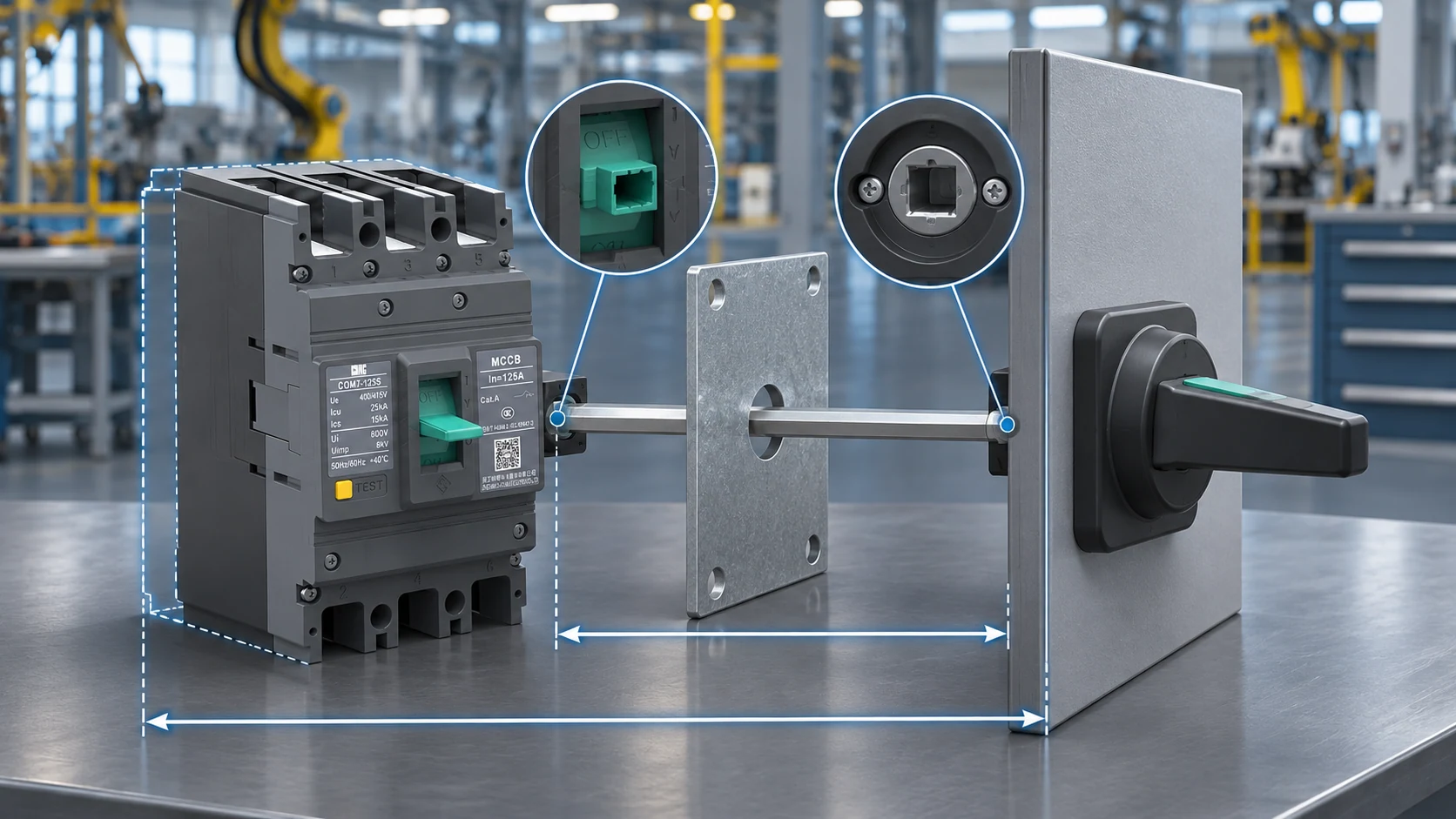
Use a dimensioned drawing for the selected mechanism, not a photograph or a drawing for a similar frame. The critical depth is the relationship between the breaker drive interface and the door operator’s mounting plane. Nominal enclosure depth alone does not describe that relationship: mounting-plate position, breaker projection and the door construction also matter.
Request the permitted shaft-length range, engagement requirements and alignment tolerances. Have the panel designer compare them with the actual layout. For the door, obtain the cutout profile, mounting-hole pattern, orientation, thickness limits and clearance envelope. Check how the door and mechanism interact throughout their intended movement; do not infer fit from the closed-door view alone.
Mechanical compatibility also differs from documented functional performance. Ask which positions can be padlocked, what door-interlock behavior is provided and what limitations apply. A lockable-looking handle does not establish an isolation function.
IEC 60947-2:2024 addresses circuit-breakers within its stated voltage scope. Its publication is not evidence that a particular CQM7 and handle combination is certified or suitable for isolation. Request evidence covering the selected combination and intended duty.
Which inputs should accompany a CQM7 handle enquiry?
Send a configuration package that allows CHAC to review compatibility rather than guess from a front-view photograph. Keep dimensional acceptance separate from functional and enclosure-protection acceptance.
| Input to provide | Confirmation to request |
|---|---|
| Complete breaker designation and identification photo | Exact compatible mechanism and accessory references |
| Tata letak bidang pemasangan dan konstruksi pintu | Shaft range, engagement and alignment requirements |
| Proposed door fabrication drawing | Cutout, fixing pattern and clearance acceptance |
| Required interlock and padlocking behavior | Documented functions and limitations |
| Required enclosure protection | Evidence and installation conditions for the completed arrangement |
A handle penetration introduces another interface into the enclosure. Review sealing provisions, door-surface conditions and assembly requirements rather than assuming the original enclosure rating remains unchanged. IEC 61439-1:2020 concerns low-voltage switchgear and controlgear assemblies; component information does not replace assembly-level verification. The responsible assembly team should determine the applicable verification requirements, with supporting documentation for the selected operator.
Pertanyaan yang sering diajukan
How does a direct MCCB rotary handle differ from an extended door-mounted handle?
A direct handle operates at the breaker mechanism. An extended arrangement places the operator on the door and uses a shaft to reach the breaker. The latter adds shaft, door-alignment and penetration checks.
Which handle mechanism is approved for the selected CQM7 frame?
The published information does not identify an approved handle mechanism for each variant. Request an explicit compatibility reference covering the full breaker designation and the proposed handle assembly.
How should shaft length be checked against the actual panel depth?
Compare the actual drive-interface-to-door geometry with the selected mechanism’s documented shaft range and engagement requirements. Include mounting-plate position and breaker projection; do not substitute the enclosure’s nominal depth.
What door cutout and mounting dimensions are needed before fabrication?
Obtain the selected operator’s cutout profile, fixing-hole locations, orientation, door-thickness limits and clearance envelope. Use its dimensioned drawing as the fabrication reference, not a visually similar accessory.
Does the handle assembly provide the required door-interlock and padlocking functions?
That remains configuration-specific. Request documentation stating interlock behavior, lockable positions and limitations. Padlocking capability alone does not demonstrate the complete isolation or access-control function required by the design.
How should the enclosure protection rating be checked after installing the handle?
Review evidence for the operator-door interface and the completed assembly, including specified seals and mounting conditions. Have the responsible assembly team assess applicable verification; neither the enclosure nor handle rating alone settles the result.
Can a replacement rotary handle be selected by appearance alone?
No. Similar external shapes can conceal different couplings, mounting patterns, shaft interfaces and interlock arrangements. Match identification details and drawings, then obtain explicit compatibility confirmation for the existing breaker.
For a CQM7 panel, resolve handle compatibility before releasing the door drawing or replacement order. Send the breaker designation, enclosure layout and required operating functions through CHAC’s enquiry channel for configuration review; consultation is not itself confirmation of fit or verified performance.