A machine feeder that trips every morning may be responding correctly to a starting condition or a fault. Replacing the device without investigating the circuit can hide the symptom while leaving the cause unchanged. Understanding the breaker’s function is the first step toward a useful diagnosis.
Riepilogo: A circuit breaker is a switching device that opens a circuit automatically under specified abnormal conditions and can generally be reset after the cause is resolved. Ordinary overcurrent breakers address overload and short circuit. Residual-current and arc-fault functions require devices specifically designed for them.
Identify the protection function before comparing products
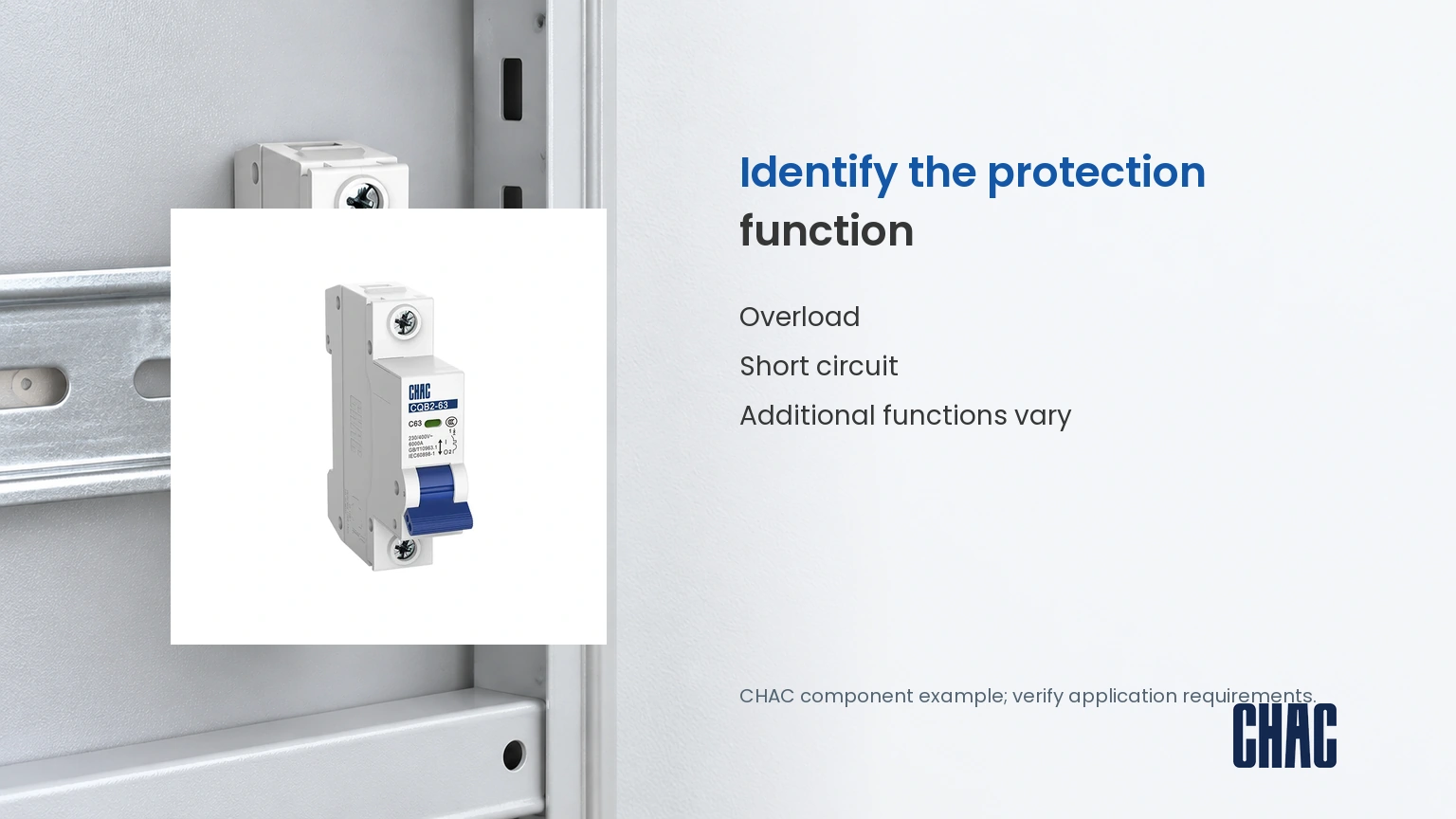
A practical circuit breaker definition includes both switching and automatic protection. Thermal-magnetic designs commonly use a delayed response for overload and a faster magnetic response at higher fault currents. Other designs use electronic trip units. The actual operating characteristic comes from the model’s documentation.
The question what does a circuit breaker do should not be answered with an unlimited safety claim. A conventional overcurrent breaker does not necessarily detect leakage, every arc or an overheating loose connection. Compare the documented functions of Interruttori di circuito miniaturizzati with those of an Interruttore magnetotermico differenziale when residual-current protection is also required.
Check more than the ampere number
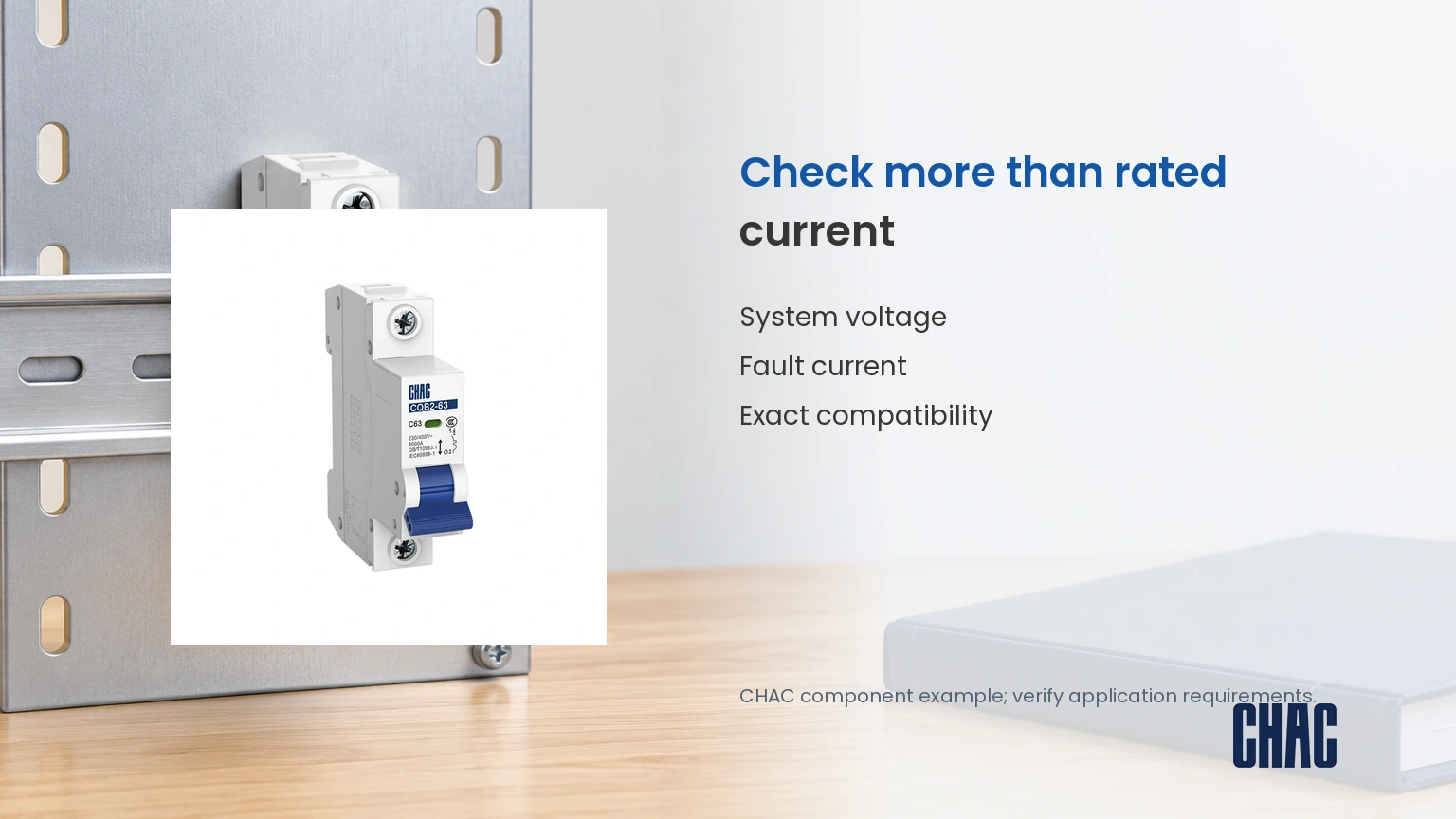
Rated current describes only one selection dimension. Voltage, AC or DC duty, poles, interruption rating, trip behavior, terminals and mounting requirements also matter. A device that fits a rail or panel opening is not automatically a permitted replacement. Use the exact panel or assembly documentation.
ABB’s MCB portfolio illustrates how characteristics, pole configurations and market approvals differ within a manufacturer’s range. Do not transfer one product’s certification or fault rating to another family. The selected interruption capacity must suit the prospective fault current, and the trip behavior must satisfy the circuit’s protection requirements.
Treat a trip as information rather than an inconvenience
For anyone asking what are circuit breakers, reset capability is an important difference from a one-time fuse, but it is not permission to reset repeatedly. OSHA 1910.334 requires a determination that equipment and circuits can be safely energized after protective operation, subject to the stated overload exception.
Record what was operating, whether the trip occurred at startup or later, and any visible signs of damage without exposing live parts. Qualified personnel can then investigate the load and circuit. A larger breaker or different characteristic should be a documented design change, not a trial-and-error repair.
Compare the options for this application
| Device function | Typical purpose | Important limit |
|---|---|---|
| Overcurrent protection | Overload and short circuit | Does not imply residual-current protection |
| Protezione contro la corrente residua | Detect residual-current conditions | Does not always include overcurrent protection |
| Arc-fault detection | Respond to specified arc conditions | Requires a suitable dedicated function |
| Manual isolation | Disconnect for an approved purpose | Must be suitable and used under the required procedure |
Check the conditions that affect the decision
| Selection item | Question to answer |
|---|---|
| Rated voltage | Is the supply type and voltage suitable? |
| Breaking capacity | Can it interrupt the available fault current? |
| Trip characteristic | Does it coordinate with load and conductor protection? |
| Compatibilità | Is the exact assembly combination permitted? |
Confirm the applicable rules and documentation
IEC 60898-1 and IEC 60947-2 address different circuit-breaker scopes. North American branch-circuit and supplementary-protection requirements are also distinct. Check the standard and approval for the exact device and destination; an IEC example is not automatically a UL-listed panel replacement.
Turn the requirements into a purchasing brief
Confirm supply, load, conductors, fault level and assembly compatibility before choosing a device. CHAC Electric offers circuit-protection models for review against these requirements. Provide the application conditions and request the documentation for the exact selection.
Domande frequenti
What destroys a circuit breaker?
Fault duty beyond its capability, heat, contamination, damage or unsuitable operating conditions can affect a device. The cause must be assessed rather than assuming age or a trip alone proves failure.
Is there a difference between a breaker and a circuit breaker?
In ordinary electrical conversation, breaker is usually a shorter name for circuit breaker. Confirm the precise device type when ordering because different protection functions are often grouped under that label.
Should a circuit breaker be on or off?
Its position depends on the operating and isolation requirements. Do not operate an unfamiliar or damaged installation without an authorized procedure.
Can I reset a breaker that has tripped?
Only after establishing that re-energization is safe. Repeated trips, signs of damage or an uncertain cause require qualified investigation rather than repeated resets.
Does a circuit breaker protect against electric shock?
A conventional overcurrent breaker is not a substitute for required residual-current protection and other protective measures. Select the required functions as part of the installation design.
Which type of circuit breaker should I choose?
Use the supply, load, fault level, conductor arrangement and approved assembly documentation. Model-specific ratings and destination rules determine the suitable choice.
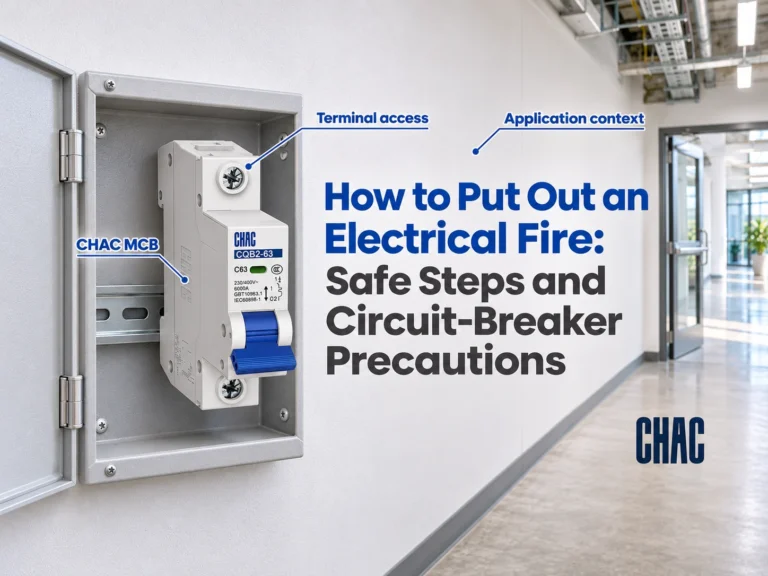
Letture correlate: Come spegnere un incendio elettrico: passi sicuri e precauzioni per l'interruttore di circuito.
Referenze
For a model-specific enquiry, review CHAC Electric products e send the application requirements with the destination, quantity and required documentation.