A Controllore di sicurezza di tipo B is a miniature circuit breaker with a B time-current characteristic. Its instantaneous magnetic operating band is commonly 3–5 times rated current in the IEC-based product families covered by the manufacturer’s curve. That band is not the normal load allowance, and “Type B” here does not mean a Type B residual-current device. Select the breaker from the load’s starting behavior and the circuit’s fault-clearing requirements together.
Understand the magnetic band and the thermal curve
A thermal-magnetic MCB responds to sustained overload through its thermal mechanism and to sufficiently high current through its magnetic mechanism. Schneider Electric’s Acti9 FAQ gives a B-curve band of 3–5 times rated current. For a hypothetical B20 device using that characteristic, the band corresponds to 60–100 A. This is an illustration of the multiplier, not a guaranteed trip point at every temperature or duration.
Below the magnetic region, the thermal curve still matters. A breaker carrying somewhat more than its rating does not necessarily open instantly. Read the complete manufacturer time-current curve, including tolerances and test conditions, when checking overloads and disconnection time.
Check the actual inrush before calling a load low-inrush
B-curve devices are often considered for resistive loads and circuits with modest starting currents. “Lighting,” however, is not a complete electrical description: a bank of LED drivers can draw a short charging pulse at switch-on. Obtain the driver’s inrush information and any manufacturer limit on the number of drivers per protective device.
The useful design question is whether the combined startup stays within the breaker’s acceptable operating envelope. A low running wattage does not prove low inrush. Group switching, simultaneous restart after a power failure and replacement driver types can all change that envelope without changing the circuit’s everyday current.
Compare B and C curves against the fault conditions
Il B-curve tripping characteristic has a lower magnetic threshold than the C characteristic in the cited Acti9 guidance, which gives C as 5–10 times rated current. Moving to C can tolerate a larger startup pulse, but it also changes the current needed for rapid magnetic operation. Check the fault path and required disconnection time before accepting that change.
For a long cable run, inspect the minimum fault-current condition as well as the maximum fault level at the board. A device must interrupt the largest credible fault within its rating and operate quickly enough at the fault conditions relevant to the installation. Raising the threshold solely to stop a nuisance trip can leave that second check unresolved.

Keep the curve letter separate from other ratings
A B marking does not establish breaking capacity, AC/DC suitability, residual-current sensitivity or arc-fault detection. Those are separate characteristics. In particular, a Type B RCD classification concerns residual-current waveforms, whereas a B-curve MCB characteristic concerns overcurrent operation. Similar wording is not evidence of equivalent protection.
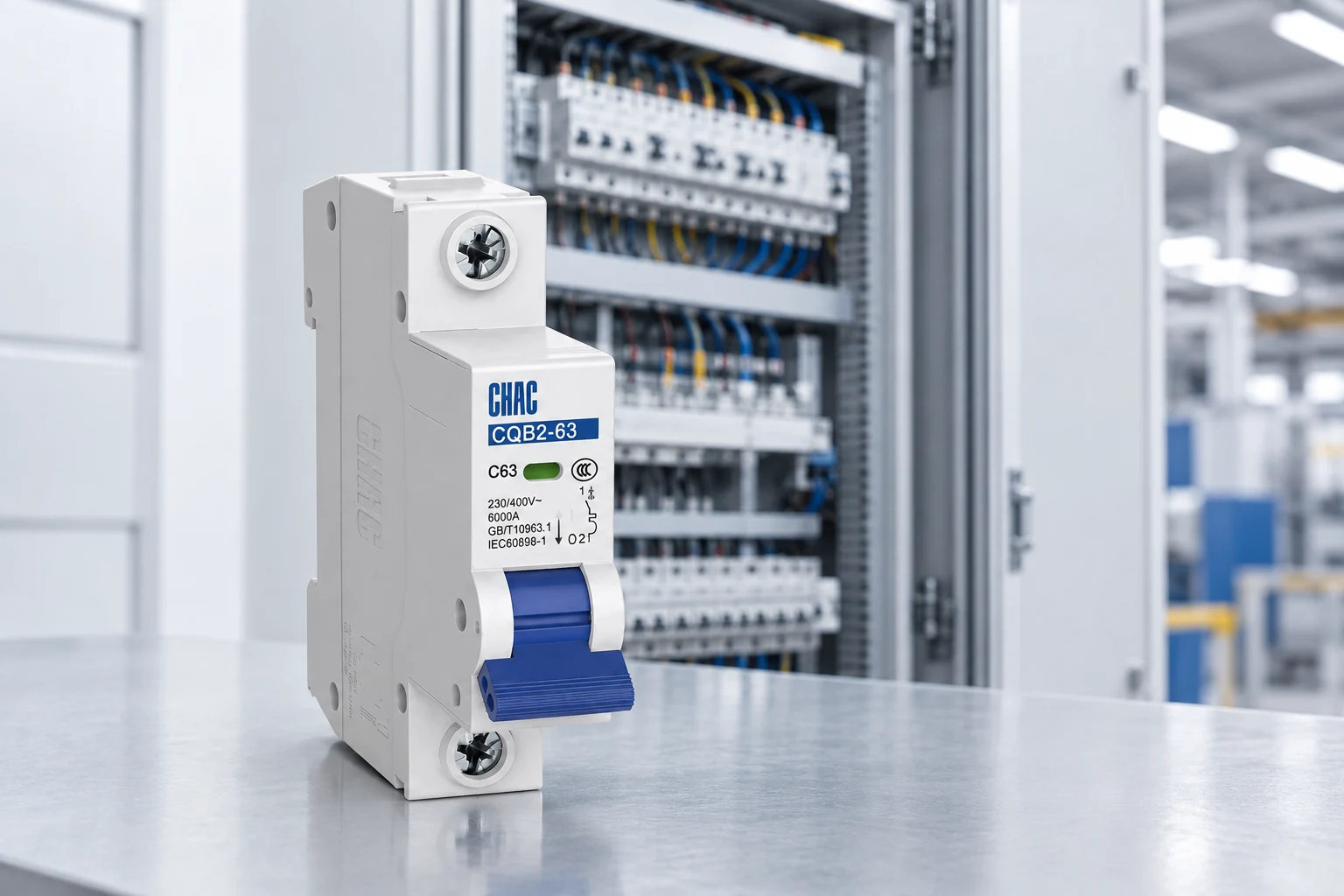
Review the available curves in CHAC’s miniature circuit breaker range and the exact variant on the CQB2-63 MCB page. Confirm the model curve and rating instead of transferring a competitor’s threshold or application approval to a CHAC catalogue number.
Diagnose unwanted trips before changing the breaker
Record when the trip occurs, which loads switch together and whether the event follows maintenance or a change of equipment. Immediate startup trips and delayed overload trips call for different investigations. Check the circuit and connections before assuming the selected curve is the only problem.
A replacement MCB curve selection should document the load inrush, cable protection and disconnection-time review. The 20 A MCB selection guide shows how the current rating and curve remain separate decisions. Keep that record so a later technician understands why the replacement was chosen.
Which part of the specification answers each question?
| Domanda | Relevant characteristic | Do not confuse it with |
|---|---|---|
| Will it tolerate startup? | Full time-current curve and load inrush | Running current alone |
| Can it clear the fault? | Breaking capacity at the declared voltage | The B curve letter |
| Does it detect leakage? | A separate residual-current function | A Type B MCB marking |
| Can it operate on DC? | Explicit DC rating and wiring instructions | Its AC trip curve |
Domande frequenti
Qual è la portata di viaggio di un MCB di tipo B?
Ai sensi della norma IEC 60898-1, la zona operativa istantanea è comunemente specificata intorno a 3–5 volte la corrente nominale, ma i limiti di test esatti e i dati del prodotto devono essere controllati. Utilizzare sempre la curva del modello offerto.
When should I use a B-curve MCB?
Consider it where the load’s inrush is compatible with the B characteristic and the circuit meets the required disconnection conditions. Resistive and some lighting circuits may fit, but LED drivers, transformers and other electronic loads need an actual inrush check.
Posso sostituire una curva C con una curva B?
Solo dopo aver verificato la storia degli eventi anomali, l’inversione di corrente e le condizioni di sovracorrente. Un livello di soglia magnetico più basso può migliorare la risoluzione dei guasti ma può causare un arresto durante l’avviamento.
Significa il tipo B che il cavo è compatibile con la DC?
No. “B” è una designazione per la curva di corrente durante il funzionamento di una famiglia di interruttori, non una indicazione per la corrente continua. Verificare separatamente la tensione, la polarità e i dati dei test della corrente continua.
What is the difference between B and C curve circuit breakers?
In the cited Acti9 guidance, B has a 3–5 times rated-current magnetic band and C has a 5–10 times band. Both also have thermal overload behavior. Choose using the exact model curve, load inrush and fault-clearing requirements rather than an application label alone.
Referenze
- Schneider Electric: B, C and D characteristics for Acti9 MCBs
- Schneider Electric Electrical Installation Guide: conductor protection
For a model-specific review, contatta CHAC Electric with the circuit diagram, supply voltage, load details and destination-market requirements.