Przewodnik po wyborze RCD & RCBO
Przeanalizuj typ i czułość prądu rezyduarnego, a następnie porównaj prąd obwodowy, pojemność kabla, napięcie oraz prąd awaryjny z podanymi wartościami RCD lub RCBO.
Przed sprawdzeniem wyłącznika różnicowoprądowego z funkcją ochrony przeciążeniowej i zwarciowej (CHAC RCBO) należy przeprowadzić kontrole typu prądu resztkowego, czułości oraz prądu/zwarcia. Wymagana czułość musi wynikać z wymagań instalacji.
Wynik
Wymóg dotyczący prądu resztkowego
Typ A / 30 mAWprowadzone kontrole numeryczne zostały spełnione; zweryfikuj kompletność instalacji.Ib ≤ In ≤ Iz; deklarowana zdolność wyłączania ≥ przewidywany prąd zwarciowy; wymagany przebieg i IΔn wynikające z projektuWynik rejestruje wymagany typ, a nie dowodzi, że podane urządzenie go zapewnia. CHAC PXB6L-63 publicznie wymienia Typ AC/A; to narzędzie nie przypisuje go do zadań Typu F/B. Urządzenie RCCB wymaga oddzielnego zabezpieczenia przeciwprądowego. Zweryfikuj rzeczywisty przebieg napięcia, uziemienie, układ przewodu neutralnego oraz zasady odłączania.
Dlaczego ten wynik?
Formuła i metoda
Przeanalizuj typ i czułość prądu rezyduarnego, a następnie porównaj prąd obwodowy, pojemność kabla, napięcie oraz prąd awaryjny z podanymi wartościami RCD lub RCBO.
Jak używać tego kalkulatora
- Wprowadź rzeczywisty prąd roboczy oraz kandydujące parametry urządzenia/kabla.
- Użyj instrukcji urządzenia, aby zidentyfikować kształt fali resztkowej. Wprowadź czułość wymaganą dla tego obwodu.
- Przejrzyj wyświetlane sprawdzenia, a następnie potwierdź typ urządzenia, liczbę biegunów, sposób obsługi przewodu neutralnego oraz koordynację zabezpieczeń.
Granice obliczeniowe
Z nazwy budynku nie wybrano uniwersalnego typu lub czułości urządzenia różnicowoprądowego. Nie oblicza to impedancji pętli zwarcia do ziemi, czasu odłączenia ani nie generuje certyfikatu z wynikiem „przekazano/przepaść”. Dostępność typów F/B nie jest wnioskowana na podstawie zakresu urządzeń CHAC typu AC/A.
Wybór RCD i RCBO: typ, czułość i prąd znamionowy
Typ przebiegu prądu resztkowego, czułość oraz klasa zabezpieczenia przeciwprądowego opisują odrębne funkcje. Wynik zawiera wymagany przebieg, który został wprowadzony, oraz sprawdza parametry prądu, przewodu, napięcia i granic zwarciowych. Nie wnioskuje on wszystkich wymagań na podstawie kategorii pomieszczenia czy budynku.
Notatki wprowadzane
| Wprowadzenie | Czego należy się zorientować |
|---|---|
| Required waveform | Use the equipment instructions. A Type A requirement is different from the smooth-DC or drive-related duties that can require other types. |
| Sensitivity and leakage | Enter the residual sensitivity required by the circuit design. Standing leakage is shown as a proportion of that value; it does not predict exact trip time. |
| Candidate ratings | Compare Ib, In, corrected Iz, operational voltage and the applicable declared short-circuit capability. Keep Icn, Icu and Ics identified correctly. |
Przykładowe rozwiązanie · wartości początkowe
Single-phase circuit requiring Type A, 30 mA
230 V · load 16 A · device In 20 A · cable Iz 25 A · fault 4.5 kA · entered breaking capability 6 kA
16 A ≤ 20 A ≤ 25 A; 4.5 kA ≤ 6 kA; 230 V ≤ 230 V
Standing leakage ratio = 5 / 30 × 100 = 16.67%. Required waveform remains Type A.
Typ A / 30 mA
The numeric entries meet these bounds. Confirm that the actual device provides the required type and sensitivity at the stated voltage and pole arrangement.
RCD vs RCBO: what protection is included?
RCD is the general term for a residual-current protective device. An RCCB detects residual current but does not provide overload and short-circuit protection. An RCBO combines residual-current and overcurrent protection in one device.
This distinction matters when reviewing an outgoing circuit. An RCCB arrangement needs a coordinated overcurrent device. For an RCBO circuit breaker, check both sets of characteristics: residual-current waveform and sensitivity, then rated current, trip curve and short-circuit capability.
A 30 mA RCBO and a 20 A RCBO rating describe different things
Rated current In is expressed in amperes and belongs to the circuit’s load and overcurrent assessment. Rated residual operating current IΔn is commonly expressed in milliamperes and belongs to residual-current protection. A device can therefore be rated 20 A and 30 mA at the same time.
For the example circuit, 16 A load current, a 20 A device and 25 A corrected cable capacity satisfy Ib ≤ In ≤ Iz. The 30 mA entry is checked separately against standing leakage. Neither number replaces the other, and the leakage ratio does not predict an exact tripping time.
Type A RCD response is different from a breaker trip curve
Type AC and Type A describe residual-current waveform response. Type A covers sinusoidal AC and pulsating DC residual currents within its specified conditions. Letters used for an overcurrent trip curve describe another characteristic; a Type A residual-current requirement does not select an overcurrent curve.
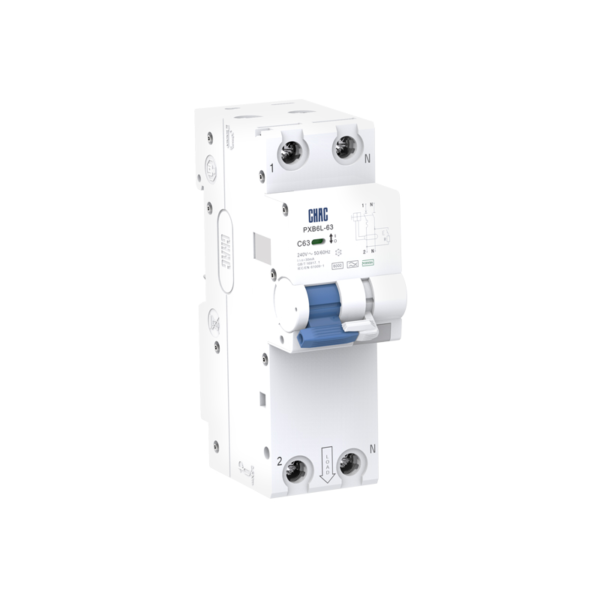
Read the connected equipment’s instructions before choosing the waveform type. CHAC PXB6L-63 lists Type AC and Type A variants. If the application requires Type F or Type B, obtain a device explicitly rated for it; selecting that requirement in the form does not identify an available PXB6L-63 model.
Type and installation still need confirmation
- CHAC PXB6L-63 publicly lists Type AC and Type A variants. Displaying a Type F or Type B requirement does not assert that this family offers that function.
- An RCCB needs coordinated overcurrent protection. Earth-loop conditions, disconnection time, neutral switching, selectivity and the applicable installation rules remain separate checks.
Często zadawane pytania
Does this tool always recommend 30 mA?
No. Sensitivity is entered from the circuit requirements. The default is an example and does not establish the rule for every circuit.
Can a Type AC device be assumed suitable for pulsating DC leakage?
No. Establish the required waveform response from the load documentation and use a device explicitly specified for that duty.
Is an RCCB the same as an RCBO?
No. An RCBO includes overcurrent protection; an RCCB relies on separate, appropriately coordinated overcurrent protection.
Does a numerical pass confirm the model is suitable?
No. The candidate entries are user-supplied. Actual waveform response, sensitivity, standard-specific breaking duty, poles and installation conditions must match the exact device.
Can a 30 mA RCBO have a 32 A current rating?
Yes. The 30 mA value is residual-current sensitivity; 32 A is rated circuit current. The circuit must satisfy the conditions for both ratings, including cable protection and the required residual-current response.
Does a Type A RCD requirement specify the breaker trip curve?
No. Residual-current type and overcurrent trip curve describe different functions. Check the load’s waveform requirement and the device’s overcurrent characteristic separately.
Potrzebujesz pomocy przy wyborze produktu CHAC?
W swoim zapytaniu należy podać napięcie zasilania, prąd obciążenia oraz warunki montażu.
Przykład zastosowania · Wykresowe dane wejściowe
Reviewing a single-phase branch with PXB6L-63 data
For a 230 V branch with an assumed 18 A load and 25 A corrected cable capacity, compare a 20 A device against Ib ≤ In ≤ Iz. If the equipment requirements call for Type A and 30 mA, the CHAC PXB6L-63 page lists those options, together with 230 V for 1P+N/2P and 6 kA Ics. Entering a 4.5 kA fault level clears the guide’s numeric fault comparison, subject to the applicable rating and standard. Confirm the exact variant, leakage conditions and neutral arrangement; the calculator records the required type rather than determining it from load current.
Dane produktu: PXB6L-63 Elektromagnetyczny wyłącznik różnicowo-prądowy
Powiązane produkty CHAC
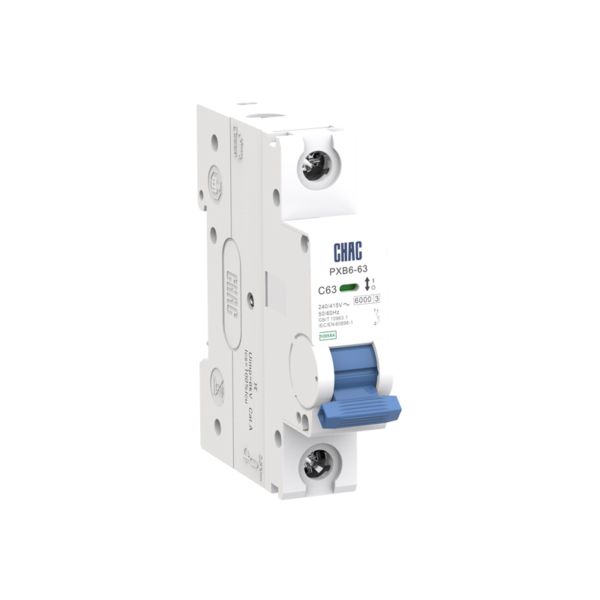
Review RCBO residual-current and overcurrent data. An MCB alone does not provide residual-current protection.