A CQM6 quotation can match the required current yet leave the voltage duty unresolved. Before releasing a panel-building order, purchasing and engineering teams need to distinguish insulation ratings from operating and fault-interruption ratings—not simply select the largest voltage printed in a catalogue.
Nominalne napięcie izolacji, Ui, is a reference for insulation-related requirements; it is not permission to operate a breaker at that voltage. CQM6 selection requires the exact variant’s declared rated operational voltage Ue, impulse withstand voltage Uimp, and breaking-capacity data at the project supply voltage.
What do Ui, Ue and Uimp tell a CQM6 buyer?
These ratings answer different questions. Treating them as interchangeable can turn an apparently complete purchase specification into an unresolved engineering enquiry.
| Ocena | Technical meaning | Purchasing implication |
|---|---|---|
| Ui: rated insulation voltage | Reference voltage for dielectric-test requirements and creepage distances | Record separately; do not substitute it for Ue |
| Ue: rated operational voltage | Voltage associated with declared operating performance | Match the supply type, voltage and applicable performance data |
| Uimp: impulse withstand voltage | Declared insulation withstand under specified impulse conditions | Review insulation coordination; do not interpret as surge suppression |
The Strona produktu CHAC CQM6 lists AC 400/415V, with additional 660/690V configurations for CQM6-1600. Those listings do not establish either Ui or Uimp for an exact ordered variant.
A useful distinction appears in the separate CHAC CQM7 specifications: rated operational voltage is listed as AC 400/415V, rated insulation voltage as 800V, and rated impulse withstand voltage as 8kV. These are CQM7 declarations, not transferable CQM6 ratings. Their value here is to show why the three fields must remain separate.
Which voltage and breaking-capacity data govern the actual circuit?
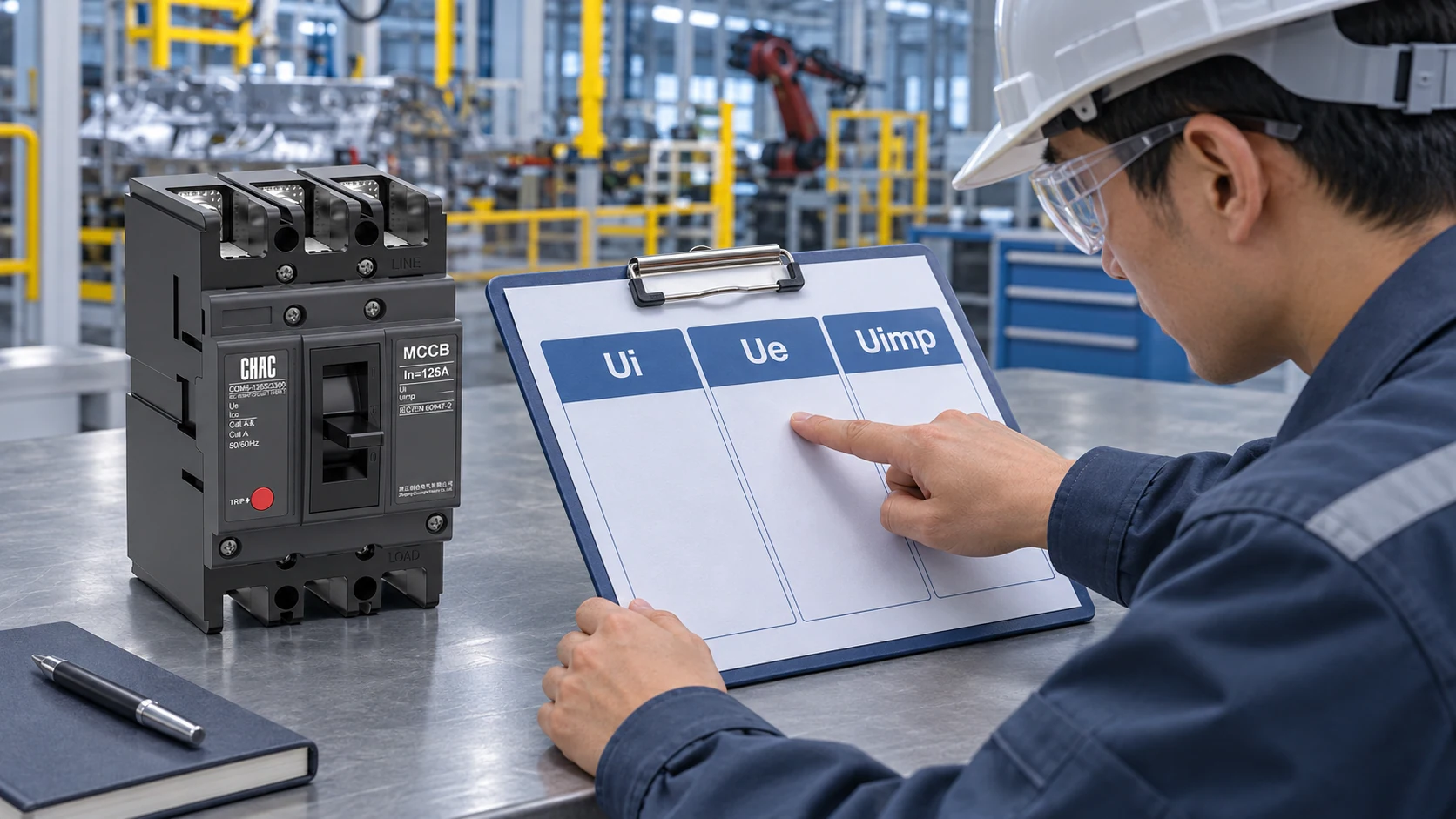
Start with the project’s supply characteristics, then locate the matching operating and breaking-capacity declarations. A higher insulation voltage cannot extend a breaker’s declared operating range or establish its short-circuit performance at another voltage.
For fault duty, request both Icu, the rated ultimate short-circuit breaking capacity, and Ics, the rated service short-circuit breaking capacity, at the actual supply voltage. Compare these with the project’s prospective fault current and service-performance requirements. A maximum value elsewhere in the range is not a substitute.
The CQM6 page reports Icu up to 100kA for listed CQM6-1600 660/690V configurations. That is a bounded range statement, not evidence that every CQM6 frame or breaking-capacity class has that rating.
AC and DC also require separate checks because their interruption conditions differ. An AC declaration does not establish DC suitability. The Zakres CHAC MCCB distinguishes AC and DC options; use that distinction to frame an enquiry, not to infer a DC rating for CQM6.
IEC 60947-2:2024 addresses circuit-breakers and their requirements within its stated scope. A standard’s scope is not a product operating rating, and a catalogue reference to that standard is not proof of certification for the purchased unit.
What evidence should be resolved before a CQM6 order is released?
Build the enquiry around one complete ordering designation. Ask for documents that connect the proposed breaker to its frame, poles, current rating, trip configuration and breaking-capacity class. A family catalogue can support shortlisting, but unresolved fields need variant-level confirmation.
| Wejście projektu | Dowody do zażądania | Decyzja została poparta |
|---|---|---|
| Supply voltage and AC or DC | Exact-model Ue declaration and applicable conditions | Operating-rating match |
| Insulation-coordination requirements | Declared Ui and Uimp with relevant documentation | Insulation review |
| Potencjalny prąd zwarciowy | Icu and Ics at the project voltage | Fault-duty assessment |
| Panel design and environment | Installation instructions, dimensions and applicable limitations | Assembly integration review |
| Required conformity evidence | Applicable declarations, certificates and reports identifying covered variants | Traceable document acceptance |
Keep breaker evidence separate from assembly verification. IEC 61439-1:2020 concerns low-voltage switchgear and controlgear assemblies; component ratings alone do not establish the completed panel’s conformity. Have the responsible assembly team review integration rather than treating the breaker’s insulation voltage as a panel-wide rating.
Często zadawane pytania
What does rated insulation voltage Ui mean on an MCCB?
Ui is the rated insulation voltage used as a reference for dielectric-test requirements and creepage distances. It describes an insulation characteristic, not the voltage at which every operating function is declared. Obtain the exact CQM6 variant’s Ui rather than borrowing another series’ value.
How does rated insulation voltage differ from rated operational voltage Ue?
Ue identifies the voltage associated with declared operating performance, while Ui is an insulation reference. The two fields serve different purposes. Selection must use the applicable Ue and its associated ratings, even when Ui is higher.
Can a high Ui rating justify using CQM6 above its declared operating voltage?
No. A high Ui cannot justify operation above the exact CQM6 variant’s declared Ue. Any proposed operating voltage needs explicit supporting product data, including applicable interruption performance; consultation alone does not establish suitability.
How does impulse withstand voltage Uimp differ from surge-protection performance?
Uimp describes insulation withstand under specified impulse conditions. It does not declare surge clamping, surge-energy handling or protection of downstream electronics. Surge-protection requirements need a separate assessment and appropriate device evidence.
Why must AC and DC operating ratings be checked separately?
AC has natural current zero crossings, whereas DC interruption conditions differ. Ratings therefore cannot be transferred between supply types. Request an explicit DC declaration and applicable configuration documentation if the project is DC.
Which breaking-capacity rating applies at the project's actual supply voltage?
Use the Icu and Ics declarations for the exact variant at the project's actual supply voltage and supply type. Compare them with the prospective fault current and required service performance, rather than using the family's highest advertised capacity.
What voltage-rating documents should buyers request for the exact CQM6 model?
Request an exact-model datasheet, ordering-code confirmation, Ui/Ue/Uimp declarations, voltage-specific Icu/Ics tables, installation instructions and applicable conformity evidence. Check that certificates or reports cover the proposed variant and relevant standard edition, not merely a related product family.
Keep Ui, Ue, Uimp and voltage-specific breaking capacities as separate procurement fields. If the proposed CQM6 documentation leaves any field unresolved, contact CHAC with the complete ordering designation and project voltage requirements for clarification before the engineering acceptance and order-release decisions.