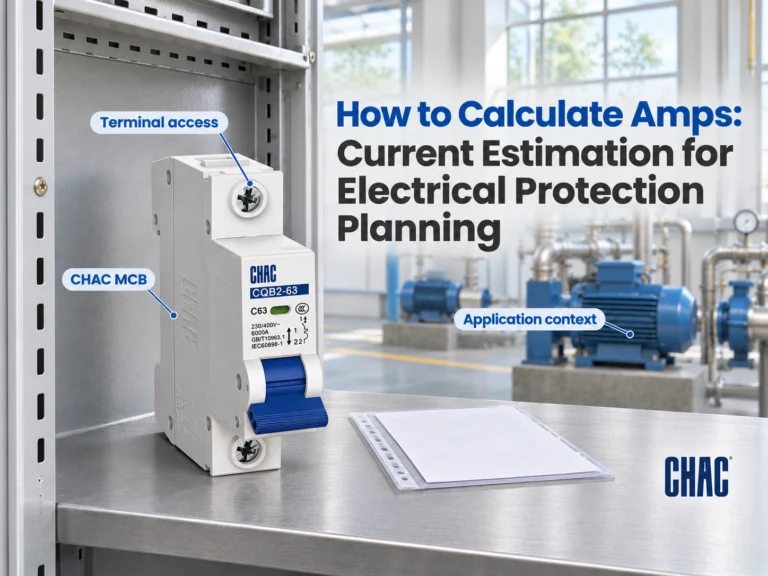
A 3 styk 100 amperowy MCB is a three-pole miniature circuit breaker with a declared current rating of 100 A per pole under its specified conditions. It does not create a single 300 A circuit. Selection requires the line-to-line voltage, current in each phase, available fault current and the exact device configuration. A suitable current rating alone does not establish motor protection, neutral switching or compatibility with a distribution board.
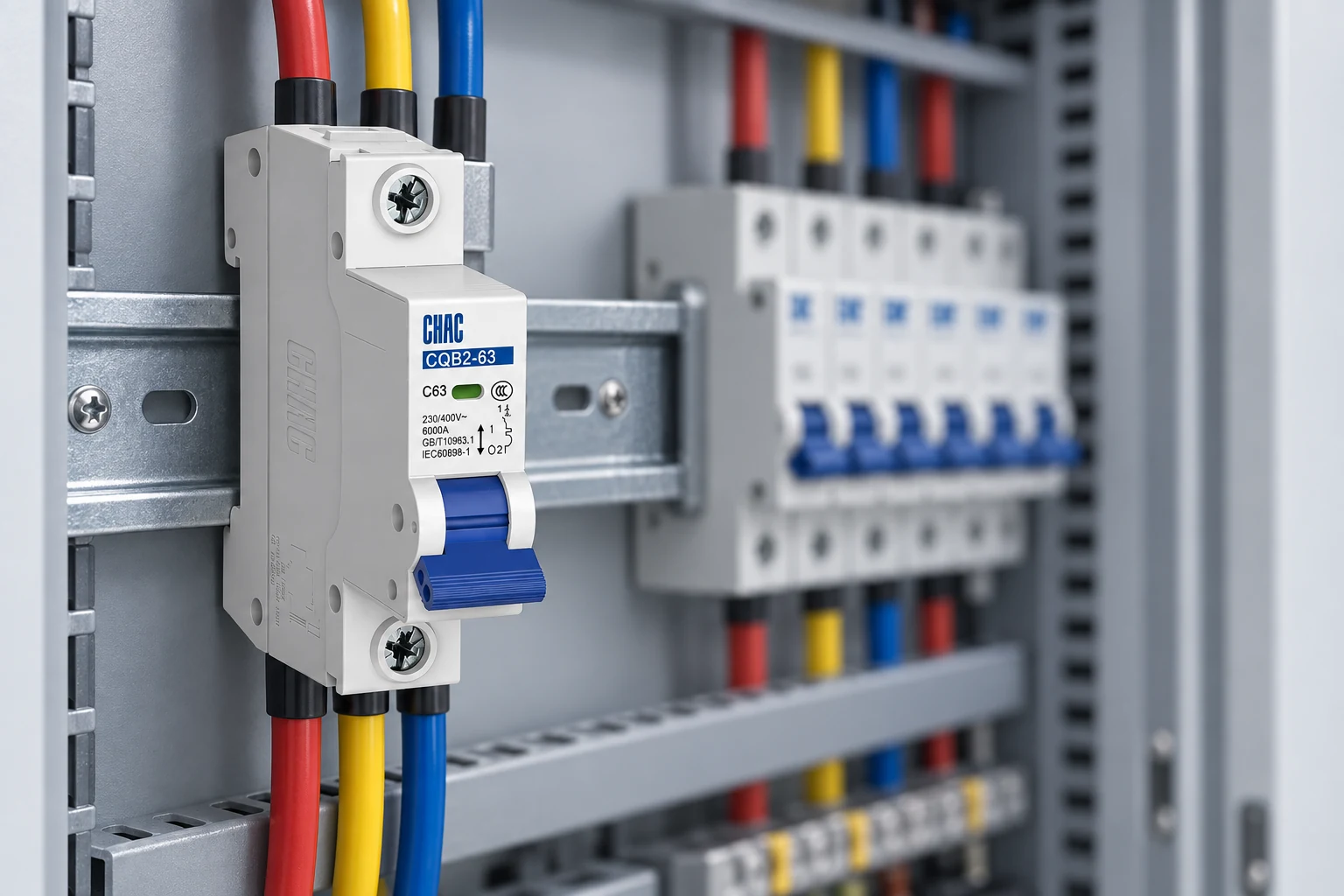
Read 100 A as a per-phase rating
Three-phase currents flow in separate conductors. If each phase carries 80 A, it is not correct to describe the breaker as carrying 240 A against a 100 A limit. Conversely, lightly loaded phases do not compensate for an overloaded phase. Review the load schedule and the most heavily loaded conductor rather than averaging the three readings to justify the selection.
Power and current are also different quantities. Converting a three-phase power demand to current requires the supply voltage and relevant power-factor or efficiency assumptions. Use the equipment’s input-current information where available, especially for motors and electronic loads, rather than dividing watts by a single phase voltage.
Confirm the neutral and common-trip arrangement
A standard three-pole arrangement connects the three phases; it does not provide an extra neutral pole. A circuit may include a continuous neutral where permitted, but a requirement to disconnect or protect that conductor must be addressed explicitly in the design. Do not put a phase through an unprotected neutral pole as a shortcut.
Specify the manufacturer’s common-trip construction. Three separate single-pole devices placed next to one another are not automatically equivalent. The related three-phase miniature circuit breaker guide explains what the linked device does and which protection functions still require separate consideration.
Check the conductor, busbar and enclosure at 100 A
At this rating, terminations and assembly conditions deserve as much attention as the breaker. Verify the cable ampacity after correction factors, the terminal conductor range, approved busbar system and enclosure temperature limits. The IEC-based selection relationship in the Electrical Installation Guide remains IB ≤ In ≤ Iz; a 100 A label does not override a lower cable or assembly limit.
For an actual product review, compare the CQB2-125 miniature circuit breaker information with CHAC’s MCB product range. Confirm the exact 100 A three-pole variant and its technical documentation. A larger catalogue family is a starting point, not evidence that every configuration is available or approved.

Use the fault study to check breaking capacity
The three-phase fault current at the board must be considered independently of the normal operating current. Verify the breaker’s declared short-circuit capacity at the actual voltage and pole arrangement. If backup protection is proposed, obtain the specific tested combination and observe the applicable installation rules; do not infer protection from the upstream device’s larger ampere rating.
Selectivity is another separate question. Two breakers may both interrupt the fault safely yet trip together, shutting down more of the installation than intended. Use the manufacturer’s coordination data and the project’s continuity requirements to assess that consequence.
Add motor-specific protection where the load requires it
A three-pole distribution MCB does not automatically detect phase loss, phase reversal or damaging imbalance. A motor circuit may need an overload device, a phase-monitoring function and suitable coordination with the contactor. Schneider Electric’s Micrologic FAQ illustrates that even more elaborate breaker systems have model-specific limits on phase-loss detection.
Choose the Krzywa ruchu MCB from the documented starting duty and required fault-clearing performance. A C-curve is not a universal motor setting. Keep startup behavior, overload protection and short-circuit interruption as distinct checks so that a device which tolerates starting current is not mistaken for a complete motor-protection scheme.
What must be confirmed for a 100 A three-pole feeder?
| Decyzja | Required check | Powszechna pomyłka |
|---|---|---|
| Normal current | Each phase and corrected cable ampacity | Adding pole ratings to get 300 A |
| Funkcja awaryjna | Available current at the declared voltage | Choosing by amperes only |
| Neutral | Required switching and protection arrangement | Assuming a fourth pole exists |
| Motor duty | Starting current, overload and phase monitoring | Treating common trip as phase-loss detection |
Często zadawane pytania
Gdzie stosuje się przekaźnik MCB trójpolowy o mocy 100 A?
Wśród powszechnych zastosowań znajdują się zasilacze trójfazowe, niewielkie tablice rozdzielcze oraz obwody elektryczne w zakresie napięcia i wartości przepięcia urządzenia. Zastosowanie musi być zgodne z lokalnymi przepisami i ograniczeniami producenta.
Czy krzywa C zawsze jest właściwa dla silnika?
Nie zawsze. Zbieżna krzywa może tolerować umiarkowane natężenie przepływu, ale ochrona silnika często wymaga dedykowanego zabezpieczenia i koordynacji z ochroną przed przeciążeniem. Wykorzystaj mierzone lub udokumentowane natężenie uruchomienia.
Czy 3-polowy przekaźnik MCB może przełączać neutralny przewód?
Standardowe urządzenie trójpolowe otwiera wszystkie trzy fazy. Jeśli konieczne jest przełączanie neutralnego przewodu, należy wybrać odpowiedni układ czteropolowy lub połączony.
Jak zainstalować bezpiecznik DIN-rail?
Qualified personnel should follow the exact mounting, terminal, line/load and tightening instructions. Perform the installation tests required by the adopted rules and commissioning plan; do not improvise a short-circuit test.
Is a 3-phase breaker rating per phase?
Yes, the declared current applies to each pole under the stated conditions. A 100 A three-pole breaker is not a 300 A single-path device, and the least-loaded phase does not offset an overload on another phase.
How do I calculate an MCB rating for a 3-phase circuit?
Determine the load current in each phase using the equipment input data and supply conditions. Then apply the adopted design rules, conductor correction factors, starting-duty review and fault-current check. Round-up arithmetic alone cannot establish the correct protective-device rating.
Przypisy
- Schneider Electric Electrical Installation Guide: protective-device ratings
- Schneider Electric: limitations and options for phase-loss protection
For a model-specific review, skontaktuj się z CHAC Electric with the circuit diagram, supply voltage, load details and destination-market requirements.