Urządzenie WiFi może pomyślnie sparować na stanowisku testowym, a jednocześnie okazać się nieprzystosowane do zastosowania w gotowym panelu. Po montażu istotne są ułożenie przewodów, warunki obudowy, zarządzanie kontami użytkowników oraz zachowanie urządzenia podczas awarii i przywrócenia zasilania. Często pomijaną kwestią jest to, jak system reaguje w przypadku przerwy w komunikacji lub powrotu zasilania, a nie czy urządzenie można za pomocą telefonu uruchomić jednorazowo. Zespoły OEM powinny zatem rozdzielić procedury akceptacji elektrycznej od procedur akceptacji cyfrowej. Niniejszy checklist wyjaśnia, co należy dokumentować, jakie stany awaryjne należy testować oraz jakie materiały dowodowe należy zachować przed przekazaniem panelu operatorowi. Dokument ten nie zawiera uniwersalnego schematu elektrycznego ani nie upoważnia do wykonywania prac na urządzeniach pod napięciem.
Krótką odpowiedzią jest zatwierdzenie a inteligentna sieć WiFi przekaźnik w dwóch etapach: najpierw funkcja elektryczna w zamierzonej konfiguracji, a następnie zachowanie komunikacyjne i sterujące. Potwierdź klasyfikacje, bieguny, zaciski, funkcje ochronne i warunki montażu na podstawie dokładnego modelu. Oddzielnie zweryfikuj dostawy, uprawnienia dostępu, jakość danych i proces odzyskiwania. Aktualizacja wytycznych NIST dotyczących IoT z 2026 sprawia, że wsparcie cyklu życia jest istotne dla zamówień publicznych, ale nie stanowi certyfikatu elektrycznego. Udany test parowania dowodzi jedynie połączenia w tych warunkach; nie potwierdza ochrony przed awariami, dokładnego pomiaru energii ani bezpiecznego automatycznego odzyskiwania.
Które sprawdzania elektryczne wykonuje się przed parowaniem?
Confirm circuit voltage, load current, conductor protection, prospective fault current and any required residual-current function. A product described as smart is not automatically an RCBO, an isolator or a device suitable for DC. The exact ordered configuration determines which functions are available. Digital circuit breaker, IoT circuit breaker and automated circuit breaker can describe different combinations of measurement, communications and control. List the required functions individually in the WiFi circuit breaker enquiry so a supplier’s marketing label cannot substitute for the feature specification.
Review the manufacturer’s instructions and the applicable assembly requirements. Device conformity does not independently approve the complete panel. Where documents refer to a standard, check the model, edition and scope rather than treating a standards logo as evidence for every optional function.
Czy urządzenie będzie pasować do samej konstrukcji?
Check mounting dimensions, busbar arrangement, conductor access and heat-producing neighbors. Identify line/load orientation, neutral requirements and any separate control supply from the exact drawing. Do not transfer terminal assignments from a similar-looking device.
Record terminal torque and conductor requirements in the approved build instructions. Radio capability does not remove enclosure or thermal constraints. A larger current option should not be selected simply to avoid an unexplained trip; the load, cable and protection design must remain coordinated.
Czy sieć WiFi będzie działać wewnątrz zamontowanej obudowy?
Test the specified network with the final enclosure closed and the equipment in its intended location. Metalwork, distance and network policy can change the connection available during bench testing. Obtain supported radio and provisioning requirements rather than assuming a frequency band or authentication method.
Separate the device account from the installer’s personal account. Define who can commission, operate, revoke access and transfer ownership. A factory reset, app removal and cloud-account deletion may have different effects; document the vendor’s actual procedures.
What should happen to interrupted commands?
Evaluate remote control as a documented sequence. A command sent is not the same as a command executed. The operator needs to distinguish requested state, reported state and unavailable feedback. Where status is delayed, show its timestamp and communication condition. If an automated schedule is required, state whether it must run locally or depends on a cloud service. Record the documented behavior during loss of connectivity and after power restoration before accepting it for unattended operation.
| Test condition | Required clarification | Dowody do zachowania |
|---|---|---|
| WiFi disconnected | Local functions and remote-command availability | Observed result against manual |
| Internet or cloud unavailable | Local versus cloud schedules and history | Storage and recovery behavior |
| Control power interrupted | State after power returns | Approved recovery sequence |
| Reconnection after an old command | Expiry, retry and conflict handling | Command/feedback record |
These are acceptance requirements, not claims that every WiFi breaker already meets them. Do not assume remote OFF means the circuit is isolated, or permit unexplained automatic reclosing after a protective trip.
Who will manage updates and access?
Request the update method, support period, vulnerability contact and end-of-life policy. Agree how operators learn about changes that affect schedules, commands or data interfaces. Document recovery from an interrupted update using the supplier’s procedure; do not invent a test by interrupting a live protective function.
NIST’s 2026 IoT manufacturer-guidance announcement provides a current lifecycle reference. It supports asking about maintained security and customer communication, not claiming that a connected breaker is certified by NIST.
What should the acceptance record contain?
| Rekord | Minimum useful content |
|---|---|
| Installed configuration | Model, rating, firmware and approved drawing |
| Electrical acceptance | Installation checks and authorized protective-function results |
| Digital acceptance | Provisioning, permissions and failure-state outcomes |
| Operator handover | Account ownership, support contact and recovery instructions |
If monitorowanie energii is required, add the documented quantities, accuracy, timestamps and export interface. An app’s current display does not independently establish energy accuracy. Test results should identify what was checked and what remains unverified.
Which published model data can be used?
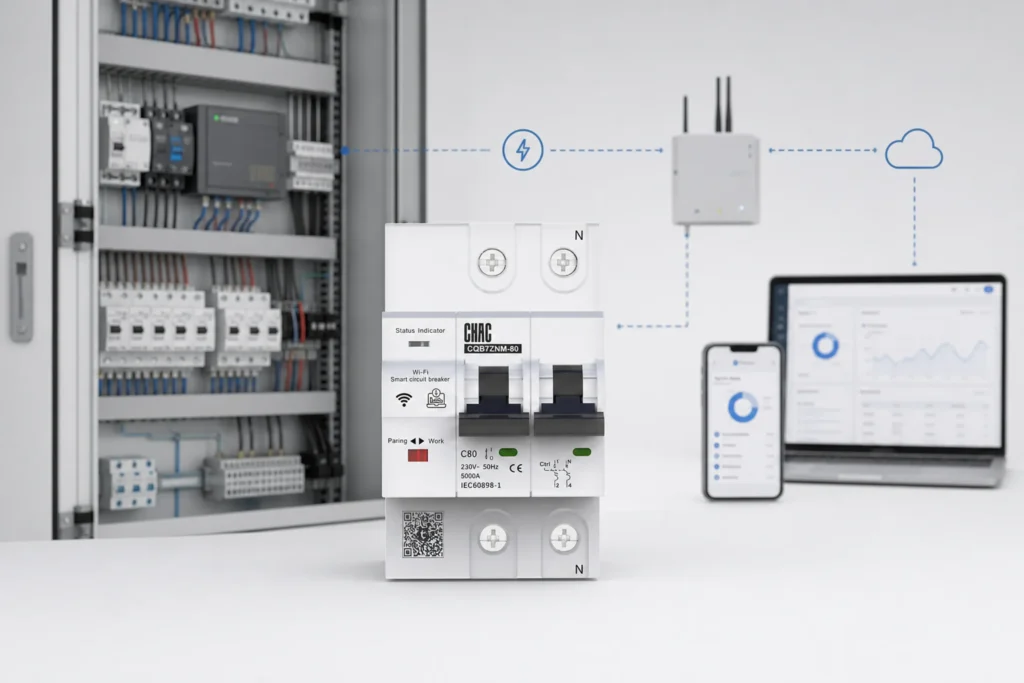
CHAC smart circuit breakers category leads to model-specific records. The WiFi circuit breaker page identifies CQB7ZNM-80, 1P+N, 230/240V AC, 50Hz, C curve and an AC residual-current type. It also lists WiFi and Smart Life/Tuya Smart. These entries do not prove arbitrary third-party API access or an offline schedule implementation.
For the choice between branch devices and panel-level monitoring, see the smart breaker versus smart panel architecture comparison. Use that architecture decision before approving an integration feature list.

Często zadawane pytania
Does pairing prove the breaker is ready for service?
No. Pairing demonstrates connectivity under the tested conditions; electrical and control acceptance remain separate.
Can the installer keep the only administrator account?
That can create a handover problem. Agree operator ownership and a documented transfer procedure before installation.
Will an app schedule work without the internet?
Only if the actual device or local platform supports it. Confirm where the schedule is stored and executed.
Can another app use the same WiFi breaker?
Not solely because both use WiFi. Integration requires documented platform or protocol support.
How should an old reading appear after a network failure?
It should be identified as stale, with its timestamp and connection status, rather than displayed as a live measurement.
Should reconnection automatically reclose a tripped circuit?
Do not assume that behavior is acceptable. Protective trips, remote commands and recovery permissions need an approved operating sequence.
Przypisy
- NIST Cybersecurity for IoT Program, including the April 2026 guidance announcement.
- NIST IR 8259 Series: activities for IoT manufacturers.
Approve the integration as an installed system, not as a paired phone and device. Establish electrical suitability first, then verify connectivity inside the final enclosure, and finally record command, failure and recovery behavior. Keep current data separate from historical data and remote switching separate from safe isolation. Ownership transfer, updates and end-of-life support also belong in the handover because they affect whether the installation remains usable. CHAC’s published configuration can support the component review; functions missing from that record should remain open questions until confirmed. Skontaktuj się z CHAC with the panel drawing and acceptance checklist for a model-specific discussion.