A prepaid-meter external-breaker quote becomes reviewable only when the meter interface and circuit fields are stated together. The RFQ needs poles, current, curve, drawing revision, quantity, required records, and the selected model proposed by the supplier; a generic “prepaid meter breaker” label cannot supply those missing details.
Part 1. Define the meter interface before naming the breaker
The RFQ should first describe the meter-program interface and the circuit role assigned to the external breaker. A project may use different meter arrangements, so the supplier needs the drawing and interface information rather than a product-family phrase alone.
Once that context is present, the circuit fields can be checked in a structured way. Pole count, rated current, tripping curve, quantity, and required documents become visible requirements instead of assumptions embedded in an order description.
Part 2. Keep circuit fields separate from platform assumptions
An external breaker associated with a prepaid meter still needs a selected-device review against the stated circuit. The prepayment purpose does not establish compatibility with every meter platform, billing system, control arrangement, or remote-operation requirement.
Keep the meter-system questions and the breaker fields in the same request, but do not treat them as interchangeable. The system owner or project team must confirm the interface, while the supplier can return the published record for the proposed device.
Importante: Do not infer prepaid-meter platform compatibility from a breaker family name, ordering image, or a generic smart-device description. Confirm the meter interface and selected-model documentation before approval. (IEC switchgear publication catalogue — selected-device review context)
Part 3. Compare the records behind an external-breaker request
The table below separates the information a buyer supplies from the evidence requested in return. It does not configure a meter platform or approve a breaker for a particular installation.
| Rever entrada | O que o comprador deve identificar | O que o fornecedor deve devolver |
|---|---|---|
| Meter-program interface | Meter arrangement and documented external-breaker role | Proposed model identification against the request |
| Pole count | Required 2P or 4P device arrangement | Selected-model pole information |
| Current and curve request | Stated circuit fields for the quotation | Published current and curve fields for the model |
| Revisão do desenho | Current record defining the circuit boundary | Confirmação do registo revisto |
| Documentos necessários | Evidence needed for comparison | Registo do produto e documentação solicitada |
This structure keeps a platform question from concealing a circuit question. It also lets a buyer compare supplier replies by the same document set rather than by an unverified product description.
Part 4. Put poles, current, and curve beside the drawing
Place the requested poles, rated current, and tripping curve alongside the current drawing revision. These fields should be copied from the approved project record or clearly identified as items requiring confirmation, not guessed from a past order or a product image.
| Evidências a fornecer | Porque é importante para o RFQ | Resposta para comparar |
|---|---|---|
| Meter interface note | Identifies the documented external-breaker role | Proposed model discussed against the note |
| Current drawing and revision | Shows the circuit boundary | Model information tied to the current record |
| Poles, current, and curve | States the requested breaker fields | Published selected-model ordering information |
| Quantity and delivery records | Defines the commercial request | Traceable product identification |
| Required document pack | Supports technical comparison | Requested product documents |
For a smart-monitoring question, read the related smart circuit breaker energy-monitoring selection article. A broader smart-interface review belongs in the smart WiFi circuit breaker integration checklist.
Part 5. Ask for a comparable prepaid-meter breaker quote
Ask suppliers to return an exact proposed model and the records that match the stated interface and circuit fields. That makes it possible to compare product identification, ordered poles, current, curve, and documentation without requesting the supplier to infer a meter platform from a short description.
| Incluir com o pedido de cotação | O que é que resolve | Resposta do fornecedor a solicitar |
|---|---|---|
| Meter interface and circuit role | Purpose of the external-breaker request | Proposed model identified to the request |
| Pole, current, and curve fields | Configuration to be reviewed | Published ordering and product information |
| Current drawing revision | Circuit boundary and record control | Documentation linked to the current record |
| Quantidade e formato da documentação | Commercial return requirements | Traceable quote and required records |
| Compatibility-review owner | System question that needs confirmation | Clear scope for supplier response |
Utilize o MCB category para o contexto de família de produtos. O Type B MCB selection article provides a separate record-review angle when the panel team needs to clarify MCB selection fields.
Part 6. Review the CHAC prepaid-meter breaker page with the RFQ
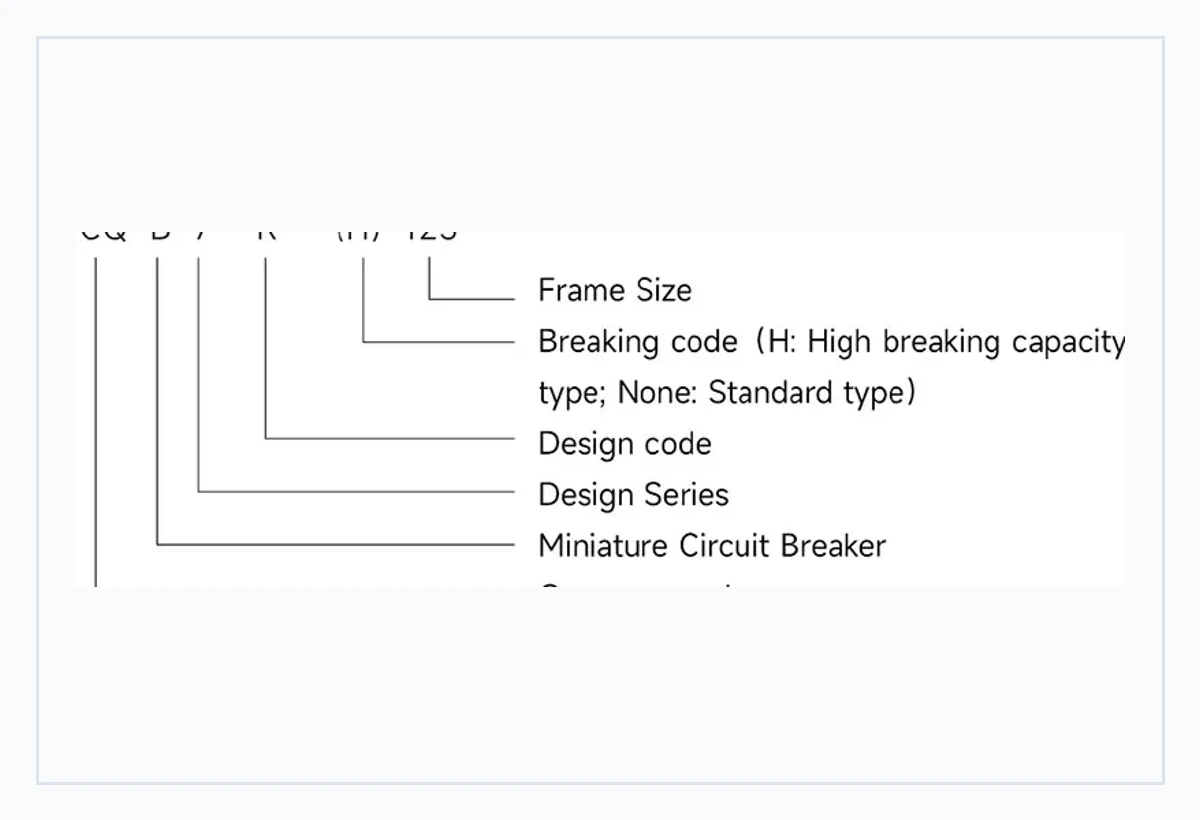
O CQB7R-125 prepaid-meter external breaker page publicly lists a prepayment-meter purpose, 2P/4P, B/C/D curves, and 40A–125A. Review those published ordering fields after the RFQ establishes the meter interface and circuit evidence; they do not establish platform compatibility or project approval.
Recomendação de produto
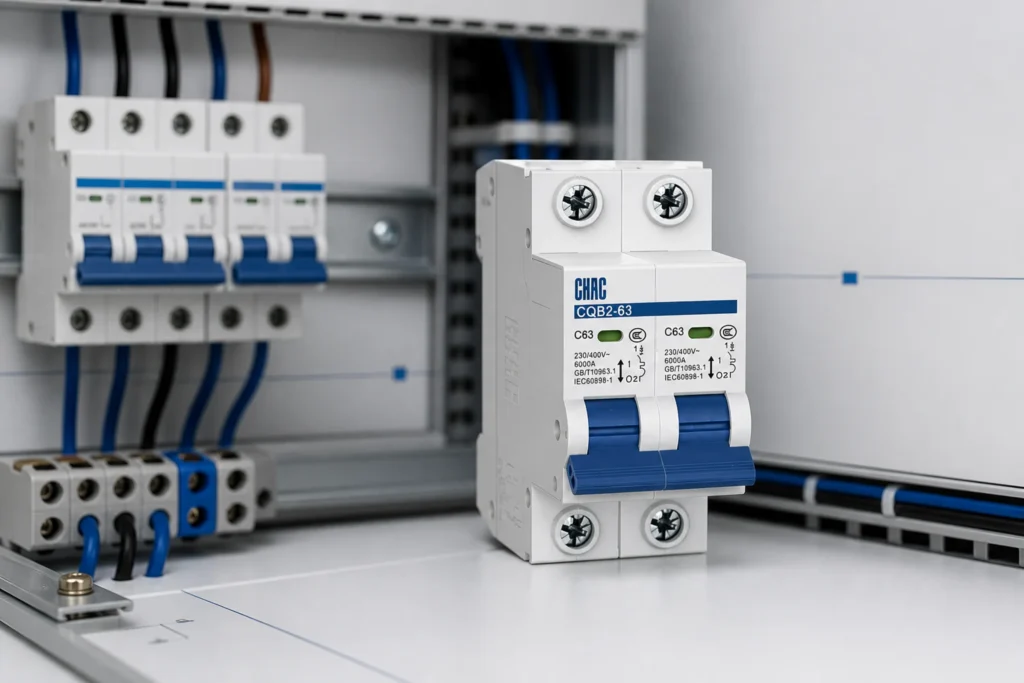
Disjuntor Miniatura CQB2-63 Para Sistemas de Energia | CHAC Electric
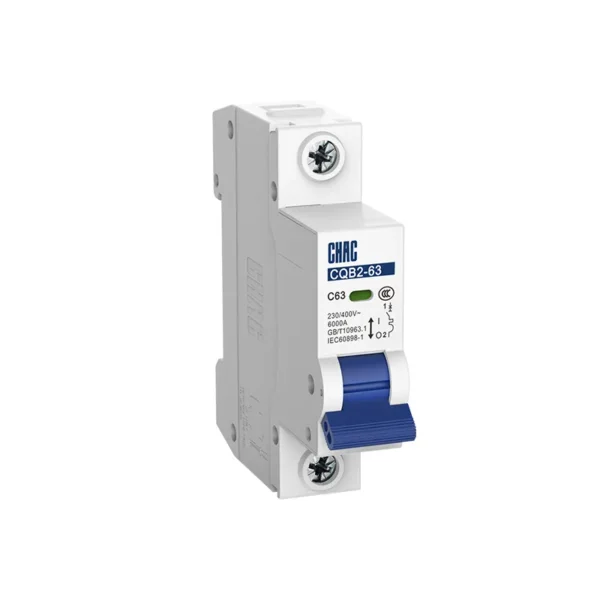
Review this CQB7R-125 page when the RFQ clearly identifies the meter interface, poles, current, curve, quantity, and requested records. Do not substitute a generic smart breaker or an image-only match: neither proves the external-breaker role or system compatibility. OEM labeling and documentation needs can be discussed through the página de personalização de terminais elétricos.
Part 7. Keep the meter-breaker request inside its fit boundary
This article supports early meter-program documentation and supplier comparison. It does not configure a meter platform, establish billing-system behavior, confirm remote operation, provide field-installation instruction, or approve a selected breaker for a named project.
Fit Boundary: retain final compatibility and selection with the meter-system owner, approved circuit documentation, selected-model records, applicable project requirements, and qualified engineering review. Send the RFQ evidence to CHAC Elétrico ao solicitar uma discussão sobre um produto.
FAQs
What is an external breaker for a prepaid meter?
It is a breaker request associated with a documented prepaid-meter arrangement. The meter interface and circuit role must be stated before a selected model is compared.
Does a prepaid meter breaker need a particular pole count?
The required pole count comes from the circuit and meter arrangement shown in the project record. Request selected-model pole information rather than assuming it from the product name.
What rated current should be specified for a prepaid meter breaker?
State the current requirement from the approved circuit documentation and ask the supplier to return the selected-model fields for comparison.
Is a prepaid meter breaker the same as a smart breaker?
No automatic equivalence should be assumed. Their meter-interface, monitoring, control, and selected-model records need separate review.
What information should a buyer send for a prepaid meter breaker quote?
Send the meter interface note, circuit role, drawing revision, poles, current, curve, quantity, required records, and the person responsible for compatibility review.
Who confirms meter-system compatibility?
The meter-system owner or responsible project engineering review should confirm compatibility using the system record and the selected-device documentation.