An MCB isolation function should be requested as its own documented feature, not blended into a generic statement about overcurrent protection. A useful RFQ describes the circuit role, poles, current, curve, isolation requirement, maintenance context, and the exact product record so each point can be reviewed on its own evidence.
Part 1. Treat protection and isolation as separate buying questions
An MCB is commonly selected for an overcurrent-protection role, while an isolation-function question asks a different thing about the product record and intended use. Keeping the two questions separate makes a quotation easier to compare and reduces the chance that a functional label is mistaken for a project decision.
Search questions such as “Is an MCB a means of isolation?” show the ambiguity directly. They do not have a universal project answer because acceptability depends on the relevant requirements, the equipment arrangement, and the documentation being reviewed.
| Review concept | RFQ question | Evidence to keep with the answer |
|---|---|---|
| Overcurrent protection | What protective role is required? | Circuit role and requested product record |
| Isolation function | What isolation-function statement is requested? | Product-page wording and selected configuration |
| Separate isolator | Is a separate device specified for the assembly? | Project documentation and equipment design |
| Project acceptability | Who confirms the final arrangement? | Applicable project review, not a blog article |
For the product family context, start with CHAC’s Categoria de produtos MCB. This article focuses only on the documentation boundary around an MCB isolation-function request.
Part 2. Put the device role before the product label
Maintenance and isolation discussions need the circuit role first. The IET’s article on isolation and switching for mechanical maintenance treats the topic as a technical context, which is why a short product name alone is not enough for an RFQ.
Describe whether the request concerns a protective MCB, a separate isolator, or a product record carrying an isolation-function statement. That description does not select a device; it tells the reviewer which functional question must be answered from which evidence.
Important: Do not turn an isolation-function label into a project approval. The IET maintenance-isolation discussion is a reminder that context matters when considering isolation and switching.
The related fused versus non-fused disconnect RFQ guide covers a different procurement boundary. It can help clarify a separate disconnect choice, but it cannot decide whether a specific MCB entry satisfies an unrelated panel requirement.
Part 3. Capture the MCB record without overextending it
Product-page fields are most valuable when they stay attached to the named series. CHAC’s PXB9N-32 page lists AC frequency, 230 V, up to 32 A, 1P+N, and B/C/D options, and describes isolation, overload, and short-circuit protection for that named product record.
Those fields are useful for organising a review. They are not a substitute for the circuit role, the required pole arrangement, or any project-level determination about the complete assembly.
Comparison resources from VIOX e Kripal reinforce the reason to keep circuit-breaker and isolator concepts visible as distinct decision points. Their general comparison perspective should not be rewritten as a claim about the PXB9N-32 series.
Part 4. Make the isolation requirement reviewable in an RFQ
Rather than asking whether an MCB “has isolation,” make the requested feature auditable. Give the reviewer a table that separates what the panel needs from what the named record actually says.
| Enviar com a consulta prévia | Why it belongs in the review | Bounded wording |
|---|---|---|
| Função do circuito | Distinguishes protective and disconnect-related questions | “State the function required in the assembly” |
| Disposição de polos | Connects the request to the physical product format | “Provide the required pole arrangement” |
| Current and curve | Identifies the requested MCB record | “State requested current and curve from the project record” |
| Isolation-function requirement | Separates the feature from protection language | “Confirm against the named product page and configuration” |
| Maintenance / equipment context | Shows why the question is being asked | “Describe the equipment context without assuming acceptance” |
| Product page or datasheet | Lets the response be traced | “Attach the selected series record” |
The phrase “confirm against the named product page and configuration” is intentionally narrow. It asks for an evidence-based reply without claiming that an MCB is automatically a substitute for a separate isolator.
For a related product distinction, the single-pole versus double-pole MCB selection article may help a buyer frame pole information. It does not replace the isolation-function requirement in this RFQ.
Part 5. Use PXB9N-32 as a named documentation example
O PXB9N-32 MCB product record gives a buyer a defined page to attach to a request. Its listed AC frequency, 230 V, up-to-32-A, 1P+N, and B/C/D fields can be quoted as the page record while the reviewer checks the requested configuration.
That makes PXB9N-32 a useful documentation example, not a universal recommendation for every panel. If the buyer needs OEM discussions after the function and product fields are organised, CHAC’s terminal electrical product customization page is the appropriate conversion path.
Part 6. Reserve project acceptability for the right review
The final RFQ should clearly state what still needs project confirmation. A product record can support a discussion of listed functions and available fields, yet it does not settle local requirements, operating procedure, maintenance controls, or the acceptability of a complete installation.
This fit boundary protects both the buyer and the vendor from an overbroad answer. Send the circuit role, requested product record, and required isolation-function wording through the Página de contacto do CHAC so the response can stay tied to the supplied documentation.
Recomendação de produto
PXB2-63 Miniature Circuit Breaker (MCB) | CHAC Electric

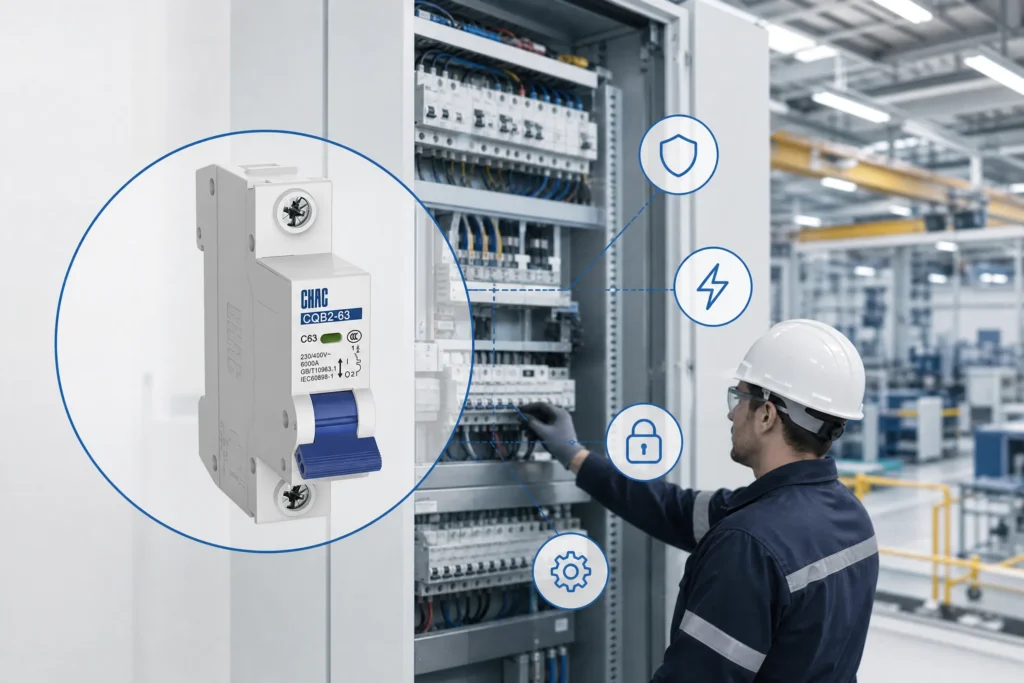
MCB isolation function should be described as a switching and maintenance requirement alongside, rather than inside, the overload and short-circuit protection requirement. State which conductors must be disconnected, the operating position that must be visible, and the installation rule or project specification that governs the choice.
Breaker selection record For a product review, include rated voltage, poles, current, curve, capacidade de quebra, terminal arrangement, mounting system, and the required documentation. The CHAC MCB range e o PXB9N-32 product record can support the first document check; final acceptability remains a project review.
Isolation requirement is clearer in an RFQ when it includes the maintenance scenario and the intended circuit boundary. That prevents a supplier from treating a generic breaker description as approval for a particular installation.
Para uma referência de seleção relacionada, consulte How Should an RFQ Define.
Frequently Asked Questions: MCB Isolation Function
What does an MCB isolation function describe?
It describes an isolation-related statement in the selected product record. Keep that statement separate from the MCB’s overcurrent-protection role and confirm it against the named series and configuration.
Is an MCB isolation function the same as a separate isolator?
No. They are separate buying questions. The RFQ should describe whether a separate isolator is specified and should not assume that one product label answers the complete assembly requirement.
Can a product page confirm project acceptability?
No. A product page provides published product information, while project acceptability depends on the complete equipment context and the requirements governing that project.
Which MCB details should accompany the isolation request?
Provide the circuit role, pole arrangement, requested current and curve, isolation-function wording sought, maintenance or equipment context, and the named product page or datasheet.
What does the PXB9N-32 page state?
The named page lists AC frequency, 230 V, up to 32 A, 1P+N, B/C/D options, and isolation, overload, and short-circuit protection wording. Confirm the selected configuration before treating those fields as relevant to a request.
Why include maintenance context in the RFQ?
Maintenance context explains why isolation is being considered and helps the reviewer understand the device role. It does not create an approval or replace the project’s own review process.