Um quadro elétrico pode não ter espaços livres de tamanho padrão e, ainda assim, dispor de capacidade elétrica suficiente para mais um circuito. Isso não torna automaticamente o disjuntor tandem a solução adequada: o problema dos espaços vazios, o número máximo de circuitos permitido pelo quadro e sua capacidade de carga são aspectos que devem ser verificados separadamente. O encaixe físico não é critério suficiente para aprovação, e um dispositivo compacto pode não oferecer a proteção necessária a um novo circuito. A decisão deve basear-se na etiqueta do quadro e na documentação do disjuntor, e não no número de alavancas que cabem atrás da tampa.
A resposta curta é que um quebra-t tandem pode fornecer dois circuitos derivados protegidos de forma independente em um espaço aprovado do quadro. Em um quadro típico dos EUA com 120/240 e fase dividida em V, ambos os circuitos tandem convencionais conectam-se ao mesmo ramo da alimentação; eles não formam um circuito 240 em V. Economizar um espaço não aumenta a classificação do quadro, do alimentador ou do serviço. Antes de especificar um, verifique o tipo e a localização do disjuntor aprovado, a disposição do neutro, a proteção necessária e a carga calculada. A UL Solutions’ Guia de Aplicação de Painel explica por que as unidades instaladas em campo devem corresponder às marcações do painel ou a uma aplicação de substituição especificamente avaliada.
O que é um disjuntor em tandem e o que ele altera dentro do quadro elétrico?
Como um único espaço físico pode atender a dois circuitos derivados?
Um disjuntor tandem convencional, também chamado de disjuntor duplo, contém dois dispositivos independentes de proteção contra sobrecorrente de polo único em um único conjunto completo.disjuntor de tamanho largura. Ela determina a forma como os circuitos utilizam uma posição de barramento aprovada, e não a classificação da caixa ou do conjunto. Outros projetos de disjuntores compactos podem adotar disposições diferentes; portanto, apenas o aspecto de meia largura não é suficiente para identificar um disjuntor em tandem.
Essa distinção deixa três aspectos a serem verificados separadamente. Os espaços correspondem às posições físicas; os circuitos são os ramais protegidos permitidos pelo quadro; e a capacidade abrange as classificações do disjuntor principal, dos disjuntores de alimentação, do barramento e da entrada de serviço. Um quadro pode permitir mais circuitos do que o número total de espaços de tamanho padrão, mas a classificação em amperes, por si só, não indica se o uso em configuração tandem é aceito.
| Atributo do painel | O que uma dupla pode mudar | O que permanece inalterado |
|---|---|---|
| Espaços físicos | Dois circuitos podem compartilhar um espaço aprovado. | Posições dos ônibus e tamanho do recinto |
| Circuitos permitidos | Utilização da indenização documentada para dispositivos compactos | O número máximo de circuitos do rótulo |
| Capacidade elétrica | Alocação adicional de filiais | Classificações de linha principal, alimentador, serviço e barramento |
| Corrente de defeito | O dispositivo de proteção da ramificação instalado | Corrente de curto-circuito disponível e classificações requeridas |
| Cargas bipolares | Nenhuma função de dois polos proveniente de um tandem convencional | Etapas de fornecimento obrigatórias, desconexão e arranjo de disparo |
Por que duas alças não formam um disjuntor V 240?
Um tandem convencional em um quadro de distribuição americano de fase dividida fornece dois circuitos independentes de 120 V a partir de uma conexão ao barramento; ele não substitui um disjuntor bipolar com disparo conjunto em uma carga de 240 V. Um quad pode combinar funções monopolo e bipolar em dois espaços, mas suas conexões ao barramento e o arranjo de disparo são específicos do modelo. A certificação UL 489 de um disjuntor por si só não garante a adequação para todos os quadros ou para todas as combinações com classificação em série; a UL Solutions’ Circuit Breaker and Supplementary Protector Services distinguishes device investigation from end-application investigation.
How Does the Panel Label Determine Whether a Tandem Is Permitted?
Why does the position diagram matter more than an empty opening?
The nameplate, diagram, position map, and instructions form the compatibility record. Some panels identify certain compact-breaker spaces; others allow none. A sound tandem breaker compatibility review records the panel catalog, breaker family, position, rating, bus connection, and terminals. Similar dimensions do not demonstrate an evaluated combination.
What does Class CTL establish?
Class CTL means Circuit Total Limitation. CTL equipment historically used markings and rejection features to constrain circuit totals and locations. A legacy non-CTL replacement is not permission to defeat those features or exceed the panel’s documented circuit limit. Equipment generations vary, so the original label and exact manufacturer instructions remain essential.
For US installations, follow the locally adopted NEC and the equipment’s installation conditions. The authority having jurisdiction makes the project-specific acceptance decision. The UL guide cautions that code section numbering can change between editions; a section number copied from another project is not a substitute for the applicable edition.
Does a UL Classified replacement allow any breaker that fits?
No. The Guia de Aplicação de Painel describes a specific Classified replacement category: breakers rated 15-60 A at 120/240 V AC, evaluated for identified Listed panelboards rated no more than 225 A at 120/240 V AC, with maximum available system short-circuit current of 10 kA. Those are limits of that described category, not universal tandem ratings or proof that a particular tandem qualifies.
Match the exact panel and replacement catalog numbers against the publication supplied with the breaker, including its restrictions. A Classified mark does not establish permission for an unlisted compact position, a higher circuit count, or an undocumented series-rated combination. UL’s Product Sourcing and Certifications Database supports checking certification identifiers and category guidance; an exact applicable record is still needed. If that evidence is unavailable, do not treat a cross-brand fit as compatibility.
Which Electrical and Protection Limits Remain After Space Is Saved?
Does higher circuit density create more usable capacity?
More handles do not mean more usable amperes. The load calculation still covers feeder demand, continuous loads, conductor ampacity, and panel rating. Greater circuit density can concentrate terminations and loads locally; a properly approved tandem is not inherently unsafe, but torque, conductor condition, and the manufacturer’s installation conditions matter. An infrared survey may reveal a hotspot but cannot prove compatibility. The Guia de Aplicação de Painel separates the assembly’s current rating from individual device ratings and explains that neutral-bus ampacity cannot be judged from dimensions alone.
Can neutral arrangements rule out a compact solution?
Map every grounded and ungrounded conductor before moving circuits. A multiwire branch circuit requires the correct supply-leg and disconnecting arrangement; two independent tandem poles on one supply leg are not an automatic solution. The shared neutral must not be mistaken for two independent neutrals. Keep this check separate from conductor sizing and from whether a particular device provides common trip.
There must also be suitable neutral terminations for the added circuits. UL’s Guia de Aplicação de Painel calls for individual branch-circuit neutral terminals and markings identifying permitted conductor combinations. Space saved at the breaker does not authorize putting unrelated branch neutrals together under an unsuitable terminal or adding an unapproved terminal kit.
Can a tandem preserve AFCI or GFCI protection?
Required AFCI, GFCI, or dual-function protection cannot be waived to recover panel space. Check whether the exact compatible device and circuit arrangement provide the protection required by the adopted code. A conventional overcurrent-only tandem is not functionally equivalent to an AFCI or GFCI breaker merely because the ampere rating matches. Any alternative protection arrangement needs project-specific code and manufacturer verification, including its neutral connections; do not assume a downstream receptacle solves every requirement.
Fault duty remains a separate check. A tandem does not reduce available fault current. The Guia de Aplicação de Painel explains that assembly short-circuit ratings can depend on specific installed devices and documented upstream/downstream combinations. Retain those conditions when adding or replacing a breaker.
When Should a Capacity Review Compare a Tandem With a Panel Upgrade?
Is the least disruptive option always the best long-term choice?
A tandem can work when the panel accepts it, the load calculation has margin, required protection is available, and expansion is modest. A panel capacity upgrade deserves consideration when circuit limits are exhausted, equipment condition is uncertain, fault-duty data is missing, or future loads need unsupported devices. Missing records should first be resolved; they do not by themselves prove the panel must be replaced.
| Condição do projeto | Possible direction | É necessário evidência |
|---|---|---|
| Approved slot and load margin | Consider a tandem | Label, position map, datasheet, neutral terminals, and load schedule |
| 240 V load or shared neutral | Specified multipole device or approved quad arrangement | Supply-leg, wiring, disconnecting, and trip documentation |
| AFCI, GFCI, or dual-function requirement | Verify the complete protection arrangement | Exact device function, panel compatibility, and neutral instructions |
| No allowance or circuit total reached | Assess a subpanel or panel redesign | Load, feeder, fault-current, and approval records |
Total installed cost includes engineering, shutdowns, relabeling, conductor work, inspection, and the next expansion. Compare those boundaries rather than the breaker price alone. A subpanel adds circuit positions but does not, by itself, increase the supplying service capacity.
What Should Procurement Preserve for Future Maintenance?
Why does catalog traceability matter?
Before release, capture the panel and breaker manufacturer, complete catalog numbers, series, ratings, permitted slot, and instructions. A later equivalent may share a frame size but differ in rejection features, terminals, or protection. If the approved family is becoming obsolete or lacks needed variants, compare documented replacement options with redesign.
After installation, update the panel directory and permitted-slot record; retain approved submittals, label images, and remaining compact positions in the asset file. For separate new low-voltage applications, equipamento de distribuição elétrica must be selected for its destination rules and assembly requirements. An IEC breaker description does not establish suitability as a replacement in a US proprietary panel.
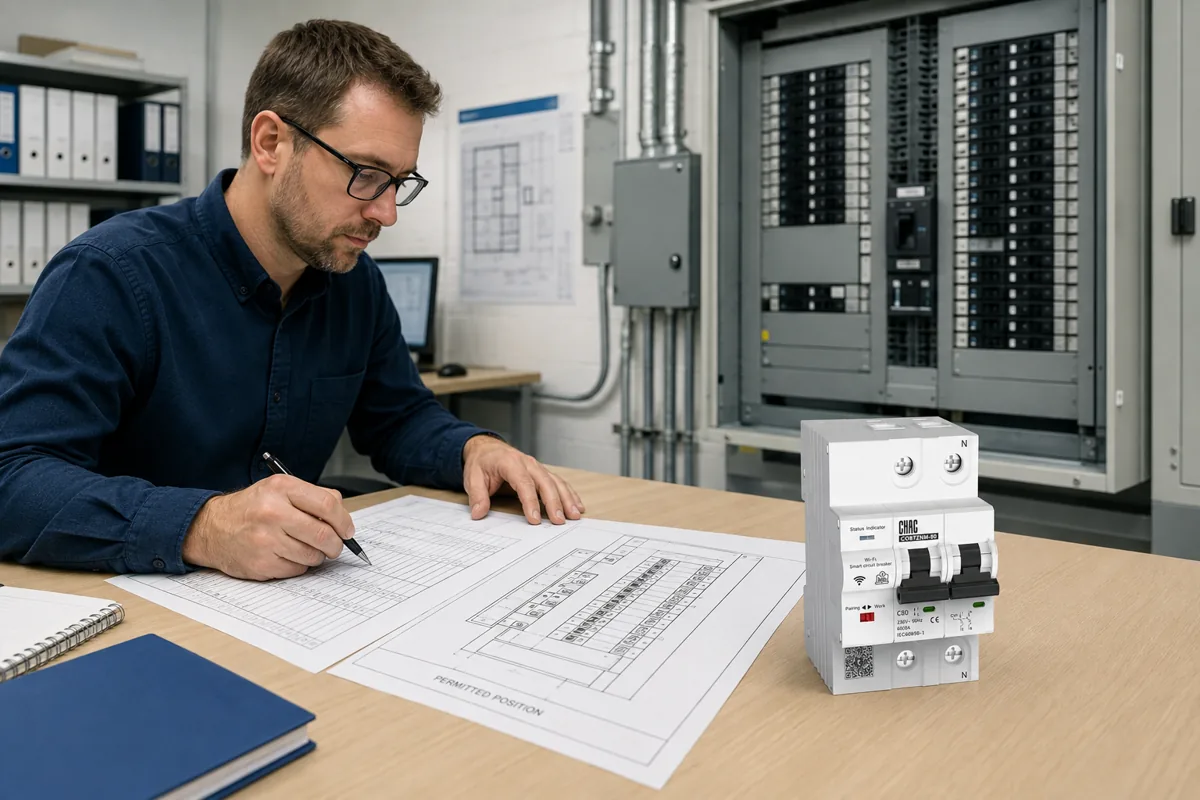
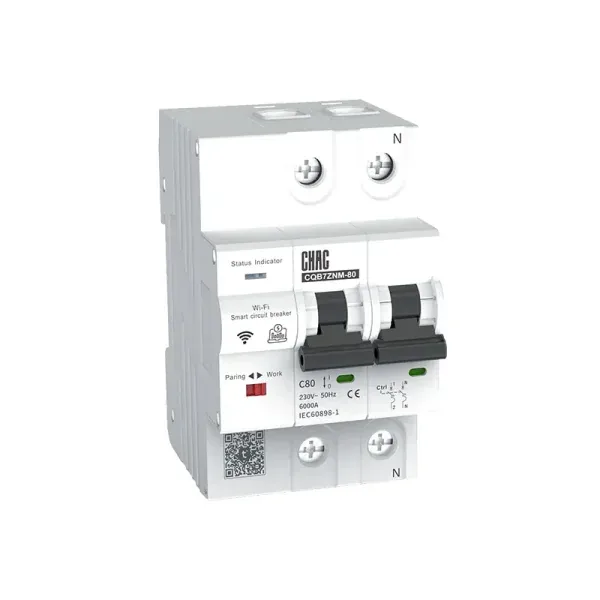
CHAC product documentation can support a separate low-voltage product review; neither the product image below nor a matching current rating establishes tandem compatibility with the existing panel.
How Should a Tandem Retrofit Be Documented for the Next Technician?
The retrofit record should show the panel catalog number, approved compact-breaker positions, complete replacement catalog number, circuit directory, conductor and neutral arrangement, protection type, and the load calculation used for the change. Keep any Classified replacement publication and applicable series-rating documentation with that record. Photographing the label and position map is useful because a future technician cannot infer certification scope from the handle shape.
When no permitted position remains, compare a subpanel or redesign rather than modifying rejection features. Installation and internal inspection belong to qualified electrical personnel; these documentation checks are not instructions for working inside an energized panel.
Perguntas Frequentes
How can a technician tell whether a panel accepts tandem breakers?
Read the panel label, position map, catalog number, and manufacturer instructions. Confirm permitted compact positions and the approved breaker type; an empty slot or matching width is not evidence. A Classified replacement requires its exact panel-specific documentation as well.
What does Class CTL mean on a breaker?
Class CTL is a circuit-total-limitation system that constrains compact breakers to designed counts and locations. It does not override the panel label; legacy non-CTL replacements need exact manufacturer and local guidance.
Can a tandem breaker be used for 240 V?
A conventional tandem in a US split-phase panel connects both independent circuits to one supply leg, so it does not replace a two-pole common-trip device for a 240 V load. An approved quad or two-pole product requires verification of its bus connections, trip diagram, and panel compatibility.
How many tandem breakers are allowed in one panel?
The panel’s ampere rating does not answer this. Permitted numbers and locations come from the exact label, design, certification conditions, manufacturer instructions, and local rules; never exceed the documented circuit total.
What is a tandem breaker used for in a 100-amp panel?
It can provide two independent branch circuits in one space only when that exact panel permits it and the load calculation supports the circuits. Neither the panel’s marked rating nor the service rating increases, and required AFCI or GFCI protection still applies.
What if the panel label or replacement compatibility list is missing?
Use the exact catalog identifiers to obtain the manufacturer’s documentation and applicable certification record before selecting the device. Do not infer permitted positions from another panel that looks similar. If the application cannot be verified, a qualified designer and the local authority should assess a documented alternative.
Referências
- Guia de Aplicação de Painel – UL Solutions; field-installed devices, current ratings, short-circuit ratings, and wiring terminals. Public guidance reviewed October 7, 2026; use the locally adopted code edition.
- Circuit Breaker and Supplementary Protector Services – UL Solutions; breaker certification and the limits of replacement-device investigation. Public guidance reviewed October 7, 2026.
- Product Sourcing and Certifications Database – UL Solutions; searching certification identifiers and product-category guidance. Public overview reviewed October 7, 2026; no exact panel replacement is established by this overview.
The right compact breaker is the one the panel record, electrical design, and future maintenance plan can all support. First resolve the permitted device and position, then check the load and protection arrangement, and finally preserve the evidence for the next technician. Neither spare electrical capacity nor a certification logo cancels a restriction on where or how a device may be installed. For a separate new low-voltage application, not as a US tandem replacement, review the Disjuntor de circuito em miniatura CQB2-63 documentation with CHAC Electric’s technical team before final selection.
Para uma referência de seleção relacionada, consulte What Is a Tandem Breaker.