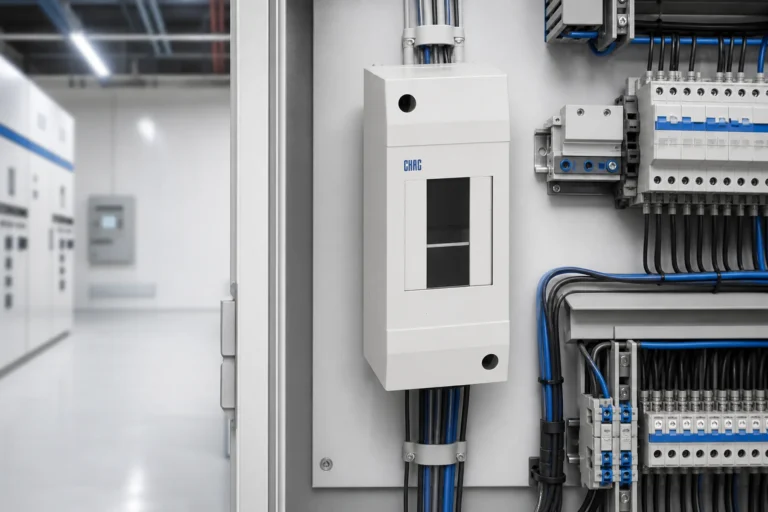
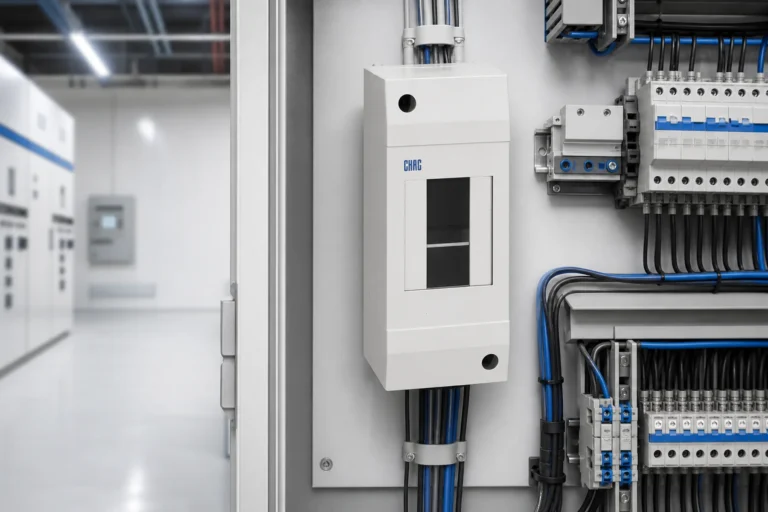
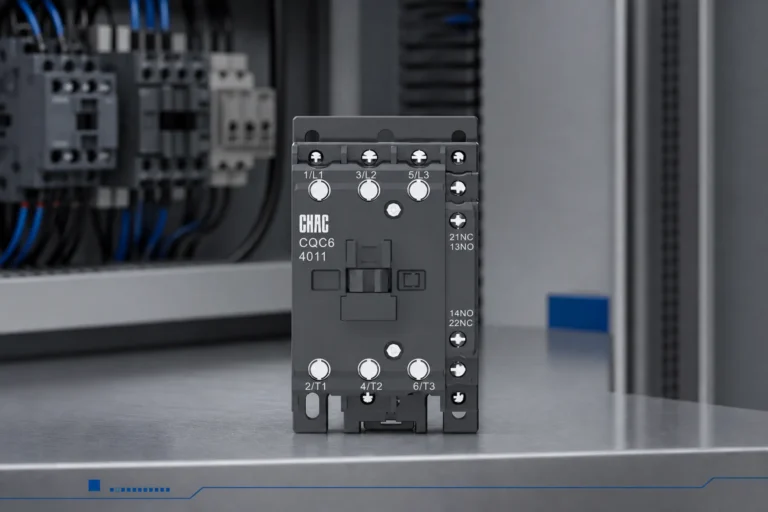
Dc mcb battery panel work starts with the circuit role, the project requirement, and selected-model documentation. DC MCB Selection Questions for Battery and DC Distribution Panels helps panel builders organize those checks before a device is specified or an RFQ is issued. DC MCB choices remain controlled by the DC single-line diagram, polarity notes, and the DC-capable model documentation named on the bill of materials.
Conteúdos
Part 1. What decision does a DC MCB review support?
A DC MCB review asks whether a miniature circuit breaker documented for DC duty fits a battery or DC distribution branch under the project rules. It is a circuit-role and documentation question, not a claim that every MCB can be reused from an AC panel.
Part 2. Which DC system inputs belong on the RFQ first?
Record nominal DC voltage context, polarity arrangement, load or source character, cable notes, and the upstream/downstream device map. These inputs separate a battery-panel branch decision from an AC lighting-panel habit.
Part 3. How should polarity and wiring rules be captured?
Require the drawing to show polarity, terminal orientation expectations, and any series-pole instructions that the selected-model documentation may impose. Missing polarity notes are a common RFQ defect in DC panels.
Importante: DC circuit behavior and polarity constraints are not proven by an AC MCB catalogue page; use only selected-model DC documentation for the battery or DC distribution design. (fonte — IEC DC and miniature circuit-breaker standards discovery)
Part 4. Where do battery panels differ from generic DC marketing claims?
Battery and DC distribution assemblies often combine protection, isolation, and service access constraints that a generic DC breaker photo does not explain. Keep isolation devices and protective devices on separate review lines when the design assigns both.
Part 5. What evidence should suppliers return?
Ask for exact model identification, DC-capable documentation, installation instructions, and any project evidence pack named in the RFQ. Do not accept an AC datasheet as proof for a DC branch.
Uma lista de introdução de RFQ compacta torna a resposta do fornecedor mais fácil de comparar:
| O comprador deve fornecer | Por que é importante | Erro comum |
|---|---|---|
| Conjunto de desenhos atual | Define o limite do circuito | A enviar um nome de produto sem um diagrama |
| Funções obrigatórias | Torna o pedido passível de revisão | Tratar opções não verificadas como padrão |
| Contexto de instalação | Identifica as condições do projeto a confirmar | Assumindo que o texto da categoria é uma aprovação de projeto |
| Pedido de documentação | Liga a RFQ à evidência exacta | Aceitar afirmações genéricas em vez de dados do modelo |
| Enviar com citação | Torna a comparação de fornecedores auditável | Citação sem o pacote de evidências solicitado |
Para um contexto mais amplo, reveja o dc mcb battery panel product family e o respetivo página de linha de produtos.
Part 6. Which CHAC product route starts sourcing?
The PXB6DC DC miniature circuit breaker product route is an appropriate starting point after DC inputs are listed, with the MCB category for family navigation. The route does not replace a battery-system design review or selected-model confirmation.
Recomendação de produto
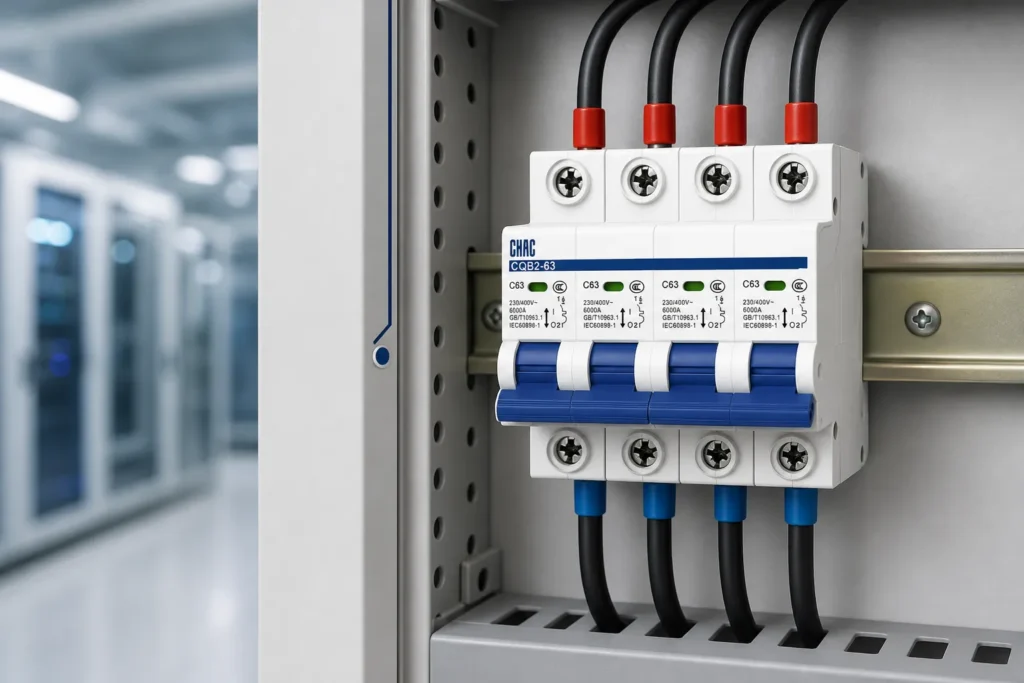
Disjuntor Miniatura CQB2-63 Para Sistemas de Energia | CHAC Electric
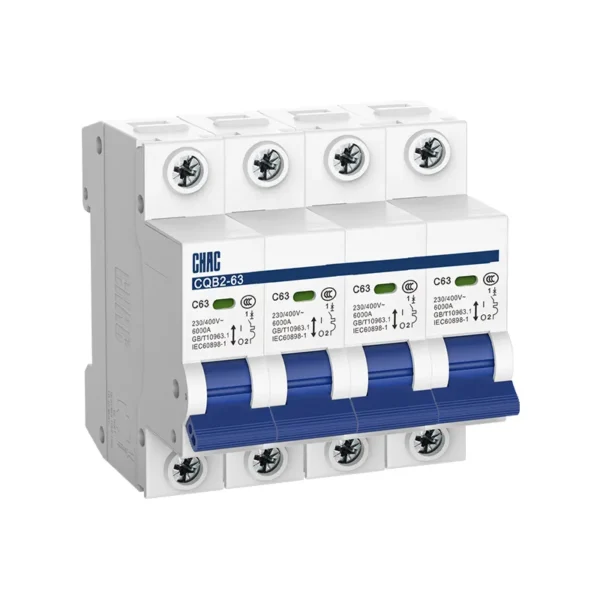
Use o publicado página de produto CHAC relevante as a documented product route starting point for a product discussion only after the RFQ inputs are complete. OEM labeling for DC miniature breakers can be discussed on the página de personalização de terminais elétricos. An AC-looking miniature breaker body does not prove DC voltage class, polarity wiring rules, or battery-circuit suitability.
Part 7. Where does DC MCB selection hand off to the battery-system designer?
This article supports early DC panel RFQs. It is not a solar-string sizing guide, a DC isolator selection article, or authorization to work on energized DC circuits without qualified procedures. Include a drawing review of polarity, string or bus arrangement, and upstream/downstream DC devices before comparing quotations.
Leitura relacionada: um artigo da CHAC mais restrito e já publicado está associado por contexto, e não como substituto para o âmbito de decisão deste artigo.
Bring the DC single-line diagram and polarity notes to contactar CHAC Electric for a DC MCB product-route discussion.
Fit Boundary: DC MCB RFQ support stops before battery energy-system certification, live DC work methods, or solar-string design claims.
FAQs
Can an AC MCB be assumed suitable for a battery branch?
No. Confirm DC-capable selected-model documentation before approving the device for a DC circuit.
What polarity information belongs in the RFQ?
Show polarity arrangement and any wiring orientation rules required by the selected product instructions.
How does this differ from a solar DC breaker checklist?
Solar-string and PV-specific checks are a related but separate review; this article focuses on battery/DC distribution panel RFQ inputs.
Should isolation and protection be quoted as one line item?
Only if the approved drawing assigns both duties to the same documented device; otherwise keep them separate.
What documents should the supplier provide?
DC-capable model evidence, installation instructions, and the documentation pack requested in the RFQ.
When should the DC breaker selection be frozen?
Freeze it after the DC single-line diagram and polarity notes are approved, before the panel bill of materials is released.