
A disconnect selected by its ampere rating alone may solve the wrong problem. Maintenance isolation, switching a running load, and clearing an electrical fault are separate duties; a device that performs one does not automatically perform the others. The distinction becomes especially important when equipment has an inverter, battery, UPS, or separate control supply: opening one switch may leave another source connected to the work area. This guide explains how to specify the required function, check the relevant ratings, and define an isolation boundary that maintenance personnel can verify before work begins.
The short answer is that a disconnect switch separates a circuit or equipment from a source within its declared duty. It does not automatically provide overload or short-circuit protection, and an off-load disconnector must not be assumed to interrupt a running load. For covered US workplace electrical work, OSHA 29 CFR 1910.333 requires disconnection from all electric energy sources and qualified-person verification of the deenergized condition. Start with the equipment’s sources and operating duty, then verify voltage, current, poles, fault-duty evidence, lockout provisions, enclosure, and the installation rules that apply.
Переключатель отключения — это устройство, управляемое вручную или механически, которое отделяет цепь или оборудование от источника питания. В региональном языке эти устройства называются переключателем предохранения, изолятором, разрывочным контактором, разрывовым переключателем и локальным отключением. Эти названия не являются показателями производительности. На этикетках и сопроводительной документации следует указать, изолирует ли изделие только цепь, прерывает ли он нормальную нагрузку, переключает ли мотор или сочетает отключение с использованием предохранителей.
Its practical purpose is to give maintenance teams an identifiable boundary between the source and the work area. An OFF handle is only an indication; safe work still requires an approved shutdown, isolation of every relevant energy source, control of stored energy, lockout/tagout, and verification.
Какую функцию выполняет переключатель отключения?
The essential function is disconnection. A автоматический выключатель instead opens automatically under specified overload or short-circuit conditions; a disconnect may have no trip mechanism. A suitable breaker can sometimes serve as the disconnecting means, but not every disconnect protects a circuit and not every breaker is an effective local isolation point.
A fused disconnect switch adds fuses that may protect the circuit or equipment and support a tested conditional short-circuit rating. A non-fused disconnect relies on separate protection, usually upstream. The designer must identify where protection occurs, whether coordination or current limitation is required, and which component combination was evaluated.
How does isolation differ from load-break duty?
An off-load disconnector establishes isolation after another device removes current. A load-break switch can make and break normal current only within its declared ratings and conditions. Operating an off-load isolator under load can create an arc hazard. State whether operation occurs at no load, at running current, or under a defined motor duty.
For IEC-market procurement, request the exact device’s declared utilization category and its associated voltage and current. Do not assign a motor-switching category from the word “isolator,” a nominal ampere rating, or an enclosure photograph. A published product-standard scope is not evidence of a particular model’s switching duty.
Why does a visible break not complete the isolation process?
Some safety switches expose open blades or provide a viewing window; others use mechanisms and position indication documented by the manufacturer. “Visible blade” and “visible break” may not mean the same thing under every standard or owner specification. Neither replaces verification of the deenergized condition. Ask what is visible, what the indication proves, and whether the mechanism satisfies the project requirement.
| Тип устройства | Основная функция | Граница выбора |
|---|---|---|
| Отключающий разъем или изолятор | Обеспечивает изоляцию после отключения токов | Не эксплуатируйте при нагрузке, если она не указана в характеристиках и не соответствует этой нагрузке. |
| Load-break switch | Switches normal current within declared ratings | Confirm isolation suitability separately; a switch-disconnector combines both duties |
| Несварная разъемная фиксация | Provides local switching or isolation as rated | Coordinate with suitable separate overcurrent protection |
| Синкопный отключитель | Сочетает отключение с защитой на основе предохранителей | Проверьте класс или тип предохранителей, правила замены, согласованность и технические характеристики сборки |
| Выключатель, используемый для отключения | Предоставляет автоматическую защиту и может привести к отключению | Confirm isolation marking, instructions, access, lockability, and applicable installation rules |
For the breaker-based option, Schneider Electric’s Основные характеристики переключателя, updated August 5, 2026, explains that isolation suitability requires the disconnector conditions at the rated voltage and the corresponding marking. Its examples concern Schneider equipment; they do not establish the isolation suitability of an unverified CHAC model.
Blurred roles lead to rejected specifications, damaged contacts, unplanned replacement, or unnecessary spares. Compare engineering, maintenance, and downtime as well as unit price.
Где применяются различные требования к средствам отключения?
For US projects, service disconnecting means, local motor disconnects, HVAC disconnects, and PV disconnects have different installation contexts. Review the locally adopted National Electrical Code edition, equipment instructions, utility requirements where relevant, and the authority having jurisdiction. A downstream general-use switch is not automatically suitable for use as service equipment.
Service equipment also raises grounding and bonding questions. The neutral and equipment-grounding arrangements depend on the system and the disconnect’s location. Ground-electrode resistance is not the same as the effective fault-current path, as this guide to гравитационная устойчивость коммерческих зданий объясняет.
For industrial motors, review motor duty, supply voltage, starting method, controller location, and switching frequency rather than selecting by continuous amperes alone. A contactor performs control switching but an open contactor is not, by itself, proof of maintenance isolation. This guide to переключение и изоляция двигателей разделяет функции управления, изоляции, защиты от перегрузки и защиты от короткого замыкания.
For air-conditioning and refrigeration equipment, review the nameplate, minimum circuit ampacity, maximum overcurrent protection, supply topology, exposure, and required disconnect location together. A weather-resistant box does not prove the correct fuse arrangement, motor duty, pole count, or load-break rating.
PV systems follow a different decision chain. Match maximum DC voltage and current, polarity, conductors opened, and the actual source topology; an AC-only switch cannot be assumed suitable for DC. Rapid shutdown, inverter control, and physical disconnection are distinct functions. Determine which conductors remain energized on each side of the proposed disconnect rather than treating an inverter shutdown indication as an isolation result.
Compliance remains an installation judgment, not a product badge. Confirm the adopted rules, markings, instructions, access, and any required lockable open position. Outside the US, apply the destination country’s rules instead; an IEC product standard does not replace local installation requirements.
Which Ratings Matter When Selecting a Disconnect?
Начните с основных принципов работы электрической системы: напряжение, частота, фаза, постоянный ток, характеристика нагрузки, окружающая температура и размер проводника. Количество полюсов должно соответствовать всем проводникам, которые необходимы для открытия системы. Переключение нейтрального поля является сознательным инженерным решением, особенно в многоисточных, передаточных или автономных системах; оно не должно подразумеваться из общих описаний трехполюсных схем.
How do fault current and interrupting duty affect selection?
The ampere rating describes continuous-current capability, not short-circuit survival. Record the available fault current at the installation point and compare it with the short-circuit current rating (SCCR), withstand rating, or tested conditional rating of the exact switch or assembly. A conditional rating may depend on a named fuse class, breaker model, maximum protective-device size, or conductor arrangement. A substitution requires confirmation that the documented combination remains valid.
Fault-current withstand must also be kept separate from interrupting duty. An assembly SCCR describes its suitability for the stated fault conditions, including any required protection; it does not mean the operator may open that fault. Likewise, a load-break or motor-duty rating addresses intended switching of normal current, not automatic interruption of a short circuit. The designated protective device clears faults, while the disconnect performs only the switching duties shown by its markings and instructions.
An industrial control panel’s SCCR is not established by the disconnect alone. Power-circuit components, documented current-limiting combinations, feeder protection, and the evaluation method affect the marked result. Breaker interrupting capacity must also be checked at the applicable voltage and standard: Icu or Icn is not the disconnect’s continuous-current rating. Where selective coordination is required, verify device time-current behavior; high SCCR does not prove selectivity.
How does the installation environment affect reliability?
Укажите условия воздействия пыли, дождя, воды под давлением, химических веществ, соли, ультрафиолета, удара, высоты, температуры и прохождения кабеля. Коды IP и типы наружных корпусов для Северной Америки не являются прямыми эквивалентами. Запросите подтверждение на собранный продукт, включая шпильки, заглушки, дренажные отверстия, окна и валы оператора.
An enclosure rating is not a load-break rating. It describes resistance to stated environmental exposure, while switching duty depends on the switch construction and its declared ratings. An outdoor enclosure can house a device still intended to open only after the load is removed; verify both independently.
Condensation deserves a separate line item. Temperature cycles can cause moisture problems in outdoor enclosures. A manufacturer-approved drain or breather, heater, thermostat, insulation, or revised mounting may be needed. Any addition must preserve the applicable enclosure rating, spacing, and approval; improvised holes can defeat them.
Помощные контакты могут сообщать о состоянии или запускать блокировку. Определите тип контакта, класс управления, последовательность и механическую связь с основными полюсами. Они не обязательно означают, что каждый контакт питания открыт, и проводка управления может использовать другой источник; укажите это на чертеже управления электроэнергией.
| Приложение | Вклады в дизайн | Доказательства или решение о проверке | Риск частых выборов |
|---|---|---|---|
| Вход в службу | Однолинейная диаграмма, напряжение, ток, полюса, неисправный ток, юрисдикция | Service suitability, fault-duty data, grounding and bonding arrangement | Применение снизу вверх переключателя безопасности к обслуживающему оборудованию |
| Промышленный двигатель | Motor duty, voltage, starting current, controller, switching frequency | Declared motor-switching duty, isolation indication, lockable OFF provision | Спутать контактор с устройствами отключения и защиты |
| Оборудование для климатической и вентиляционной системы | Данные таблички, максимальная защита, минимальный ток, условия эксплуатации на открытом воздухе | Fuse arrangement, motor duty, poles, enclosure, location | Выбор по внешнему виду корпуса или номинальным амперажам |
| PV or battery-connected system | Maximum DC voltage and current, polarity, all sources, operating modes | DC duty, isolation boundaries, conductors opened, manufacturer instructions | Equating inverter OFF or rapid shutdown with complete isolation |
| Граница технического обслуживания | Every energy source, stored energy, access, written procedure | Замок, индикация положения, инструкция по эксплуатации, метод проверки | При условии, что ручка с замком не требует затрат энергии |
| Место установки на открытом воздухе или в помещении с возможностью мытья | Вода, пыль, химические вещества, температурные скачки, прокладка кабелей | Документация, данные о коррозии, план контроля конденсата | Сравнивать код IP напрямую с классификацией типа в Северной Америке |
Как правила блокировки и стандарты продукции влияют на выбор?
For covered US workplace electrical work on or near exposed deenergized parts, the directly relevant rule is OSHA’s 1910.333 Selection and use of work practices. Paragraph (b)(2)(ii) requires disconnection from all electric energy sources and rejects control-circuit devices as the sole means of deenergizing equipment. Paragraph (b)(2)(iv) requires a qualified person to verify that equipment cannot restart and test the parts employees will be exposed to, including possible induced voltage or unrelated backfeed.
OSHA 1910.147 addresses hazardous-energy control during covered servicing, but electrical exposure addressed by Subpart S has its own requirements. A 1910.147 procedure can satisfy 1910.333(b)(2) only under the conditions stated there, including the specified electrical-hazard, tagging, and verification provisions. Neither rule is a universal consumer installation or licensing law.
How should the isolation boundary account for batteries and inverters?
Use the one-line diagram and exact equipment instructions to list every source that can energize the work area. Depending on the installation, this can include utility supply, PV input, battery connections, a generator or UPS, and separately supplied control circuits. Record the required disconnecting means for each relevant source, the parts still live beyond the boundary, and any stored-energy controls. Opening the AC feeder alone does not establish that an inverter’s DC connections or battery circuit are deenergized.
This source-boundary record is more useful than a single “main OFF” label. It distinguishes stopping power conversion from separating sources and from verifying the condition at the work location. A smart-app OFF command, an open contactor, or a status LED is a control or indication result, not a substitute for the required isolation and verification process. The qualified team must follow the equipment-specific procedure; no universal capacitor waiting time or battery-disconnection sequence can be inferred from the term “disconnect switch.”
The product should support that procedure. Verify padlock quantity and size, group-lockout compatibility, door interlocking, and prevention of closure while locked. One switch may isolate a feeder while leaving another electrical supply, pneumatic accumulator, or gravity hazard active. Define those boundaries before choosing the handle and enclosure.
IEC 60947-3 concerns switches, disconnectors, switch-disconnectors, and fuse-combination units; UL 98 concerns enclosed and dead-front switches. Consult the applicable product-standard edition and exact model documentation. A standard name does not establish load-break category, fault rating, service suitability, or certification. Installation codes, employer work practices, and product standards address different questions.
Unsupported claims can delay approval, invalidate an assembly fault rating, or force field modification. Make technical-document review a design-release checkpoint, and require written approval before a supplier substitutes the switch, fuse, enclosure, or operator mechanism.
Как следует выбрать разъем для подключения при установке?
Превратите однострочный диаграмму и метод работы в пятиступенчатый процесс отбора:
- Define the role. State whether the device is service equipment, a local machine isolator, an HVAC disconnect, a DC disconnect, or a normal-load switch.
- Calculate the electrical duty. Record voltage, frequency, phase, continuous current, poles, motor or DC duty, available fault current, and intended switching frequency.
- Place the protection. Decide whether local fuses are needed for equipment protection, current limitation, coordination, or a tested conditional rating; otherwise document the separate protective device.
- Design the isolation method. Define indication, padlocks, group-lockout needs, auxiliary contacts, every alternate energy source, stored energy, and the verification boundary.
- Verify the complete assembly. Review the enclosure, cable entries, terminals, temperature limits, SCCR evidence, drawings, instructions, and destination-market approvals.
Procurement cost is wider than the switch price. Include engineering review, fuses and spares, enclosure accessories, installation time, inspection risk, planned replacement, and downtime after a nuisance opening or failed component. A non-fused design can reduce spare-part management when suitable separate protection already exists; a fused design may be more economical when current limitation or a documented fault-rating combination avoids a larger redesign.
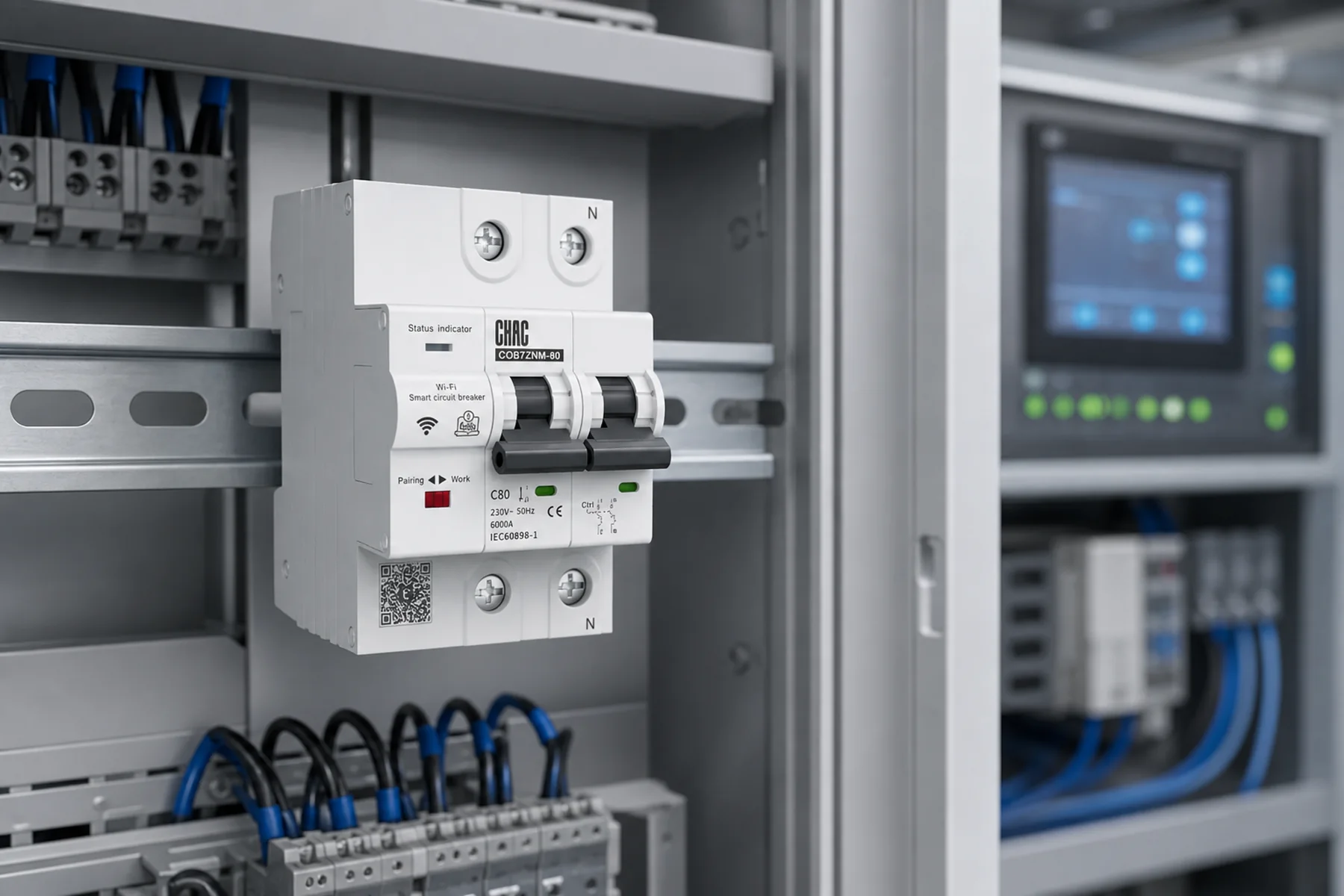
CHAC Electric’s isolating switch page is a starting point for model-document review, not proof of suitability for every load. The Страница распределительного шкафа серии CQMG20C provides an enclosure reference. For both, obtain the exact assembly evidence rather than inferring operating duty or approvals from the product name.
Часто задаваемые вопросы
What is the difference between a disconnect and a breaker?
A disconnect establishes an open point for isolation or rated switching; a breaker automatically opens under specified overcurrent conditions. Some breakers also provide isolation when their markings, instructions, installation, access, and lock provisions satisfy the applicable requirements. Handle appearance alone does not prove interchangeability.
What are the three types of disconnects?
A practical field grouping is off-load disconnectors, load-break switch-disconnectors, and fused disconnects. It is not a universal taxonomy because non-fused, service-rated, motor-use, enclosed, and breaker-based designs overlap. Purchase by required function, standard, and rating rather than category name alone.
What do electricians call disconnects?
Common terms include disconnect switch, safety switch, isolator, disconnector, switch-disconnector, local disconnect, and disconnecting means. Usage varies by region and standard. Reconcile the field name with the product marking and instructions.
When is a fused disconnect required?
Use one when the applicable code, equipment instructions, protection design, or tested fault-rating combination requires fuses at that location. The decision depends on the load, separate protection, available fault current, coordination objective, and exact assembly. Select and document the fuse class or type with the switch.
Can a disconnect switch be used as an emergency shutoff?
Sometimes, if its load rating, accessibility, identification, stop behavior, and installation satisfy the applicable requirements and risk assessment. It does not automatically meet emergency-stop or machine-safety control requirements. Define whether the objective is operational stopping, electrical isolation, emergency switching, or a combination before approval.
Does turning a smart switch off in an app make equipment safe to service?
No. The command may stop the load without isolating every source or controlling stored energy. For covered US workplace electrical work, OSHA 1910.333 requires the prescribed source disconnection, lockout/tagging, and qualified-person verification; an app display is not that verification. Use the equipment-specific energy-control procedure.
Which Sources Define the Relevant Boundaries?
- US Occupational Safety and Health Administration, 1910.333 Selection and use of work practices, particularly paragraphs (b)(2)(ii) and (b)(2)(iv); public text checked October 7, 2026.
- Schneider Electric Electrical Installation Guide, Основные характеристики переключателя, updated August 5, 2026; manufacturer guidance on isolation marking and breaker ratings, not CHAC model evidence.
- International Electrotechnical Commission, IEC 60947-3, Low-voltage switchgear and controlgear – Part 3; product-standard reference, not evidence of a model’s declared switching category.
- UL Standards & Engagement, UL 98, Standard for Enclosed and Dead-Front Switches; product-standard reference, not an exact-model listing.
The durable rule is to specify the function before the hardware. Identify every source that can energize the work area, decide which loads the device must switch, and establish where fault protection operates. Then verify the exact device and assembly evidence at the project’s voltage, fault conditions, and installation context. A convenient OFF command or a lockable handle cannot replace the required source isolation, stored-energy control, and verification. For a project-specific shortlist, CHAC Electric’s электрораспределительное оборудование resources provide a starting point for discussing the one-line diagram, operating duty, environment, and required documentation. The final selection must support both the installation design and the maintenance procedure.