

DC МКБ selection for a battery or DC distribution panel begins with arc interruption, not with an AC current label. DC systems do not have the same natural current-zero behaviour as AC, so the exact voltage, pole arrangement, polarity, breaking capacity and wiring method must be documented for the selected device.
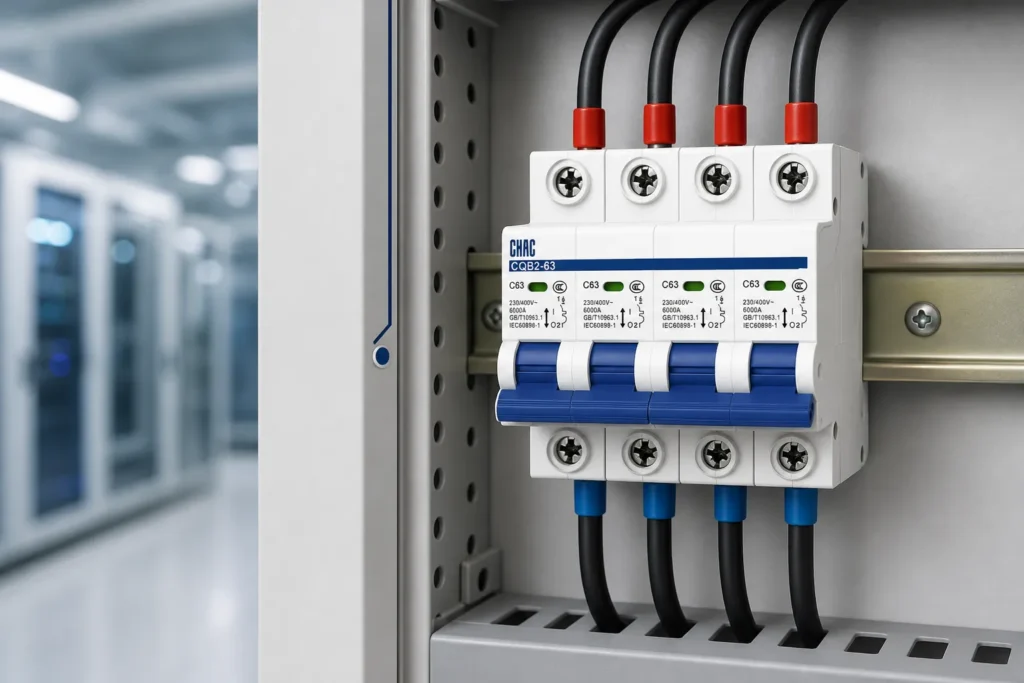
What must a DC MCB protect and isolate?
Define whether the breaker protects a battery branch, converter input, distribution feeder or another DC circuit. Then record maximum operating voltage, continuous current, prospective short-circuit current, polarity and the isolation boundary. The PXB6DC-63 DC MCB page is a product-specific starting point for that review.
Which DC system inputs matter before a model is chosen?
Provide nominal and maximum voltage, battery chemistry and capacity, state-of-charge assumptions, parallel strings, continuous and prospective fault current, conductor size, ambient temperature and the required breaking capacity. A low nominal voltage does not guarantee a low battery fault current.
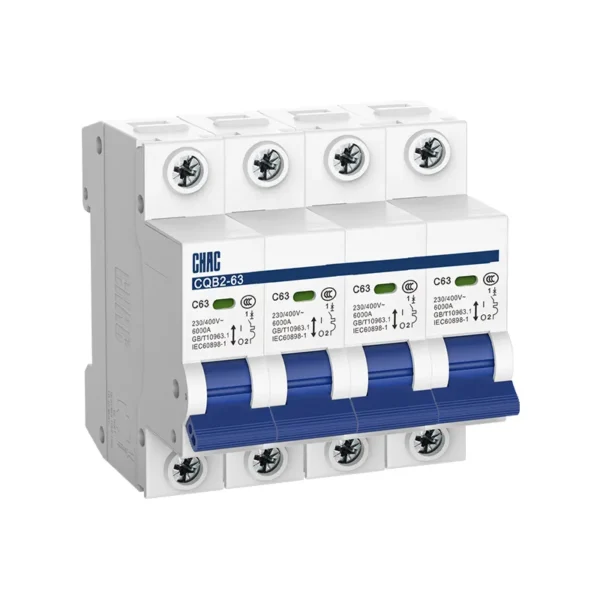
How should polarity and series-pole wiring be shown?
Show positive and negative conductors, the intended isolation points, polarity-sensitive terminals and any series-connected poles required by the manufacturer. Do not assume that a visually similar AC MCB has the same arc-extinguishing path or permitted wiring orientation.
Why do battery panels need more than a voltage label?
Battery fault current depends on chemistry, capacity, internal resistance, state of charge and parallel connections. Also consider reverse-current paths, converter behaviour, cable protection and whether both conductors must be isolated under the project rules.
What evidence should accompany a DC breaker quotation?
Request the exact model, DC voltage and breaking-capacity data, pole and polarity diagram, installation instructions, temperature limits and any required coordination information. IEC 60947-2 provides a circuit-breaker standard context for specified DC applications, but the model documentation still controls.
Which CHAC DC products can be compared?
Compare the PXB6DC model with the CQB7DC DC MCB range only after checking voltage, poles, polarity and breaking capacity for the actual circuit. A product-family name is not evidence that every variant shares the same DC ratings.
When should the battery designer take over?
Return to the battery-system designer when fault current, isolation of both conductors, reverse energy or converter coordination is unresolved. The IEC 60947-3 publication can support a separate disconnect-switch review; it does not replace the DC MCB selection evidence.
A complete DC автоматический выключатель selection record therefore includes voltage at the actual pole arrangement, polarity, interrupting capacity and the battery fault-current assumptions.
Часто задаваемые вопросы
Can an AC MCB be assumed suitable for a battery branch?
No. Confirm DC-capable selected-model documentation before approving the device for a DC circuit.
What polarity information belongs in the RFQ?
Show polarity arrangement and any wiring orientation rules required by the selected product instructions.
How does this differ from a solar DC breaker checklist?
Solar-string and PV-specific checks are a related but separate review; this article focuses on battery/DC distribution panel RFQ inputs.
Should isolation and protection be quoted as one line item?
Only if the approved drawing assigns both duties to the same documented device; otherwise keep them separate.
What documents should the supplier provide?
DC-capable model evidence, installation instructions, and the documentation pack requested in the RFQ.
When should the DC breaker selection be frozen?
Freeze it after the DC single-line diagram and polarity notes are approved, before the panel bill of materials is released.


